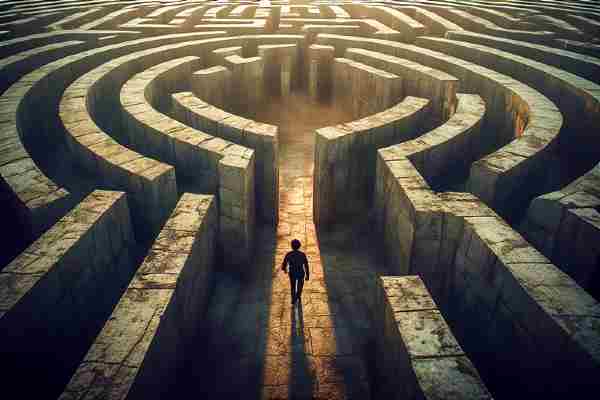
The mystical labyrinth pattern appears across cultures as both symbol and structure. The labyrinth is more than an ancient design. It shows a pattern and a path to change. This path connects myth, awareness, and real-life experiences.
The labyrinth endures not just in architecture and legend. It reflects a core part of human experience. Its winding path, hidden center, and steady pace reflect what happens in the mind and spirit.
To truly grasp the mystical labyrinth, we need to see past its stone paths and holy places. The labyrinth becomes powerful when viewed as more than just a structure. It symbolizes ongoing processes in the mind.
Inner Work Gate:
This article explores symbolic processes of inner descent, confrontation, and integration. It may increase discomfort before clarity as unresolved material surfaces. Emotional stability should be established before engaging deeply with this process.
The labyrinth pattern as an inner symbol
The labyrinth is not just a structure — it is a recurring pattern and doorway to transformation. The labyrinth endures because it mirrors something intimate and ancient within us. Its twisting path and hidden center show something deep inside us. When we step into a labyrinth, we are not merely walking through stone or earth — we are entering a symbolic landscape of the soul.
The labyrinth has symbolized descent in many cultures and times. It shows a shift from surface identity to deeper understanding. The path does not proceed directly because inner change is never direct. It curves, doubles back, and narrows perception. What first appears as confusion becomes a slowing of thought. What feels like delay becomes confrontation.
The center of the labyrinth symbolizes convergence. Here, fragments of the self meet — memory and desire, fear and longing, persona and shadow. This encounter is not always peaceful. Integration requires recognition. Recognition requires honesty. The concealed center represents the point at which avoidance becomes impossible.
Yet the symbolism does not end at the center. The pattern and doorway to transformation begin as soon as you step into the labyrinth. The trials encountered along the way expose the limits of comfort and reveal where resistance is strongest.
Many labyrinths lead outward again. The return path signifies reconfiguration — a movement back into the world altered by what was faced within. Transformation is not escape from complexity but the capacity to move through it differently. Leaving the labyrinth physically does not conclude its inner work.
The labyrinth is not about getting lost.
It is about undergoing a process that leads from fragmentation to integration.
From unconscious pattern to conscious participation.
Origins and mythological roots
The word “labyrinth” comes from the Greek “labrys,” which means double-axe. This symbol was sacred and linked to ancient fertility rites and earth goddesses. Labyrinthine structures were found from Minoan Crete to Egyptian temples. They were more than just interesting buildings. They were sacred designs woven into myth and initiation.
In Greek mythology, the labyrinth of Crete housed the Minotaur, a creature hidden at the center of a confounding maze. The hero Theseus entered it not merely to slay a beast, but to confront the unknown. The thread he received stands for guidance in confusion. It represents wisdom that helps the seeker avoid getting lost in darkness.
Similar patterns emerge elsewhere:
- Egyptian and Sumerian underworld myths describe journeys through symbolic corridors.
- Medieval cathedral labyrinths offered an inner pilgrimage when travel to Jerusalem was impossible.
- Christian theology later adopted the center as a symbol of salvation and spiritual completion.
The persistence of this pattern suggests something universal. The labyrinth is less a structure of one religion and more a shared spiritual archetype.
The mystical labyrinth pattern as a psychological map
If mythology externalizes the labyrinth, psychology internalizes it. The same winding pattern that appears in stone and story reappears in dreams, memory, and identity formation. The labyrinth does not only represent inner life — it mirrors its structure.
Symbolism is the language of the subconscious
The unconscious does not speak in plain language. It communicates through symbols, repetition, and pattern. The labyrinth shows up in dreams when we feel confused, face hidden truths, or seek change.
Dream journaling, symbolic reflection, and contemplative writing let us explore our inner paths. They help us understand ourselves better. The goal is not to solve the maze immediately. It is to recognize the pattern forming beneath experience.
Spiritual insight starts when we see that our outer struggles reflect inner issues we haven’t resolved.
Dreams are where symbolism becomes alive
In dreams, corridors and tunnels can show confusion. Rooms and circular paths often mean searching or facing challenges. These images are rarely random. They reflect the way consciousness organizes experience: layered, compartmentalized, and partially concealed. The psyche does not unfold in straight lines. It moves through association, repression, resurfacing, and integration.
Psychic structures revealed
In this sense, the labyrinth functions as a blueprint for psychic structure. Memory forms chambers. Trauma seals off passageways. Desire creates hidden corridors. Contradictions coexist in separate rooms until awareness draws connections between them. The labyrinth’s pattern shows how consciousness protects its structure. It gradually reveals its contents.
The pattern and doorway to transformation
Psychological growth, then, is not a linear ascent but a patterned process. One revisits old material from new vantage points. What once felt like dead ends become turning points. What seemed like an enclosure becomes containment. The labyrinth reflects the recursive movement through which understanding deepens over time.
To recognize this pattern is to understand that disorientation is not failure. It is structural. The mind reorganizes itself through cycles of concealment and revelation. The mystical labyrinth pattern endures because it reflects this recursive process.
Spiritual practice and inner work
Walking a labyrinth — whether physical or imagined — becomes meaningful only when it is enacted as process. The slow pace regulates breath. The absence of choice interrupts distraction. The curved path prevents premature arrival—attention shifts from destination to movement itself.
Similar patterns emerge in other forms of inner work. Recording dreams for weeks might reveal common themes. You may see corridors, locked rooms, or circular movement. What initially feels like confusion begins to reveal repetition. The psyche is not wandering randomly; it is circling material that seeks recognition.
At times, nothing dramatic occurs. The center may feel empty. Insight may arrive only after repeated engagement. The doorway to transformation does not always open on the first attempt.
Similar patterns emerge in other forms of inner work. Someone recording dreams over several weeks may notice recurring imagery of corridors, locked rooms, or circular movement. What initially feels like confusion begins to reveal repetition. The psyche is not wandering randomly; it is circling material that seeks recognition.
Entry — a deliberate turning inward.
Descent — surfacing of unresolved material.
Confrontation — encounter with fear, contradiction, or shadow.
Stillness — recognition without immediate reaction.
Return — integration of insight into daily life.
Shamanic journey practices follow a similar pattern. You start by descending into your inner world. Then, you encounter symbolic figures or places. Finally, you come back with gained knowledge. Automatic writing can function in the same way. Over time, scattered fragments can show a clear emotional pattern. The labyrinth pattern appears again — movement inward, encounter, reorientation.
The center, in lived experience, is rarely dramatic. It may be a quiet realization, a release of tension, or the simple recognition of a truth long avoided.
Sustained attention leads to transformation, not the completion of the puzzle.
Types of labyrinths and their symbolism
Not all labyrinths are constructed the same way, and the difference is spiritually meaningful.
Structural Distinction
Unicursal:
One continuous path leads to the center and back out. No choices. No dead ends.
Multicursal:
Multiple paths, false turns, and dead ends. Progress requires discernment.
The unicursal form represents surrender and trust. The path is fixed. One walks it fully.
The multicursal form represents choice, trial, and error. In psychology, the unicursal labyrinth symbolizes inevitability. It shows that some encounters cannot be avoided.
The multicursal form shows the illusion of control. Detours and dead ends highlight how the mind often avoids facing issues. It mirrors the moral and psychological complexities of life, where discernment determines direction.
In both forms, the journey measures readiness, not worthiness. It shows the willingness to keep going, even with uncertainty. The doorway is sometimes a significant eureka moment, but it is more often a door that opens slowly.
Modern echoes of a mystical pattern and doorway
The labyrinth has not vanished. It has transformed.
The underlying pattern remains intact, and the doorway to transformation still opens for those who recognize it. These mechanisms must be understood if they are to function as more than decoration.
Garden mazes, cathedral floors, ritual circles, virtual worlds, and story structures in books and games all have a common design. When players explore complex digital worlds with obstacles and hidden centers, they engage in a modern mythic pattern.
The enduring appeal lies in recognition. We sense intuitively that life itself resembles a labyrinth:
- The goal is visible only in glimpses.
- The route is rarely direct.
- Obstacles test patience and awareness.
- Progress requires persistence.
Modern expressions may lack ancient stones or hidden chambers. However, their symbolic strength remains.
Why the symbol endures
Ancient labyrinths were often concealed — carved into caverns or designed so their full pattern could not be seen from above. One had to walk them to understand them. The pattern and doorway reveal themselves only to those who walk the labyrinth.
This remains true in practice — the doorway to transformation reveals itself only through movement.
You cannot interpret a labyrinth from the outside. You must enter it. The pattern only reveals itself through movement. The labyrinth endures because it reveals a vital truth about transformation. We reach the center not by pushing, but by engaging with the pattern.
The path curves. It doubles back. It tests us. Yet it always leads somewhere meaningful.
The question is never simply, “What does the labyrinth mean?”
The deeper question is, “Where are you on the path?”
References
- Carl Jung. Stanford Encyclopedia of Philosophy.
- Symbolic Processing in Human Cognition. Frontiers in Psychology.
- Stories and the Brain: The Neuroscience of Narrative. Frontiers in Psychology.
- Labyrinth. Encyclopædia Britannica.
- The Labyrinth in Ancient Art and Myth. The Metropolitan Museum of Art.
- How the Brain Creates Meaning. Scientific American.
- The Science of Dreams. American Psychological Association.
- Narrative Identity and Psychological Integration. Frontiers in Psychology.