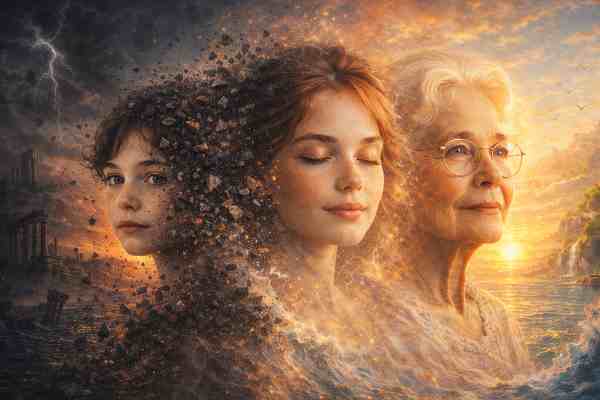
Tales of rebirth, renewal, and reincarnation are important to many spiritual beliefs. They are belief maps and archetypes of cycles of collapse and renewal. These elements are also an inherent part of our culture. To understand the culture, we must understand these elements.
Stories are one of the oldest tools for explaining inner change. The best ones use archetypes, trials, and symbolic deaths to show how a person breaks down and rebuilds. These patterns appear in every culture because they mirror real psychological experiences.
In ancient times, myths of dying gods and sacred renewal rites helped people grasp growth. Dramatic returns from darkness also played a key role in this understanding. Some believe these tales are real events; others see them as metaphors for the inner journey — the struggle, the loss, and the return to a stronger self.
Pattern Generation
Human beings do not invent transformation stories arbitrarily. They emerge from built-in psychological capacities and mechanisms. The transformation story is a pattern generated to contain the desired steps.
These include:
- Pattern recognition
- Narrative construction
- Emotional encoding (fear, loss, relief, renewal)
- Identity restructuring
- Memory and meaning-making
When these mechanisms process intense experiences—loss, crisis, growth—they tend to produce recurring structural outputs.
Those outputs are what we call archetypes.
Archetypes are not learned stories. They are generated patterns that arise when human cognitive and emotional systems process transformation.
The mapping of belief comes later. They organize these patterns into stable interpretations.
Belief Maps and Archetypes
Belief systems are frameworks — ways of organizing how different ideas connect. We are here to investigate three elements: rebirth, renewal, and resurrection. These three are particularly interesting because of the mechanisms they invoke.
Archetypes emerge from human psychological mechanisms; interpretive frameworks organize those archetypes into usable meaning.
Archetypes and interpretive frameworks are two different layers of the same psychological machinery:
- Archetypes = the universal pattern
- Interpretive framework = the personal structure built on that pattern
They interlock in three precise ways:
- Archetypes provide the generated pattern; interpretation assigns meaning and narrative structure.
- Archetypes supply the emotional charge; the framework supplies the logic.
- Together, they produce maps of beliefs and values that guide behavior.
Resurrection, renewal, and rebirth are archetypes. Each becomes a personal schema when someone uses it to explain their own experience.
Rebirth, renewal, and resurrection
Belief maps and archetypes are reflected in resurrection, renewal, and rebirth. These elements are similar, but not the same idea. They overlap, they echo one another, and they often get blended in myth. Understanding the differences is the key to understanding the dying-god pattern.
Rebirth is the transformation of identity. It is psychological. A person sheds an old self and emerges as someone new. Many myths use symbolic death — wilderness, trials, betrayal, sacrifice — to mark this inner shift.
Renewal is the cyclical return of vitality. It is seasonal, emotional, and communal. Renewal rites use fire, water, fasting, or cleansing to release what is old and restore balance.
Resurrection is the literal or symbolic return from death. It is the most dramatic form of rebirth. In myth, resurrection is not about biology — it is about the return of light, order, or consciousness after a period of darkness.
These three ideas form the backbone of the ancient mystery religions. They describe the same psychological movement. They embody collapse, transformation, return — but with different levels of intensity.
Why these three archetypes appear
Rebirth, renewal, and resurrection are not random categories. They correspond to three distinct ways the human system processes collapse:
- Rebirth → identity-level reorganization
- Renewal → cyclical regulation and recovery
- Resurrection → continuity restoration after total loss
Each reflects a different mechanism of adaptation:
- Identity reconstruction
- Emotional and physiological reset
- Narrative continuity repair
These mechanisms produce the archetypes. Cultures then encode them into beliefs that map the steps and requirements of the system.
Rebirth, renewal, and resurrection are not just themes — they are archetypes. Each one is a universal pattern of transformation that cultures turn into belief maps and archetypes.
The archetype provides the deep structure; the belief map provides the interpretation. That is why these three variations appear everywhere: they give people a way to understand collapse, change, and return. Every dying-god myth is built on one of these archetypal maps.
Western and Eastern religious architectures
Overview
Western religions collapse if the central god-figure is removed. The system collapses because the entire system is built around a single load-bearing savior narrative.
These figures—Mithras, Dionysus, Attis, Osiris/Horus, Jesus—are not metaphors. They are the structural anchors of the belief system. Remove the figure, and the story collapses. Remove the story, and the religion dissolves.
Eastern religions do not collapse when their gods disappear because their gods are not structural anchors. They are symbolic expressions of deeper principles like dharma, karma, the Tao, liberation, and the Hero’s Journey. The principle is the foundation, not the deity. Remove the deity, and the principle remains. The religion continues.
Different religious architectures stabilize these archetypes differently.
Western religions centralize archetypal mechanisms in a single narrative figure, while Eastern systems distribute those same mechanisms across practices, principles, and recurring processes.
Western systems are single-point-of-failure architectures. Eastern systems are distributed architectures. This is the primary structural difference.
Western religions’ god-figure systems
Western religions are built around a single load-bearing savior narrative. The god is the structural center. Remove the figure and the entire system loses its anchor.
Examples:
- Mithras
- Dionysus
- Attis
- Osiris/Horus
- Jesus
Remove the figure → no story.
Remove the story → no salvation.
Remove salvation → no religion.
Western systems are single-point-of-failure architectures. The god is the hinge. If the hinge breaks, the door falls off.
Eastern religions’ technology metaphors
Eastern religions are built on principles, not personalities. The gods are expressions of deeper laws, not the foundation of the system.
One Eastern form that is a precursor for the Western model is Krishna. Krishna foreshadows the form of the dying god but not the function. He looks like the dying god pattern on the surface, with a divine birth, miraculous acts, and instruction. But he does not enact the death-transformation-return cycle.
In the Bhagavad Gita, Krishna is a revealer and instructor. Any other character could also perform these tasks. Krishna resembles the dying-god figures in form, but not in function; he is an avatar who guides transformation, not one who undergoes it.
Examples of foundational principles:
- Dharma
- Karma
- Tao
- Liberation
- Practice
- Meditation
- Ritual
- Community
Remove the deity → the principle remains.
Remove the metaphor → the practice remains.
Remove the story → the system still functions.
Eastern systems are distributed architectures. No single figure is load-bearing.
The Core Difference
Western religions depend on a single irreplaceable savior-figure. The biography of the dying god is the mechanism of salvation.
Eastern religions depend on impersonal principles, practices, and cosmic laws. They do not require a central figure.
Western gods = load-bearing narrative centers.
Eastern gods = symbolic expressions of deeper principles.
This is the primary structural difference.
Archetypes of the dying gods in Western religion
Many cultures preserved stories of divine figures who suffer, die, and return. These myths were not biographies. They were belief maps based on three key archetypes: rebirth, renewal, and resurrection.
Each culture picked one of these patterns and turned it into a story. This created dying-god figures that reflect the journey from collapse to change and back again.
Below, each figure is tagged with the archetype it expresses and the belief map it encodes.
Jesus — Resurrection Archetypes of Rebirth and Continuity
Jesus embodies the resurrection archetype: the same being returns in a transformed state. The belief map is continuity-through-death — identity survives collapse and returns with higher authority.
Horus — Resurrection Archetype of Divine-Order
Horus expresses the resurrection archetype, framed through cosmic order. The belief map is a restoration of rightful balance — death disrupts the world, resurrection restores it.
Mithra — Resurrection Archetypes of the Warrior-Ordeal and Renewal
Mithra follows the resurrection archetype with a martial emphasis. The belief map is victory-through-ordeal — death functions as a proving ground for worthiness.
Dionysus — Rebirth Archetype of Ecstatic-Identity
Dionysus embodies the rebirth archetype: the old identity dissolves, and a new one emerges. The belief map is ecstatic dissolution — transformation through breakdown, frenzy, and release.
Attis — Renewal Archetype of Seasonal-Cycle
Attis expresses the renewal archetype: cyclical death and return tied to nature. The belief map is seasonal restoration — life declines, returns, and repeats.
These figures are key to the dying-god typology. Cultures share the same psychological themes but use different symbols. These motifs are common because they reflect similar belief maps and archetypes. The tables below focus on these shared motifs, making the structural parallels clear.
Comparison of the dying god functions
These recurring motifs are not coincidental. They reflect the same underlying psychological mechanisms expressed through different cultural beliefs, which become codified maps.
Virgin or Divine Birth
Virgin-birth motifs show that the transforming figure comes from a higher realm. They convey the belief in divine origin, meaning transformation starts with a being beyond normal time and identity. This motif lays the foundation for all three transformation archetypes by creating a sacred or cosmic beginning.
| Figure | Birth Theme |
|---|---|
| Jesus | Virgin birth on Dec 25 |
| Horus | Virgin birth |
| Mithra | Born on Dec 25 |
| Dionysus | Virgin birth at the solstice |
| Attis | Virgin birth |
Death and Return
The death‑and‑return motif is the core of the dying‑god pattern. Each figure embodies one of the three transformation archetypes: rebirth, renewal, or resurrection. Collapse leads to transformation in several ways. This can happen through identity dissolution, seasonal cycles, or even a literal return from death.
| Figure | Return Theme |
|---|---|
| Jesus | Resurrected after three days |
| Horus | Solar death and rebirth |
| Mithra | Resurrected after three days |
| Dionysus | Death and return |
| Attis | Resurrected after three days |
Miracles and Initiation
Miracle and initiation motifs establish the figure’s authority within the belief map. These actions show divine power. They confirm the upcoming transformation and identify the followers who join in. They reinforce the archetype by showing that the figure’s death and return are part of a larger sacred design.
| Figure | Motifs |
|---|---|
| Jesus | Miracles; 12 disciples |
| Horus | Baptized at 30; 12 followers |
| Mithra | Miracles; 12 followers |
| Dionysus | Turns water into wine |
Symbolic Function
Each dying god performs a specific psychological function inside its belief map. Some restore order, some model victory through ordeal, and others dissolve identity so a new self can emerge. These functions show why rebirth, renewal, and resurrection mattered. They helped cultures grasp the idea of transformation.
| Figure | Function |
|---|---|
| Jesus | Restores continuity after collapse; guarantees identity survives death |
| Horus | Re-establishes cosmic order after disruption |
| Mithra | Models victory through ordeal; legitimizes transformation through trial |
| Dionysus | Breaks down identity to allow ecstatic rebirth |
| Attis | Embodies seasonal renewal; life returning after decline |
Islamic and Jewish renewal narratives
Islam does not contain a dying‑god motif, but it inherits the symbolic lineage of earlier traditions. Judaism’s renewal practices trace back to Babylonian, Assyrian, and Persian sources. The Code of Hammurabi appears in the Book of Exodus, showing how older laws shaped later spiritual narratives.
Judaism is built on ethnic identity, not belief in the dying god myth. Jewish ethnic culture is a part of life’s daily rituals. Islam does not treat Mohammad as a god but as a prophet.
Conclusion
The dying‑god stories of the ancient mystery religions are still with us. Their names have changed, but the pattern remains. These tales endure because they describe something real: the human experience of loss, renewal, and awakening. We must each choose what parts, if any, we use from any traditional belief maps and archetypes.
References
- The Hero with a Thousand Faces, Joseph Campbell.
- The Power of Myth, Joseph Campbell.
- The Archetypes and the Collective Unconscious, Carl G. Jung.
- Psychology and Religion: West and East, Carl G. Jung.
- The Golden Bough: A Study in Magic and Religion, James George Frazer.
- Myth and Reality, Mircea Eliade.
- Patterns in Comparative Religion, Mircea Eliade.
- Religions of the Ancient World: A Guide, National Institutes of Health.
- Archetype, Stanford Encyclopedia of Philosophy.
- Dying-and-Rising Deity, Wikipedia.