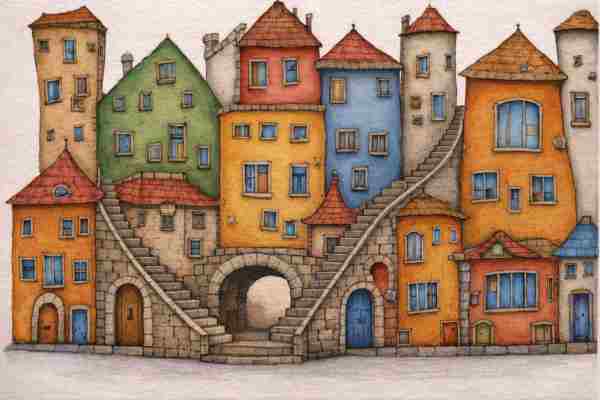
Archways, doors, stairways, and windows are archetype symbols of the psyche. The four portals of awareness show up in our thinking and dreams. Understanding awareness mechanics and symbolism helps you understand the hierarchy of the programming in your mind.
These symbols stay with us because they mirror how awareness works. Windows, doors, archways, and stairways appear in dreams, stories, and inner imagery for a reason. Each one marks a different kind of shift in perception. Each one reflects a different movement in the mind.
The mechanics and symbolism represent the two layers of awareness. Symbols form the surface layer. Beneath them sits the mechanics of the psychological layer. When you place the two layers together, the system becomes clear. The symbols show the story. The mechanics show the process.
Awareness deals with levels of clarity and insight. This is the mental space we have for perception and discernment.
➡ For more, see: The Continuum of Awareness From Enchantment to Enlightenment
The four portals of awareness
The symbolic layer
The symbolic layer uses four architectural elements that show up across cultures and eras. They are simple, intuitive, and emotionally loaded. They describe how awareness mechanics work.
- Window — seeing, noticing, gaining perspective
- Door — choosing, committing, stepping into or out of a frame
- Archway — transitioning, recognizing, moving between states
- Stairway — progressing, rising, deepening, emotional ascent
The four portals of awareness are not mystical fabrications. They are perceptual markers. They show where awareness shifts and how you relate to the shift. Because they are fundamental to awareness, they appear across cultures, traditions, and symbolic systems.
When you notice that you are using one of these portals, you are using one of the primary mechanisms, “observer of awareness” — observing thoughts without attachment, identification, or judgment. This mechanism appears across many forms of awareness work, but here it functions only as a descriptive lens.
It may seem like an insignificant act of perception, but it strengthens attention and observational awareness.
Functional awareness mechanics layer
Beneath the symbols are the actual mechanics of the system. Each portal reflects a specific capacity in the mind and a way awareness shifts beneath the surface.
Windows — point to meta‑awareness and observer awareness. This is the ability to notice what’s happening in your own mind without trying to change it.
Doors — highlight the mind’s reasoning and evaluative functions. This is where you weigh options, consider consequences, and choose which frame you’re stepping into.
Archways — signal orientation and the recognition that a shift is already underway. It’s the quiet sense of moving into a different state before you fully name it.
Stairways — capture integration and the way emotional movement unfolds over time. This is how meaning deepens or progresses as you move through layers of experience.
These are the underlying capacities that shape how awareness mechanics operate. The four portals of awareness appear as symbols on the surface. The capacities beneath them are the functional structure that gives the symbols their meaning.
The mapping between mechanics and symbolism
This model shows how the conscious layer and the subconscious layer interact. The conscious layer expresses itself through symbols. The subconscious layer expresses itself through mechanics. The symbol shows the movement. The mechanics show what the movement means within the four portals of awareness.
| Portal | Symbolic Meaning | Functional Mechanics |
|---|---|---|
| Window | Seeing clearly, gaining perspective | Meta‑awareness and observer awareness |
| Door | Choice, commitment, stepping into a frame | Reasoning, evaluation, selecting direction |
| Archway | Transition already underway | Orientation and recognizing a shift in state |
| Stairway | Progression, ascent, emotional movement | Integration and the unfolding of emotional depth |
The four portals of awareness
These portals can appear in the symbolism of dreams, creative visualization, or the shamanic journey. Sometimes they are the focal point of the experience. Other times, they are secondary.
Many stories use these archetypes to emphasize the importance of what the character is going through. Knowing how the mechanics and symbolism interact helps you understand the movement taking place.
1. Window symbolism: perception and self‑observation
A window changes what you can see without forcing you to move. It is the symbol of perspective. Clear windows offer direct sight. Distorted windows bend the view. Open windows invite new information. Closed windows protect or limit.
In dreams, windows often appear when your perspective is shifting. You may be inside looking out, anchored in your current identity, or outside looking in, seeing your own patterns from a distance.
This is the territory of meta‑awareness and observer awareness. The window marks the moment you begin to notice what is actually happening instead of what you assumed was happening.
2. Door symbolism: reason and decision
A door is a threshold that requires a choice. You can open it, close it, avoid it, or walk through it. Doors appear when a decision is forming. They
In the functional layer, this is the domain of reasoning and evaluation. This is where you weigh options, consider consequences, and choose which frame you’re stepping into.
A dream door that is locked, missing, or endlessly multiplying often reflects a conflict between what you see and what you are willing to do.
3. Archway symbolism: intuition and transition
An archway is a threshold without a barrier. It marks a transition already underway. You do not open an archway. You pass through it because something in you has already shifted.
This is the symbolic expression of orientation and quiet recognition. It’s the moment you sense you’re moving into a different state before you fully name it.
Archways in dreams often signal a turning point. You are not deciding. You are realizing.
4. Stairway symbolism: emotion and progression
A stairway is a movement with direction. Upward, downward, spiraling, steep, gradual — each variation reflects a different kind of progression.
Here, emotion is not catharsis or release. It is movement in meaning — the way depth accumulates, rises, or descends as you move through layers of experience. A stairway symbolizes the arc of inner progression: rising, deepening, climbing, or descending into something you need to understand.
In dreams, stairways often appear when you are moving through emotional material that is layered, complex, or developmental.
How the portals work together
The four portals of awareness describe the natural process of the mind’s movement:
- You see something (window).
- You evaluate and choose a direction (door).
- You shift into a new state (archway).
- You move through the depth that follows (stairway).
This cycle repeats throughout life. It appears in dreams, relationships, creative work, conflict, and self‑development. The portals give you the symbolic language. The capacities beneath them give you the functional structure.
Together, they form a complete system.e
The observer mindset
The observer mindset is not a higher self or a mystical entity. It is a position in awareness where you can see your thoughts, emotions, and reactions without being pulled fully inside them.
When the portals and their underlying capacities align, the observer stance becomes accessible. You see clearly. You choose deliberately. You shift smoothly. You move through emotional depth without losing yourself.
This is the purpose of the system: to help you relate to your own mind with clarity, honesty, and space.
Why these symbols still matter
Windows, doors, archways, and stairways endure because they describe the movements of awareness in a way anyone can understand. They give shape to inner experience. They help you recognize where you are in the four portals of awareness, and what comes next.
When paired with the functional capacities beneath them, the symbolism becomes a practical tool. It shows you how perspective shifts, how choices form, how transitions unfold, and how meaning deepens over time.
This is the architecture of awareness — symbolic on the surface, functional underneath, unified in the observer stance. Understanding the mechanics and symbolism provides insight into your mind.
References
- The Archetypes and the Collective Unconscious, Carl G. Jung.
- Man and His Symbols, Carl G. Jung.
- The Interpretation of Dreams, Sigmund Freud.
- The Rediscovery of the Mind, John R. Searle.
- Metacognition, Stanford Encyclopedia of Philosophy.
- Attention and Awareness in Cognitive Neuroscience, National Library of Medicine.
- Mindfulness and Meta-Awareness, National Institutes of Health.
- Decision Making and Cognitive Processes, National Institute of Mental Health.
- Archetype, Wikipedia.
- Metacognition, Wikipedia.