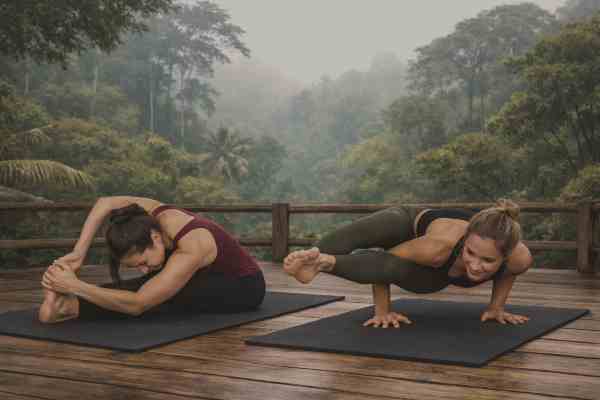
Yoga is far more than stretching and postures. Asana involves more than familiar shapes. It’s a full system for physical, mental, and spiritual growth. When you explore the eight limbs and seven traditional paths of yoga, you see the whole practice. Each system reveals a different part of the journey.
To choose a yoga practice that truly fits you, it helps to understand both frameworks and how modern styles grow out of them. Seeing how they overlap gives you a clearer sense of where each method sits within the broader paths of yoga.
Two core systems of yoga
The practice of yoga may be the most widely used system of physical and mental development. Most people associate yoga with its physical postures, but this is only one aspect of this holistic system.
There are many schools of thought about yoga and many ways to categorize the practice of this art. We will discuss the two fundamental ways of grouping and then list all the different types available.
The seven traditional paths of yoga
Indian tradition speaks of Shiva, the Adiyogi, the first yogi, who shared different aspects of Yoga with seven sages, the Sapta Rishis. Over time, these aspects became known as the seven classical paths. Each emphasizes a different primary capacity or orientation within the traditional paths of yoga.
| The seven traditional forms of yoga | |
|---|---|
| Path | Description |
| 1. Jnana Yoga | The path of knowledge, insight, and inquiry into the nature of reality and self. |
| 2. Bhakti Yoga | The path of devotion, emotional expression, and love directed toward the divine or a chosen ideal. |
| 3. Karma Yoga | The path of selfless action, service, and ethical behavior without attachment to results. |
| 4. Mantra Yoga | The path of sound, using specific vibrational formulas (mantras) to focus and refine awareness. |
| 5. Raja Yoga | The royal path of inner work, using meditation and mental discipline to explore the psyche. |
| 6. Tantra Yoga | It balances polarities, such as masculine and feminine energies. This helps expand freedom. |
| 7. Hatha Yoga | The path of physical practice, using postures, breath, and subtle techniques to prepare body and mind. |
The seven traditional paths of yoga are not mutually exclusive. Many modern systems mix elements from different styles. This creates practice styles that overlap with several paths.
Explore the eight limbs of yoga from Patanjali
Centuries later, Patanjali organized Yoga into a clear eight-part framework in the Yoga Sutras. He did not invent Yoga, but he created a concise map of its inner progression.
Indian folklore tells us about Shiva, the Adiyogi, or the first yogi. Legend has it he lived several thousand years before recorded history. He created and gave the system we know as Yoga to the Sapta Rishis, the original seven sages. He did not leave a written record.
Legend has it he was too wild to be a scholar. So, he chose seven people and gave each a different aspect of the system. These became the seven traditional paths of yoga. Today, there are hundreds of variations of these forms.
When you explore the eight limbs in this context, you see how they form a developmental sequence rather than a random list.
| Patanjali’s 8 limbs of yoga | |
|---|---|
| Limb | Description |
| 1. Yamas | Ethical restraints and disciplines in relation to others. |
| 2. Niyamas | Personal observances and self-training practices. |
| 3. Asana | Physical postures that stabilize and prepare the body. |
| 4. Pranayama | Breath regulation to influence energy and attention. |
| 5. Pratyahara | Withdrawal of the senses from external distraction. |
| 6. Dharana | Concentration, holding attention steadily on a chosen object. |
| 7. Dhyana | Meditation, continuous, unbroken flow of attention. |
| 8. Samadhi (and the Siddhis) | Absorption, transcendence, and advanced experiential states. |
These systems describe the same territory from different angles. The seven traditional paths emphasize orientation. When you explore the eight limbs, you are moving through a sequence of inner work methods.
How to choose a yoga practice
Choosing a yoga practice is easier when you start with your real goal instead of the trend of the moment. Different styles emphasize different capacities:
- Strength
- Flexibility
- Nervous-system regulation
- Devotion
- Critical inquiry
- Meditation
Understanding where they sit relative to the seven traditional paths of yoga and eight limbs helps you avoid random experimentation.
Step 1 — Clarify your primary goal
Start by getting clear about what you want from yoga. Many people come for better physical health, hoping to build strength, flexibility, or balance.
Others want stress relief so they can feel calmer and sleep more easily. Some are drawn to inner work and want to understand their thoughts and emotions.
There are also those who feel connected to spiritual or devotional practice and enjoy ritual or emotional expression. And some are curious about energy and subtle experience, using breath and awareness to explore deeper states.
Step 2 — Match your goal to a category
Once your goal is clear, it becomes easier to choose a style. People focused on physical benefits often do well with Hatha, alignment-based classes, or flow styles.
Those who want a calmer pace usually prefer slow, breath-centered practices. Anyone interested in inner work may connect with methods rooted in Raja or Jnana Yoga.
Students who enjoy devotion or ritual often feel at home in Bhakti-style practices. And people who want advanced energy work can explore Kundalini or Siddhi-focused methods after building a strong foundation.
Step 3 — Evaluate the teacher and environment
The teacher and setting shape the whole experience. Look for resonance—a place where you feel safe, respected, and able to learn. Notice the pacing and whether the class matches your current level.
Pay attention to the teacher’s clarity and how well they explain the purpose of each practice. Strong ethics also matter, including clear boundaries and respect for students. When a class leaves you in pain, overwhelmed, or unsettled, it’s a sign that the style or teacher may not be right for you at this time.
If you consistently leave class in pain, overwhelmed, or emotionally destabilized, the style or teacher is not a good fit for you right now, regardless of where it sits among the traditional framework of yoga.
Categories of yoga practices
Below is a grouped overview of common yoga types. Use it as a map, not a hierarchy. The “right” practice is the one that aligns with your goals, body, and current stage of development within the broader paths of yoga.
1. Physical and asana-dominant practices
Hatha Yoga
Hatha is the broad umbrella for all physical posture-based Yoga. It balances body, breath, and attention, and can be adapted to almost any age or condition. Most general “yoga classes” in the West are forms of Hatha.
Best for: General health, flexibility, gentle strength, and mind–body awareness.
Cautions: Choose level-appropriate classes; avoid forcing into deep postures.
Vinyasa Yoga
Vinyasa links postures in a flowing sequence synchronized with breath. Sequences often change from class to class, requiring focus and adaptability.
Best for: Those who enjoy movement, variety, and moderate-to-strong physical challenge.
Cautions: Can be too fast or intense for beginners or those with joint issues.
Ashtanga Yoga
Ashtanga is a demanding, structured series of postures practiced in a set order with synchronized breath. It is physically intense and often practiced regularly.
Best for: Experienced practitioners who want discipline, strength, and stamina.
Cautions: Not ideal for beginners, injuries, or those needing gentle practice.
Iyengar Yoga
Iyengar emphasizes precise alignment, often using props such as blocks, straps, and bolsters. Poses are held longer, with detailed instruction.
Best for: Injury recovery, joint issues, and those who appreciate technical detail.
Cautions: Can feel slow or intense for those seeking flowing movement.
Bikram Yoga
Bikram uses a fixed sequence of 26 postures in a heated room with low humidity. The heat increases sweating and intensity.
Best for: Those who tolerate heat well and want a strong physical challenge.
Cautions: Not suitable for heart conditions, heat sensitivity, or some medical issues.
Yin Yoga
Yin involves holding postures for several minutes, targeting deeper tissues and encouraging stillness.
Best for: Increasing flexibility, patience, and tolerance for stillness.
Cautions: Overstretching is possible; joint issues require careful modification.
Kripalu Yoga
Kripalu blends physical postures, breathwork, and self-reflection. It is generally moderate and accessible.
Best for: Those wanting a balanced practice with both movement and introspection.
Cautions: As with all forms, choose level-appropriate classes.
2. Meditative and inner-work practices
Japa Meditation
Japa uses the repetition of a mantra, silently or aloud, to settle the mind and access deeper states of rest and awareness. It is closely linked to Patanjali’s meditative limbs and is a core method for reaching Samadhi.
Best for: Those seeking a simple, repeatable seated meditation practice.
Cautions: Instruction from an experienced teacher improves consistency and depth.
Jnana Yoga
Jnana is the path of knowledge and inquiry. It uses questioning, reflection, and discrimination to see through conditioning and assumptions.
Best for: Introspective practitioners drawn to philosophy and self-inquiry.
Cautions: Can become abstract without grounding in daily life and embodiment.
Raja Yoga
Raja, the “royal path,” focuses on inner disciplines, meditation, and exploration of the psyche. It often integrates concentration, visualization, and structured inner work.
Best for: Those committed to systematic inner practice and psychological exploration.
Cautions: Deep inner work benefits from guidance and emotional stability.
Meditation (Dhyana)
Meditation in the yogic sense is sustained, unbroken attention. It follows concentration (Dharana) and leads toward absorption (Samadhi).
Best for: Anyone wanting to cultivate calm, clarity, and stable attention.
Cautions: Beginners may benefit from shorter sessions and simple anchors.
Moving Meditation
Moving meditation includes practices like Tai Chi, Qigong, and mindful walking, as well as yoga sequences done with meditative attention. Movement becomes the object of awareness.
Best for: Those who struggle with stillness or prefer learning through movement.
Cautions: Requires enough coordination and balance for safe practice.
Kundalini Yoga
Kundalini uses breath, postures, mudras, and visualization to work with subtle energy along the spine and through the chakras.
Best for: Practitioners with a stable foundation who are curious about subtle experience.
Cautions: Intense practices should be approached gradually and with qualified guidance.
3. Devotional, ritual, and integrative practices
Bhakti Yoga
Bhakti channels emotion into devotion, using song, mantra, ritual, and community to cultivate love and connection.
Best for: Those who feel drawn to music, chanting, and heartfelt expression.
Cautions: Choose communities that respect autonomy and avoid coercive belief structures.
Karma Yoga
Karma Yoga is the practice of selfless action. It emphasizes doing good without attachment to recognition or reward.
Best for: Those who want to integrate Yoga into daily life through service and ethics.
Cautions: Service should not become self-neglect; boundaries still matter.
Mantra Yoga
Mantra Yoga focuses on the use of specific sounds and phrases to influence attention and subtle states. Mantras can be spoken, chanted, or repeated mentally.
Best for: Those who connect strongly with sound, rhythm, and repetition.
Cautions: As with all subtle practices, context and intention matter.
Tantra Yoga
Tantra seeks to balance and integrate polarities, often framed as Shakti (feminine) and Shiva (masculine). It can involve ritual, visualization, breath, and sometimes sexual energy, though popular portrayals often distort its depth.
Best for: Practitioners interested in the integration of body, energy, and psyche.
Cautions: Requires ethical, mature guidance; avoid teachers who exploit the sexual dimension.
Jivamukti Yoga
Jivamukti blends physical practice, chanting, philosophy, and activism. It is an integrative, modern form that draws from several traditional elements.
Best for: Those who want a mix of movement, music, and ethical or spiritual themes.
Cautions: As always, evaluate the specific teacher and community culture.
Final thoughts on the eight limbs and the seven traditional paths
Understanding how these systems sort yoga helps explain today’s many styles. It gives us a clear context for what we see now. You can use Asana just for exercise. But when you see it as a path to deeper practices, it turns into a doorway instead of a destination.
Start with your real goals, your current capacity, and your honest preferences. Try beginner-friendly forms. Notice how you feel during and after practice. Pick teachers who respect your limits and your independence. Finding the right yoga practice feels like coming home. It’s not about forcing yourself into a mold. Instead, it’s a way to move, breathe, and focus that truly supports your life.
References
- Yoga for Health: What the Science Says, National Center for Complementary and Integrative Health (NIH).
- The Effects of Yoga on Physical and Mental Health, International Journal of Preventive Medicine.
- Meditation and Its Regulatory Role on Attention and Emotion, Frontiers in Psychology.
- Breathing Practices (Pranayama) and Their Effects on the Autonomic Nervous System, Frontiers in Human Neuroscience.
- The Neuroscience of Mindfulness Meditation, Nature Reviews Neuroscience.
- Yoga, Physical Activity, and Cardiovascular Health, European Journal of Preventive Cardiology.
- The Effects of Meditation on Brain Structure and Function, Annals of the New York Academy of Sciences.
- Mind–Body Practices and Their Impact on Health, Psychosomatic Medicine.
- Yoga in Stress Management: A Systematic Review, International Journal of Yoga.
- Effects of Meditation on Cognitive and Emotional Processes, Perspectives on Psychological Science.
- Attention and Consciousness, Frontiers in Psychology.