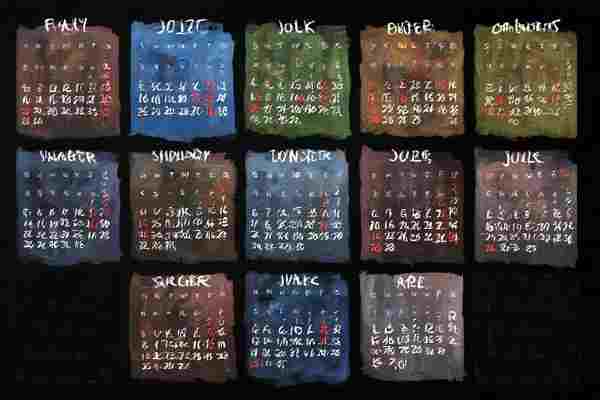
It may be time for a 13-month lunar calendar. Here’s why. The 12-month system we use now came from religion and politics, not nature. A lunar structure offers a clearer, more consistent way to track the year.
The current structure we follow came from old power choices, uneven month lengths, and compromises that do not fit natural cycles. A lunar layout creates a steady rhythm that stays the same every year.
Calendars are not neutral. They encode what a culture values, how it organizes work and ritual, and who controls the story of time. The Gregorian calendar connects us to a solar-zodiac system and a linear idea of progress. In contrast, the moon provides a different view: cyclical, tangible, and visible every night.
Lunar traditions around the globe show that time can be measured by what we see and feel—phases of light, tides, animal behavior, and human mood. The question is no longer just historical or spiritual. It’s practical.
What a lunar cycle calendar is
A lunar cycle calendar measures time by the moon’s orbit around Earth. One complete cycle—from new moon back to the same phase—is called a synodic month and lasts about 29.5 days. Over a solar year, the moon completes thirteen of these cycles, which is why many traditions speak of thirteen moons.
Because the solar year is about 365.25 days, any calendar must decide how to handle the extra fraction of a day. The Gregorian system uses leap years. A 13-month lunar-based system uses thirteen equal months and one additional day outside the cycle. The rise in awareness shows it is time for a 13-month lunar calendar,
The 13 lunar cycles
A lunar cycle is a full orbit with a beginning, a peak, a decline, and a reset. These repeating arcs made the moon a natural clock long before mechanical time.
Why cycles matter more than phases
Phases are visual markers. Cycles are temporal containers. Ancient cultures used the full cycle for planting, harvesting, tracking migrations, and timing rituals.
Thirteen cycles as a natural template
Thirteen cycles of roughly 28–29 days create a year that feels regular, predictable, and biologically intuitive. Many people notice emotional or physical rhythms that align more with a 28–30 day cycle than with the irregular lengths of Gregorian months.
Many believe it’s time for a 13-month lunar calendar instead of the 12-month system. This change reflects patterns seen in the sky, in ecosystems, and in our bodies.
Ancient time-keeping and cultural identity
Different cultures built calendars around what mattered most to them—seasons, stars, rivers, or ritual. Solar calendars, like the Gregorian, focus on the sun’s path and seasonal changes, which are useful for agriculture and modern industry. Lunar and lunisolar calendars tie time to visible phases of the moon and often to religious life.
Some Indigenous cultures view time as cyclical rather than linear. They track equinoxes, star risings, and lunar phases. They often include these markers in architecture and ceremonies. Time is experienced as a repeating pattern rather than a straight line.
Lunisolar systems, like the Hebrew calendar, combine lunar months with adjustments to stay aligned with the solar year. The Mayan Long Count, the Chinese lunisolar calendar, and other ancient systems show that time-keeping always mirrors worldview.
The Ethiopian 13-month system
The Ethiopian calendar is a living example of a 13-month structure. It has twelve months of 30 days and a 13th month, Pagume, with five days in common years and six in leap years. This keeps the calendar closely aligned with the solar year while preserving a simple, regular pattern.
The year begins with Meskerem (around September), associated with renewal and the Ethiopian New Year. The system shows agricultural cycles and religious events. It also places human life in a unique cosmic timeline.
Chronobiology and biological rhythms
Chronobiology is the study of biological rhythms—how living systems keep time. It connects the abstract idea of a calendar to the concrete reality of bodies, hormones, sleep, and behavior. When we talk about aligning with the moon, we’re also talking about aligning with internal clocks.
Human biological timing
Circadian rhythms occur in 24-hour cycles. They control sleep. They also manage body temperature, hormone release, and digestion. They are strongly influenced by light and darkness. Disrupting these rhythms can happen due to shift work, late-night screens, or irregular schedules. This can affect mood, thinking, and health.
Infradian rhythms last longer than a day. The menstrual cycle is a clear example, often approximating the length of a lunar month. Many people notice changes in mood, energy, and sensitivity. These often follow internal cycles and external light patterns.
A 13-month lunar calendar doesn’t change biology, but it recognizes that human life isn’t just linear. It provides a framework that expects recurring emotional and physical patterns. These patterns are not seen as oddities to suppress.
Animal and ecological timing
Many animals use the moon as a clock. Some species time migration, feed, or reproduce during specific phases. Marine life often responds to tidal cycles, which are directly influenced by the moon’s gravity. Plants may germinate or flower in response to seasonal and lunar cues.
When time-keeping ignores these rhythms, human planning drifts away from the living systems we depend on.
Psychological mechanics of time systems
How we measure time changes how we feel time. A calendar is not just a grid; it’s a mental model that shapes stress, attention, and the sense of being rushed or grounded.
Linear time versus cyclical time
A linear calendar emphasizes progress, deadlines, and forward motion. It encourages thinking in terms of quarters, fiscal years, and long-range plans. This can be useful, but it also feeds a constant sense of “not enough time” and a pressure to move faster.
A cyclical model emphasizes return and renewal. The same phases return, not as mere repetition, but as a spiral. They are familiar patterns that offer new levels of experience. Tracking life by cycles—like seasons, moons, or rituals—helps people feel more in tune. They often report less anxiety about “falling behind.”
Predictability and mental ease
A 13-month calendar with 28 days in each month creates a perpetual pattern. Every date always falls on the same weekday each year. The 1st is always a Monday, the 7th is always a Sunday, and so on. This lightens the cognitive load. Planning gets easier, and the hassle of uneven month lengths goes away.
Each lunar cycle has 28 days. And 28 × 13 = 364 days + 1 day out of time.
That “day out of time” acts like a cultural pause. It’s a reset that highlights our need for rest and reflection, not just constant activity.
Cultural power structures embedded in calendars
The choice between a 12-system and a lunar calendar is not just about astronomy. It’s about who defines reality. Calendars are tools of coordination, but they are also tools of control.
Calendars as tools of control
Agricultural empires needed predictable seasonal markers to manage planting, taxation, and labor. Religious institutions needed fixed dates for festivals and authority over sacred time. Industrial societies later needed set hours and days. This helped synchronize factories, trains, and global trade.
When a single calendar becomes dominant, it carries its metaphors with it. The Gregorian calendar reinforces a sun-centered, linear, progress-oriented worldview. Time becomes a resource to be managed, sold, and optimized.
Why the 12-month system of the Gregorian calendar dominated
The Gregorian calendar was introduced by Pope Gregory XIII in 1582 to correct the drift of Easter relative to the spring equinox. It refined the earlier Julian system and gradually became the global standard through colonial expansion, trade, and political power.
Over time, this structure became invisible. Most people never question why months have different lengths or why February occasionally gains a day.
Environmental synchronization
In an era of climate disruption and ecological stress, the way we mark time matters.
Ecological rhythms
Ecosystems operate in cycles. They have wet and dry seasons. There are times for flowering and dormancy, as well as spawning and migration.
Traditional calendars linked rituals and work to natural patterns. People planted by certain moons, harvested at others, and hunted or fished when light and tides matched.
When we lose track of these rhythms, we tend to overuse resources.
Why a lunar calendar fits modern sustainability
A 13-month lunar cycle calendar invites people to pay attention to cycles again. It doesn’t replace science or policy, but it nudges awareness toward:
- Local seasons instead of abstract quarters
- Regenerative pacing instead of constant acceleration
- Visible sky cues instead of only digital clocks
Why it is time for a 13-month lunar calendar
| Reasoning for a calendar based on the lunar cycle | |
|---|---|
| Reason | Explanation |
| Alignment with natural rhythms | Thirteen equal months track the moon’s cycles and many biological and ecological patterns, reinforcing a felt connection to nature. |
| Consistent month lengths | Every month has 28 days, eliminating the irregular 30/31-day pattern and the exception of February. |
| Improved time management | A perpetual pattern—same weekday for each date every year—simplifies planning for individuals, schools, and businesses. |
| Cultural and spiritual continuity | Many traditions, from Indigenous groups to ancient civilizations, used lunar or 13-month systems. Returning to this structure revives those threads. |
| Psychological well-being | Regular cycles and a built-in “day out of time” support rest, reflection, and a less frantic relationship with time. |
| Environmental awareness | A lunar calendar encourages people to notice phases, tides, and seasonal shifts, which can foster more sustainable habits. |
| Historical continuity | The Maya, Celts, and others used 13-month or 13-cycle frameworks. Adopting a similar system reconnects us with a long lineage of sky-based time-keeping. |
| Break from inherited power structures | Moving away from a zodiac-church-imperial calendar is a symbolic step toward re-authoring our cultural narrative around time. |
The simple math
Thirteen cycles of 28 days create 364 days. The remaining one day becomes a “day out of time”—a cultural pause before the new year begins.
This structure also makes the 13-month calendar a perpetual calendar. The 1st of every month is always a Monday, the 7th always a Sunday, and so on.
Solar versus lunar: what we chose and why
The 12-month system, like the Gregorian calendar, aligns tightly with the seasons, which is crucial for agriculture and large-scale coordination.
Lunar and lunisolar calendars align more with visible sky changes and cultural observances.
The choice between solar and lunar is not purely technical. It reflects what a culture prioritizes. A lunar cycle calendar does not have to replace the solar year; it can exist alongside it.
Conclusion
The debate between a solar calendar and a lunar cycle calendar is really a debate about how we want to live.
The Gregorian system ties us to a linear, progress-driven structure shaped by historical power systems. A 13-month lunar calendar ties time to cycles of light and dark, biological rhythms, and recurring patterns.
The question is not just whether the 12-month system is working, but what kind of relationship with time it creates.
References
- Calendrical Calculations: The Ultimate Edition, Edward M. Reingold & Nachum Dershowitz.
- Mapping Time: The Calendar and Its History, E. G. Richards.
- The Dance of the Moon, The Sun, and The Earth: An Introduction to Lunar and Solar Calendars, Guy Ottewell.
- Chronobiology: Biological Timekeeping, Jay C. Dunlap, Jennifer J. Loros & Patricia J. DeCoursey.
- Circadian Rhythms and Biological Clocks, National Institute of General Medical Sciences.
- Sleep and Circadian Rhythms, National Institutes of Health.
- Biological Rhythms and Human Health, National Library of Medicine.
- Calendar Reform and the 13-Month Calendar Debate, National Institute of Standards and Technology.
- Gregorian Calendar, Stanford Encyclopedia of Philosophy.
- Lunar Calendar, Wikipedia.