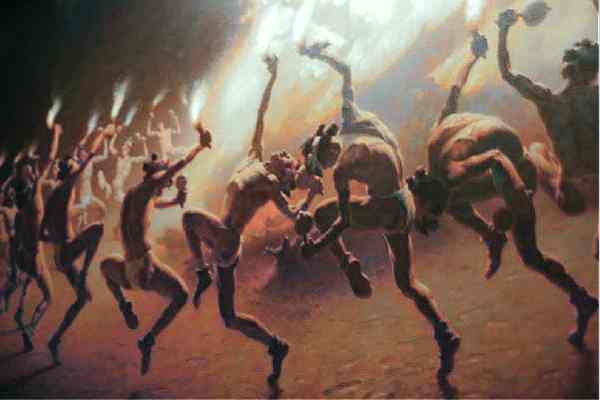
The superstition mechanism is the hidden engine that turns simple stories into a powerful system. It is the mechanism that links ancient mythology to religion. This is how myth becomes doctrine. When we understand how this mechanism works, we can see why some beliefs are harmless while others grow into systems that shape laws, identity, and culture.
This article explores how superstition begins, how it grows, and how it becomes a force that can guide or control entire societies. When the dots between belief, stories, and cultural influence are connected, the results are easy to see. Once the consequences are revealed, every individual must decide what to accept and what to release.
Inner Work Gate Notice:
It may increase discomfort before resolution. The exercises are designed to examine and restructure belief patterns, identity structures, or emotional resistance. Emotional stability should be established before engaging this material. This article is not designed for immediate calming. It is designed for transformation.
What superstition really is
Superstition is a belief that links an action, object, or event to an unseen force. It does not rely on evidence. It grows from a story that feels true and a group that repeats it. Superstition explains luck, danger, fate, and hope in simple ways that feel comforting. Because it offers quick answers, it can shape behavior without people noticing.
Superstition becomes stronger when it feels personal. Fear, excitement, and uncertainty make the story feel real. When many people share the same story, it becomes part of their identity. Over time, the belief becomes a rule, and the rule becomes a truth. This is superstition as a belief system — not yet the mechanism that creates it.
As a superstition becomes ingrained in the cultural narrative, it goes unquestioned. The longer it remains unchallenged, the more support it gains in the general population. Over time, superstitions can become forms of bias and prejudice. In turn, these prejudices can become unspoken rules and even laws.
Superstitions are hard to root out because of the superstition mechanism that propels and sustains them.
The superstition mechanism
There is a four-part mechanism that creates superstition. It is the machinery that turns a simple idea into a structured belief, and then into a cultural rule. This mechanism works the same way in pagan folklore, organized religion, and modern belief systems. It is not mystical. It is a predictable pattern in human thinking.
The superstition mechanism begins when the mind searches for meaning. When something confusing or frightening happens, the brain tries to connect it to something familiar. If two events happen close together, the mind links them, even when the connection is not real. This is the first spark of superstition. The superposition mechanism selects the closest pattern that meets these criteria.
Next, the superstition mechanism is strengthened by emotion. Fear, hope, relief, and excitement make the story feel important. When a belief is tied to strong emotion, it becomes easier to remember and harder to question.
Repetition spreads the belief. When people hear the same idea again and again, it begins to feel true. Families, communities, and traditions repeat the story until it becomes part of daily life. The superstition mechanism removes resistance to contradictory evidence through repetition of the idea.
Authority is the final element of the superstition mechanism that locks the belief in place. When leaders, teachers, or sacred texts support the idea, it becomes a rule. Questioning the rule feels dangerous or disrespectful. Once authority confirms the belief, it becomes a cultural truth. That is the formula for how myth becomes doctrine.
The superstition mechanism = pattern → emotion → repetition → authority
Together, these steps turn a simple idea into a powerful force that shapes behavior, identity, and culture.
Pagan superstitions: harmless roots
Pagan superstitions began as small stories used to explain nature and chance. People in ancient cultures faced storms, sickness, and danger without science to guide them. They created stories to make sense of these events. These stories helped them feel safer and more in control. Because these beliefs stayed personal and local, they never grew into systems that controlled society.
- Friday the 13th is treated as an unlucky date
- Walking under a ladder is seen as risky
- Breaking a mirror is linked to seven years of misfortune
- A horseshoe above the door is viewed as protective
- A black cat crossing your path signals caution
- A rabbit’s foot is carried as a charm for luck
These beliefs were harmless because they stayed small. They did not shape laws or moral codes. They did not define who was “good” or “bad.” They did not create enemies. They were simple stories people used to feel safe or lucky. Today, they survive as cultural habits, not as systems of control.
When superstition gains power
Superstition becomes dangerous the moment myth becomes doctrine, instead of personal stories. This is when the superstition mechanism is used to define the values of people, places, and things.
This happens when a belief becomes part of a group’s identity. Once a story is repeated for generations, people stop questioning it. Leaders begin using it to guide behavior. Emotional triggers like fear and hope become tied to the belief. At this point, superstition becomes a cultural rule instead of a personal idea.
- Stories pass through generations without being questioned
- Communities treat certain ideas as sacred or untouchable
- Leaders use these stories to direct behavior or enforce norms
- Strong emotions like fear or hope become tied to the belief
This is the superstition mechanism at work. A simple idea becomes a force that shapes identity, values, and choices.
Organized religion: how myth becomes doctrine
Organized religion takes this mechanism of superstition and builds it into a complete system. Instead of small stories, religion uses large narratives about creation, destiny, and morality. These narratives explain why things happen, who has authority, and how people should behave. Because these beliefs are shared by millions, they gain cultural power.
People look for patterns when life feels uncertain. Religion offers clear answers. It tells people who is in charge, what rules to follow, and what happens after death. These answers feel comforting, so people accept them. Over time, these beliefs become the foundation of a worldview.
- The causes behind events and outcomes are assigned spiritual meaning
- Authority figures are believed to hold special moral or divine power
- Acceptable behavior is defined through doctrine
- Forbidden actions are framed as dangerous or sinful
- Group identity is shaped by shared beliefs
- Outsiders are viewed as threats to unity or purity
This gives superstition a new level of influence. It becomes a tool that shapes culture, law, and identity.
Why this use of superstition is harmful
When myth becomes doctrine, superstition gains authority. People stop seeing it as a story and start seeing it as truth. This shift has serious consequences. It changes how people think, how they treat others, and how they make decisions.
Here is the missing explanation:
Humans are wired to avoid danger. When a belief system ties danger to disobedience, people obey out of fear. When a belief system divides the world into “us” and “them,” people protect their group and distrust outsiders. When questioning is punished, curiosity dies. These psychological forces make superstition a powerful tool for control.
Fear-based obedience becomes normal. People follow rules to avoid punishment rather than to understand them. The superstition mechanism becomes a tool of control
Group boundaries harden. Outsiders are treated as threats even when they pose no danger. The superstition mechanism protects itself through its emotional and authoritative elements.
Curiosity fades. Questioning beliefs becomes risky, so people stop exploring new ideas.
Laws and policies reflect superstition. Fear-based beliefs can restrict rights and limit freedoms. Every law based on sexual preference, ethnicity, or race has its basis in superstition. In this case, myth becomes doctrine, and the doctrine becomes law.
Harmful traditions stay protected. Practices continue simply because they are labeled sacred.
These consequences show how superstition, when scaled up, can shape entire societies.
The core superstitions of Western religion
Western religion uses superstition to explain fate, reward, punishment, and destiny. These beliefs follow the same pattern as ancient folklore, but they are treated as absolute truth. They shape how people see the world and how they judge others.
Here is the missing mechanism:
When a belief system claims to know the unseen world, it gains power over the visible one. People act differently when they think invisible forces watch them. They judge others based on imagined spiritual rules. They fear punishment they cannot see. This gives religious superstition a level of influence pagan superstition never had.
- A supreme being watches and judges human behavior
- Spiritual helpers act as messengers or protectors
- A powerful evil force works against the good
- Dark spirits are believed to influence events and choices
- The afterlife is said to deliver rewards or punishments
- Hell serves as a place of eternal suffering
- Prayer is thought to change outcomes
- One sect claims to hold the only true path
- Followers are urged to defend the faith from outside ideas
- Science and humanism are framed as threats
These ideas shape laws, politics, identity, and morality.
The selling of fate
The afterlife is the most powerful superstition in Western religion. It promises eternal reward or eternal punishment. Because no one can test it, the belief stays strong. It is sold through fear, hope, and tradition.
Here is the missing mechanism:
Humans fear death. When a belief system claims to control what happens after death, it gains enormous power. People obey rules to secure a reward. They avoid doubt to escape punishment. They judge others based on imagined eternal outcomes. This makes the afterlife the strongest tool for control.
- People learn to fear death instead of understanding it
- Many accept suffering because they expect a reward later
- Judgments are made about others based on imagined eternal outcomes
- Harmful systems keep their power because people fear punishment
Why the superstition mechanism works
Superstition works because it uses basic human psychology. These forces exist in every culture and every time period. They shape belief long before a person can question them.
Here is the missing mechanism:
Humans fear the unknown. When something cannot be explained, the mind fills in the gaps. Superstition offers simple answers. Humans also want control. When life feels unpredictable, superstition gives the illusion of safety. People want to belong, so they adopt the beliefs of their group. They trust authority figures, especially when those figures claim special knowledge. Strong personal experiences feel like proof, even when they are coincidences. And culture shapes beliefs from childhood, long before logic develops.
- Fear of the unknown shapes how people react to uncertainty
- Desire for control makes simple explanations feel comforting
- Need for belonging encourages people to adopt group beliefs
- Trust in authority leads people to accept claims without evidence
- Powerful personal experiences feel like proof even when they are not
- Family and cultural pressure reinforce beliefs from childhood
These forces make superstition feel natural and true.
How to see the superstition mechanism
You can spot superstition in your own thinking by asking simple questions. These questions reveal the surface-level signs that a belief may come from habit, fear, or cultural pressure instead of evidence or personal values.
- Do I believe this because I learned it early in life?
- Does questioning the belief make me uneasy?
- Does the idea comfort me even without a clear reason?
- Am I following it because people around me expect it?
- Does it divide people into “good” and “bad” groups?
- Have I accepted it without knowing its origin?
- Does it promise luck, protection, or punishment?
- Do I feel guilty when I ignore it?
- Does it rely on invisible forces or hidden intentions?
- Would I still hold this belief if I grew up in another culture?
These questions help you notice the outer layer of superstition. They show you the signs that a belief may not come from your own reasoning. They reveal the places where emotion, habit, or culture may be guiding you without your awareness.
Once you see these patterns, the next step is understanding why you hold the belief. If you believe something, it is because it feels valid to you. You do not see the downside or the harm in it. If you did, you would not hold onto it. This is why deeper inner work is important. It helps you see the hidden reasons a belief feels true.
To explore these deeper layers, you can use this tool → The Core Process For Repairing Harmful Thinking, Beliefs, and Values.
These tools help you move from surface awareness to deeper understanding. They show how the superstition mechanism works inside your own worldview and help you decide which beliefs serve you and which ones you can release.
Conclusion
The superstition mechanism is the hidden engine behind myth and religion. It starts as a small belief, grows into a shared story, and becomes a cultural force. Pagan superstition shows how it begins. Western religious doctrine shows how far it can go.
When we understand the superstition mechanism, we can see how myth becomes doctriine. We can question what we were taught. We can choose what to keep and what to let go. We can build a worldview based on clarity instead of fear.
This is the first step toward understanding what you believe and why.
References
- The Believing Brain: From Ghosts and Gods to Politics and Conspiracies, Michael Shermer.
- Why People Believe Weird Things, Michael Shermer.
- The Righteous Mind: Why Good People Are Divided by Politics and Religion, Jonathan Haidt.
- The Elementary Forms of Religious Life, Émile Durkheim.
- The Varieties of Religious Experience, William James.
- A Theory of Cognitive Dissonance, Leon Festinger.
- Thinking, Fast and Slow, Daniel Kahneman.
- Cognitive Bias and Decision Making, National Institute of Mental Health.
- Social Identity Theory and Group Behavior, National Institutes of Health.
- Fear and Decision-Making in the Brain, National Institute of Neurological Disorders and Stroke.
- Propaganda and Persuasion, Garth S. Jowett & Victoria O’Donnell.
- Superstition, Stanford Encyclopedia of Philosophy.
- Superstition, Wikipedia.