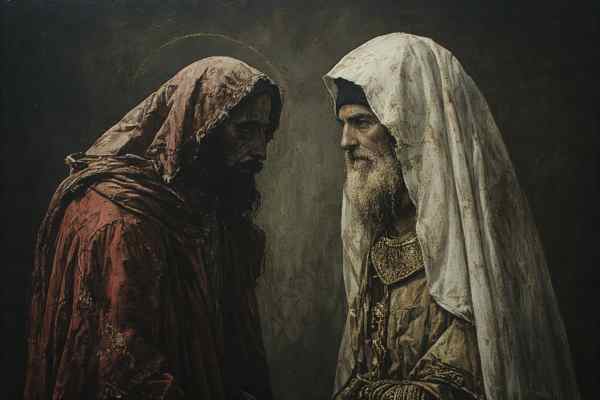
Western religion is a major force in the modern world. Yet, many of its assumptions are rarely examined. What if the moral beliefs we hold today aren’t divine truths? What if they are just leftovers from old systems? These ideas still influence how we judge, fear, and see the world.
To understand how these belief systems work, we have to step outside the stories themselves. We need to reveal the deeper architecture beneath them. Only then can we see the framework that guides Western thought. This lets us question, analyze, and finally understand it.
Pure dualism versus mitigated dualism
Dualism is a way of seeing the world by splitting everything into two sides. It sorts life into simple pairs like light and dark or order and disorder. It becomes so normal that people assume everyone sees reality in the same way. They take for granted that everything must be labeled good or evil. This simple split becomes the basic map people use to explain how the world works.
Pure dualism
Opposites are seen as parts of one whole.
In the yin and yang model, light and dark depend on each other. Each side holds a bit of the other, and both are needed for balance.
Mitigated dualism in Western religion
Turns opposites into a fight.
Good stands against evil. Heaven stands against hell. One side must win, and the other must lose. It creates a sharp split that shapes how people judge the world. It is a modified version that introduces a two-level hierarchy.
Instead of two equal forces, it places a supreme good being above a lesser evil being. The opposition remains, but the relationship becomes uneven. One side is slightly superior to the other. Neither has enough of an edge to eliminate the other. A good supreme god sits at the top, and a lesser evil being sits below.
It is this structure that teaches people to see their own lives as part of a battle. They feel pulled between two sides and judge themselves through that split. Instead of seeing tension as normal, they see it as a sign that something is wrong.
The hierarchical form of dualism was not invented by Western religion. It was blended together from the ancient mystery religions. Persian, Assyrian, and Babylonian cosmologies contained a mitigated form of dualism. When these regions were conquered by the Roman army, it assimilated all of the cults to keep its cash flow. It rebranded all of their beliefs and rituals about cosmic order and opposing divine beings.
This modified version of dualism produces a set of logical problems. These issues affect how Western religion views conflict, sees divine action, and understands good and evil. The sections that follow examine how this inherited structure shapes belief and culture.
The disadvantages of mitigated dualism
The logical problems
The modified form of dualism runs into trouble when it tries to explain evil under an all-powerful, all-good God.
Traditional god-like qualities include Omniscience. This means having complete, unlimited knowledge of everything all at once. If God is all-powerful and omniscient, why did God create Satan, knowing he would rebel?
Epicurus helps us understand the disadvantages of mitigated dualism in Western religion.
Is God willing to prevent evil, but not able? Then he is not omnipotent.
Is he able, but not willing? Then he is malevolent.
Is he both able and willing? Then whence cometh evil?
Is he neither able nor willing? Then why call him God? ― Epicurus
It is this dilemma that sits at the center of the system.
Many teachings try to solve it. One answer says evil exists because of free will and the rebellion of Satan. Another says people grow stronger by resisting evil. A third says you need darkness to understand light. These ideas sound helpful at first, but they do not solve the core issue. They circle back on themselves and leave the same question standing.
If God knows everything and can do anything, why allow a lesser evil being at all? The system never gives a clear answer. It keeps the conflict in place, but cannot explain why it must exist. Here is the main logical weakness that the rest of the structure cannot escape.
Myth structure and superstition
Mitigated dualism in Western religion teaches that the spiritual world matters more than the real world. God is at the top, angels below, and the devil and demons at the bottom. When people believe this ladder is the true map of reality, it changes how they see everything.
The physical world starts to feel less important. People, animals, and even the earth can be treated like pieces in a larger fight between good and evil. It is one of the disadvantages of mitigated dualism: it pulls attention away from real life and toward an imagined battle.
This way of thinking has serious effects. It can make people see anyone outside their group as a threat or an enemy. It has been used to excuse hate, prejudice, and even violence. Wars can be framed as battles for God. Whole groups can be harmed or wiped out because they are seen as part of the “evil” side. When the supernatural is treated as more real than human life, terrible things can be justified.
Everyday thinking also gets twisted. Normal problems—like sickness, stress, or conflict—are blamed on hidden forces instead of real causes. A cold becomes an attack. A disagreement becomes a danger. A natural disaster becomes a punishment that opens the door to superstition. People start looking for signs and omens instead of facts. They trust fear and guesswork instead of evidence.
Worldviews based on this system help to keep old myths alive. Ancient stories about higher and lower beings get new names, but the pattern stays the same. The system depends on a constant fight between good and evil, so it never fixes its own contradictions. People are asked to live inside a story that never fully makes sense, and the tension becomes part of daily life.
The lion and the deer as a cosmological metaphor
The story of the lion and the deer gives a simple way to understand how dualistic roles work. From the lion’s point of view, hunting the deer is good because it keeps the pride alive. From the deer’s point of view, the lion is an evil force that brings danger and fear. Each side sees the other through its own role, and neither can step outside that view.
When we look at nature as a whole, we see something different. Both the lion and the deer are necessary for the balance of the ecosystem. The lion keeps the herd healthy by hunting the weak or sick. The deer keep the land in balance by grazing. Together, they form a natural system that works only because both sides exist.
Here is where the observer perspective becomes important. When you observe the system without beliefs or judgment, you stand outside the roles of predator and prey. From this wider view, the lion is not good, and the deer is not evil. They are simply doing what they must do to survive. The larger pattern only becomes clear when you step outside the narrow frame of either role.
Mitigated dualism in Western religion works the same way. When people live inside a dualistic system, they see the world as a battle between two sides. They cannot see the whole picture because they are trapped in one role or the other. The observer perspective shows how limited this view is. It reveals that the conflict is part of a larger structure, not the whole story.
To step outside the story, you must see through the metaphor of religion.
Cultural and social consequences
Mitigated dualism in Western religion shapes more than belief. It shapes culture. When a system teaches that one side is good and the other is evil, it becomes easy for groups to see themselves as superior.
It is a mindset that promotes and justifies exclusion. People outside the group are treated as wrong, dangerous, or less human. The original article shows how this black‑and‑white thinking closes people’s eyes to the values and rights of others.
This worldview also reinforces moral absolutism. It leaves no room for shades of grey or cultural differences. What one group calls “good” becomes the only acceptable way to live. Anything outside that boundary becomes a threat. This creates intolerance, because the system teaches that questioning the rules is the same as siding with evil.
These beliefs do not stay inside churches or temples. The disadvantages of mitigated dualism infect the culture. It influences laws, politics, and social norms. When a religion claims to hold absolute truth, it pushes its values into government and public life. The article explains how these dogmas often take precedence over fair treatment of people and the environment. The paradigm protects itself by shaping the rules everyone must follow.
Groupthink manipulation, mental conditioning, and lifelong indoctrination are the tools. To keep the system strong, many traditions use brainwashing tools, banned books, and information control. Followers are told what they can read and what they must avoid. Myths take precedence over facts. People are encouraged to stay inside the worldview and distrust anything outside it. It makes it easier for leaders to maintain control and harder for individuals to think for themselves.
This helps explain why the Abrahamic religions have such a wide social reach. As the article notes, more than half of the world’s population belongs to one of these systems. Their influence spreads through families, schools, governments, and culture. Even people who do not belong to these religions still feel their impact. The paradigm is large, old, and deeply woven into society.
Mitigated dualism keeps its contradictions because the system depends on them. It needs the battle between good and evil to stay in place. It needs followers to see the world in black and white. This is how the paradigm maintains its power and why it continues to shape culture on such a massive scale.
Conclusion: moving beyond mitigated dualism
The modified version of dualism creates a world that is split into fixed roles. It supports moral absolutism and fuels group superiority. People become trapped in a simple good-versus-evil story. These limits show why it is important to question the beliefs and myths we inherit. When we do not examine them, they shape our thinking without our awareness.
Looking outside your own worldview is one way to break this pattern. The places your tradition tells you not to explore are often the places that open the most growth. When you study ideas beyond your usual boundaries, you begin to see how many other ways there are to understand life.
The lion and deer metaphor shows why this shift matters.
The lion and the deer cannot see the whole system because they are stuck inside their roles. Only the observer can see how the larger pattern works. Stepping into the observer perspective is a way to move beyond the narrow frame of dualistic thinking.
Non-dual perspectives offer a different path. They do not depend on a good god versus bad god structure. They avoid the disadvantages of mitigated dualism in Western religion. When you understand the system behind the myth, you gain the freedom to understand yourself and others with more clarity and balance.
References
- The Problem of Evil, Stanford Encyclopedia of Philosophy.
- Letter to Menoeceus (Problem of Evil Argument), Epicurus.
- The Righteous Mind: Why Good People Are Divided by Politics and Religion, Jonathan Haidt.
- God and Other Minds: A Study of the Rational Justification of Belief in God, Alvin Plantinga.
- The Evolution of God, Robert Wright.
- Cognitive Bias and Religious Belief, National Institutes of Health.
- Groupthink and Ideological Polarization, National Library of Medicine.
- Dualism, Stanford Encyclopedia of Philosophy.
- Problem of Evil, Wikipedia.
- Dualism (Philosophy), Wikipedia.