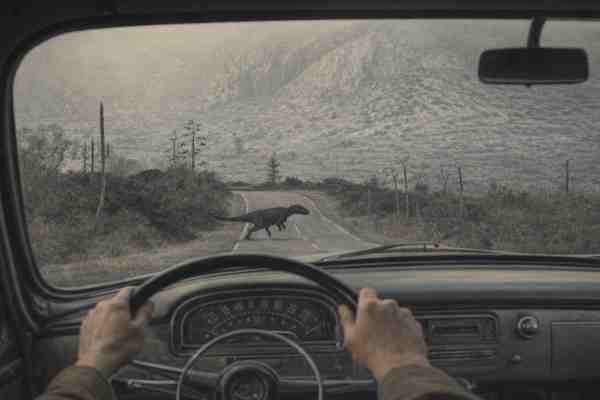
A velociraptor road-crossing encounter with an unknown phenomenon may be more common than you think. Almost half the population has seen or felt something they could not explain. How about you?
Imagine you are driving a desert road and have a velociraptor road-crossing encounter. Would you ignore it, doubt yourself, or think it was a mirage? As strange as it seems, encounters with an unknown phenomenon are not uncommon. Almost half the population has seen or felt something they could not explain.
These moments can shake your sense of certainty. They can make you question your senses, your beliefs, and the stories you use to understand the world. When something unexpected happens, you need a clear way to approach it without jumping to conclusions or shutting down too fast.
What is needed is a simple path for making sense of the unknown. We can do that in a way that supports curiosity and a critical mindset. It will enable us to look at the experience from more than one angle. With this approach, even the strangest moment can become easier to understand—and sometimes, more meaningful than it first appeared.
Encounter with an unknown phenomenon
It is not uncommon to see things that do not fit expectations. A strange shape. A bright light. A velociraptor road-crossing encounter. Anything that should not exist. When this happens, the mind tries to decide if it was real, a trick, or something imagined.
Before you can make sense of something strange, it helps to understand how perception works—and how it breaks. Several forces shape what we think we saw long before we analyze the event itself.
Natural pattern recognition process
When we see something strange (like a velociraptor road-crossing), our minds try to fit it into what we already believe. If a velociraptor road-crossing encounter does not fit our worldview, we might call it a monster, an alien, or a spirit instead. Our culture gives us a list of things we are “allowed” to see. These moments can feel exciting or scary, and they can make us question what we think we know.
Stress reaction can lead to altered states
Some people follow the ideas of Carlos Castaneda, who wrote about a teacher named Don Juan. In those stories, shocking events are used to push students into new levels of awareness. A dinosaur crossing the road could be seen as a tool for shifting consciousness. Stress, surprise, or fear can temporarily shift perception into a more symbolic or heightened state.
Cultural interference blurs perception
A large number of reports come from people who were alone, which makes them hard to confirm. Photos and videos are often blurry, shaky, or missing reference points. Even when evidence exists, people may want to believe so strongly that they ignore problems with it.
Belief systems like the Word of Faith Movement teach that thoughts and expectations can shape reality. If someone believes strongly enough, they may expect to see things others would ignore. Cultural programming shapes perception in ways we rarely notice. The mind tries to place the event into a familiar story, even when the story does not fit.
Ordinary and non-ordinary reality
Reality is not only what we see with our eyes. It is also shaped by our expectations. If something fits our normal experience, we accept it. If it does not, we may ignore it or explain it away.
Phenomenology, a field linked to Edmund Husserl, studies experience itself. It focuses on what we experience without deciding the cause right away. From this view, if you see a dinosaur, the experience is real as an event in your awareness, even if there is no physical dinosaur in the road.
Practices like Japa meditation and the Shamanic Journey can change how we notice things. They can make us more aware of the shift between waking and sleep. They can also make us more open to experiences that others might overlook. When you learn to watch your thoughts instead of getting pulled into them, strange moments become easier to understand.
Science, patterns, and hidden forces
Science tries to understand the world by finding patterns and laws. Albert Einstein searched for a unified field theory that would connect all the forces of nature. He often trusted ideas before he could prove them.
Science also reaches limits. Particle physics shows us the smallest building blocks of matter, and DNA shows us the code of life, but these fields do not always explain the deeper reason behind their patterns. They show the parts, but not the force that organizes them.
Some thinkers compare the mind to a radio. A radio does not create the music. It receives it. In the same way, our bodies and brains might be receivers for something deeper.
Rupert Sheldrake suggests that invisible “Morphic Fields” shape how things form and behave. These fields may guide patterns in nature, culture, and thought. If something like this exists, it could help explain why certain ideas or images appear again and again. It also raises the question of whether intent or faith can influence these fields.
How we judge other strange events
People have reported strange events for a long time. Some famous examples include:
- The Cottingley Fairies — two girls used paper cutouts to fake fairy photos.
- The Loch Ness Monster “surgeon’s photo” — later revealed to be a toy submarine with a fake head.
- The Patterson–Gimlin Bigfoot film — many experts believe it shows a person in a costume.
- The 1952 Washington, D.C. UFO radar sightings — bright lights and radar blips later linked to weather effects.
- The 1997 Phoenix Lights — thousands saw a V-shaped formation of lights, possibly flares or aircraft.
These cases show how easy it is to misread unknown events. They also show how much people want to believe in mysteries.
People often use simple rules to judge strange events:
- Consistency: Does the story stay the same?
- Multiple witnesses: Did more than one person see it?
- Expert input: Can experts explain it?
- Physical evidence: Are there tracks or objects left behind?
- Environment: Could weather or lighting cause confusion?
- Cultural influence: Do beliefs shape what people think they saw?
What makes something real?
There are several ways to think about reality:
- Physical reality: Something is real if it leaves evidence and can be tested.
- Personal reality: Something is real if it is a true experience in your awareness.
- Cultural reality: Something is real if your culture accepts it as possible.
- Deep reality: Something may be real if it fits into larger patterns we do not fully understand yet.
We only notice what we expect to see. The more open we are, the more we can see. That does not mean everything we see is physically real. It means our expectations shape our experience. You begin to see how your reactions, beliefs, and values shape the meaning you give to the event.
Personal experience may seem real, but feelings and beliefs are not proof of reality.
Now that you understand how perception can break, you need a method that keeps you grounded when something strange happens.
A simple three-step process to use if you have an encounter with an unknown phenomenon. These steps minimize the interference from preconceived beliefs and expectations.
The three steps to better decision-making
Gather evidence
Find and document the facts. Eyewitness statements and hard evidence like photos and video. Separate emotion from the event as much as possible. Ask questions and gather information without jumping ahead to conclusions. You are exploring the strange event.
Test and analyze data
Test the evidence to see if it holds up to factual and scientific scrutiny. Rank the evidence in terms of validity from the highest to the lowest. High credibility requires multiple unbiased sources of evaluation. Here, you are trying to prove what happened.
Analyze and develop conclusions
Develop a hypothesis based on the most and least likely conclusions. Make sense of what the data means in the larger scope of other events.
These steps help us stay calm and think clearly. Exploring opens our minds. Proving tests our ideas. Understanding helps us see the bigger picture. They also help us check our assumptions and see how our beliefs shape what we notice. Here, you are trying to understand what it might mean.
This sets the stage for the correct orientation and critical inquiry needed for the most accurate conclusions.
The case study: A velociraptor road-crossing encounter
Imagine you and your friend Alex driving across a hot desert. The sky is clear. The road is empty. Then something large runs across the road. You hit the brakes. Your heart jumps. You both think it looked like a dinosaur.
You had heard jokes about velociraptor road-crossing sightings in the area before the trip. That detail matters because it shapes what your mind expects to see. Now you have a mystery. Was it real? A trick of the light? A mirage? Your imagination? Before you decide, you steady yourself so your mind can settle.
This is where the three steps help us understand the meaning of an encounter with an unknown phenomenon. Meaning is the function of symbolic encoding that converts metaphor, symbolism, and experience into judgments about experience.
Gather evidence:
This is about exploring the strange event. You and Alex talk about what you saw. You agree it looked like a dinosaur, but you also know the desert heat can play tricks on your eyes. You search online for similar sightings. You find ideas about holograms, time travel, and leftover creatures like the Chupacabra, which some people believe is a surviving dinosaur-like animal.
You also think about your day. Maybe you were tired. Maybe you watched a dinosaur movie recently. Exploring is not about finding the final answer.
What could influence your encounter with an unknown phenomenon like this? It is about opening the door to many possibilities and noticing how your feelings might affect what you think you saw. You also begin to notice how your mind tries to fit the event into a familiar story.
Test and analyze data:
Next, you look for evidence. You are trying to prove what happened. You check the sand for tracks or marks. You do not find any. That does not prove that nothing was there, but it does not support a velociraptor road-crossing either.
You talk to experts. A paleontologist explains that dinosaurs have been gone for millions of years. A psychologist explains that stress, excitement, or strong expectations can make people see things that are not really there. When something falls outside normal experience, the brain may reclassify it into something familiar. If the event feels threatening, the fight, flight, or freeze response may activate.
You take a moment to focus your attention so you can look again with a steadier mind. Proving is about checking your story against the world. You look for physical clues, expert opinions, and other witnesses. You test your idea instead of just believing it.
Analyze and develop conclusions:
After exploring and trying to prove what happened, you think it through. You want to understand what it might mean. Maybe it was a large bird, a deer, or a trick of light and shadow. Maybe it was a hologram from a nearby event. Maybe your mind filled in the details because you were tired or excited.
Understanding means accepting that your senses are not perfect. It also means noticing how your beliefs and mood can shape what you think you saw. You may decide the dinosaur was not physically real, but the experience still teaches you something about how your mind works. Sometimes a strange moment shows you more about your own patterns than about the world outside.
What to do when a dinosaur crosses the road
If you ever see something impossible, here is a simple way to respond:
- Stay calm and curious.
- Explore what happened.
- Look for evidence.
- Think about your state of mind.
- Consider how beliefs shape perception.
- Stay open, but stay grounded.
Witnessing a velociraptor road-crossing is like seeing the Virgin Mary. Both are powerful experiences. The difference is that dinosaurs have fossils, and many religious figures do not. This comparison shows how belief shapes what we accept as real.
Having a velociraptor road-crossing encounter is rare and unforgettable. It may not be physically real, but the experience still matters. It can teach you about your mind, your beliefs, and the world around you.
You carry the lesson forward, letting it shape how you see yourself and how you talk about strange events with others. When something strange crosses your path, use it as a chance to explore, prove, and understand. It is not just about what you saw. It is about how you make sense of the world.
References
- The Demon-Haunted World: Science as a Candle in the Dark, Carl Sagan.
- Thinking, Fast and Slow, Daniel Kahneman.
- The Structure of Scientific Revolutions, Thomas S. Kuhn.
- Phenomenology of Perception, Maurice Merleau-Ponty.
- Ideas: General Introduction to Pure Phenomenology, Edmund Husserl.
- The Teachings of Don Juan: A Yaqui Way of Knowledge, Carlos Castaneda.
- A Separate Reality, Carlos Castaneda.
- Mind, Self and Society, George Herbert Mead.
- Relativity: The Special and the General Theory, Albert Einstein.
- A New Science of Life: The Hypothesis of Formative Causation, Rupert Sheldrake.
- The Presence of the Past: Morphic Resonance and the Habits of Nature, Rupert Sheldrake.
- The Varieties of Religious Experience, William James.
- An Enquiry Concerning Human Understanding, David Hume.
- Critique of Pure Reason, Immanuel Kant.
- Perception and Visual Illusions, National Institutes of Health.
- Cognitive Bias and Pattern Recognition, National Institute of Mental Health.
- Stress Response and Perceptual Distortion, National Library of Medicine.
- Scientific Method and Evidence Evaluation, National Academy of Sciences.
- Phenomenology, Stanford Encyclopedia of Philosophy.
- Apophenia, Wikipedia.