
Dreamtime is one of the most advanced and mysterious forms of the shamanic journey. It blends story, land, consciousness, and time into a single living system. We will explore Australian Aboriginal Dreamtime beliefs as a spiritual technology.
Dreamtime is not only a creation story. It is a way to enter a visionary landscape and altered states of awareness. Here, the past, present, and future exist together. It teaches that the land holds memory and that people are connected to it through ancestry and story.
This article follows the full revised structure used across the shamanism series. It expands each section heavily while keeping the meaning clear, grounded, and aligned with the original content.
Aboriginal Dreamtime beliefs vs Western
Most people know Western theology comes from older Near Eastern systems. Abrahamic religions tell stories of creation, floods, and judgment. These stories link to Babylonian, Persian, and Egyptian tales. They share similar themes and ideas. These stories do not hold up well under science, yet they still shape how many people imagine the world.
The cosmology behind Aboriginal thought is different in content and structure:
1. Older continuity. Aboriginal Dreamtime beliefs and stories have been passed down for tens of thousands of years. They stay linked to families, land, and long lines of teachers. Western cosmology has many breaks and rewrites. It was shaped by empires, councils, and borrowed ideas.
2. Land-anchored myth. In Dreamtime, narratives live in the land. Hills, rivers, rocks, and tracks show where ancestor-beings moved. The land is the record. Western stories are mostly placeless. Eden has no clear location, and Heaven and Hell are not tied to real geography.
3. Ongoing creation. Dreamtime is not a moment in the past. It is active now. Creation continues through cycles, rituals, and right relationship with the land. Western cosmology treats creation as finished. The world is made once, and then history begins.
4. Experiential access. Australian Aboriginal dreamtime is a state you can enter through ceremony, song, dance, and focused awareness. People can meet ancestor-beings and take part in creation. Western traditions limit access. Revelation is treated as something that happened long ago, not something you can step into today.
5. Relational ontology. Dreamtime cosmology teaches that humans, animals, plants, landforms, and ancestor-beings are kin. Life is a web of relationships. Western cosmology is more hierarchical. Humans are placed above nature, and the sacred is often seen as separate from the world.
6. Layered time. Dreamtime blends past and present. The past is still here and still active. Western cosmology is linear. It moves from creation to fall to redemption to judgment, with each step locked in order.
7. Knowledge as custodianship. Dreamtime knowledge is something you practice and protect. It is earned through duty to land and community. Western religion focuses on belief. What you accept as true becomes more important than what you do.
Dreamtime is a living, land-based, and ongoing way of seeing the world. It is something people can enter and take part in. Western cosmology is more distant, linear, and belief-centered. One is a relationship with a country; the other is a story about creation.
Before conception, a person is said to be sitting as a Dreamtime being. This process is thought of as a transformation from the Dreaming into the actual. Dreaming links everything together. Thus, a person is linked to a place.
The four layers of Dreamtime reality
You can think of Dreamtime as a multi-layered cosmology rather than a single mythic era:
1. The Eternal Layer (Ancestral Realm). Ancestral beings exist outside linear time. Their actions shape landforms, species, and laws.
2. The Creation Layer (Mythic Events). Stories of how rivers, mountains, animals, and clans came into being. These are not “once upon a time” tales but ongoing templates.
3. The Living Layer (Present Reality). Everyday life unfolds within patterns established in Aboriginal Dreamtime beliefs. People, places, and events are expressions of deeper ancestral designs.
4. The Return Layer (Post-Death Continuity). After death, consciousness returns to Dreamtime, rejoining ancestral presence and the land.
This structure mirrors some modern scientific and philosophical ideas:
- Block universe theory: All times coexist; we move through them rather than create them.
- Non-local consciousness: Awareness is not strictly confined to one body in one moment.
- Field-based identity: Self is woven into land, kin, and story rather than isolated in a single ego.
Australian Aboriginal Dreamtime: shamanic technology
Across the world, many shamanic cultures learned how to travel inward using rhythm, posture, and strong symbols. These methods helped people enter altered states of consciousness. Anthropologist Michael Harner called this the Shamanic State of Consciousness (SSC). It is often linked with slow theta brainwaves and clear, dreamlike images.
A specialized form of the shamanic journey
Dreamtime works like a shamanic journey, but it has its own shape and purpose. It uses rhythm and steady movement. This helps focus awareness and shift the mind into a different state. In this state, a person can sense ancestor beings, follow songlines, and explore the land’s deeper meanings. Many cultures use drums or chanting to reach non-ordinary reality. Aboriginal Dreamtime beleifs links these tools to place, story, and duty.
Independent evolution
Dreamtime developed in isolation for tens of thousands of years. Because of this, it refined its own symbols, rules, and ways of teaching. Each group guarded its knowledge and passed it down through families and custodians. Over time, this created a system that is both simple on the surface and extremely detailed underneath. Its methods were shaped by the land itself, not by outside influence.
Time-space navigation
Many shamanic systems focus on traveling to spirit realms or meeting helping spirits. Dreamtime includes this, but it also goes further. It allows movement through time and across great distances. A person in Dreaming can witness events from the deep past, follow the paths of ancestor-beings, or see how actions today affect the future. Time is not a straight line. It is layered, and Dreamtime gives trained people a way to move within those layers.
We may never fully reverse engineer Dreamtime—and perhaps we should not try. We can honor it as a deep spiritual technology. It shows what is possible when a culture connects with land, story, and the mystery of time over thousands of years.
Dreamtime epistemology: how knowledge is known
Dreamtime is not just a set of stories; it is a way of knowing. Knowledge in this system is:
- Experientially — Truth is validated through direct experience in Dreamtime, not through abstract belief.
- Relationally — Knowledge arises from relationships with land, ancestors, and beings. Yet, it is not from detached observation.
- Embodied — Posture, movement, and place are part of the knowing process.
- Symbolic and land-based —Rocks, rivers, and tracks are both physical and informational. They are living archives of ancestral action.
Dreamtime integrates all elements. It is empirical, meaning it’s tested in experience. It is also symbolic, rich in myth and imagery. Additionally, it’s psychological, engaging deeply with inner states. Yet, it stays rooted in land and community.
This contrasts with:
- Western empirical epistemology: Prioritizes measurement, analysis, and repeatable observation.
- Dogmatic religious epistemology: Prioritizes revelation through texts and authority figures.
- Modern psychological epistemology: Prioritizes internal states, narratives, and therapeutic frameworks.
Core processes of Dreamtime altered states practice
Secrecy, initiation, and cultural boundaries
Dreamtime is not a public workshop technique. It is a sacred practice in certain Aboriginal communities. It is passed down through long preparation and initiation. Dreamtime has boundaries to protect its system. They help keep its methods stable over time. These boundaries aren’t meant to exclude. They aim to preserve a living spiritual technology. This technology relies on context, lineage, and responsibility.
Restricted access is one of the defining features of Dreamtime practice. Outsiders may learn the stories, but the inner methods remain within the culture. This keeps the practices true and linked to the land, the ancestors, and their responsibilities. Without this protection, the system would lose the very relationships that make it work.
Preparation for Dreamtime work is long and demanding. Training can take years. It needs discipline, ritual, and guidance from elders. They decide when someone is ready for deeper knowledge. The process isn’t just about learning techniques; it’s about focusing attention. It’s about building character. It’s also about managing Dreamtime access responsibilities. A person must be able to carry the weight of what they learn.
Ethics are woven into every part of Dreamtime practice. A practitioner must honor land, kin, and ancestral law. Knowledge is not used for personal gain or entertainment. It is used in the service of community, continuity, and balance. Without this ethical foundation, the practice loses its meaning and its power.
Dreamtime is a private and spiritually significant event. Outsiders can learn about Dreamtime and its stories. However, taking part in the spiritual practice is reserved for those within the community. This keeps the system mechanisms intact generation after generation.
Postural techniques: the one-leg stance
One of the most distinctive aspects of Dreamtime practice is posture. It uses static posture control as a mechanism for altered state induction:
- Standing. Practitioners standing on one leg for extended periods, even hours.
- Stillness. Many shamanic traditions that use dancing or swaying to induce a trance state. Dreamtime emphasizes still, focused endurance to achieve this shift.
- Somatic threshold. The physical challenge itself becomes a gateway. It sharpens attention and alters perception.
This differs from:
- Siberian and Mongolian traditions. Seated or moving drumming journeys.
- Amazonian ceremonies. Often conducted lying or sitting, with plant medicines and icaros.
- African trance dances. Rhythmic movement and communal drumming.
The one-leg stance functions as both discipline and signal. The body is placed in an unusual, demanding configuration that marks a shift from ordinary life into Dreamtime engagement.
Rhythm, sound, and altered states
Like other shamanic systems, Dreamtime uses rhythmic sound to regulate heart rate and shift awareness:
- Drums and clapsticks. Provide steady rhythmic frameworks.
- The Didgeridoo. Produces low-frequency vibrations that can be felt throughout the body.
- Chant and song. Carry ancestral narratives and encode routes, laws, and relationships.
Most forms of the Shamanic Journey use rhythmic sounds and sometimes psychotropic additives. This process is common in many indigenous cultures around the world. However, we only partially understand how it works.
Songlines: cosmological navigation systems
Songlines are one of the most powerful and underappreciated aspects of Dreamtime:
- Maps in melody. Songlines trace the paths of ancestral beings across the land. Singing them is both remembering and re-walking those routes.
- Memory palaces. Each verse encodes landmarks, resources, and laws, turning the landscape into a living library.
- Spiritual GPS. Following a songline is both physical navigation and spiritual alignment with Dreamtime patterns.
Songlines function like:
- Tibetan mandalas as maps of spiritual space.
- The Norse Yggdrasil as a world-tree connecting realms.
- The Kabbalistic Tree of Life as a diagram of creation and consciousness.
But unlike abstract diagrams, songlines are walked, sung, and inhabited. They are cosmology in motion.
Dreamtime, time travel, and astral projection
Beyond symbolic journeying
In many shamanic traditions, journeys focus on:
- Meeting spirit allies.
- Retrieving lost vitality.
- Gaining insight into present-life issues.
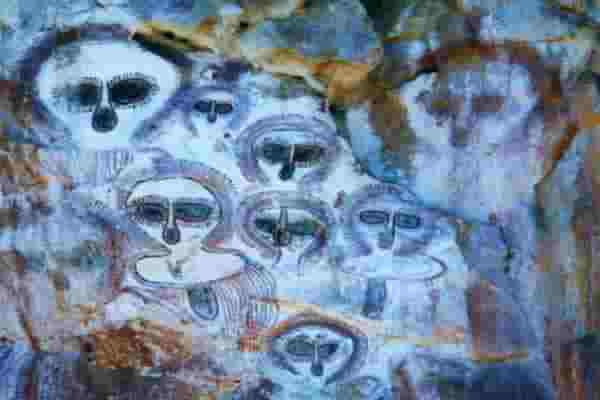
Australian Aboriginal Dreamtime brings a new layer. Practitioners can see past or future events and describe faraway places with amazing accuracy. This has led many to compare Dreamtime to time travel and astral projection.
With this form, practitioners view events in the past or the future. So, this sounds like the experience of projecting awareness and time travel. Most other forms of the Shamanic Journey deal only with the spirit world.
Dreamtime projection versus Western astral projection
Western esoteric traditions often describe astral projection as:
- Leaving the body and floating above it.
- Traveling through subtle planes or astral realms.
- Observing physical locations from a disembodied perspective.
Dreamtime projection is framed differently:
- Entering the eternal layer. The practitioner shifts into Dreamtime, where past, present, and future coexist.
- Accessing ancestral memory. Events are seen within the context of ancestral patterns and land-based stories.
- Moving through time-space as story. Locations and eras are not just coordinates; they are segments of ongoing Dreamtime narratives.
Stories describe travelers who foresaw events such as humans walking on the moon decades before it happened. To outsiders, this sounds impossible. However, within Dreamtime cosmology, it is a natural to move through an ever-present creation field.
Lucid dreaming, Dreamtime, and non-ordinary reality
There are intriguing parallels between:
- Lucid dreaming. Becoming aware within a dream and gaining some control over the dream environment.
- Shamanic journeying. Entering a structured inner landscape with guides and symbolic encounters.
- Dreamtime travel. Moving through a reality where time and space are fluid, yet anchored in land and story.
Some key distinctions:
- Lucid dreams are often private and idiosyncratic. Dreamtime journeys are embedded in communal cosmology.
- Shamanic journeys may be symbolic and therapeutic. Dreamtime journeys can be both symbolic and informational about real-world events.
- Dreamtime is not just “inside the mind.” It is a shared field that connects people, land, and ancestors.
This leads to a radical question: if all experience arises in consciousness, is ordinary waking life just one type of dream among many?
Dreamtime and modern science
Altered states and measurable differences
We know that:
- Shamanic drumming. Rhythms around 4–7 beats per second can shift brainwaves into the theta range, associated with deep meditation and vivid imagery.
- Sound-based practices. Low-frequency vibrations from the didgeridoo can stimulate the vagus nerve and promote relaxation.
- Higher states. Transcendental consciousness, SSC, and other altered states show distinct physiological signatures. These differ significantly from waking, dreaming, and sleep states.
We lack detailed scientific data on practitioners in real Dreamtime processes. The secrecy and cultural boundaries around Dreamtime make it hard to measure with instruments.
Dreamtime and physics: a speculative bridge
Dreamtime’s view of time and space resonates with several modern ideas:
- Non-linear time. Past and future are accessible from a timeless field, similar to some interpretations of the block universe.
- Entanglement-like connection. People, places, and events remain linked across distance. This echoes the non-local correlations in quantum physics.
- Holographic reality. Each place and story contains the pattern of the whole, much like holographic models of the universe.
These parallels do not prove Dreamtime in a scientific sense. It does show that Aboriginal cosmology aligns closer to emerging scientific thought. This contrasts sharply with the mythos of Western religion.
Ethics, appropriation, and respect
Why Dreamtime cannot be “downloaded.”
Because Dreamtime is embedded in the cultural lineage, it cannot be ethically extracted as a technique for outsiders to use.
Key ethical points:
- Context is non-negotiable. Dreamtime practices are inseparable from responsibilities to land, kin, and law.
- Appropriation causes harm. Stripping techniques from their cultural roots turns living traditions into commodities.
- Listening over taking. The appropriate stance for outsiders is to learn, support, and respect—not to replicate or claim ownership.
Learning from Dreamtime without stealing it
Even without practicing Dreamtime itself, we can learn from its principles:
- Reverence for land. Treating the place as sacred, alive, and intelligent.
- Relational identity. Seeing self as woven into community, ancestry, and environment.
- Experiential spirituality. Valuing direct experience over secondhand belief.
- Non-linear time. Honoring the influence of past and future on the present in more than a metaphorical way.
Ethics are not just rules; they are how we keep the spirit of these traditions alive rather than consuming them.
Dreamtime, shamanism, and spiritual technologies
Dreamtime as a key to other altered states
Understanding Dreamtime may help illuminate:
- Near-death experiences.
- Out-of-body experiences.
- Spontaneous precognitive dreams.
- Other forms of time dilation and time distortion.
Dreamtime appears to be a refined method for navigating a non-linear reality. As such, it may offer clues to how consciousness interacts with time and space more generally.
Parallel traditions and hidden lineages
Other systems hint at similar capacities:
- Siddhis in yogic traditions. Sutras about invisibility and finding things show ways to perceive beyond normal limits.
- Hermetic and esoteric Western lineages. Suggest hidden practices for exploring non-ordinary reality, though key methods remain obscured.
- Global shamanic journeys. From Siberia to the Amazon, cultures discovered common ways to explore consciousness. They utilized rhythm, posture, and symbolism for altered state induction.
Australia’s geographic isolation helped preserve Dreamtime from outside interference. It survived by avoiding the destructive forces of Western religion that erased other ancient systems. It gives us hope that other intact lineages may still hold complementary pieces of this larger puzzle.
Why Dreamtime matters now
In a world facing ecological crisis, spiritual disconnection, and meaning collapse, Dreamtime offers:
- A model of deep belonging. Identity rooted in land, ancestry, and responsibility.
- A non-extractive spirituality. Practices that emphasize reciprocity rather than consumption.
- A reminder of our capacities. Humans have always had tools for exploring consciousness far beyond default waking states.
We may never fully reverse engineer Aboriginal Dreamtime—and perhaps we should not try. We can honor it as one of humanity’s deepest spiritual tools. It shows what’s possible when a culture connects with land, story, and the mystery of time over thousands of years.
References
- Stanner, W. E. H. (1965). The Dreaming. In Australian Aboriginal Anthropology. University of Western Australia Press.
- Rose, D. B. (1996). Nourishing Terrains: Australian Aboriginal Views of Landscape and Wilderness. Australian Heritage Commission.
- Berndt, R. M., & Berndt, C. H. (1994). The World of the First Australians. Aboriginal Studies Press.
- Elkin, A. P. (1977). Aboriginal Men of High Degree: Initiation and Sorcery in the World’s Oldest Tradition. University of Queensland Press.
- Chatwin, B. (1987). The Songlines. Viking Penguin.
- Harner, M. (1980). The Way of the Shaman. Harper & Row.
- Lewis-Williams, J. D. (2002). The Mind in the Cave: Consciousness and the Origins of Art. Thames & Hudson.
- Walsh, R. (2007). The World of Shamanism: New Views of an Ancient Tradition. Llewellyn Publications.
- Vaitl, D., et al. (2005). Psychobiology of Altered States of Consciousness. Psychological Bulletin.
- Laughlin, C. D., McManus, J., & d’Aquili, E. G. (1992). Brain, Symbol and Experience: Toward a Neurophenomenology of Consciousness. Columbia University Press.
- Tonkinson, R. (1991). The Mardu Aborigines: Living the Dream in Australia’s Desert. Holt, Rinehart and Winston.
- Morphy, H. (1991). Ancestral Connections: Art and an Aboriginal System of Knowledge. University of Chicago Press.
- Glowczewski, B. (1991). Dream Trackers: Yapa Art and Knowledge of the Australian Desert. University of Chicago Press.
- McClenon, J. (2002). Wondrous Healing: Shamanism, Human Evolution, and the Origin of Religion. Northern Illinois University Press.
- Australian Institute of Aboriginal and Torres Strait Islander Studies (AIATSIS). (2020). Dreaming and Songlines. AIATSIS.
About this project
The Seeker Project 4 Spiritual Exploration (SP4SE) is a project of Americans In Alliance. The mission of SP4SE is spiritual education. The mission of Americans In Alliance is environmental conservancy. Click the links below to learn more and support our efforts.