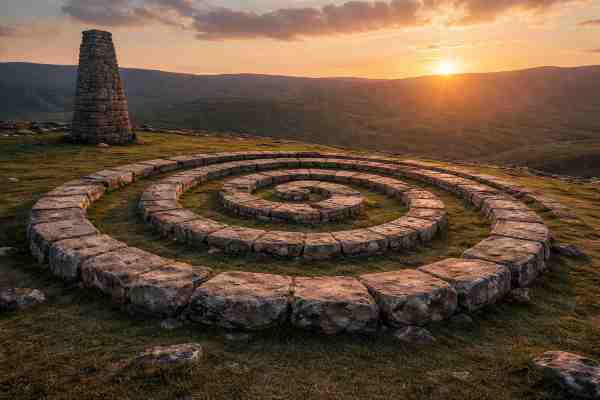
What if the meaning and symbolism we attach to the sacred spiral aren’t as straightforward as they look? Sometimes a new take appears in the smallest details—quiet, subtle, and easy to miss. It changes how the symbolism of the sacred spiral feels long before you can explain why.
We often treat the sacred spiral as something familiar, but the shape has a way of unsettling that confidence. A curve here, a shift there, and the pattern starts to feel different from what was expected. That’s where the new perspective begins—not in certainty, but in the moment something doesn’t quite line up.
A new take on the sacred spiral symbol
We talk about the spiral as if it’s a single idea, but the form refuses to stay in one meaning. It shows up in storms, shells, galaxies, carvings, and mathematics, yet it never behaves the same way twice. The shape looks simple, but its behavior is anything but.
A spiral can widen, tighten, rise, flatten, twist, or collapse depending on the forces shaping it. Some spirals move like growth, others like pressure, others like motion frozen in place. The form doesn’t tell one story—it reacts, shifts, and changes depending on what created it.
This is where the familiar interpretations start to crack. If the sacred spiral itself won’t hold still, why do we assume its meaning does? The symbol we inherited may not match the pattern we’re actually looking at.
Memory, meaning, and symbolism
Meaning is like memory; it changes over time because of outside influences.
Rethinking the sacred spiral begins with this shift: stop treating it as a message, and start treating it as a behavior. Once you do, the shape becomes far more complex—and far more revealing—than the tidy explanations we’ve been repeating.
1. The sacred spiral as a predatory geometry
The symbolism of the sacred spiral is often interpreted as harmony and growth, but its most powerful expressions in nature tell a different story. The generally accepted meaning and symbolism do not align well with reality.
Spirals appear where energy concentrates, accelerates, and overwhelms. They are like hurricanes, pulling everything toward their center. Tornadoes drill through landscapes, while black holes draw matter into a point of no return. These forms do not guide gently. They consume and destroy.
The comforting spiral is symbolic.
The predatory spiral is real.
This darker reading aligns with the emotional responses people rarely admit. As the original article notes, typologies can trigger deep unconscious reactions, including fear. That fear is not accidental. Spirals show where nature shows its clever side. They mark the spots where systems fail under stress and where the world grows too powerful for us to manage.
This does not make the sacred spiral negative. It makes it honest. Growth is not the only force shaping our lives. Some patterns pull us forward. Others pull us under. The spiral is both.
2. The spiral as a cognitive artifact
How the brain creates the spiral
The sacred spiral is often described as a universal archetype, something encoded in the human psyche. But a more grounded reading is far more disruptive: the spiral may not be universal at all. It may simply be a pattern the human visual system is built to detect.
The brain is wired to track rotation, curvature, and motion. Specialized neurons respond to shifting angles and repeating curves. When people close their eyes and see spirals, it may not be a mystical imprint. It may be the visual cortex generating its own internal motion maps. The hypnotic spiral works for the same reason. It overwhelms the brain’s orientation system and pulls attention inward.
Why the spiral feels meaningful
This reframes the symbol entirely. Instead of a cosmic message, the sacred spiral becomes a cognitive artifact. It feels meaningful because the brain is tuned to it. It feels ancient because the nervous system is ancient. It feels spiritual because it bypasses language and goes straight to perception.
This does not diminish the sacred spiral. It makes it more intimate. The symbol is not outside us. It is built into the way we see.
It does more than feel meaningful—it generates meaning. When perception locks onto a repeating, intensifying pattern, the brain begins to search for an explanation. This is where belief begins—not as truth, but as a response to unresolved perception. The longer a pattern resists closure, the more the mind fills it with interpretation.
In this sense, the spiral is not just something we interpret. It is something that organizes interpretation for us. And once interpretation begins to organize itself, repetition is never far behind.
3. The spiral as the opposite of a labyrinth
This is a new take on how the spiral’s form and function deliver the opposite of conventional thinking.
Two shapes, two movements
The sacred spiral is often grouped with the labyrinth, but the two forms behave in completely different ways. A labyrinth leads you inward and then outward again. It has a center, a return, and a built‑in resolution. A spiral does not. It pulls you inward without release. It loops, tightens, and repeats. It is motion without completion.
Why the spiral breaks the idea of progress
This distinction matters because many people use the spiral as a symbol of spiritual progress. But progress requires a path that eventually turns and leads somewhere new.
The sacred piral offers no such turn. It is the geometry of recursion, not transformation. It mirrors the mental patterns people fall into when they believe they are evolving but are actually circling the same insight. They are more often circling the same wound or the same identity.
The hypnotic pull of repetition
This is why the spiral feels hypnotic. It mimics the way the mind loops when it is overwhelmed or searching for meaning.
Stage hypnotists use spirals for a simple reason. The spinning pattern disrupts your sense of direction, narrows your focus, and makes you feel like you’re falling inward.
Even the opening of *The Twilight Zone* used a spiral to unsettle the viewer before a single word was spoken. The shape bypasses logic and goes straight to the part of the brain that tracks motion and threat.
The labyrinth resolves.
The spiral deepens.
Understanding the difference gives the symbol its real power. The spiral shows us the places where we are caught. The labyrinth shows us the way out.
Repetition does more than hold attention—it stabilizes it. What repeats begins to feel familiar. What feels familiar begins to feel true. This is how loops become beliefs. Not because they are accurate, but because they are uninterrupted.
As attention narrows and external reference points fade, the mind begins responding more to its own activity than to the outside world. This is the threshold of altered states: when perception becomes self-reinforcing, and the distinction between observing and imagining begins to blur.
Meaning and symbolism become anchors for hypnotic loops.
4. The sacred spiral was never universal
The modern idea of the spiral as a universal spiritual symbol is a recent construction. Ancient cultures did not agree on its meaning, and many used the spiral for purposes that had nothing to do with enlightenment or cosmic energy. The symbol was practical, local, and often contradictory. This is a new take on the spiral’s function as a marker or reminder.
- In one place: spirals marked water sources, migration paths, or seasonal routes.
- In another, they signaled danger zones, astronomical events, or solar death cycles.
- Elsewhere, they served as territorial markers, animal‑movement maps, or ritual boundaries.
The same shape carried different meanings because it served different needs. This challenges the idea that the spiral expresses a single, shared human truth. Instead, it reveals how easily symbols are repurposed and romanticized.
Presence across cultures does not equal agreement. The symbol traveled, but its meaning did not. What we call universal may simply be a collage of unrelated interpretations woven together long after the fact.
Seeing this clearly does not diminish the spiral. It frees it. The symbol becomes dynamic rather than fixed, shaped by context rather than myth. Its power comes not from a single ancient meaning but from its ability to hold many meanings at once.
5. The spiral as symbolic encoding
Symbols do not store meaning the way language does. They compress it.
A spiral can hold motion, growth, danger, recursion, and time all at once because it does not define any of them precisely. It encodes relationships rather than conclusions.
This is why symbols travel so easily across cultures. They are not understood the same way—they are completed differently by each mind that encounters them.
The sacred spiral does not carry a fixed message. It provides a structure that the mind fills.
6. The uncomfortable synthesis
The real question is not what the spiral means, but why we are so quick to decide that it must mean something at all.
Critical inquiry begins at the moment a pattern feels significant but the explanation feels inherited.
When the spiral is stripped of its romantic interpretations, a different picture emerges. It is not a universal symbol of harmony, nor a guaranteed path of growth, nor a shared spiritual language across cultures. It’s a pattern that shows up when systems grow stronger, when perception repeats, and when meaning is made instead of passed down.
The spiral becomes powerful precisely because it refuses to settle into a single definition. It can represent predatory force, cognitive bias, cultural fragmentation, or psychological recursion. It can reveal where we are expanding and where we are repeating ourselves. It can show us the difference between a path that resolves and a pattern that traps.
What the symbolism of the spiral is vs what it is not
| What the spiral is | What the spiral is not |
|---|---|
| A pattern of intensification | A universal message |
| A cognitive loop | A guaranteed path of growth |
| A mirror for perception | A fixed spiritual truth |
| A map of where we repeat | A symbol with one meaning |
This makes the spiral more relevant, not less. Instead of a fixed spiritual emblem, it becomes a mirror for human experience. We grow in spirals, but we also get stuck in them. We evolve through cycles, but we also circle the same lessons until we finally see them clearly.
Understanding this gives the symbol its real depth. The spiral is not the answer. It is the question that keeps returning until we are ready to meet it.
We don’t just interpret symbols. We stabilize ourselves through them.
7. The symbolism of the sacred spiral returns
The spiral endures because it refuses to stay in one meaning. It can be precise or irregular, mathematical or emotional, expansive or consuming. It appears in storms, shells, galaxies, carvings, and the mind’s own internal imagery. Some spirals grow with perfect ratios. Others wobble, tighten, or break their own symmetry. The form is not consistent, and that inconsistency is the point.
When we stop forcing the spiral into a single interpretation, a deeper pattern emerges. The spiral shows how systems behave when they intensify. It shows how the mind loops when it is overwhelmed. It shows how cultures project meaning onto shapes that were never meant to carry one message. It shows how growth and repetition can look identical until we learn to tell them apart.
The spiral returns because we return.
Not just in movement, but in interpretation. We return to the same patterns, the same meanings, and the same beliefs until something interrupts the loop.
This is the real power of the spiral. It is not a symbol of certainty. It is a symbol of movement. It reveals where we are expanding and where we are circling. It shows us the difference between a path that resolves and a pattern that deepens. It reminds us that life does not unfold in straight lines. It turns, tightens, widens, and returns.
The meaning and symbolism of the sacred spiral are not designed to reassure us. They are here to unsettle and awaken. If we follow the cue honestly, it leads not to a single truth but to the place where meaning is made, lost, and made again.
References
- The Power of Myth, Joseph Campbell.
- Man and His Symbols, Carl G. Jung.
- The Golden Ratio: The Story of Phi, the World’s Most Astonishing Number, Mario Livio.
- On Growth and Form, D’Arcy Wentworth Thompson.
- Spiral Dynamics: Mastering Values, Leadership, and Change, Don Edward Beck & Christopher C. Cowan.
- Visual Cortex and Pattern Recognition, National Institutes of Health.
- Perception and Visual Processing, National Library of Medicine.
- Symbolism, Stanford Encyclopedia of Philosophy.
- Spiral, Wikipedia.
- Golden Spiral, Wikipedia.