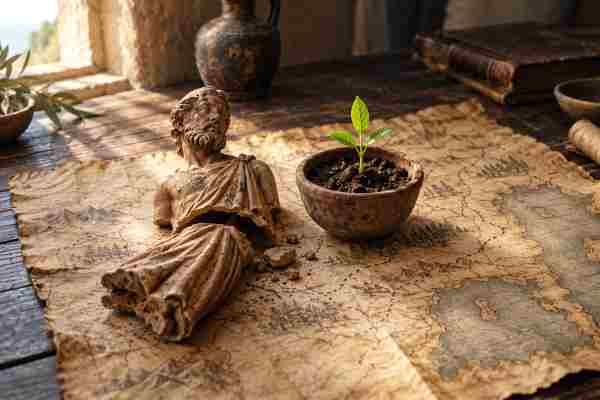
Stories of dying gods are some of the oldest in religion. They become belief maps that show how people break down and rebuild. Some of the famous claims about dying and rising gods are true, and some were invented. Knowing which is which changes how you see your own beliefs.
Many traditions tell of a god who suffers, dies, or vanishes, and returns. Osiris, Dionysus, Attis, and Jesus are the best known. Each story carries one of three patterns: rebirth, renewal, or resurrection.
These patterns are archetypes. A belief system turns them into a map that tells followers what to believe and do. This article looks at both layers.
It also checks the popular parallels against the ancient sources. The real pattern is strong enough on its own. It doesn’t need help from myths about myths.
How dying gods become belief maps
People don’t invent transformation stories at random. The stories grow out of built-in psychological capacities and mechanisms. Each story is a pattern that holds the steps of change.
Several mental processes work together here:
- Pattern recognition
- Narrative construction
- Emotional encoding (fear, loss, relief, renewal)
- Identity restructuring
- Memory and meaning-making
When these processes handle a hard experience, such as loss or crisis, they produce the same shapes again and again. Those repeating shapes are what we call archetypes.
Archetypes are not stories we memorize. They are patterns that form when the mind works through change. Carl Jung saw them as inherited forms in the psyche. Many researchers today see them as products of shared human experience. Both views agree that the patterns repeat across cultures.
Belief systems come later. They take these patterns and fix them into stable meanings.
➡ For more, see: How the Narrative Mechanism Organizes Belief
Archetypes and belief maps
Archetypes and belief maps are two layers of the same machinery. The archetype is the shared pattern. The belief map is the structure a culture or a person builds on top of it.
The two layers lock together in three ways:
- The archetype supplies the pattern. The map assigns its meaning.
- The archetype supplies the emotional charge. The map supplies the logic.
- Together, they tell people what to value and how to act.
Rebirth, renewal, and resurrection are archetypes. These become belief maps when someone uses them to explain their own life.
➡ For more, see: The Psychological Foundation of Belief Structures
Rebirth, renewal, and resurrection
These three ideas overlap, and myths often blend them. Still, they are not the same. The differences are the key to understanding the dying-god pattern.
Rebirth is a change of identity. It is psychological. A person sheds an old self and emerges as someone new. Myths mark this shift with a symbolic death, such as wilderness, trials, betrayal, or sacrifice.
Renewal is the return of vitality in a cycle. It is seasonal, emotional, and shared by a community. Renewal rites use fire, water, fasting, or cleansing to release what is old and restore balance.
Resurrection is the return from death, literal or symbolic. It is the most dramatic form of rebirth. In myth, it is about the return of light, order, or awareness after a time of darkness.
Each archetype repairs a different kind of collapse.
| Archetype | What it repairs |
|---|---|
| Rebirth | Identity. The old self breaks down, and a new one is built. |
| Renewal | Energy and balance. Body, mood, and community reset on a cycle. |
| Resurrection | Continuity. The story of a self or a world is restored after total loss. |
Cultures encode these archetypes into belief maps that spell out the steps and the rules. That is why the three patterns appear almost everywhere. They give people a way to understand collapse, change, and return.
➡ For more, see: The Meaning We Project Onto Rebirth Symbols
The best-known dying gods
Several ancient cultures kept stories of gods who suffer, die, or disappear, and then return in some form. These myths were not biographies. They were belief maps built on one of the three archetypes. Many of the ancient mystery religions built their initiations around these figures.
Each figure below is tagged with its archetype, and the belief maps encode it.
Osiris: resurrection and divine order. Osiris is murdered by his brother Set, and his body is scattered. His wife, Isis, gathers the pieces and restores him. He does not return to life on earth. He becomes king of the dead, and his son Horus takes the throne of the living. The belief map is restored to balance. Death disrupts the world, and rightful order returns.
Many modern lists name Horus as the dying god. In the Egyptian sources, it is his father, Osiris, who dies.
Dionysus: rebirth through ecstasy. The Greeks called Dionysus the twice-born god. In one myth, Zeus rescues him from his dying mother, Semele, and carries him until birth. In the Orphic version, the Titans tear the child apart, and he is made whole again. The belief map is ecstatic dissolution. The old identity breaks down so a new one can emerge.
Attis: renewal in the seasonal cycle. Attis is the young companion of the mother goddess Cybele. He dies after castrating himself in a fit of madness. In the oldest accounts, he does not come back, and Cybele can only keep his body from decaying. Later Roman festivals in March mourned his death and then broke into celebration. Whether those festivals marked a true return is still debated. The belief map is seasonal restoration. Life declines, returns, and repeats.
Mithras: rebirth through ordeal. Mithras is not a dying god. No surviving source describes his death. His central image shows him killing a bull, and his cult moved members through seven grades of initiation. In this system, the follower passes through trials and is remade, not the god. The belief map is victory through ordeal. Hardship proves worthiness.
Jesus: resurrection and continuity. In Christian belief, Jesus dies and returns as the same being in a changed state. The belief map is continuity through death. Identity survives collapse and returns with greater authority. Only Christianity makes a single death and return the center of its whole system.
These figures share psychological themes but use different symbols. That is why they look alike from a distance. Up close, the details differ a great deal.
What the evidence supports
Popular books, websites, and films often list similarities between Jesus and other dying gods. The lists claim virgin births on December 25, twelve disciples, and returns after three days. Most of these details can’t be traced to any ancient source.
Many of them come from 19th-century writers such as Kersey Graves and Gerald Massey. Massey taught himself to read Egyptian, and Egyptologists of his time rejected his readings. The 2007 film Zeitgeist carried his claims to a new audience.
Here is how the most common claims hold up.
| Claim | What the sources show |
|---|---|
| Horus had a virgin birth | Unsupported. Isis conceived Horus with Osiris after restoring his body. It is a miraculous conception, but not a virgin birth. |
| Mithras had a virgin birth | Unsupported. Mithras is shown being born from a rock, already grown. No mother appears. |
| Dionysus had a virgin birth | Unsupported. His mother, Semele, was a lover of Zeus. |
| Attis had a virgin birth | Partly supported. Pausanias reports that his mother, Nana, conceived after placing almond fruit in her lap. This is the closest real parallel. |
| They were born on December 25 | Mostly unsupported. No ancient source gives this date for Horus, Dionysus, or Attis. A Roman calendar from 354 CE lists it as the birthday of the sun god Sol Invictus. A link to Mithras is debated. The Gospels give no date for Jesus’s birth. |
| They returned after three days | Mostly unsupported. The Gospels report it for Jesus. Mithras has no death or return. For Attis, clear return language shows up only in late Roman sources. |
| Horus and Mithras had twelve followers | Unsupported. No source gives either one twelve followers. The number twelve fits Jewish tradition and the twelve tribes of Israel. |
| Horus was baptized at 30 | Unsupported. No Egyptian source says this. The figure “Anup the Baptizer” appears only in Massey’s books. |
| Dionysus turned water into wine | Partly supported. Greek sources tell of wine miracles. At Elis, empty jars left in his temple overnight were said to be full of wine by morning. It is a real parallel to the wedding at Cana, though not an exact one. |
Scholars still argue about the larger category of dying and rising gods. James Frazer grouped these gods together in The Golden Bough. In 1987, Jonathan Z. Smith argued that the category was mostly Frazer’s invention. Most of these gods die or vanish without truly rising, he said.
In 2001, Tryggve Mettinger answered Smith. He showed that a few gods, such as Dumuzi and Baal, do die and return in sources older than Christianity. He also found no clear evidence that the Gospel story was copied from those myths. However, it does show that this concept was not novel or unique when Christianity was engineered.
The fair conclusion is this. The archetype is real and widespread. The exact matches are mostly modern inventions. The critique of Western religion is stronger without them, because the shared pattern makes the point on its own.
➡ For more, see: The Pagan Origins of Christian Holidays and Festivals
Western and Eastern religious design
Religions hold these archetypes in different ways. The difference is structural.
Western single-anchor systems
Christianity is built around one figure whose death and return carry the whole system. The story is the mechanism of salvation.
Remove the figure, and there is no story. Remove the story, and there is no salvation. Remove salvation, and the religion loses its reason to exist.
The apostle Paul made this point himself. In 1 Corinthians 15:14, he wrote that if Christ was not raised, Christian preaching and faith are worthless.
This is a single-point-of-failure design. The god is the hinge. If the hinge breaks, the door falls off.
The older mystery cults also centered on their gods, including the dying and rising gods Osiris, Dionysus, and Attis. But these cults sat inside larger worlds of many gods. None of them claimed to be the only path.
➡ For more, see: Comparing Christian Beliefs to Pagan and New Age Traditions
Eastern distributed systems
Hinduism, Buddhism, and Taoism rest more on principles than on personalities. Their gods express deeper laws. They are not the foundation.
These systems spread the load across several supports:
- Dharma, or duty and cosmic order
- Karma, or action and its results
- The Tao, or the natural way
- Liberation, called moksha or nirvana
- Practice, such as meditation, ritual, and community
Remove a deity, and the principle remains. Remove the story, and the practice still works. Renewal and rebirth are spread across daily practice, the seasons, and the cycle of lifetimes.
This is the main structural difference. Western systems rest on one load-bearing figure. Eastern systems spread the same mechanisms across many supports.
The line is not absolute. Devotional paths in Hinduism and Pure Land Buddhism do center on a single figure. Still, even those paths sit on top of principles that would survive without that figure.
Krishna: the form without the function
Krishna is a useful test case. On the surface, he appears to be like other dying gods. He has a divine birth, performs wonders, and teaches.
But he does not enact the death-and-return cycle. In the Bhagavad Gita, he is a revealer and a teacher. In later texts, a hunter’s arrow strikes his foot, and he leaves his body. He does not rise again to save anyone.
Krishna guides transformation. He doesn’t undergo it on behalf of others. Another teacher could deliver his lessons on duty and devotion, and the lessons would still stand. That is the difference between a figure who carries a system and one who points to it.
Judaism and Islam
Neither Judaism nor Islam includes the idea of dying gods. Both still carry renewal themes, such as fasting, repentance, and a yearly cycle of holy days.
Judaism ties renewal to a covenant people and their history. Its laws also show older influences. Some laws in Exodus 21 to 23 closely match the Code of Hammurabi. The rules for an ox that gores a person are the best-known example. Scholar David P. Wright argues that the biblical writers knew Hammurabi’s laws and revised them.
Islam treats Muhammad as a prophet, not a god. Its renewal comes through daily prayer, the fast of Ramadan, and the pilgrimage to Mecca.
Neither faith rests on a god who dies and returns. So neither has a single point of failure in the same way.
➡ For more, see: The Ancient Mystery Religions and The Abrahamic Traditions
How to read your own belief map
The stories of dying gods still shape thinking and become belief maps. Knowing the pattern helps only if you apply it. These steps help you see the belief map you inherited and decide what to keep.
1. Name the archetype. Ask which pattern your tradition uses most. A faith built on being born again uses rebirth. A faith built on Easter uses resurrection. A faith built on seasonal holy days uses renewal.
2. Find the load-bearing claim. Ask what would happen if one belief were removed. If the whole system falls, you have found its anchor. Write that claim down in one sentence.
3. Separate the pattern from the claim. The pattern of collapse and return is part of human experience. The claim that one event in history guarantees it is a separate belief. You can accept the first without accepting the second.
4. Check the evidence. When you hear a parallel or a proof, trace it to a source. Ask whether it is documented, disputed, or unsupported. Drop what you can’t trace, even when it supports your side.
5. Keep what works in practice. Renewal doesn’t require belief. A seasonal reset, a fast, a personal rite of passage, or time in nature can restore balance. Choose practices by their results, not by their story.
➡ For more, see: The Cultural Values Test — Are Your Beliefs Really Your Own?
➡ For more, see: The Hero’s Journey: Map for Inner Change
Conclusion
The stories of dying and rising gods are still with us. Their names have changed, but the pattern remains. They endure because they describe something real: the human experience of loss, renewal, and return.
The details added in modern times don’t change that. The pattern was never borrowed from one source. It came from the way people live through change.
Each of us can choose which parts of these belief maps and archetypes, if any, to use.
References
- The Golden Bough: A Study in Magic and Religion. James George Frazer, Macmillan, 1890.
- Dying and Rising Gods. Jonathan Z. Smith, in The Encyclopedia of Religion, Vol. 4, Macmillan, 1987.
- Drudgery Divine: On the Comparison of Early Christianities and the Religions of Late Antiquity. Jonathan Z. Smith, University of Chicago Press, 1990.
- The Riddle of Resurrection: “Dying and Rising Gods” in the Ancient Near East. Tryggve N. D. Mettinger, Almqvist and Wiksell, 2001.
- Ancient Mystery Cults. Walter Burkert, Harvard University Press, 1987.
- Religions of the Ancient World: A Guide. Sarah Iles Johnston (ed.), Harvard University Press, 2004.
- On Isis and Osiris. Plutarch, in Moralia, Vol. 5, c. 100 CE.
- Description of Greece. Pausanias, c. 170 CE.
- Cybele and Attis: The Myth and the Cult. Maarten J. Vermaseren, Thames and Hudson, 1977.
- The Roman Cult of Mithras: The God and His Mysteries. Manfred Clauss, Routledge, 2000.
- How December 25 Became Christmas. Andrew McGowan, Bible Review, 2002.
- Inventing God’s Law: How the Covenant Code of the Bible Used and Revised the Laws of Hammurabi. David P. Wright, Oxford University Press, 2009.
- The Archetypes and the Collective Unconscious. Carl G. Jung, Collected Works, Vol. 9i, 1959.
About this project
Seeker Project 4 Spiritual Exploration (SP4SE) offers resources for exploring consciousness. It also helps with awareness and self-observation. It is a project of Americans In Alliance.
- Support SP4SE to help maintain and develop its educational resources.
- Visit Americans In Alliance to learn more about the parent organization.