Four Ways to Define Spirituality From Healthy to Harmful

Four Ways to Define Spirituality From Healthy to Harmful

People define spirituality in very different ways. You can define spirituality in four ways that exist on a continuum from healthy to harmful. This gives us a simple test to gauge the health of any belief system, and a way to apply it to your own life.

A Framework for Guiding Principles Without Religion

A Framework for Guiding Principles Without Religion

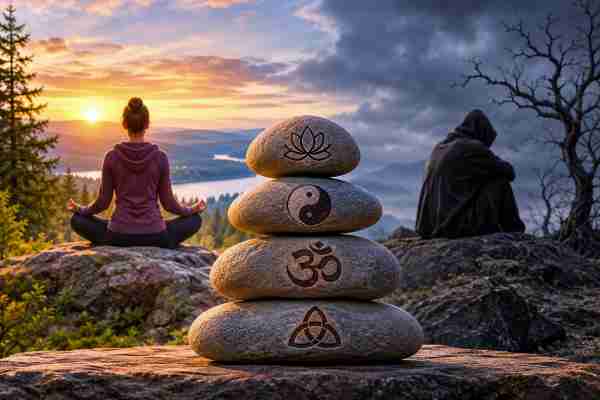
Most people already operate from a set of principles. Most are inherited from culture, family, or belief systems—not chosen intentionally. We have a framework for guiding principles without religion. This provides a foundation of equitable, inclusive, and just moral precepts.

Rethinking Spiritual Gifts as Ancestral Inheritance

Rethinking Spiritual Gifts as Ancestral Inheritance

Most people have heard the phrase spiritual gifts. Every religion has a different definition, and most don’t make sense. Let’s explore another possibility. What if spiritual gifts are capacities of awareness? An intuitive intelligence that is our ancestral inheritance? That would change how we see these gifts.

How Mental Conditioning and Brainwashing Shape Beliefs

How Mental Conditioning and Brainwashing Shape Beliefs

Mental conditioning and brainwashing are tools for indoctrination. They are used to shape beliefs, identity, and behavior. Understanding how this process works helps expose the hidden influences behind it. Once you recognize the pattern, you begin to see it everywhere.

The Psychological Foundation of Belief Structures

The Psychological Foundation of Belief Structures

The psychological foundation of belief structures is a set of basic human needs. We want to feel safe and to belong. We want life to make sense and the world to be fair. These needs come before any story, church, or culture.

How the Narrative Mechanism Organizes Belief

How the Narrative Mechanism Organizes Belief

The narrative mechanism is the way the mind turns scattered facts into stories. Those stories give events a beginning, a middle, and an end. They explain why things happen and what we should value. Once a story takes hold, it organizes belief. It decides which ideas we accept and which ones we reject.

How Institutions Spread Beliefs and Defend Doctrine

How Institutions Spread Beliefs and Defend Doctrine

Institutions spread beliefs from one generation to the next. They also defend doctrine, the official version of what a group believes. Churches, schools, governments, and even families give beliefs a home. They decide what a belief means, teach it to newcomers, and reward those who go along.

How Belief Systems Shape Society

How Belief Systems Shape Society

Belief systems shape society in ways most people never notice. Shared beliefs turn into habits, habits turn into rules, and rules turn into laws. Over time, those beliefs shape the lives of everyone in a community, even people who never held them.

How The Self-Correction Mechanism Prevents Extremism

How The Self-Correction Mechanism Prevents Extremism

The self-correction mechanism is the way a belief system notices its own mistakes and fixes them. It prevents extremism from taking control of the system. Systems that have it can grow and change. Systems that lose it tend to harden, and over time they can drift toward extremism.

Faith Cannot Overcome Fear, But Facts Can

Faith Cannot Overcome Fear, But Facts Can

Faith cannot overcome fear, because it only trades one fear for another. Facts can overcome fear by shrinking the unknown and giving you solid ground to stand on. Once you see how fear works and how it is used against you, its hold on your thinking begins to loosen.