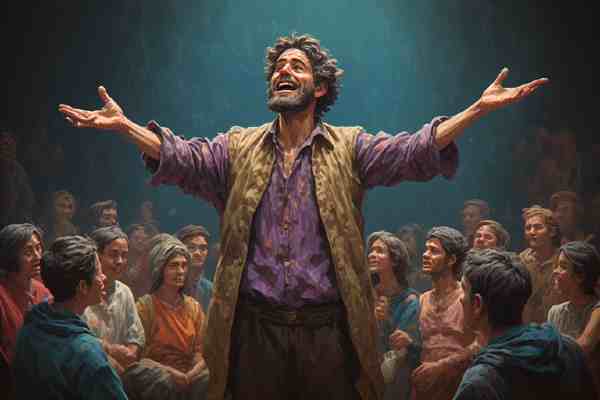
The narrative mechanism is the way the mind turns scattered facts into stories. Those stories give events a beginning, a middle, and an end. They explain why things happen and what we should value. Once a story takes hold, it organizes belief. It decides which ideas we accept and which ones we reject.
People do not take in the world as a pile of loose facts. We look for patterns, causes, and reasons. We want to know why something happened and what it means. Stories answer those questions, which is why they are one of the most powerful tools for shaping belief.
The sections below show how the narrative mechanism organizes belief. They also show how stories can quietly filter out facts that do not fit, and how they can grow into full systems of belief.
This is part of a series about how ideas take hold in the mind and shape culture. The last article looked at the human needs that make us open to certain ideas. Here, we look at how stories give those ideas a shape the mind can hold.
Each article in this series can be read on its own. But they make the most sense in order, from the inside of the mind out to the whole culture:
- Layers of Social Programming and Influence
- How Mental Conditioning and Brainwashing Shape Beliefs
- The Psychological Foundation of Belief Structures
- How the Narrative Mechanism Organizes Belief (This article)
- How Institutions Spread Beliefs and Defend Doctrine
- How Belief Systems Shape Society (This article)
- How the Self-Correction Mechanism Prevents Extremism
- How Memetic Transmission Shapes Culture
Emotional Readiness Gate:
This article examines how stories shape beliefs, group identity, and ideas about right and wrong. Some examples may challenge beliefs tied to your faith, family, culture, or political views. If you feel upset or defensive, pause and return when you feel steady enough to consider the ideas and evidence
Why the mind thinks in stories
The world can be messy and confusing. Things happen for many reasons at once, and often for no clear reason at all. The mind does not like that. It wants order. So it arranges events into stories, with a cause, an effect, and a reason behind them.
This is the narrative mechanism at work. A story turns a jumble of events into something that makes sense. It tells us who acted, why they acted, and how things turned out. Once we have a story, we feel we understand what happened. That feeling of understanding can be comforting, even when the story is wrong.
Triangles that told a story
How strong is this habit? A famous experiment from 1944 offers a surprising answer.
Two psychologists, Fritz Heider and Marianne Simmel, made a short animated film. It showed a large triangle, a small triangle, and a small circle moving in and around a box. That was all. There were no faces, no words, and no plot. Just shapes sliding across a screen.
Then they asked people to describe what they had seen. Almost no one described shapes moving. Instead, nearly everyone told a story. The big triangle was a bully. The small triangle and the circle were a couple trying to escape. The box was a house. People talked about fear, anger, and rescue, all from a few moving lines.
The film proves how deeply the narrative mechanism runs. We do not choose to see stories. Our minds build them automatically, even out of triangles. This automatic mechanism organizes belief. If we do that with shapes, imagine how quickly we do it with real people, real events, and real beliefs.
How stories help us remember
Stories are not only how we make sense of things. They are also how we remember them.
In 1969, two researchers named Gordon Bower and Michal Clark gave people lists of words to memorize. One group simply studied the lists. The other group was told to link the words together into a story. Later, both groups were tested. The story group remembered about seven times as many words.
People have known this for thousands of years. Long before writing, people used stories to teach survival skills. Stories explained the seasons and taught right from wrong. A story is far easier to remember than a list of rules. That is why so many cultures teach their biggest lessons through myths and legends. A good story organizes belief in a way the mind can carry for a lifetime.
➡ For more, see: How Myth And Symbolic Stories Shape Culture
➡ For more, see: How Memetic Transmission Shapes Culture
When the story becomes the filter
The narrative mechanism helps us understand the world, but it can also mislead us. Once a story takes hold, we start to see new facts through it. The story stops being one way to explain events. It becomes the lens we use to judge everything else.
Bending facts to fit
When new information fits our story, it feels right. When it does not fit, it feels wrong, even when it is true. So we tend to accept facts that support the story and explain away facts that challenge it. Psychologists call this confirmation bias. This is the dark side of how the narrative mechanism organizes belief.
Over time, a story protected this way can become almost impossible to shake. It no longer has to match reality. It only has to match itself.
➡ For more, see: Reasoning Errors: How Bias And False Certainty Distort Belief
Setting the mood first
Strong stories often begin with a feeling. They stir up fear, awe, pride, or anger before they explain anything. That feeling prepares us to accept what comes next. A story that makes us afraid can feel true before we have had time to check it.
➡ For more, see: How Mental Conditioning and Brainwashing Shape Beliefs
Heroes and villains
The narrative mechanism sorts people into simple roles. Someone is the hero, someone is the villain, and the rest of us must pick a side. These roles make conflict easy to understand. They also make it easy to forget that real people are more complicated than any character.
➡ For more, see: Errors of Rigid Black-and-White Thinking and Moral Absolutism
How beliefs become ideologies
A single belief is like a single brick. An ideology is the whole building. It is a full set of shared beliefs. It explains how the world works, what is right and wrong, and what people should do. Stories are the mortar that holds those bricks together. This is the narrative mechanism working on a large scale.
Many belief systems are built from the same kinds of stories. Origin stories explain how the world or the group began. Moral stories show which actions are praised and which are punished. Stories about the past describe the group’s victories, struggles, and injuries. Stories about the future describe what is coming and what part the group will play.
These stories do more than explain the world. They tell people who they are. Some people tie their sense of self to a group’s story. For them, a challenge to the story feels like a challenge to them. The story of the group becomes the story of the self. At that point, a belief has become an ideology.
➡ For more, see: The Superstition Mechanism: How Myth Becomes Doctrine
Three stories belief systems tell
The narrative mechanism often organizes belief around three kinds of stories. They show up again and again in religions, nations, and political movements. Each one can bring people together. Each one can also be used to divide them.
The chosen-one story
In this story, a group believes it has a special place or mission in the world. In 1845, an American writer named John O’Sullivan gave one version of this story a name: Manifest Destiny. He wrote that the United States was meant by God to spread across the whole continent. The idea inspired many settlers. It was also used to justify taking land from Native American nations and going to war with Mexico.
A chosen-one story can build pride and unity. But when a group believes it is chosen, it can start to see others as less important.
The enemy story
In this story, an outside group is blamed for the problems a community faces. After Germany lost World War I in 1918, a false story spread through the country. It claimed that the army had not truly been beaten on the battlefield. Instead, it said Germany had been betrayed at home by politicians, socialists, and Jews. Historians call this the stab-in-the-back myth.
The story was untrue, but it gave angry and frightened people someone to blame. Adolf Hitler and the Nazis used it to build support. An enemy story gave them a ready-made target, with terrible results.
The salvation story
In this story, today’s problems will one day be solved. Often, it describes a lost golden age that the group will bring back, or a perfect future the group will build. Religious movements may promise a final day of justice. Political movements may promise a perfect society once their enemies are defeated.
A salvation story can give people hope in hard times. But when the promise is used to excuse any action needed to reach it, hope can turn dangerous.
These three stories often work together. A group is chosen. An enemy stands in its way. Victory will bring a better world. When you hear all three at once, it is worth paying close attention.
From story to doctrine
As a belief system grows, people begin to argue about what its stories really mean. Leaders and institutions step in to settle those arguments. They write the stories down in sacred texts, political documents, or official teachings. Over time, a living story becomes a fixed doctrine. It has an official meaning that members are expected to accept. Organized belief becomes authority.
Finding the story behind a belief
Most of the stories that shape our beliefs are invisible to us. We do not think of them as stories at all. We think of them as simply the way things are. Learning to notice the narrative mechanism at work is a powerful skill.
The next time you hear a strong claim, or feel a strong reaction, try asking a few questions:
- What story is this claim part of?
- Who is the hero, and who is the villain?
- What feeling did the story stir up before it explained anything?
- Which facts fit the story, and which ones did I explain away?
- How would the same events look if someone told a different story?
Stories are not the enemy. They help us learn, remember, and connect with one another. The goal is not to stop telling stories. It is to know when a story is doing our thinking for us.
➡ For more, see: Questioning the Cultural Narrative: The Invisible Operating System
➡ For more, see: A Healthy Skeptical Mindset: Cultivating Healthy Skepticism
What comes next
The narrative mechanism organizes belief into a shape the mind can hold. But for a belief to last across many generations, it needs more than a good story. It needs groups that organize it, teach it, and protect it. The next article in this series looks at how those groups work.
➡ For more, see: How Institutions Spread Beliefs and Defend Doctrine
References
- An Experimental Study of Apparent Behavior. Fritz Heider and Marianne Simmel, 1944.
- Narrative Stories as Mediators for Serial Learning. Gordon H. Bower and Michal C. Clark, 1969.
- Actual Minds, Possible Worlds. Jerome Bruner, 1986.
- The Storytelling Animal: How Stories Make Us Human. Jonathan Gottschall, 2012.
- Annexation. John L. O’Sullivan, United States Magazine and Democratic Review, 1845.
- The Coming of the Third Reich. Richard J. Evans, 2003.
- Myth. Encyclopaedia Britannica.
- Ideology. Encyclopaedia Britannica.
About this project
The Seeker Project 4 Spiritual Exploration (SP4SE) is a project of Americans In Alliance. The mission of SP4SE is spiritual education. The mission of Americans In Alliance is environmental conservancy. Click the links below to learn more and support our efforts.