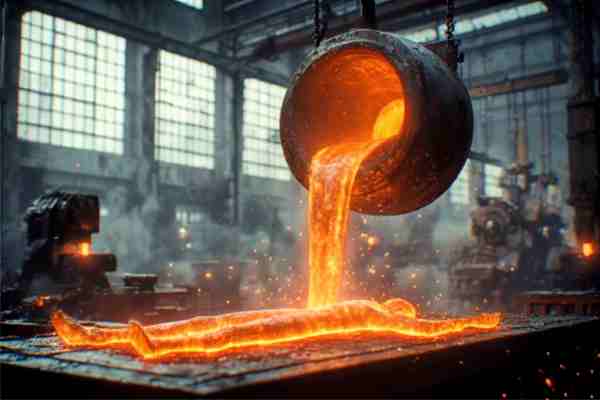
Spiritual alchemy sounds old-fashioned, but it describes something immediate: the fires of inner change. This is how a life breaks down and reorganizes under pressure. Stripped of its strange symbols, it becomes a clear picture of inner change as it actually happens.
Most writing on spiritual alchemy either worships the symbols or explains them to death. This article does neither. It treats alchemy as a working diagram of how the self breaks down, clears, and rebuilds. No costumes, no stages to pass, just patterns you can see from the inside.
You’ll find where these ideas came from, a corrected look at what mystic Evelyn Underhill actually wrote, the four fires of inner change, and a simple practice to use when your own life is in the furnace.
Emotional Readiness Gate:
This article examines periods of loss, uncertainty, major life transitions, identity disruption, and the challenges often described as the dark night of the soul. Reflecting on these experiences may bring up grief, fear, disappointment, confusion, or other strong emotional reactions. Emotional balance and stability can help you engage with these ideas thoughtfully and recognize your own experiences without becoming overwhelmed by them. Move at your own pace, and allow difficult life changes to be considered with patience, perspective, and self-compassion.
What spiritual alchemy really describes
For centuries, alchemists worked to turn lead into gold. They called this the Great Work. Their writings are full of furnaces, metals, dragons, and colors that change from black to white to red.
Historians such as Lawrence Principe point out that many alchemists were doing real chemistry, and their lab work helped lay the ground for modern science. But alongside the chemistry, many writers used the same images to describe something else: the transformation of a person.
Underhill and Jung
Two writers did the most to bring out that second meaning.
Evelyn Underhill (1875–1941) was an English writer whose 1911 book Mysticism became a classic study of mystics across many traditions. She grouped the symbols mystics use into three families: the pilgrim’s journey, the bond of love, and transmutation, the alchemist’s work of turning base metal into gold. For Underhill, the alchemist’s furnace was a picture of the soul being refined.
Psychiatrist Carl Jung went further. In Psychology and Alchemy (1944), he argued that alchemists were often projecting their own inner process onto the chemicals in their flasks. The stages of the Great Work, he believed, mapped onto the stages of psychological growth.
One useful way to read spiritual alchemy today comes from both of them:
- The fire is attention.
- The experiment is your life.
- The Great Work is the process by which the self is broken down, cleared, and reorganized.
The goal is not power or secret knowledge. It is a self that is less scattered and less driven by fear. The old symbols become reports from people who watched their own minds change. They are not instructions to copy. They are attempts to describe what it feels like when your usual story about yourself starts to crack.
➡ For more, see: Meditation Methods for Training Attention
Underhill’s coin and gold
Underhill saw that mystics in every faith were describing the same core experience in different languages. She put it this way in Mysticism:
Almost any religious system which fosters unearthly love is potentially a nursery for mystics: and Christianity, Islam, Brahmanism, and Buddhism each receives its most sublime interpretation at their hands. Attempts, however, to limit mystical truth—the direct apprehension of the Divine Substance—by the formula of any one religion, are as futile as the attempt to identify a precious metal with the die which converts it into current coin.
The dies which the mystics have used are many. Their peculiarities and excrescences are always interesting and sometimes highly significant. Some give a far sharper, more coherent, impression than others. The gold from which this diverse coinage is struck is always the same precious metal: always the same Beatific Vision of a Goodness, Truth, and Beauty which is one. Hence its substance must always be distinguished from the accidents under which we perceive it: for this substance has an absolute, and not a denominational, importance. — Evelyn Underhill
A die is the stamp that presses a design into metal to make a coin. Each religion is a different die. Each produces a different-looking coin. But the metal underneath is the same.
That is the idea worth keeping. The symbols are the coins. The change itself is the gold. You can spend a lifetime studying the designs stamped on the coins and never notice the metal.
The fires of inner change
The alchemists described their Great Work as a sequence of color changes: nigredo (blackening), albedo (whitening), and rubedo (reddening). Taken literally, it looks rigid. Read as spiritual alchemy, it names three moves found in any real change, plus a fourth that tests them.
You don’t pass through these once. You cycle through them as life demands. As you read, notice which fires feel familiar right now. The point isn’t to find your stage. It’s to see more clearly what is already happening in you.
First fire: breakdown (nigredo)
Nigredo is the darkening. Spiritual alchemy uses disintegration as a starting point. Inside, this is the moment your inherited story stops working. The role you were playing no longer fits, but you don’t have another one yet.
It feels like confusion or failure. The temptation is to patch the old story or to numb out. The alchemical move is different: stay with the breakdown long enough to see what was holding the old story together. What looked solid starts to show its seams.
In this sense, “purification” means letting go of what you had to keep believing to hold the old identity in place.
Second fire: clarification (albedo)
Albedo is the washing. Inside, this is the slow work of seeing what remains when the old story is no longer running the show.
In spiritual alchemy, clarity is where the turn begins. It isn’t always pleasant, and it rarely arrives all at once.
You begin to notice which desires hold up under honest attention and which fall apart. You see which fears belong to you and which were handed down. The mind clears not through belief, but through honesty.
This phase is quiet. It is sorting, not revelation. The danger is turning early clarity into a new doctrine.
➡ For more, see: The Core Process For Repairing Harmful Thinking, Beliefs, and Values
Third fire: integration (rubedo)
Rubedo is the return of color. Inside, this is when a new way of living starts to show up in small, concrete choices.
Integration in spiritual alchemy is like taking the pieces you sorted in the second fire and beginning to fit them together.
You speak more honestly. You refuse an old performance. You build one new habit that matches what you actually value. The “gold” is coherence, not perfection. What has changed is not only what you think, but what you no longer do.
Integration is not a finish line. It is a way of moving through the world with less inner conflict.
Fourth fire: testing (the dark night of the soul)
After integration comes testing. Life presses on the new pattern to see what holds and what collapses. Old habits reappear. New clarity wavers. You find yourself back in smaller versions of breakdown and clarification. That isn’t failure. The work is cyclical, and each return deepens the pattern instead of erasing it.
In the scheme of spiritual alchemy, the testing often comes unexpectedly. The clarity gained is tested in the real world. At this stage, the question is whether or not the puzzle you are building holds together under stress.
Underhill named this stage directly. Her own map of the mystic’s path has five stages: awakening, purification, illumination, the dark night of the soul, and union. The dark night comes after illumination. It is the painful period when the light seems to disappear, and everything gained feels lost. Underhill saw it as a necessary test, not a fall.
This fourth fire is repetition with awareness. The self steadies not by staying the same, but by learning how to reorganize without losing its center.
| Fire | What happens inside | Closest stage in Underhill |
|---|---|---|
| Breakdown (nigredo) | The old story stops working. | Awakening and purification |
| Clarification (albedo) | You sort what is real from what was inherited. | Illumination |
| Integration (rubedo) | New choices show up in daily life. | Union |
| Testing | Life presses on the new pattern, and old struggles return. | The dark night of the soul |
Underhill places the dark night before union. In daily life, the order is rarely that neat. Testing can come at any point, and it often returns after each new step forward.
A practice for any hard change
You don’t need a furnace to feel the heat of your own life. Relationships, work, failure, illness, and aging are the furnace. The practice is to stay present enough to see what they reveal. For example:
A relationship ends. You may discover how much of your identity was built around being needed, or around keeping someone else happy.
A job is lost. You may find that your sense of worth was tied to a title, and start asking what you value apart from it.
A plan fails. You may see which beliefs about yourself were assumptions you never tested, like “I always succeed if I try hard enough.”
An illness slows you down. You may notice which activities you did out of habit or fear, and which ones truly matter to you.
Aging changes your body or role. You may realize how much of your story depended on being young, strong, or in charge, and what remains when that shifts.
Each of these starts as a breakdown. Each can also lead to clarity, a new way of living, and a stronger center, if you stay present long enough to see what it shows you.
Questions to ask about life changes
When you are in the middle of a hard change, set aside 15 minutes once a week to write answers to three questions:
1. What is falling apart? Name the beliefs, roles, or habits that no longer hold. Don’t rush to replace them.
2. What is holding? Notice what survives the pressure: the values, relationships, and truths that are still standing.
3. What is quietly rebuilding? Look for small new choices, even tiny ones, that match who you are becoming.
Keep your answers together. After a month, read them in order. You will likely see the fires at work: breakdown, clearing, rebuilding, and testing, often more than once. Seeing the pattern makes the hard parts easier to bear, because you can recognize them as part of the process instead of proof that something is wrong.
➡ For more, see: Practicing Without an Agenda: Trusting the Process
Use the map without worshiping it
The more vivid the symbols, the easier it is to mistake them for a map you must follow. When that happens, the metaphor hardens. People start asking, “Which stage am I in?” instead of, “What is actually happening in me right now?” The language meant to free attention becomes another way to perform.
Use spiritual alchemy as a loose map, not a contract. When something falls apart, you can name it as breakdown and remember that it is part of the process. When things feel clearer but fragile, you can recognize the clarifying fire. When new patterns hold, you can see integration without imagining you are finished.
The key is to check the map against your experience. If a symbol helps you see more clearly, keep it. If it makes you perform, drop it. That is the modern mystic’s approach to every tradition: keep the gold, and hold the coins lightly.
Alchemy is only one map of inner change. Others, like the hero’s journey, the butterfly’s transformation, and the stories of rebirth found in many cultures, describe the same territory from different angles.
➡ For more, see: The Mystical Path: Becoming a Modern Mystic
➡ For more, see: The Hero’s Journey: Map for Inner Change
➡ For more, see: The Meaning We Project Onto Rebirth Symbols
Becoming more real
Used this way, spiritual alchemy becomes what it was always meant to be: a language for the quiet, radical work of becoming more real. It happens again and again, wherever life applies pressure.
Watch what falls apart. Watch what holds. Watch what quietly rebuilds. It is slower than any method and harder to fake, but it is the real Great Work.
References
- Mysticism: A Study in the Nature and Development of Man’s Spiritual Consciousness. Evelyn Underhill, Methuen, 1911.
- Practical Mysticism. Evelyn Underhill, J. M. Dent, 1914.
- The Essentials of Mysticism and Other Essays. Evelyn Underhill, J. M. Dent, 1920.
- Psychology and Alchemy. Carl G. Jung, Collected Works Vol. 12, Princeton University Press, 1953 (German edition 1944).
- Alchemical Studies. Carl G. Jung, Collected Works Vol. 13, Princeton University Press, 1967.
- The Archetypes and the Collective Unconscious. Carl G. Jung, Collected Works Vol. 9, Part 1, Princeton University Press, 1959.
- The Secrets of Alchemy. Lawrence M. Principe, University of Chicago Press, 2013.
About this project
Seeker Project 4 Spiritual Exploration (SP4SE) offers resources for exploring consciousness. It also helps with awareness and self-observation. It is a project of Americans In Alliance.
- Support SP4SE to help maintain and develop its educational resources.
- Visit Americans In Alliance to learn more about the parent organization.