Rebirth symbols carry old stories about endings, change, and return. Yet each of us brings memory, belief, fear, and hope to them. Learning to separate those layers helps reveal the meaning we project onto what we see.
Symbols are not empty when we meet them. A phoenix, butterfly, flame, or story of death and return already has a history. People have used these images for centuries to express ideas about loss, change, survival, and renewal.
Yet we do not receive those meanings like information printed on a label. Our minds mix what the symbol already carries with our own feelings and beliefs. This article looks at that meeting point so we can tell which meaning came with the symbol and which meaning came from us.
Inner Work Gate:
This article examines projection, inherited beliefs, and personal interpretation. It may bring familiar assumptions into question. Emotional stability should be established before engaging deeply.
The meaning we project onto rebirth symbols
When we look at a symbol, two kinds of meaning can meet at once. The first comes from the stories, customs, religions, and other uses that gave the symbol a history. The second comes from the person looking at it.
Think about a phoenix rising from ashes. Long before you see that image, the phoenix has already been tied to destruction, return, and renewal. You did not create those links. They are part of the story that has been passed forward.
What happens next is more personal. If you recently recovered from a hard time, you may see survival. If you are afraid of losing something important, the fire may stand out more than the bird that rises from it. Someone else may see hope, faith, freedom, or even a fantasy creature with no personal meaning at all.
The shared meaning and the meaning we project can blend so quickly that they feel like one thing. That is why we sometimes believe a meaning is built into a symbol when part of it actually came from our own mind.
This does not make personal meaning false or useless. It simply means that we should know where it came from. A symbol can carry a shared pattern while still allowing each person to respond to it in a different way.
➡ For more, see: The Sigil Symbolism Mechanisms of Symbolic Encoding.
One image, but different meanings
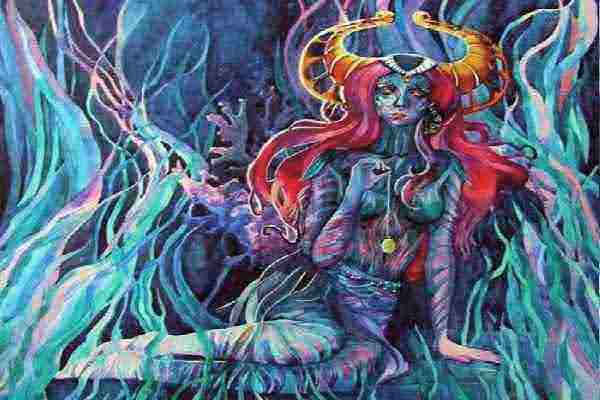
The feature image for this article gives us a good place to see this happen. Before thinking about what the picture was supposed to mean, what did you see?
Some people see a maiden sitting peacefully in the grass. Others see something threatening, perhaps a demon surrounded by blue flames. The picture has not changed between one viewer and the next, yet the meaning is different for two viewers.
Part of this comes from the image itself. Shapes, colors, shadows, faces, and familiar forms give the mind clues. The mind then tries to fit those clues into patterns it already knows. It may see a person, creature, threat, sacred figure, or something else that feels familiar.
Then our personal history joins the process. A color may remind us of a religious image from childhood. A face may resemble someone we trusted or feared. Flames may suggest danger to one person and spiritual power to another. A person looking for darkness might spot scary details first. In contrast, someone else might see beauty.
This is why the picture is useful. It allows us to catch interpretation while it is happening. Instead of assuming that our first impression must be what the picture actually means, we can ask where that meaning came from.
What came from the image, and what came from me?
That question does not require us to distrust everything we see. It simply helps us notice that seeing and interpreting happen together. The meaning we project onto what we see is shaped by the filter of our own conditioning.
What rebirth symbols already carry
Rebirth symbols have lasted because they give form to experiences people know well. Things end, and new things begin. People lose roles, homes, beliefs, relationships, and ways of seeing themselves. Sometimes they recover what was lost, while at other times they move forward as someone changed by the experience.
➡ For more, see: Examining Non-Negotiable Sacred Ground.
Stories turn those changes into images that are easier to picture and remember. The phoenix burns and returns. The butterfly leaves one form and appears in another. A person enters darkness and later comes back into light. Rituals may mark the end of one stage of life and the beginning of another.
Other traditions use ideas such as reincarnation, resurrection, ancestral return, or renewal. These are not all the same belief, and they should not be treated as though they tell one identical story. What they share is a concern with what happens when one condition ends and something else follows. This article uses the word rebirth in that broad sense, even though rebirth, renewal, and resurrection are distinct ideas.
The underlying pattern of collapse and return may arise from the way people process change. The specific images and associations attached to it are learned through stories, families, and cultures. That shared pattern can carry several familiar themes:
- an ending followed by a beginning;
- loss followed by return or recovery;
- a change in identity or role;
- renewal after hardship;
- continuity through change;
- movement from darkness toward light; and
- leaving an old condition and entering a new one.
These themes give rebirth symbols a background before we ever make them personal. The larger study of rebirth, renewal, resurrection, and the belief maps built around them belongs in its own article.
➡ For more, see: Belief Maps and Archetypes of Rebirth, Renewal, and Resurrection.
The phoenix: what the symbol carries and what we add
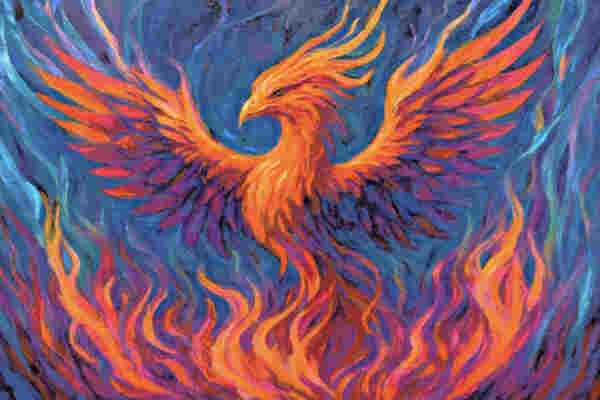
The phoenix makes the difference between shared and personal meaning easy to see because the version most people know is so clear. Fire destroys the old form, ashes remain, and the phoenix rises again.
In Thus Spoke Zarathustra, Friedrich Nietzsche wrote:
You must be ready to burn yourself in your own flame. How could you become new if you haven’t first become ashes?
People often connect that idea with the phoenix because both use destruction as an image for change. Yet even here, the symbol does not tell every person what kind of change to imagine.
Someone recovering from a painful loss may see the phoenix as survival. A person leaving an old way of life may see freedom, while someone starting over after failure may see another chance. For a person who fears change, the flames may carry more emotional weight than the return.
The phoenix’s own history shows how much meaning gets added over time. In the earliest Greek and Latin accounts, the phoenix does not burn at all. Herodotus describes a bird that carries its father’s body to the temple of the sun at Heliopolis in Egypt. Ovid describes a phoenix that builds a nest of spices and dies, after which a young phoenix rises from its body. The fiery death most people picture today was added later. Some scholars also connect the Greek phoenix with the Egyptian bennu bird, which was linked with the sun and renewal.
The Chinese fenghuang shows the same process from another direction. It is often called a phoenix in English, but it is not a bird of death and rebirth. It was traditionally linked with harmony, virtue, and good fortune. The rebirth connection came largely through translation, not from the Chinese tradition itself. A familiar meaning was carried over to an unfamiliar symbol, which is the same kind of projection this article describes.
Modern stories can add still more layers. In the Harry Potter stories, for example, the phoenix is not only linked with return. It also becomes a healing and protective companion. The older pattern has not vanished, but the newer story gives it another emotional role.
This is one reason rebirth symbols can survive for so long. They have enough shared meaning to remain familiar. Yet, many rebirth symbols have enough room for new cultures and new people to add something of their own.
The phoenix brings the pattern of destruction and return. The meaning we project helps decide whether that pattern feels like hope, danger, freedom, loss, healing, or something else.
The butterfly: the same distinction in another form
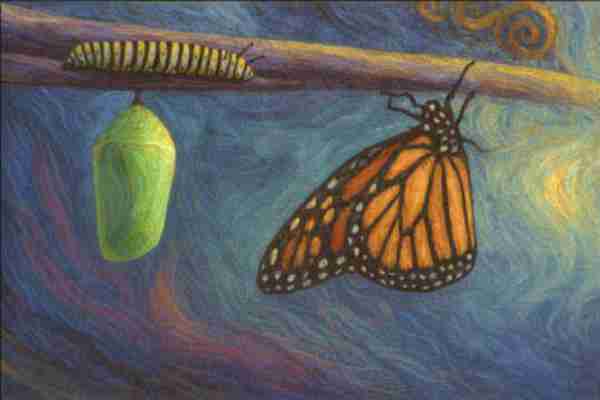
The butterfly gives us a quieter image of change. Unlike the phoenix, it does not burn in a dramatic act of destruction. Its change takes place largely out of sight.
A caterpillar enters the chrysalis, disappears from view, and later emerges in another form. Because of that life cycle, the butterfly has become strongly linked with transformation. Yet the basic pattern still leaves room for many personal meanings.
A person facing a private struggle might focus on the chrysalis. Others can see the change, but they miss what happens in between. A person who has waited a long time for change may see patience, while another may focus on freedom when the butterfly finally flies.
Someone else may see beauty, growth, fragility, or simply a remarkable part of nature. The biological event has not changed, but the meaning given to it has.
That difference matters because the butterfly does not need one fixed personal message to remain one of the best rebirth symbols. Its life cycle gives us a pattern of change, while our own lives affect which part of that pattern speaks most strongly to us.
The full transformation process of the butterfly has its own structure and deserves a separate explanation.
➡ For more, see: Butterfly Transformation Process, Symbolism, and Change Mechanism.
Other rebirth images work the same way
Fire is a common symbol of rebirth and change. It destroys one form but creates space for something new. Yet fire does not have one meaning in every setting. It can signal danger, warmth, cleansing, anger, divine presence, destruction, or renewal. The meaning changes with the story and the viewer.
Ashes work in much the same way. They are what remains after something has burned, so they can seem like an ending. At the same time, a phoenix rising from ashes turns them into the starting point for something new. A person who just lost something may see that image differently than someone ready to start anew.
Darkness and light carry many layers too. A journey into darkness can suggest fear, grief, confusion, mystery, rest, or the unknown. Coming into light may suggest safety, discovery, hope, awareness, or a return to life. The setting helps shape the meaning, but personal experience shapes it further.
Stories about death and return make the difference even clearer. A believer might see resurrection or reincarnation as a real event after death. Someone else might see the same story as a metaphor for shedding an old identity and starting anew.
The symbol alone does not settle that larger question. It gives people a pattern to work with, while belief and experience help shape the meaning they find in it.
How to tell what you are projecting
Projection is hard to notice because it usually does not feel like we are adding anything. We see the image, feel a reaction, and the meaning seems to arrive all at once.
A useful first step is to slow the process down. Look at what is actually present before deciding what it means. Then look at what you brought into the encounter.
Ask yourself:
- What can I actually see in the image or symbol?
- What meanings have stories or traditions already attached to it?
- What did I feel when I first saw it?
- Does it remind me of something from my own life?
- Are my religious, cultural, or family beliefs shaping my reaction?
- Am I connecting it with a recent fear, hope, loss, or change?
- Could another reasonable person see something different?
- Which part of the meaning came from the symbol, and which part came from me?
The goal is not to remove personal meaning. That would be impossible, and it would also take away one of the reasons symbols are useful. A symbol can help us notice feelings and ideas that are difficult to put into words.
The goal is simply to recognize our part in the process. Once we do that, our reaction becomes useful information about ourselves, not just a statement about the symbol.
Projection can make personal meaning feel universal
Some meanings become so familiar that they seem to belong naturally to the symbol. Perhaps we learned them as children in our families. Many learn them through religion. We see them in art or media. These same stories and symbols are repeated for years. By the time we are adults, we may no longer remember where the connection began.
This is how inherited meaning can start to feel inherent. We forget that the connection was learned, so it seems as though everyone should see the symbol the same way.
There is also a reason we hold on to these meanings so tightly. Endings are frightening, and a meaning that promises continuity can ease that fear. When a symbol has helped us through loss or change, questioning its meaning can feel like losing that comfort. Research on terror management theory suggests that shared beliefs and symbols help buffer the fear of death. This helps explain why people often defend them so strongly.
Rebirth beliefs show this clearly. Stories of reincarnation and resurrection can bring comfort. They help people think about life after death. They can also answer a deep wish for life or identity to continue after an ending.
Those beliefs are spiritually important. However, a rebirth symbol doesn’t show which view of death is correct. The symbol can show hope, fear, or faith. It also represents a way to think about continuity without deciding what comes after death.
The same caution applies to personal change. A person might see a phoenix and think it symbolizes spiritual awakening. This meaning aligns with their own journey. Another person may see recovery from grief, while another sees nothing spiritual in it at all.
Each response can be meaningful. The problem starts when we turn our own response into the only meaning the symbol is allowed to have.
When projection moves beyond symbols
The same process can happen when the thing in front of us is a person rather than an image. We notice a face, voice, manner, role, or behavior and connect it with patterns already stored in memory. We often judge a person quickly. Before learning much, we might sense if they are safe, dangerous, wise, weak, trustworthy, or threatening.
That topic goes beyond rebirth symbols. People aren’t just symbols. Our feelings toward them include memory, attachment, boundaries, and real actions. The basic warning is still useful here. Noticing when someone feels familiar is one thing, but assuming that familiarity tells us who they are is projection.
➡ For more, see: The Mirror Effect: The Hidden Meaning in Everyday Encounters.
The real value of rebirth symbols
Rebirth symbols do not need to give everyone the same message to be useful. Their strength comes from the way a shared pattern can meet a personal experience.
A phoenix can inspire one person to cope with loss and another to begin anew. A butterfly can give shape to a change that happened slowly and out of sight. Fire can help someone imagine an ending that opens space for something new. Darkness and light shape the journey from confusion to clarity.
These images can help us talk about experiences that are hard to explain in plain language. Loss can feel like a kind of death even when no one has died. Letting go of an old identity can feel like losing a piece of us. But moving forward can feel like coming back to life.
That does not mean every rebirth story is secretly about the same thing. Old symbols stay useful. This is because people still face endings, change, recovery, and new beginnings.
Their value becomes even greater when we learn to notice both sides of the exchange. We can honor a symbol’s history while also seeing the meaning we project from our own lives.
Neither side has to erase the other.
Conclusion
Rebirth symbols reach us through stories, beliefs, rituals, art, and culture, so they already carry meaning before we see them. The phoenix brings a story of destruction and return, while the butterfly brings a pattern of change that unfolds largely out of sight. Fire, ashes, darkness, light, death, and return carry histories of their own as well.
Yet those histories are only part of what happens when we meet a symbol. Our memories, beliefs, fears, hopes, losses, and desires affect what we notice and how the image feels. That is where the meaning we project enters the picture.
Instead of asking only what a rebirth symbol means, we can ask a better pair of questions: What did this symbol bring with it, and what did I bring to the symbol?
Keeping those two sources of meaning separate does not weaken symbolism. It lets us see more of what is really happening, both in the symbol and in ourselves.
References
- Man and His Symbols. Carl G. Jung (ed.), 1964.
- The Archetypes and the Collective Unconscious. Carl G. Jung, Collected Works, Vol. 9i, 1959.
- On the Psychology of the Unconscious. Carl G. Jung, 1917 (rev. 1943), in Two Essays on Analytical Psychology, Collected Works, Vol. 7.
- The Hero with a Thousand Faces. Joseph Campbell, 1949.
- The Interpretation of Dreams. Sigmund Freud, 1899.
- Thus Spoke Zarathustra. Friedrich Nietzsche, 1883–1885.
- The Phoenix: Its Nature and Its Place in the Religions of Antiquity. R. van den Broek, 1972.
- The Histories, Book II. Herodotus, c. 430 BCE.
- Metamorphoses, Book XV. Ovid, c. 8 CE.
- The Rorschach: A Comprehensive System, Vol. 1. John E. Exner Jr., 1974.
- Metamorphosis: On the Development of Affect, Perception, Attention, and Memory. Ernest G. Schachtel, 1959.
- The Symbolic Life: Miscellaneous Writings. Carl G. Jung, Collected Works, Vol. 18, 1976.
- Rapid and Dynamic Processing of Face Pareidolia in the Human Brain. Susan G. Wardle, Jessica Taubert, Lina Teichmann, and Chris I. Baker, Nature Communications, 2020.
- The Worm at the Core: On the Role of Death in Life. Sheldon Solomon, Jeff Greenberg, and Tom Pyszczynski, 2015.
About this project
The Seeker Project 4 Spiritual Exploration (SP4SE) is a project of Americans In Alliance. The mission of SP4SE is spiritual education. The mission of Americans In Alliance is environmental conservancy. Click the links below to learn more and support our efforts.