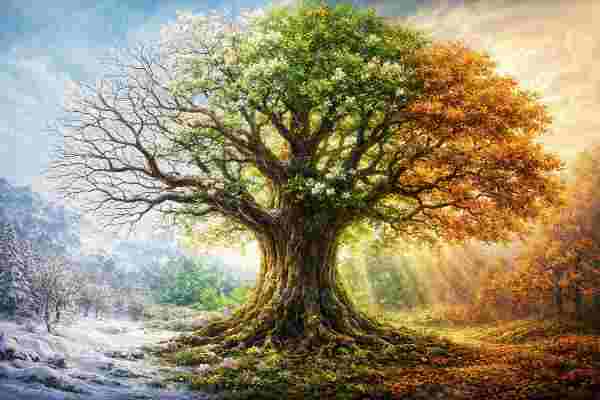
Many cultures see something sacred in trees. Their roots, trunks, and branches form a natural map of life. This article explores the spiritual symbolism of trees in myth and religion. It also looks at how trees help us picture our inner world.
In the city of Anuradhapura, Sri Lanka, a fig tree has been tended for more than 2,000 years. It grew from a cutting of the tree where the Buddha is said to have found enlightenment. Pilgrims still travel to sit beneath it. Few living things have been cared for so long by so many hands.
That tree is one example of something much older. Long before written history, people gathered under trees. They buried their dead near them and told stories about them. Trees were the largest and oldest living things most people ever saw. They seemed to stand between the earth below and the sky above.
The stories differ from one tradition to the next, but the shape stays the same. Roots below, a trunk in the middle, and branches above still help people make sense of growth, loss, and change.
How myth and religion shape tree symbolism
A tree’s shape tells a story without words. Its roots reach down into the dark, where we can’t see them. Its trunk rises through the world we live in. Its branches spread into the open sky. Many traditions read that shape as a picture of the whole world in three layers: below, here, and above.
The hidden part matters as much as the visible part. Roots draw water and food from places no one can see. Without them, the tree falls. That simple fact became a lesson. What is hidden supports what is seen.
Trees also outlast us. A Great Basin bristlecone pine in California, known as Methuselah, is more than 4,600 years old. It was already growing when the Great Pyramid of Egypt was built. A tree like that seems to hold memory. It links the people who planted or found it to the people who stand under it now.
A symbol becomes powerful when it holds several meanings at once. The tree links the body and the spirit, the person and the world, and the seen and the unseen. That is why it travels so easily from one culture to another through myth and religion.
➡ For more, see: The Sigil Symbolism Mechanisms of Symbolic Encoding
Psychologist Carl Jung called these shared patterns archetypes. They are forms of meaning that show up again and again, across people and cultures who never met. The tree is one of the clearest examples.
➡ For more, see: Belief Maps and Archetypes of Rebirth, Renewal, and Resurrection
What do trees reveal about the parts of life we cannot see?
The tree as a map of the inner self
Jung was so struck by tree imagery that he wrote a long essay about it, called “The Philosophical Tree.” Many of his patients painted or drew trees to express what they felt inside. They often did so without being asked. To Jung, the tree stood for the slow growth of the whole self over a lifetime.
Each part of the tree can stand for a part of your inner life:
- Roots: memory, family, and instinct, the things that feed you from below the surface.
- Trunk: your steady center, the sense of who you are.
- Branches: thought, imagination, and the ways you reach toward others.
- Leaves: moods and experiences that come and go.
- Fruit: what your growth gives to the people around you.
Seen this way, a tree is a picture of how the inner world is built. A deep root system lets a tree grow tall without falling over. In the same way, a steady inner life lets you stretch toward new ideas and people without losing yourself.
➡ For more, see: Strengthening The Mind-Body Connection Through Self-Awareness
If your inner life had roots, a trunk, and branches, where would you locate your growth?
The world tree across cultures
Many traditions describe a great tree at the center of everything. Scholars call it the world tree. Historian Mircea Eliade used another name for it, the axis mundi. That means “the axis of the world.” It is the line that joins the world below, the human world, and the heavens.
| Culture | Tree | Meaning |
|---|---|---|
| Norse | Yggdrasil | A giant ash that links all nine worlds |
| Maya | Ceiba | The axis joining the underworld, earth, and sky |
| Hindu | Ashvattha | An upside-down tree whose roots grow from the divine |
| Hebrew | Tree of Life | Life and wisdom at the center of the Garden of Eden |
| Irish | Crann Bethadh | A tribe’s sacred tree and the heart of its gathering place |
| African | Baobab | Survival, generosity, and a link to the ancestors |
| Haudenosaunee | Great Tree of Peace | Unity among nations, with roots spreading in four directions |
Yggdrasil, the Norse world tree
In Norse myth, Yggdrasil holds the nine worlds in its branches and roots. Three wise women called the Norns water it from a sacred well, so it never dies. In one poem, the god Odin hangs from the tree for nine nights to win the knowledge of the runes. The tree is both the frame of the universe and a place of hard-won wisdom.
The upside-down tree
The Bhagavad Gita describes the Ashvattha tree in a surprising way. Its roots grow above, in the divine, and its branches spread down into the world. The image turns the usual tree on its head. It says that the world we see grows from a source we can’t see. The Ashvattha is the sacred fig, the same kind of tree the Buddha sat under.
The Tree of Life
In the Book of Genesis, the Tree of Life stands in the center of the Garden of Eden. Later Jewish mystics drew their own Tree of Life as a map of how the divine flows into the world. The idea has lasted for thousands of years.
In Ireland, each tribe had a sacred tree, often at the place where its kings were crowned. In the year 982, a rival high king attacked one of these sites, called Magh Adhair. He cut down its sacred tree and dug up the roots. It was a deep insult, because the tree stood for the tribe’s strength and memory.
In parts of Africa, the baobab is also called the Tree of Life. It stores water in its huge trunk, gives food and shelter, and can live for more than a thousand years. Many stories describe it as a bridge between the living and their ancestors.
➡ For more, see: Rethinking Spiritual Gifts as Ancestral Inheritance
The Great Tree of Peace
The Haudenosaunee are also known as the Iroquois. They tell of a Peacemaker who united five warring nations. He planted a great white pine as a sign of their peace. In many tellings, the nations buried their weapons beneath it. Its white roots spread in four directions, so that others who wanted peace could follow them back to the tree. An eagle sits at the top, watching for danger.
Why do you think so many cultures turn to the tree when words fall short?
Trees as places of revelation
Trees are not only symbols. They are also places where important things happen.
The Buddha sat beneath a fig tree in Bodh Gaya, India, and vowed not to rise until he understood the cause of suffering. That tree became known as the Bodhi tree, the tree of awakening. In the Hebrew Bible, the prophet Deborah sat under a palm tree, and people came to her there for judgment. In the Quran, the Prophet Muhammad’s night journey reaches a lote tree at the edge of heaven. It marks the boundary beyond which no one may pass.
Trees have also served as everyday gathering places. In many West African villages, elders meet under a large shade tree to settle disputes and share news. It is sometimes called the palaver tree. A tree like that becomes a kind of outdoor temple, courtroom, and classroom all at once.
Seasons of change
A tree lives by seasons. Leaves appear, grow full, change color, and fall. Then, after a bare winter, they return. That cycle has long been used to describe the seasons of human life.
Transformation is not linear. It unfolds in phases, each with its own purpose.
Falling leaves don’t mean the tree is dying. The tree is letting go of what it no longer needs so it can survive the winter. Many traditions see the same lesson in human loss. Letting go can be part of growing, not the end of it.
➡ For more, see: The Meaning We Project Onto Rebirth Symbols
Which season of your own inner cycle are you living through right now?
Using the spiritual symbolism of trees for reflection
One of the most useful lessons a tree teaches is about wounds. A tree can’t repair damaged wood the way skin heals. Instead, it seals off the wound and grows new wood around it. Scientists call this compartmentalization. The scar stays, but the tree keeps growing, and the scar becomes part of its shape. Growth does not erase the past. It builds around it.
You can use the tree as a simple tool for reflection. Sit with a real tree if you can, or picture one clearly. Then move slowly from the ground up, asking one question at each part:
- Roots: What holds me steady right now?
- Trunk: What is the center I keep coming back to?
- Branches: Where am I reaching, and toward whom?
- Leaves: What am I ready to let go of?
- Fruit: What does my growth give to others?
Write down a short answer for each one. Come back to the same five questions a few months later and compare. Like rings in a tree trunk, the changes show how you have grown.
Conclusion
Trees endure, adapt, and renew themselves through every season. Their roots ground them, their branches reach outward, and their cycles keep them alive.
That is why so many cultures saw something sacred in them. The spiritual symbolism of trees gives people a way to picture the world, the self, and the slow work of change. When we look at a tree for meaning, we see more than nature. We see a picture of our own path. It is slow and patient, and it is always unfolding.
References
- The Archetypes and the Collective Unconscious. Carl G. Jung, 1959.
- Alchemical Studies, including “The Philosophical Tree.” Carl G. Jung, Collected Works Volume 13, 1967.
- Patterns in Comparative Religion. Mircea Eliade, 1958.
- The Tree of Life: Image for the Cosmos. Roger Cook, 1974.
- The Golden Bough: A Study in Magic and Religion. James George Frazer, 1890.
- A New Tree Biology. Alex L. Shigo, 1986.
- Tree Worship. Encyclopaedia Britannica.
- Yggdrasil. Encyclopaedia Britannica.
About this project
Seeker Project 4 Spiritual Exploration (SP4SE) offers resources for exploring consciousness. It also helps with awareness and self-observation. It is a project of Americans In Alliance.
- Support SP4SE to help maintain and develop its educational resources.
- Visit Americans In Alliance to learn more about the parent organization.