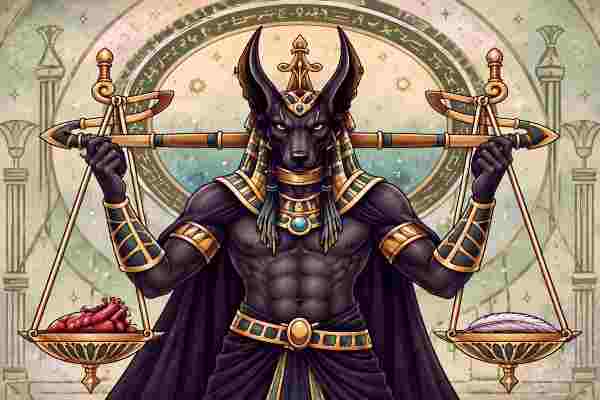
The process of weighing core moral values helps us determine what is right and wrong. We use this method to shape how we treat each other, the laws we pass, and what we teach our children. But where do core moral values come from? And how do we know which ones are good? The ancient Egyptians answered with a picture. They imagined a scale.
In their story, the jackal-headed god Anubis, pictured above, led the dead into the Hall of Judgment. There, he placed a person’s heart on one side of a great scale. On the other side sat a single feather. It belonged to Ma’at, the goddess of truth, justice, and balance.
A heart heavy with wrongdoing tipped the scale. A beast named Ammit waited beside it. She was part crocodile, part lion, and part hippopotamus, and she devoured the heavy heart. A heart that balanced with the feather passed on to the afterlife.
This article uses that scale as a guide. We will look at what goes on the scale, where our core moral values come from, and what tips the scale along the way. Then we will look at how to keep the scale honest.
Emotional Readiness Gate:
This article discusses moral values tied to religion, politics, family, and national identity. It covers divisive cases such as flag burning, the Equal Rights Amendment, extremist groups, and a shooting driven by a false online story. These subjects can bring up strong reactions, especially when they touch values you hold closely. Emotional balance helps you weigh the claims and examples fairly, so that reactions to them don’t override careful judgment.
What goes on the scale
Before the weighing, the dead had to speak. The Egyptian Book of the Dead gave them the words. In a section scholars call Spell 125, the dead stood before 42 judges. To each one, they declared a wrong they had not done.
“I have not stolen.”
“I have not killed.”
“I have not told lies.”
“I have not made anyone weep.”
Scholars call this the Negative Confession. Copies were written on papyrus and buried with the dead about 3,500 years ago. It is one of the oldest lists of core moral values we have. Honesty, fairness, and kindness were on it. Read it today, and most of it still sounds right.
That is the first clue. Some core moral values seem to last across thousands of years and very different cultures.
Values, morals, beliefs, and norms
These four words get mixed up, so it helps to pull them apart.
A value is something we care about, such as honesty, family, or freedom. A moral is a rule about right and wrong that grows from a value. If you value honesty, the moral is “Don’t lie.” A belief is something we accept as true, with or without proof. A norm is an unwritten rule about what people in a group usually do.
Core moral values sit at the center. They are the few values a person or a culture treats as most important. When two of them clash, the core ones usually win.
Beliefs and values work together. A belief about what is true often decides how a value gets used. Two people may both value safety. One believes a vaccine is dangerous. The other believes it saves lives. The same value leads them to opposite choices. That is why the last part of this article turns to facts.
The core moral values every culture shares
In 2019, a team of researchers at Oxford University set out to test an old idea. They wanted to know if any core moral values were truly universal. They studied written records from 60 societies around the world.
They found seven behaviors that every society they studied called good:
- Helping your family
- Helping your group
- Returning favors
- Being brave
- Respecting elders and leaders
- Dividing things fairly
- Respecting what belongs to others
Every one of these helps people cooperate. That may be why they show up everywhere. Groups that work together survive.
One rule shows up again and again in the world’s traditions. We call it the Golden Rule. Confucius taught, “What you do not wish for yourself, do not do to others.” The Jewish teacher Hillel said, “What is hateful to you, do not do to your neighbor.” Jesus said to treat others as you want to be treated. The Hindu epic the Mahabharata teaches the same idea.
These teachers lived in different places and times. Still, they put the same weight on the scale.
Where core moral values come from
If some values are shared everywhere, where do they start? The answer has two parts. Some roots are inside us from birth. Others are added by the world around us.
Roots we are born with
In 2003, two scientists named Sarah Brosnan and Frans de Waal ran a simple test with capuchin monkeys. Each monkey handed over a small rock to get a treat. At first, both monkeys got cucumber slices, and both were happy.
Then the scientists gave one monkey a grape instead. Monkeys like grapes much more than cucumbers. The monkey still getting cucumber grew angry. Some refused to take it. One threw the cucumber back at the scientist. The monkeys had a sense of fairness, and no one taught it to them.
Human babies show something similar. In 2007, researchers at Yale showed six-month-old babies a puppet show. A wooden toy tried to climb a hill. One puppet helped it up. Another pushed it down. Afterward, the babies were offered both puppets. Almost all of them reached for the helper.
These babies could not talk or walk. Yet they already seemed to prefer kindness. Fairness and caring may be part of our human starting point.
Roots that culture adds
We are born with a rough moral sense, but the world fills in the details. Families, faith groups, schools, laws, and the media all add weight to the scale. They teach us which values matter most and who deserves our care.
Children learn this by observation and then practicing it in play. When adults show empathy and fairness, children copy them. When adults show prejudice, children copy that, too.
The way these outside forces work is a multifaceted topic. It is covered in an eight-part series that begins with the article below. Each of the next seven articles explores one part in depth.
➡ For more, see: Layers of Social Programming Influence
Why we weigh values differently
If we share so many core moral values, why do good people disagree so much? Psychologist Jonathan Haidt spent years studying that question. He found that most people draw on six main core moral concerns:
- Care: protecting others from harm
- Fairness: treating people justly
- Loyalty: standing by your group
- Authority: respecting leaders and tradition
- Sanctity: keeping some things pure or sacred
- Liberty: freedom from control
Almost everyone cares about all six. The difference is how much weight each one gets. In his research, people on the political left leaned most on care and fairness. People on the right tended to spread their weight more evenly across all six.
Here is a real example. In 1984, a man named Gregory Lee Johnson burned an American flag in Dallas. He did it outside the Republican convention. Texas convicted him. In 1989, the Supreme Court ruled 5 to 4 that burning the flag is protected free speech.
People are still divided over that ruling. Those who weigh loyalty and sanctity most see flag burning as an attack on something sacred. Those who weigh liberty most see the ruling as freedom at work. Both sides are using their core moral values. They just load the scale differently.
Seeing this does not mean every view is equally right. It does mean that the people we disagree with are usually not monsters. Most of them are weighing core moral values we share, but in a different order.
➡ For more, see: Errors of Rigid Black-and-White Thinking and Moral Absolutism
When two good values collide
Some of the hardest choices are not between good and bad. They are between two core moral values. Honesty can clash with kindness. Loyalty to a friend can clash with fairness to a stranger.
In the 1950s, psychologist Lawrence Kohlberg asked people to solve a puzzle. He called it the Heinz dilemma. A woman is dying of cancer. A druggist in town has made a drug that might save her. It costs him $200 to make, but he charges $2,000. Her husband, Heinz, can raise only $1,000. The druggist refuses to lower the price. Should Heinz break in and steal the drug?
Kohlberg did not care much whether people said yes or no. He cared about why. Young children often said, “Don’t steal, or you’ll go to jail.” Older children and many adults said, “Stealing breaks the law, and laws keep order.” Some people reasoned from a deeper principle. They said, “A human life matters more than a druggist’s profit.”
Kohlberg saw these as stages of moral growth. First, we follow rules to avoid punishment. Then we follow them to fit in. Some people go on to reason from principles of their own.
Psychologist Carol Gilligan later pointed out a problem. Kohlberg’s early studies looked only at boys. When Gilligan listened to girls, she heard a different kind of reasoning. An eleven-year-old girl named Amy did not want Heinz to steal. She also did not want his wife to die. Instead, she asked whether Heinz could talk to the druggist or borrow the money. She was looking for a way to keep everyone connected.
Gilligan called this an ethic of care. It weighs relationships and responsibility, not just rules and rights. Both ways of thinking belong on the scale.
➡ For more, see: The Stages of Spiritual Maturity
What tips the scale
A scale is only as honest as the people who use it. In Egypt, the god Thoth stood by and wrote down the result. Everyone trusted the record.
In real life, people sometimes press a thumb on the scale. Core moral values like fairness and equality can be bent to serve power. When that happens, a society’s laws and institutions start to reflect the bent values.
When laws carry distorted values
Laws grow out of what a society values. When the values are healthy, laws protect rights and treat people equally. Public trust grows. When the values are distorted, laws can turn exclusion into policy. Rules start serving special interests instead of the common good.
➡ For more, see: How Belief Systems Shape Society
Religious institutions often claim the role of moral judge. Some use that power to shape laws that everyone must follow, believer or not.
➡ For more, see: The Social Cost and Systemic Harm of Organized Religion
The Fairness Doctrine
In 1949, the Federal Communications Commission created a policy called the Fairness Doctrine. It was a rule, not a law passed by Congress. It required radio and TV stations to cover important public issues. It also required them to air more than one side.
The idea was simple. The airwaves belonged to the public, so stations owed the public balance. In 1969, the Supreme Court upheld the rule.
In 1987, the FCC stopped enforcing it. The next year, Rush Limbaugh’s talk show went national. One-sided political talk radio grew fast. Stations no longer had to offer airtime to the other side. The FCC formally erased the rule in 2011.
The doctrine only ever covered broadcast stations that used public airwaves. It never applied to cable news. Still, its end changed how many Americans heard the news. One side of the scale no longer had to be shown.
➡ For more, see: Censorship and Media Regulation: Protection or Control?
The Equal Rights Amendment
In 1923, a women’s rights leader named Alice Paul wrote the Equal Rights Amendment. Its main line is short. It says equal rights under the law cannot be denied “on account of sex.”
Congress finally passed it in 1972. Then the states had to approve it. Three-fourths of them, or 38 states, needed to say yes. Thirty-five had done so by the deadline in 1982.
Opponents warned that the amendment would upset traditional roles for men and women. The campaign against it, led by activist Phyllis Schlafly, was built on those fears. It helped stall the amendment for decades.
Then the effort came back. Nevada approved it in 2017, and Illinois followed in 2018. In 2020, Virginia became the 38th state. But the National Archives records new amendments. It has said it cannot add the ERA because the deadline passed. The fight now rests with Congress and the courts.
The ERA story shows two sets of core moral values pulling against each other. One side weighs equality. The other weighs tradition. Over a full century, the scale has never quite settled.
Patriotism as a disguise
Some groups wrap harmful goals in the language of love for country. Many militias and patriot groups say they defend the nation and family values. They often cast racial minorities, immigrants, and LGBTQ people as threats.
The Oath Keepers called themselves defenders of the Constitution. In 2023, their founder, Stewart Rhodes, got 18 years in prison. He was found guilty of seditious conspiracy. The charge came from the attack on the U.S. Capitol on January 6, 2021. His sentence was commuted in 2025.
A flag can be held up as a symbol of values. It can also be used to hide what is really on the scale.
➡ For more, see: Are Freedom and Autonomy Possible When Extremists Rule?
How core moral values change
Core moral values can feel fixed, as if they were carved in stone. History shows they are not.
In 1958, Gallup asked Americans a question. Did they approve of marriage between Black and white people? Only 4 percent said yes. At the time, many states made such marriages a crime. In 1967, the Supreme Court struck those laws down in a case called Loving v. Virginia. By 2021, approval had climbed to 94 percent.
The underlying values did not change. People already believed in love, family, and fairness. What changed was who they applied those values to.
The philosopher Peter Singer calls this the expanding circle. Long ago, people cared mostly about their own family or tribe. Over time, the circle grew to include strangers, other nations, and other races. Some people now include animals and the earth itself.
What makes the circle grow? Often, it is contact. When people meet, work beside, and love people who are different, old fears lose their weight. Stories help, too. They let us feel what life is like for someone else.
➡ For more, see: Moving From A Tribal Mindset to A Universal Mindset
Keeping the scale honest
Our core moral values are only as good as the facts we weigh them with. False information is like a hidden weight. Often, it is what tips the scale without our knowing.
How small falsehoods grow
In 2016, a false story spread online. It claimed that a pizza restaurant in Washington, D.C., was hiding a crime ring run by powerful politicians. There was no truth to it. But the story was shared thousands of times.
In December of that year, a man drove from North Carolina to the restaurant. He walked in with a rifle and fired it inside. He told police he had come to “self-investigate” and rescue children. There were no children and no crime ring. The restaurant did not even have a basement.
The man believed he was doing something good. His values were not the problem. His facts were. A lie had put a false weight on his scale.
Signs of a credible source
Some sources earn more trust than others.
Universities and research centers usually follow clear methods. Their work is often checked by other experts before it is published. This is called peer review. It catches many mistakes, though not all of them. Money can still shape research. Big findings should be confirmed by other studies.
Government agencies publish data on health, the economy, and more. They usually follow legal standards for how they collect it.
Some news organizations have strong records for accuracy. The Associated Press, Reuters, and NPR are often cited as examples. They correct their mistakes in public.
Here is a quick guide:
| Source | Strengths | What to watch |
|---|---|---|
| Universities and research centers | Clear methods, expert oversight | Who paid for the study |
| Peer-reviewed journals | Checked by experts | Conflicts of interest |
| Trusted news outlets | Fact-checking, public corrections | How the story is framed |
| Social media and forums | Fast news | Rumors and fake accounts |
| Partisan or sensational sites | Strong emotion | Hidden motives, one-sided claims |
Watchdogs that rate the news
You do not have to judge every outlet on your own. Groups such as NewsGuard and Ad Fontes Media rate news sites for accuracy and bias. Fact-checkers such as PolitiFact and FactCheck.org test specific claims.
Court records can also show what an outlet got wrong. In 2023, Fox News paid $787.5 million to settle a lawsuit by Dominion Voting Systems. The suit was over false claims that Dominion’s machines changed votes in the 2020 election. A record like that is worth weighing the next time a source tells you what to believe.
Simple habits for checking claims
- Confirm big claims with two or three independent sources.
- Ask who made the content and who paid for it.
- Look for how the source reached its conclusion.
- Slow down when a story makes you angry or afraid.
- Be extra careful with stories that prove you were right all along.
➡ For more, see: A Healthy Skeptical Mindset: Cultivating Healthy Skepticism
➡ For more, see: Spotting Logical Fallacies: Avoiding Manipulation
The feather test
The Egyptians imagined one feather for every heart. You can use a feather of your own. Pick any core moral value you hold, and weigh it with three questions.
- Does it cause harm? Look at who gets hurt when people live by this value.
- Would it be fair if everyone lived by it? Would you still accept it if it were used on you?
- Does it hold up against the facts? Check whether the value rests on verifiable facts or on something you were told.
A value that passes all three is likely worth keeping. A value that fails one deserves a closer look. It may need changing, or it may need to be set down.
This test asks whether a value is good. Other tools ask whether it is truly yours, or how to put it into action.
➡ For more, see: The Cultural Values Test — Are Your Beliefs Really Your Own?
➡ For more, see: The Core Process For Repairing Harmful Thinking, Beliefs, and Values
➡ For more, see: Turn Positive Values Into Action
Final thoughts: a heart in balance
The Egyptians did not expect a perfect heart. They expected a balanced one. The Negative Confession was not a list of great deeds. It was a list of harms avoided.
Core moral values work the same way. We are born with a sense of fairness and care. Culture adds weight, sometimes wisely and sometimes not. Good people weigh the same values in different orders. Over time, the circle of who we care about can grow.
No one escapes the responsibility of weighing core moral values. Every day, our choices place something on the scale. The question is whether we decide what tips the scale, or let others press their thumbs down for us.
References
- The Egyptian Book of the Dead: The Book of Going Forth by Day. Raymond O. Faulkner (trans.), 1994.
- Is It Good to Cooperate? Testing the Theory of Morality-as-Cooperation in 60 Societies. Oliver Scott Curry, Daniel Austin Mullins, and Harvey Whitehouse, Current Anthropology, 2019.
- Monkeys Reject Unequal Pay. Sarah F. Brosnan and Frans B. M. de Waal, Nature, 2003.
- Social Evaluation by Preverbal Infants. J. Kiley Hamlin, Karen Wynn, and Paul Bloom, Nature, 2007.
- The Righteous Mind: Why Good People Are Divided by Politics and Religion. Jonathan Haidt, 2012.
- Texas v. Johnson, 491 U.S. 397. U.S. Supreme Court, 1989.
- The Philosophy of Moral Development. Lawrence Kohlberg, 1981.
- In a Different Voice: Psychological Theory and Women’s Development. Carol Gilligan, 1982.
- Fairness Doctrine: History and Constitutional Issues. Congressional Research Service, 2011.
- Red Lion Broadcasting Co. v. FCC, 395 U.S. 367. U.S. Supreme Court, 1969.
- The Equal Rights Amendment: Then and Now. Congressional Research Service.
- National Archives Statement on the Equal Rights Amendment. National Archives and Records Administration, 2024.
- Antigovernment Movement. Southern Poverty Law Center.
- Record High 94% of Americans Approve of Black-White Marriage. Gallup, 2021.
- Loving v. Virginia, 388 U.S. 1. U.S. Supreme Court, 1967.
- The Expanding Circle: Ethics, Evolution, and Moral Progress. Peter Singer, 1981.
- Political Polarization and Media Habits. Pew Research Center.
About this project
Seeker Project 4 Spiritual Exploration (SP4SE) offers resources for exploring consciousness. It also helps with awareness and self-observation. It is a project of Americans In Alliance.
- Support SP4SE to help maintain and develop its educational resources.
- Visit Americans In Alliance to learn more about the parent organization.