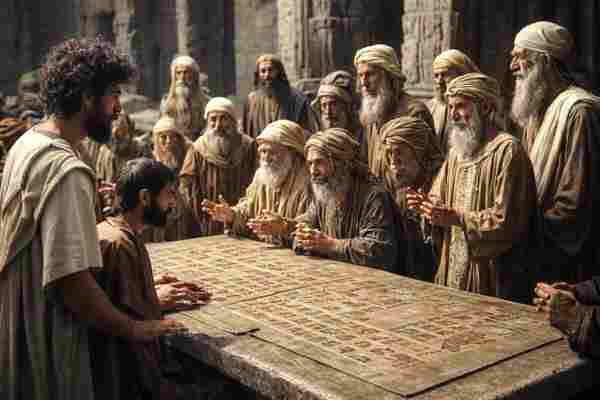
The rebranding of magic by religious authority is a lesson in institutional power. It shows how authority is centralized and preserved through structural control. This story becomes visible when we examine the history of the process.
If we are to clarify why an institution undertakes such a mission, we must separate myth from structure. To do this properly, we must examine the motives and tactics used in the rebranding of magic.
We begin by defining magic, then examine the history of religious consolidation and rebranding of magic. We show how the rebranding process is used to reshape ritual meaning to preserve authority.
This is part of a three-article series on ritual and magic. The first asks what a ritual says makes a result happen. The second looks at how ritual can shape meaning, thought, feeling, and action. The third examines how religious authorities renamed and controlled ritual practices, accepting some while condemning others.
1. Exploring The Ritual Causation Formula
2. The Ritual Mechanism: From Meaning to Action
3. The Rebranding of Magic by Religious Authority
Emotional Readiness Notice:
This article examines religious authority, persecution, forbidden beliefs, and the use of social and legal power to control ritual practices. These subjects may bring up anger, fear, grief, or strong reactions tied to religion or personal beliefs. Emotional balance can help you examine the history and evidence without those reactions getting in the way of careful judgment
The history of magic
The word magic carries more than one meaning, and confusion between them fuels much of its cultural controversy. What matters here is that practices which were called magic were already part of human culture. They existed before religious institutions drew firmer lines between accepted and forbidden ritual.
The word itself also changed. The root term magus first referred to a Persian priestly class. In Greek and Roman settings, related words slowly became tied to foreign ritual and unusual power. They also began to carry suspicion. By the late Roman and medieval periods, magic was more often linked with practices seen as unlawful, dangerous, or heretical.
That history shows why the label cannot be separated from the culture using it. A practice did not have to disappear when its name or status changed. Its place within religion could change while parts of the practice remained. Historically, magic has been understood as a supernatural transaction.
Clarifying Distinction: The ritual structure can stay the same, even if the reasons behind it change.
➡ For more, see: Exploring The Ritual Causation Formula.
Magic as a universal human practice
Ritual, symbolism, and intention are present in every civilization. There are signs of magical formulas and mechanisms in:
- Sumerian healing rites
- Egyptian funerary texts
- Vedic fire ceremonies
- Pre-Christian European festivals
They reveal structured symbolic actions aimed at bringing about change or transformation.
Before Western organized religion existed, communities had established cultural traditions, ceremonies, and rituals. Some cultures called on gods, spirits, ancestors, or other unseen powers. Others became customs passed from one generation to another. The concept of magic was not something apart from culture. It existed within the religious and social worlds of the people who practiced it.
Magic was an accepted part of the culture.
➡ For more, see: Ancient Mystery Religions and Abrahamic Traditions
The power of cultural narrative
Meaning is not neutral. Cultural and religious authority defines it. The establishment of Western theology was a turning point in human cultures. The Abrahamic religions of Christianity, Islam, and Judaism all compete for control of society. One of the tools they use is renaming or rebranding. History shows that the rebranding of magic was one of its primary objectives.
Once a label changes, it can also change how people see a practice. Calling something sacred, superstitious, heretical, or evil carries more than a description. It can affect how people respond to the ritual and to those who perform it.
A negative label could make certain teachings less acceptable to explore. It might raise suspicion about those who practiced them. It could also pressure others to stick to approved religious boundaries. Control over words could therefore become part of control over practice.
This helps explain why actions that look similar can receive very different treatment. One spoken formula may be accepted as prayer, while another is condemned as an incantation. One sacred object may belong within worship, while another is dismissed as a charm. The visible act matters, but the authority behind it and the cultural story around it can matter too.
Once that difference becomes accepted, the culture is no longer only describing two practices. It is deciding which one belongs inside accepted religious life.
Labels do not become taboo by accident. When practices challenge centralized religious authority, they are reframed as unacceptable. It works because:
- Reframing alters public perception
- Labeling limits intellectual exploration
- Association with evil creates social compliance
Control over terminology often precedes control over practice.
Religious authority and consolidation
As the Abrahamic empires grew, similar beliefs lessened the need for constant military force.
Religious authority through military might gave them the ability to rename and rebrand at will. They chose which magical and ritualistic practices were rebranded. This strengthened institutional control while minimizing resistance. Centralized belief systems provide administrative and social stability across vast territories.
The Roman Empire was the first to grasp the economy of scale that could be achieved by rebranding magic and its associated traditions. Early Christianity absorbed the “ancient mystery religions” of the Mediterranean region. The ritual forms were preserved while interpretive authority was rebranded. It is almost impossible to find any tradition, ritual, or practice that does not have precedents in these earlier cults.
This pattern of ritual absorption is acknowledged explicitly in early twentieth-century Catholic scholarship.
Symbolism in a greater or lesser degree is essential to every kind of external worship, and we need not shrink from the conclusion that in the matter of baptisms and washings, of genuflections and other acts of reverence, of lights and sweet-smelling incense, of flowers and white vestitures, of spiritual unctions and the imposing of hands, of sacrifice and the rite of the Communion banquet,
The Church has borrowed without hesitation from the common stock of significant actions known to all periods and to all nations.
In such matters as these, Christianity claims no monopoly or originality. ― The Catholic Encyclopedia and International Work, Vol. 14 (1907)
Borrowing ritual forms is common in religious history. What is significant is the later demonization of parallel practices outside religious authority.
The consolidation and rebranding of magic
The rebranding of magic by religious authority does not eliminate competing practices outright. It reframes them.
The rebranding begins by redefining terms. Practices that were once customary ceremonies are outlawed. They are relabeled as superstition, heresy, witchcraft, or pagan corruption. The structure of the ritual may remain intact, but its legitimacy is transferred.
Once a practice gained a negative moral meaning, religious authority could draw a tighter line around accepted ritual. Practices outside that line could be presented as false or dangerous. Sermons and public teaching could make the difference stronger. So could legal codes and punishment. What had once been part of a wider ritual world could now be divided between approved religion and forbidden practice.
This allowed absorption and suppression to happen at the same time. An institution could keep ritual forms it accepted while condemning practices tied to competing traditions. One version could become part of normal worship, while another became linked with magic, paganism, heresy, or forbidden practice.
This process operates in stages:
- Semantic shift: Neutral or respected terms acquire negative moral weight.
- Authority transfer: Ritual meaning is centralized under institutional interpretation.
- Boundary enforcement: Parallel practices are declared illegitimate or dangerous.
- Public reinforcement: Legal codes, sermons, and spectacle solidify the new framing.
Over time, these practices effectively hide the links to the original ancestors. The accepted form could come to look naturally religious, while the rejected form looked naturally magical. Later generations were then left with labels that seemed older and more fixed than they really were.
The merging and rebranding of magic allows for easy ritual absorption and ritual suppression to happen at the same time. Forms are preserved within authorized structures while alternative expressions are delegitimized.
Structural Observation: Large institutions often retain ritual forms while transferring interpretive authority. The history of religious consolidation is not over; it is an ongoing effort.
This pattern appears repeatedly across Mediterranean and Western religious history.
Demonization as a competitive strategy
When authority centralizes, alternative ritual systems become competitors. A common method of eliminating competition is semantic transformation.
The term “magic” did not begin as an accusation of evil. Nor did the term “the craft.” Over time, cultural institutions labeled these terms as evil and dangerous. They were described as heretical and morally corrupt. Those associated with them were labeled witches, sorcerers, or heretics.
Demonization serves multiple functions at once.
- Makes alternative ritual systems socially undesirable.
- Deters institutional members from exploring pre-Christian practices.
- Justifies prosecution and public punishment.
- Enables the confiscation of land, property, and economic assets.
Records from the Christian Inquisition document witch trials. These trials show how religious boundaries could become systems of enforcement. Claims of ritual wrongdoing or forbidden belief could lead to investigation and prosecution. Convictions could lead to prison, torture, execution, and loss of property. Public punishment showed what could happen. It warned people about crossing religious boundaries.
These punishments reached beyond the person being accused. Public prosecution strengthened the cultural story around approved and forbidden ritual. Once religious judgment became tied to law, the difference had effects far beyond a dispute over belief.
The history of religious consolidation often led to oppression and violence. Yet physical force was only part of the process. Language had already helped create the categories through which practices were judged. A culture might view one ritual as sacred and another as evil. This could make different treatments seem fair, even before comparing the practices.
Reclaiming the craft
The rebranding of magic is reversible.
The rebranding of magic did not end with medieval or early modern condemnation. Cultural language can change again. Words once used mainly to shame or condemn can later be reclaimed by people who choose them for themselves.
During the late twentieth century, popular culture helped bring the term the Craft back into everyday talk. The 1996 film The Craft was one clear example. Although dramatized, it placed the term inside a modern story about magical practice and personal identity. It no longer appeared only as an accusation tied to evil or forbidden religion.
Modern practitioners and spiritual communities have also reclaimed terms such as magic, witch, and the Craft. In these settings, the words can mean:
- Intentional ritual
- Nature cycles
- Symbolism
- Personal choice
- Modern spiritual identity
They are not always used with the meanings tied to them during periods of persecution.
Reclamation does not erase the older history. It changes the cultural setting in which the language is used. A term that was once an accusation can become a word people embrace. Older meanings can still exist alongside the new ones.
This later change shows how unstable these labels have always been. A word can move from priestly title to suspicion, then from suspicion to accusation. Later, it can move from accusation to chosen identity. Tracking those shifts shows how authority changes behind the label. This approach avoids seeing the label as a fixed description.
This history helps us see the structural comparison.
Conclusion
The rebranding of magic was an organizational necessity for the Abrahamic family of traditions. The rebranding of magic by religious authority eliminated competition and solidified their membership base.
These institutions could choose which practices they saw as sacred. They could decide which meanings were valid and which forms lay outside accepted religion.
Language gave those boundaries force. Words like magic, superstition, heresy, witchcraft, and paganism carried strong judgments. These shaped how people and their practices were treated. When those judgments became tied to legal and social power, the consequences could move far beyond a dispute over belief.
Yet the meanings were never fully fixed. Practices survived, labels changed, and some stigmatized terms were later reclaimed. What one period used as an accusation could become a chosen identity in another.
The central issue is not whether religion and magic are secretly the same. Their beliefs, histories, purposes, and explanations can differ greatly. The main question is who had the power to define these differences. It also involves deciding which rituals were accepted, absorbed, restricted, or condemned.
It is the changing religious authority that connects the history. Ritual traditions can survive even if their status shifts. This allows practices to be kept alive, gain new meanings, be suppressed, and later be reclaimed under different names.
References
- The Cambridge History of Magic and Witchcraft in the West: From Antiquity to the Present. Cambridge University Press.
- Ritual Boundaries: Magic and Differentiation in Late Antique Christianity. University of California Press.
- Magic in the Middle Ages. Cambridge University Press.
- The Rise of Magic in Early Medieval Europe. Princeton University Press.
- Magic in the Ancient Greek World. Wiley-Blackwell.
- The Oxford Handbook of Early Christian Ritual. Oxford University Press.
- Trafficking with Demons: Magic, Ritual, and Gender from Late Antiquity to 1000. Cornell University Press.
- The Making of the Abrahamic Religions in Late Antiquity. Oxford University Press.
- Christianizing the Roman Empire: A.D. 100–400. Yale University Press.
- The Oxford Handbook of Witchcraft in Early Modern Europe and Colonial America. Oxford University Press.
- The Witch-Hunt in Early Modern Europe. Routledge.
- The Catholic Encyclopedia and International Work, Vol. 14. Robert Appleton Company.
About this project
The Seeker Project 4 Spiritual Exploration (SP4SE) is a project of Americans In Alliance. The mission of SP4SE is spiritual education. The mission of Americans In Alliance is environmental conservancy. Click the links below to learn more and support our efforts.