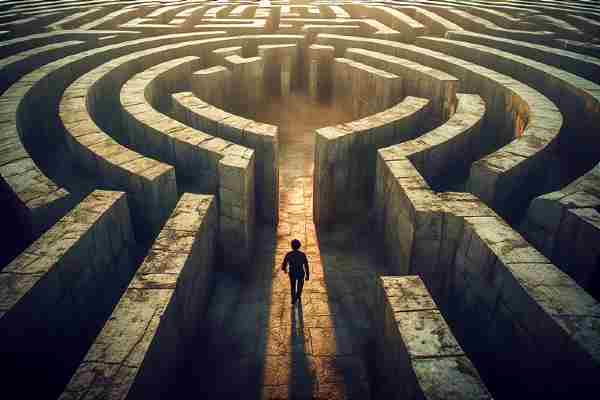
Labyrinth design is a pattern with meaning that has existed for thousands of years. It holds both inherited and personal meaning. People have used it in myth, ritual, pilgrimage, contemplation, and personal reflection.
Beneath the myths, rituals, and spiritual ideas is a real structure. It has an entrance, a winding path, a center, and often a route back out. Different cultures did not find one hidden message inside that structure. Instead, they found different ways to use the journey already built into it.
To see how the labyrinth pattern gained so much meaning, we have to begin where every walker begins: at the entrance to the path.
Emotional Readiness Notice:
Walking a labyrinth may bring up memories, feelings, personal questions, or thoughts about change and loss. Make sure you feel calm and steady before using the walk for personal reflection. If strong feelings begin to take over, pause the practice and return when you feel ready.
Walking the labyrinth pattern
Imagine standing beside a large labyrinth before you enter. From the outside, you may be able to see much of the design at once. You can watch the path bend around itself, move toward the center, turn away, and then circle back toward it.
Once you step inside, your view changes. You can no longer see the whole design at once. Instead, you see the path beneath your feet and the next turn ahead. The center may still be somewhere in sight, but now you have to follow the route to reach it.
This change from seeing to walking is one of the most important things about the labyrinth pattern. Many symbols can be viewed, carried, drawn, or displayed. A labyrinth can surround the person using it. Once someone steps inside, the pattern becomes a journey that must be followed one part at a time.
What makes a labyrinth a labyrinth
Labyrinths come in many forms, but several features appear again and again. There is usually an entrance, a boundary, a winding route, a series of turns, and a center. In many walkable labyrinths, reaching the center is only part of the experience because the path also leads outward again.
The route may bring the walker close to the center and then carry the path away. Another bend may change the direction before slowly leading inward again. From above, these movements are easy to see as parts of one design. Inside the labyrinth, they happen one after another as the person walks.
Because of this, the structure creates a simple order before anyone gives it a symbolic meaning. A person enters, moves through the turns, reaches a place inside, and then returns. That simple order changed the labyrinth into a meaningful pattern. Later stories and traditions could then build on this journey in many ways.
Where the word comes from
The origin of the word labyrinth is uncertain. A clay tablet from Knossos, written in the early Greek script known as Linear B, mentions a “labyrinthos.” This shows the word was already in use on Crete during the Bronze Age.
One long-standing theory links the word to labrys, a term for the double-axe, a symbol found at Minoan sites. Scholars still debate this connection. The word may also come from a language spoken in the region before Greek.
Labyrinth versus maze
The words labyrinth and maze have often been used for the same kind of structure. Today, however, a useful distinction is often made between them. A maze, sometimes called a multicursal design, usually has branches where the traveler must choose between several routes. Some of those choices may lead to dead ends.
A unicursal labyrinth has one continuous path. The route can twist and turn many times, but the walker does not need to solve it by choosing the correct branch. As long as the person stays on the path, the journey continues.
This changes what the walker pays attention to. In a maze, much of the attention goes toward finding the right way. In a one-path labyrinth, the person can pay more attention to the act of following the route.
This difference can make the labyrinth pattern useful when the goal is not to solve a puzzle. The winding path can guide someone through a longer experience without forcing the person to keep deciding which way to go.
Why walking changes the labyrinth pattern
A small labyrinth can be traced with the eyes or a finger in a few moments. A large one must be followed with the body. The walker must navigate every part of the route. This way, the labyrinth pattern transforms from something seen all at once into an experience that unfolds over time.
A center that looked close at the beginning may take much longer to reach than expected. One turn may seem to lead away from it, while another later brings the walker closer again. The person has to experience those changes instead of simply looking across the design and seeing where everything leads.
Walking also adds time, movement, attention, and the use of the body. These features allowed the labyrinth to become more than an image. It could become the setting for a story, a route used in ritual, or a path used for quiet thought. This is one way a simple design became a pattern with meaning.
The labyrinth in ancient story and history
One of the best-known labyrinth stories comes from Greek mythology. It tells of Theseus and the Minotaur, with the labyrinth forming the place where the main action happens.
The structure matters because it changes what Theseus has to do. He cannot simply walk up to the creature and fight it. He must enter the place that hides it, find his way through the winding route, and still have some way to get back out.
The Cretan labyrinth
According to the myth, King Minos had Daedalus build a labyrinth to hold the Minotaur. This creature was a fearsome mix of part man and part bull. Theseus entered the labyrinth to kill the creature. He knew that winning wouldn’t matter if he got trapped inside afterward.
Ariadne gave him a way to return. She provided a thread that Theseus could unwind as he moved inward. After facing the Minotaur, he could follow the thread back along the route he had already traveled.
The labyrinth gives each part of this story its importance. The hidden interior makes the Minotaur hard to reach, while the winding path makes Ariadne’s thread useful on the way back. What might have been a simple fight becomes a journey into danger and then back out again.
Later readers could find many meanings in that journey. The Minotaur could suggest danger, the thread could suggest guidance, and the return could suggest survival or escape. These meanings grew around the story, but they did not become a fixed code for every labyrinth.
What lasted was the strong link between the labyrinth pattern and the story. The pattern gave the myth a physical form, while the myth gave later generations a powerful way to imagine what might wait inside such a place.
➡ For More See: How Myth And Symbolic Stories Shape Culture.
Earlier labyrinth traditions
The Cretan story is one of the best-known labyrinth traditions in the Western world. However, labyrinth designs are not just tied to this myth. They appear in art, decoration, and built spaces across many times and places.
The oldest securely dated labyrinth drawing appears on a clay tablet from Pylos in Greece, from around 1200 BCE. Someone scratched the classic seven-circuit pattern onto the back of a palace record. Centuries later, coins from Knossos on Crete carried labyrinth designs, tying the pattern to the place the myth called home.
The Romans set labyrinths into floor mosaics in homes and public buildings across their empire, sometimes with Theseus and the Minotaur pictured at the center. Along the coasts of Scandinavia and the Baltic, people laid out walkable labyrinths in stone. Many of these are hard to date, and some may be medieval or later, but they show the pattern living on far from Crete.
The word could also be attached to buildings that did not follow the pattern at all. The Greek historian Herodotus described a vast Egyptian complex of rooms and courtyards, usually identified with a site at Hawara, and called it a labyrinth. By then, the name could suggest any place too complicated to understand at a glance.
Later, in medieval Europe, churches and cathedrals featured walkable labyrinths. Some were linked to religious ceremonies.
From architecture to ritual
A walkable labyrinth could give religious movement a clear form. Instead of crossing a space in a straight line, the person followed a winding route that made the journey longer and gave it a clear destination.
When labyrinths became part of churches and other religious spaces, the path itself could become part of the practice.
Medieval and cathedral labyrinths
Some medieval European churches and cathedrals included labyrinth patterns in their floors. When these designs were large enough to walk, people could experience the pattern with the whole body instead of only seeing it as an image.
The labyrinth at Chartres Cathedral is one of the best-known examples that still survives. Its long path winds across the floor before reaching the center.
In a place like this, the building and the path work together. The cathedral creates the larger religious setting, while the labyrinth gives the person a route through part of that space.
Historical research connects some French cathedral labyrinths with Easter ceremonies. The best-documented example comes from Auxerre Cathedral, where records describe clergy performing an Easter dance on the labyrinth while passing a ball among them. Today, Chartres opens its labyrinth for meditative walking and pilgrimage.
The medieval and modern uses are not the same, but both show how the pattern could become more than something viewed on the floor. People could physically take part in it.
➡ For More See: Spiritual Rites of Passage: Spiritual Transitions and Life Changes.
Why a center became so important
After following a winding route for some time, reaching the center can feel very different from simply seeing that point from outside. The walk has made the arrival feel important.
Stories and traditions could then decide what kind of importance the center would have. In the Cretan myth, danger waits inside the labyrinth. In a religious setting, the center could become a place for prayer. A modern walker might stop there with a private question or purpose in mind.
The center can work in all of these settings because its physical role is simple. It is a place the path leads toward. What happens there can change with the story, belief, or purpose that surrounds the walk.
This freedom helped the labyrinth remain a pattern with meaning even as its uses changed. People could keep the same basic structure while giving its center very different meanings.
Inherited and personal meaning
A person who sees a labyrinth today does not meet an empty pattern. Stories, religion, buildings, art, and modern spiritual practices have already shaped the way many people see it.
At the same time, no one enters with cultural history alone. Every walker also brings a personal history.
Meanings already attached to the labyrinth
Someone who knows Greek mythology may think of Theseus, the Minotaur, and Ariadne’s thread. A person who first saw a labyrinth in a church may connect it with prayer or pilgrimage. Someone else may know the pattern through gardens, meditation, books, or art.
These meanings have built up over time instead of replacing one another. People kept using the same basic pattern for new purposes, so the labyrinth could carry signs of several times and traditions at once.
This history gives the modern labyrinth a background before anyone takes the first step.
Meaning brought into the labyrinth
The personal layer begins with whatever the walker brings to the labyrinth. Someone may enter while facing a hard choice, grieving a loss, starting a new part of life, or simply wondering what it feels like to follow the path.
Because of this, the same labyrinth walk can become linked with very different experiences. A quiet pause at the center may stay in one person’s memory because of what was happening in life at that moment. Another person may enjoy the walk without giving it any deeper meaning.
Neither experience changes what the labyrinth meant in Greek myth or medieval religion. A walker’s personal associations grow beside the labyrinth’s older meanings. This is another reason the labyrinth can remain a pattern with meaning while still becoming part of a new life.
➡ For More See: The Meaning We Project Onto Rebirth Symbols.
Walking the labyrinth as contemplation
For a modern walker, the journey may begin with a prayer, a question, a memory, or nothing more than curiosity. On the path, everyday thoughts might linger. Attention shifts between the surroundings, the walk, and what was already on the person’s mind.
A one-path labyrinth doesn’t require constant choices about direction, so attention is free to settle elsewhere. Some walkers repeat a prayer. Others notice their breathing and footsteps, hold a question in mind, or simply watch their thoughts come and go as they walk.
Reaching the center can provide a natural place to pause before the walk turns outward. Sometimes nothing unusual happens there at all. The value may come from the time spent walking rather than from a dramatic moment at the center. The return also gives the person time to carry thoughts from the inward journey slowly back toward the entrance.
This gives prayer, meditation, reflection, remembrance, and personal ritual a simple physical frame. The labyrinth does not provide the answer or create the experience by itself. Instead, it gives the person a path and enough time to stay with whatever was brought into the walk.
The labyrinth as a model for a journey
The movement that made the labyrinth useful for myths and quiet thought also makes it a natural comparison for other journeys. Its winding route shows how a journey can keep moving forward even when progress does not follow a straight line.
The comparison works best when every part of the design is not forced to mean one thing. A certain turn does not have to stand for fear, and the center does not always have to stand for change. The labyrinth gives us a shape for thinking about a journey without becoming a full theory of how personal change happens.
➡ For More See: The Hero’s Journey: Map for Inner Change.
Labyrinths in dreams, stories, and imagination
A pattern used for so long in myth, buildings, and ritual eventually moved beyond physical places. Writers could place characters inside winding passages. Artists could use labyrinth forms to suggest mystery or a search. Games could turn hidden routes into challenges.
Similar images can also appear in dreams. Corridors, rooms, mazes, and paths get their meaning from the larger dream around them. A winding passage may feel frightening in one dream and welcoming in another because the image alone does not decide what it means.
The labyrinth pattern remains useful in imagination. It creates the feeling of moving through something that cannot be seen or understood all at once. Even if the walls are just in a story or dream, you can still feel the old experience. Entering, searching, and moving through an uncertain path remains familiar.
➡ For More See: Interpreting Dreams Using Personal Symbols, Patterns, and Meanings.
Why the labyrinth pattern still attracts people
Modern labyrinths appear in churches, gardens, retreat centers, parks, and other places. People still walk them for prayer, meditation, reflection, and remembrance. They also do it out of curiosity and for many other reasons.
The labyrinth pattern has many uses. Its long history means it never settled on one meaning. Greek myth shared a strong story. Religious traditions added their own uses. Today, walkers bring their questions and concerns from life.
What stays the same is the experience of entering a path and learning its shape from within. The route offers people a clear path. This helps them shape their experience without needing to define its meaning in advance.
This balance of clear form and open meaning has helped the labyrinth last. It has survived changes in culture, belief, and use. It has stayed meaningful because new uses can grow without erasing the original path.
Conclusion — a pattern with meaning
Many symbols remain outside us. We see them in pictures, read about them in stories, or place them in meaningful spaces. The labyrinth is different because a person can step inside the pattern and experience its shape through movement.
That simple feature connects much of its history. Myth used the labyrinth as the setting for a dangerous journey. Religious traditions placed walkable labyrinths inside sacred spaces. Later walkers found ways to use the same kind of path for quiet thought and personal reflection.
The meanings changed because the people using the labyrinth changed. The path stayed familiar enough to carry new stories without completely losing the older ones.
That is what makes the labyrinth a pattern with meaning. Its winding shape invites people on a journey. History, culture, and personal experiences shape what they discover along the way.
References
- Through the Labyrinth: Designs and Meanings over 5,000 Years. Hermann Kern. Prestel.
- The Idea of the Labyrinth from Classical Antiquity through the Middle Ages. Penelope Reed Doob. Cornell University Press.
- The Maze and the Warrior: Symbols in Architecture, Theology, and Music. Craig Wright. Harvard University Press.
- Labyrinth. George M. A. Hanfmann and B. C. Dietrich. Oxford Classical Dictionary.
- The Minotaur. Stephen M. Trzaskoma. The Oxford Handbook of Monsters in Classical Myth, edited by Debbie Felton, Oxford University Press.
- Into the Labyrinth. Nicholas Mee. Celestial Tapestry: The Warp and Weft of Art and Mathematics, Oxford University Press.
- The Labyrinth. Cathédrale Notre-Dame de Chartres.
- Labyrinths and Mazes: A Complete Guide to Magical Paths of the World. Jeff Saward. Lark Books.
- Mazes and Labyrinths: Their History and Development. W. H. Matthews. Dover Publications.
- The Labyrinth: Symbol of Fear, Rebirth, and Liberation. Helmut Jaskolski. Shambhala Publications.
- Walking a Sacred Path: Rediscovering the Labyrinth as a Spiritual Practice. Lauren Artress. Riverhead Books.
- A Unitary Caring Theory Perspective of Labyrinth Walking Research. Howard Karl Butcher. Nursing Science Quarterly.
About this project
The Seeker Project 4 Spiritual Exploration (SP4SE) is a project of Americans In Alliance. The mission of SP4SE is spiritual education. The mission of Americans In Alliance is environmental conservancy. Click the links below to learn more and support our efforts.