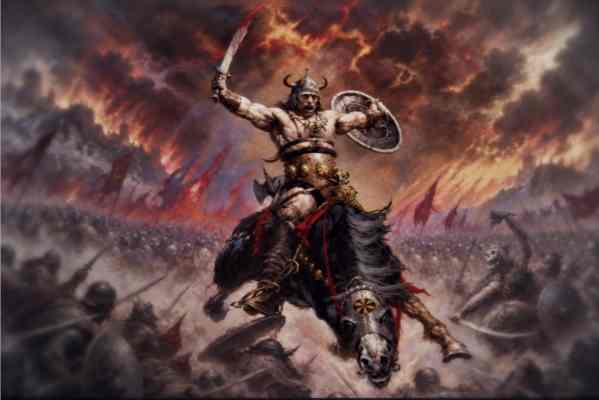
Myth and symbolic stories shape culture. They turn ideas, values, fears, and experiences into narratives that people can remember and share. Those stories pass from one generation to the next. They shape culture and carry its meaning forward.
Myth and symbolic stories can entertain, but they can also help people make sense of life, danger, loss, and hope. What a culture sees in those stories can reveal how its people see themselves and the world around them.
Myths are stories a group uses to explain life, the world, or itself. They often contain lessons about what people should value, or what dangers they should fear.
Symbolic stories represent people, places, or events as metaphors for ideas and concepts. They can be part of a myth or stand on their own. A journey can mean change, while a monster can stand for fear or danger.
How myth and symbolic stories shape culture
Imagine people gathered around a fire many generations ago. A traveler begins their journey by leaving home. They encounter danger and make mistakes throughout their adventure. After facing these challenges, they return home, but they are changed by their experiences. Listeners hear an adventure. They also see courage, fear, loyalty, greed, loss, and judgment in the choices people make.
This gives important ideas a form people can picture. Instead of explaining pride as an idea, the story can show a proud ruler whose choices bring disaster. Instead of giving a definition of courage, it demonstrates it. It follows someone who is afraid but still chooses to help another person.
As stories circulate among a group, the people and symbols in them gain meaning beyond the events. A journey can stand for change. A monster can stand for danger. A loyal friend represents trust. A big sacrifice shows what people value and want to protect.
Soon, these images become part of a shared language. People can connect them with things that happen in their own lives, while others around them know what those images mean.
Tools for cultural memory
Before writing became common, people had to depend much more on memory. A long explanation could easily be lost, while a story gave the listener a path to follow. Someone wanted something, faced a problem, made a choice, and then lived with what happened next.
Myth and symbolic stories help make the path and its lessons easy to remember. They fill it with vivid images, clear characters, repeated patterns, and emotional moments. A dangerous river could mark a hard crossing, while a dark forest could give fear or doubt a shape. A cruel ruler, a clever outsider, a faithful friend, or a frightened traveler each shows the listener choices that could teach a lesson.
Emotion also helped hold those events in memory. Fear made danger matter, while grief made loss harder to forget. Hope gave people a reason to care about how the story ended. Rhythm, repeated phrases, and familiar story patterns helped people remember what came next each time the story was told.
This is why myth and symbolic stories work as mnemonic memory devices. A mnemonic is something that helps us remember. Myths do this by putting large ideas into symbols, conflicts, and feelings that are easier to recall than a long list of lessons.
A storyteller might forget a name or add a new detail, but the main pattern could still survive. This enables myth and symbolic stories to move through families and communities for generations. They act like time machines, keeping the lessons that people believe are worth remembering.
The same advantage exists today. We can save huge amounts of information, yet people often remember the story around an idea long after they forget the list of facts that came with it.
➡ For More See: Cultural Building Blocks: The Circle, Campfire and Rhythm
What cultural memory carries
Once a story can survive, what it carries starts to matter. A culture shares more than facts through its stories. It also passes along ideas about how people should live and which choices deserve praise or blame.
A hero who protects someone weaker may show that courage and care deserve respect. Another hero may keep a promise even when doing so comes at a cost. A different story may praise the person who refuses to follow an unfair ruler. When listeners see those choices, they learn what their culture sees as honorable.
Villains and failures teach another side of the lesson. A selfish ruler may show the danger of greed, while a traitor can show what happens when trust is broken. Stories like these shape what a culture sees as good or evil. They also give meaning to success and failure, courage and fear, and honor and shame.
Those ideas are not the same in every culture. One group may see wealth and victory as success, while another values someone who loses it all but stays true to a promise. Stories place these values inside lives and choices, so they feel less like a list of rules and more like part of the world people know.
Symbolic stories also shape identity and belonging
The same symbolic stories can help people understand where they fit inside that world. A culture may admire the warrior, healer, parent, rebel, faithful servant, wise elder, seeker, or survivor. Each one gives people a picture of the kind of person they might become.
The symbolic stories often contain outsiders. They may appear as strangers, enemies, fools, traitors, or people who do not fit the accepted pattern. The way the story treats them can quietly teach who belongs inside the group and who is pushed outside it.
When these roles appear in myths and symbolic stories for many generations, they can become part of a culture’s value system. People might feel pride toward one kind of person but fear or distrust another without stopping to ask where those feelings began.
Stories about people with less power can tell us a great deal about a culture. If those people are often shown as weak, dangerous, foolish, or less worthy, the story may help keep old bias alive. Looking at how a culture talks about people with less power can show what it accepts and what it still needs to question.
How shared stories become part of everyday culture
A story gains more influence when it moves beyond the person who first tells it. A child might hear its values at home and then see the same values in religion, school, holidays, public ceremonies, and traditions. Each new setting makes the ideas more familiar.
How myth and symbolic stories become accepted beliefs
After enough repetition, people may no longer need to hear the original tale to know the idea behind it. A culture might expect good leaders to behave in certain ways. It may believe that successful people should live a certain kind of life. It may also assume that some roles belong to certain people.
At that point, the lesson has moved beyond memory and has started shaping belief and expectation.
Families help start this process because they pass along the stories they believe are important. Communities add customs and traditions. Institutions can then keep the same ideas alive on a much larger scale. Religious groups share sacred stories through rituals and worship. Schools repeat national tales, while governments use ceremonies and symbols to show what a country stands for.
As these ideas become part of everyday life, they can shape customs, social rules, and laws. People may no longer notice the stories that helped shape those customs, rules, and beliefs.
This larger process involves much more than myth. Family, authority, education, social pressure, identity, and the need to belong can all affect how ideas take hold.
➡ For more, see: How Mental Conditioning and Brainwashing Shape Beliefs
➡ For more, see: Mental Conditioning and Social Programming: Layers of Influence
Institutions can also do more than repeat beliefs. They may organize them, explain how people are supposed to understand them, and protect them when they are questioned.
➡ For more, see: The Role of Institutions: Create, Spread, and Defend Beliefs
Myth and symbolic stories become authority
Both myth and symbolic stories can share wisdom across generations, but they can also carry fear, prejudice, and past mistakes.
An old story may show another group as dangerous, dishonest, or less worthy. Long after the events behind that story are forgotten, people may still inherit the fear attached to it.
Stories can also make power seem right. A leader may claim to be carrying out a sacred mission or protecting the values of the group. An institution may use the same story to make its rules seem necessary. When power becomes part of a story people already trust, questioning that power can feel like turning against the group itself.
When myth density becomes a problem
Every culture has many stories, so having myths is not the problem. Myth density becomes a problem when more of those stories are seen as facts that cannot be questioned.
When that happens, a story can affect how real people are judged and treated. The meaning of the story and the truth of its events can also begin to blend together. Questioning it may feel like attacking the family, religion, nation, or group that protects it. Doubt may begin to look like betrayal.
A creation story can show how a group sees its place in the world, but it does not prove how the universe began. A story about death may help people face grief without proving what happens after death. A hero can teach courage even if that hero did not live exactly as the story says.
Keeping meaning and factual claims separate lets us ask both kinds of questions. We can explore what a story means while still asking for evidence when it makes a claim about the physical world.
When those questions get mixed together, myth and symbolic stories can turn into doctrine and become harder to question.
➡ For more, see: The Superstition Mechanism: How Myth Becomes Doctrine
Fear, sacred authority, loyalty, and the need to belong can make the problem even stronger when they are used to protect weak reasoning.
➡ For more, see: Religious Camouflage Hiding Illogical Thinking
Cultures reshape the stories they inherit
Cultural stories can survive for a long time even as the larger society changes. Later generations live in a different world, so they may notice things that earlier listeners did not question.
A ruler once known for strength may later be seen as cruel when people learn more about those who suffered under that rule. A character once treated as an outsider may gain importance when people notice that their voice was missing. A lesson that once valued obedience may look different after people see the harm unfair authority can cause.
Sometimes the plot stays almost the same while the meaning changes. A supernatural event once taken as literal may later be read as a symbol. An old story about punishment may become a lesson about the results of human choices.
Other stories fade away because their values no longer match what people want to support.
Sometimes an old story loses its hold before a new one takes its place. People may stop trusting the old explanation, while different stories compete to explain what is happening. These periods can be confusing because people no longer share the same story about who they are or where they are going.
Modern culture keeps creating myths
Modern life still creates myths and symbolic stories about what people should value, fear, admire, or hope for.
A large house and expensive car may become signs of success. A person who never stops working may be shown as more valuable than someone who lives a quieter life. A lone hero solving every problem can make doing everything alone seem better than teamwork. An ideal family image can suggest that happiness has only one shape.
Politics may describe nations through heroes, enemies, decline, rescue, or a lost golden age. Advertising may tie products to freedom, beauty, status, youth, or belonging. Social media can shrink a large story into a slogan, picture, meme, or short video.
Different groups may also tell very different stories about the same people and events. One group may see a leader as a hero while another sees the same person as a threat. One story may celebrate a nation’s progress, while another focuses on the people who paid the price.
Online platforms can make these differences stronger. They may show some stories more often than others, while different groups keep sharing the stories they already trust. Over time, people can end up living with very different pictures of the same world. This can make it harder for the groups to understand one another or agree on what is happening.
➡ For more, see: Challenging Distorted Historical Narratives and The National Folklore
References
- Myth: A Very Short Introduction. Oxford University Press.
- The Structural Study of Myth. The Journal of American Folklore.
- Cultural Memory and Early Civilization: Writing, Remembrance, and Political Imagination. Cambridge University Press.
- Memory in Oral Traditions: The Cognitive Psychology of Epic, Ballads, and Counting-Out Rhymes. Oxford University Press.
- Oral Tradition as History. University of Wisconsin Press.
- The Narrative Construction of Reality. Critical Inquiry.
- Cooperation and the Evolution of Hunter-Gatherer Storytelling. Nature Communications.
- Metaphors We Live By. University of Chicago Press.
- Religion as a Cultural System. The Interpretation of Cultures, Basic Books.
- The Invention of Tradition. Cambridge University Press.
- Imagined Communities: Reflections on the Origin and Spread of Nationalism. Verso.
- A Philosophy of Political Myth. Cambridge University Press.
Conclusion: deciding what culture carries forward
Every generation receives stories it did not create. The question is what deserves to keep traveling with them.
People can learn what myth and symbolic stories meant in the past. Then, look at what it carries now, and decide what is still worth telling to the next generation.
About this project
The Seeker Project 4 Spiritual Exploration (SP4SE) is a project of Americans In Alliance. The mission of SP4SE is spiritual education. The mission of Americans In Alliance is environmental conservancy. Click the links below to learn more and support our efforts.