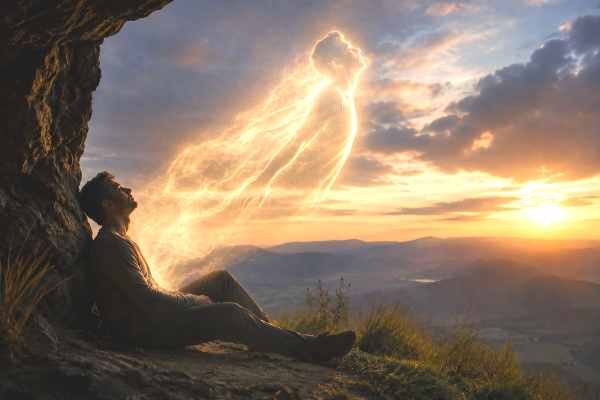
Does the soul exist? Investigating the existence of the human spirit or soul seeks the answer. The question lacks a simple answer. There are at least seven different ways to approach this subject. We will look at each to see how it helps illuminate this topic.
The idea of a human spirit or soul has followed us through history. Different cultures use different names and explanations for this aspect of human nature. Many traditions describe an inner essence that seems to be more than the physical body.
We do not make assumptions about whether the soul exists or not. Instead, we will look at seven ways people have investigated the question. Then we can see what each one can actually tell us about the existence of the human spirit or soul.
➡ For More See: Understand The Ego, Soul, and Self Through the Four Lenses.
Emotional Readiness Notice:
This article examines the possible existence of a human spirit or soul. It explores questions about consciousness, identity, death, and near-death experiences. It also looks at religious beliefs and personal meaning. These subjects may bring up fear, grief, uncertainty, or strong beliefs about what happens after death. Emotional balance is key. It helps us analyze evidence without letting our beliefs shape our views.
The existence of the human spirit or soul
Before looking for evidence, we need a simple idea of what we are looking for. The words human spirit and soul refer to the possible individual essence behind a human life. Many traditions believe this essence is more than the body and may continue after physical death.
That definition gives us a place to begin. It does not tell us whether the idea is true.
This matters because different kinds of support do not carry the same weight. A philosophical argument may show that something is possible. A personal experience may make it seem convincing. Science looks for evidence that can be observed and tested.
The question also matters because ideas about the human spirit or soul are tied to some of the deepest parts of human life. They shape how people think about identity, death, morality, meaning, and what may happen after the body dies. Even people who do not follow a religion may still wonder whether there is something about us that reaches beyond the physical body.
That helps explain why the question has lasted for so long. We are not only asking whether a soul exists. We are also asking what makes us who we are, what consciousness is, and whether anything about us continues after death.
The question is not simply whether something supports belief in a human spirit or soul. We also need to ask how much that support can actually establish.
➡ For More See: What is True: Weighing Truth by Faith and Truth By Fact.
The soul as the essence of life
The idea of a soul originally reached beyond the question of what happens after death. In many ancient traditions, the soul or spirit was also connected with life itself. It helped explain what made a living being aware, active, and different from something that was not alive.
The ancient Greeks sometimes described living beings as “ensouled.” In this sense, the soul was not only something that might survive death. It was also part of how people explained awareness, intention, and the experience of being alive.
Other traditions developed their own ideas about a life-force or inner essence. Some treated it as an individual part of a person, while others connected it with ancestors, nature, or a larger spiritual reality. These ideas were not all the same, but they show that the word soul has carried more than one meaning across history.
That wider background matters because this investigation is not limited to one religious idea of an immortal soul. It asks whether some part of human life or awareness may reach beyond what the physical body alone can explain.
Investigating the existence
A question this large is easier to explore from several directions. Each perspective below looks at the same mystery from a different position.
Philosophy asks what reason allows. Experience asks what people have lived through. Culture shows what ideas appear again and again. Science examines what can be measured and where questions remain. Inner awareness looks at experience from the inside. Logic tests the conclusions we draw. Symbols and stories reveal how people have pictured the human spirit or soul across time.
As we move through them, one question stays in view: What does this perspective actually support?
1. Philosophical evidence
For thousands of years, philosophers have asked about the human spirit. They have also wondered about the soul. The relationship between mind, body, and identity is difficult to explain.
One traditional answer is dualism. In simple terms, it says that the physical body and the mind, spirit, or soul may not be the same thing. The body changes throughout life, yet most people continue to experience themselves as the same person.
That raises a basic question. What creates this sense of a continuing self while so much else changes?
Plato described the soul as something that could exist apart from the body. Descartes argued that the thinking self was different from physical matter. Aquinas viewed the soul as the source of life and reason. Kant linked the soul to morality and the limits of reason’s proof.
Modern philosophy has kept the question alive in a different way. David Chalmers calls the mystery of subjective experience the “hard problem” of consciousness. Brain activity can be measured. However, this raises a key question: why do physical processes come with an inner experience? Chalmers doesn’t claim this proves a soul exists. It shows why questions about consciousness and a possible nonphysical self remain open.
These thinkers did not agree on what the human spirit or soul is. What they show is that questions about a nonphysical self did not come only from religion. They also grew from problems involving consciousness and identity.
Philosophy can help us see why the soul remains a reasonable subject for investigation. A sound argument, however, can show that an idea is possible without proving that the thing being described actually exists.
➡ For More See: Understand The Ego, Soul, and Self Through the Four Lenses.
2. Experiential evidence
For many people, belief in the human spirit or soul begins with an experience rather than an argument. People have also linked many other experiences with the idea of a human spirit or soul.
These include:
- Mystical states that bring a sense of peace, unity, or guidance
- Déjà vu and other unusual experiences of memory
- Psychedelic states involving unity, timelessness, or a deeper sense of self
- Intuition or a feeling of knowing without knowing why
- Synchronicities that seem unusually meaningful
- Personal changes that feel like discovering a truer self
- Love or compassion that seems to reach beyond self-interest
- Shamanic or other traditional inner journeys
The difficulty begins when we explain what happened.
A person might say, “I felt as though I left my body.” That describes the experience. Saying, “My soul left my body,” adds an explanation.
That explanation may be right, but other explanations may also be possible. The experience could involve changes in the brain, memory, perception, or a state of consciousness we do not fully understand. This does not make the experience meaningless. It means the experience and its cause need to be kept separate.
Personal experiences can therefore become important evidence to the person who has them. They can raise the question of whether consciousness goes beyond the body. However, they don’t have to answer it for everyone.
➡ For More See: Interpreting Non-ordinary Experience, Metaphysical and Unusual Events.
3. Cross-cultural evidence
Another clue comes from the number of cultures that developed some idea of a life-force, human spirit, or soul continuing inner essence.
Ancient Greek traditions used ideas such as psyche. Hindu traditions describe Atman. Many Indigenous traditions speak of spirits, ancestors, or life-force. The Abrahamic religions have beliefs about the human spirit or soul which mirror the ancient mystery religions.
➡ For More See: The Ancient Mystery Religions and The Abrahamic Traditions.
To see some of these differences more clearly, compare how several traditions describe the inner self:
| Culture or tradition | Term for soul | Key theme |
|---|---|---|
| Ancient Greece | Psyche | Life, awareness, and survival after death |
| Hindu traditions | Atman | Inner self linked to a greater reality |
| Indigenous traditions | Spirit/life-force | Connection with life, nature, and ancestors |
| Abrahamic faiths | Soul/spirit | Identity, judgment, salvation, and afterlife beliefs |
These traditions do not describe the same thing. Some teach that the human spirit or survives death. Others describe rebirth, resurrection, ancestral presence, or connection with a larger spiritual reality.
Still, the pattern is striking. People developed funerals, burial customs, prayers for the dead, and stories about what happens after life ends. Again and again, people imagined that something important about a person might remain after the body dies.
This widespread pattern does not prove that the human spirit or soul exists. It does show that the question reaches far beyond one religion or culture.
The recurring idea may reflect a shared human response to consciousness, identity, death, or the mystery of being alive. Whether those beliefs describe an outside reality remains open.
4. Scientific evidence
Science faces a unique challenge. No scientific method has directly measured the human spirit or soul. We can measure brain activity. This helps us see how changes in the brain affect memory, behavior, emotion, and awareness. This gives us strong evidence that the brain plays an important role in conscious life.
What remains difficult is explaining consciousness itself.
A brain scan can show what happens while someone sees a color, remembers an event, or feels pain. The measurement does not contain the private experience itself. We can observe the physical activity from outside, while the person experiences it from inside.
This gap has led to different theories.
Most scientific approaches connect consciousness closely with brain function. Some philosophical models ask if the brain shapes consciousness. They wonder if it filters it rather than creates it from nothing.
The brain-as-receiver idea is interesting, but it remains a model. It does not prove that consciousness comes from somewhere outside the body.
Claims involving energy or quantum physics have also been used to support belief in a soul. However, neither currently shows that personal consciousness survives death.
Science tells us a lot about the brain. However, it leaves some questions about consciousness open. Those unanswered questions keep the investigation open, but they are not scientific proof of the human spirit or soul.
➡ For More See: How Brain and Mind Functions Differ and How to Exercise Each.
➡ For More See: The Universal Mind as a Shared Field of Consciousness.
5. Inner awareness
Science usually studies consciousness from the outside. Inner awareness begins from the inside. Whatever you are experiencing right now is happening from your point of view. Thoughts, feelings, sensations, and memories can change. Still, you always feel like you are the one experiencing them. That continuing sense of “I” has often been connected with ideas of the human spirit or soul.
Our inner experience also has qualities that only we can directly know. We can measure brain activity while a person sees red, feels pain, hears music, or tastes something sweet. Yet the measurement does not contain the actual experience of redness, pain, music, or sweetness.
Philosophers call these private qualities of experience qualia. We know they exist because we experience them, but no one else can enter our awareness and experience them exactly as we do.
This raises an important question. If thoughts, feelings, and sensations keep changing, what is the part of us that experiences those changes? And why does physical brain activity come with a private inner experience at all?
Spiritual traditions may describe that deeper point of awareness as soul or spirit. Philosophy and psychology offer other explanations. Science looks for the brain processes involved.
The existence of conscious awareness is not in doubt. What remains uncertain is what that awareness is and whether it can exist apart from the physical brain. Inner awareness therefore gives us a real experience to investigate. It does not tell us which explanation is right.
➡ For More See: Meta-Awareness And Inner Observation.
6. Logical evidence
Logic helps us see where an observation ends, and an assumption begins. Consider the idea that every experience requires an experiencer. A thought is experienced. A feeling is experienced. Someone is aware that something is happening.
From there, however, we can take a much larger step and say that the experiencer must be an immortal human spirit or soul. That conclusion needs more support.
The same problem can work in the opposite direction. If we begin by assuming that only physical things can exist, we may decide that a soul is impossible before investigating it.
A fair inquiry cannot build the answer into its starting assumptions.
Logic helps by making those steps visible. It allows us to ask what we actually know, what we are inferring, and what remains uncertain. This is helpful when exploring the human spirit or soul. The topic blends personal experience, philosophy, religion, and science easily. A conclusion may sound strong even when one of its starting ideas has not been established.
Logic cannot answer the soul question by itself. It can help keep the investigation from reaching beyond the evidence.
➡ For More See: Investigating Religious Claims Using A Rational Framework
7. Symbolic evidence
The soul also appears throughout the stories humans tell about themselves.
Many cultures share tales of death and rebirth. They explore journeys through darkness and the return to light. These stories often describe the loss of an old identity and the discovery of a deeper self. Sacred texts, myths, poems, and modern stories show the same patterns. These patterns help people express their inner changes.
Symbols also carry these ideas. Light can stand for awareness or hope. Fire can suggest change or renewal. Water often appears with cleansing, rebirth, or a new beginning. Flight can represent freedom or release. Phrases like “dark night of the soul” and “finding the light” use strong images. They describe deep inner feelings.
These patterns show how much ideas about spirit and soul affect human thought. They reveal our deep views on the inner self. They reveal key insights about self-understanding. However, they do not prove that the human spirit or soul exists as a separate entity.
Stories and symbols show what people fear, hope for, and believe in themselves. Their value in this investigation is cultural and psychological rather than physical proof.
➡ For More See: How Myth And Symbolic Stories Shape Culture.
What the evidence can tell us
When the seven perspectives are placed together, they do not form one single proof. They provide different kinds of support.
Philosophy shows why a nonphysical self remains possible. Personal experience gives some people strong reasons to believe. Cross-cultural patterns show how widely the idea has appeared. Science reveals important facts about the brain and consciousness. But many questions remain unresolved.
Inner awareness gives us a direct way to explore these concepts without claiming more than that experience can support. Stories and symbols show how deeply the concept of the human spirit or soul has shaped the way humans understand themselves.
Taken together, these perspectives keep the question alive. What they do not do is turn possibility, personal conviction, or cultural importance into final proof.
That distinction is the central result of the investigation.
What remains unanswered
Investigating the existence of the human spirit or soul eventually brings us to the limits of what we currently know.
After looking at all seven perspectives, the central uncertainty remains. We have reasons to keep asking whether a human spirit or soul exists, but none of the approaches gives us a final answer.
At the same time, a lack of final proof does not establish that no soul exists.
The question remains open because several different possibilities still fit what we know.
Something can be possible because it has not been ruled out. It can appear plausible because there are reasons to consider it. It can be deeply meaningful because it shapes how people understand themselves and death. None of these is the same as verifiable proof.
We may eventually learn that consciousness is produced entirely by the brain. We may discover that the relationship between brain and awareness is more complex than that. We may even find that older ideas about spirit or soul were pointing toward something we do not yet know how to describe.
For now, investigating the existence of the human spirit or soul means keeping those possibilities open. We must weigh what we believe against what the evidence can support.
References
- Ancient Theories of Soul. Stanford Encyclopedia of Philosophy.
- Dualism. Stanford Encyclopedia of Philosophy.
- Personal Identity. Stanford Encyclopedia of Philosophy.
- Afterlife. Stanford Encyclopedia of Philosophy.
- The Neuroscience of Consciousness. Stanford Encyclopedia of Philosophy.
- Self-Consciousness. Stanford Encyclopedia of Philosophy.
- Facing Up to the Problem of Consciousness. Journal of Consciousness Studies.
- Multisensory Brain Mechanisms of Bodily Self-Consciousness. Nature Reviews Neuroscience.
- AWAreness During REsuscitation II. A Multi-Center Study of Consciousness and Awareness in Cardiac Arrest. Resuscitation.
- Consciousness and the Dying Brain. Anesthesiology.
- Near-Death Experience in Indigenous Religions. Oxford University Press.
- Building Bridges, Dissolving Boundaries. Toward a Methodology for the Ethnographic Study of the Afterlife, Mediumship, and Spiritual Beings. Journal of the American Academy of Religion.
About this project
The Seeker Project 4 Spiritual Exploration (SP4SE) is a project of Americans In Alliance. The mission of SP4SE is spiritual education. The mission of Americans In Alliance is environmental conservancy. Click the links below to learn more and support our efforts.