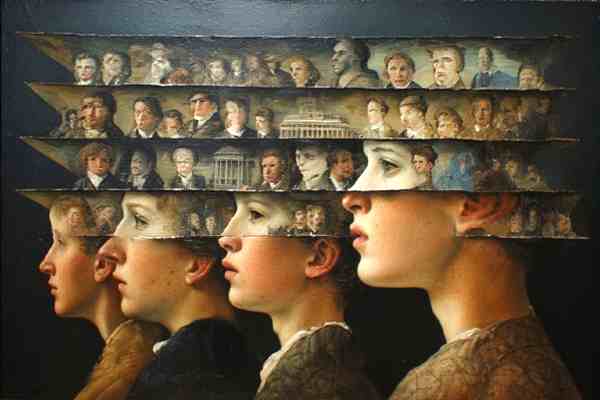
Our societies are built with layers of social programming and influence. These layers shape the world around us, determining what we think, value, and do. These layers of programming and influence build on one another. Once we can see these layers, we can choose our beliefs for ourselves.
No one grows up in empty space. From the day we are born, families, schools, faith groups, media, and friends teach us what is normal. Most of these lessons feel like plain common sense. That is what makes them so powerful. We rarely ask where they came from.
This article is the starting point for an eight-part series. The series follows how ideas take hold in the mind, grow into shared systems, and shape whole cultures. Here, you will find a map of the layers of programming and influence.
Each article in this series can be read on its own. But they make the most sense in order, from the inside of the mind out to the whole culture:
- Layers of Social Programming and Influence (this article)
- How Mental Conditioning and Brainwashing Shape Beliefs
- The Psychological Foundation of Belief Structures
- How the Narrative Mechanism Organizes Belief
- How Institutions Spread Beliefs and Defend Doctrine
- How Belief Systems Shape Society
- How the Self-Correction Mechanism Prevents Extremism
- How Memetic Transmission Shapes Culture
Each layer adds its own pull, from the needs inside us to the stories, groups, and media around us. Below, every layer gets a short look and a link to the article that explores it in depth.
Emotional Readiness Gate:
This article examines how family, culture, religion, and social groups shape beliefs. Some ideas may challenge beliefs tied to your faith, family, or identity. If you feel upset or defensive, pause and return when you feel steady enough to consider the ideas and evidence.
What’s behind Layers of social programming
Mental conditioning happens inside the individual. Social programming happens around the individual.
The layers of social programming and influence are the steady pressure of the world around us. It is not one message or one moment. It is thousands of small lessons, repeated over a lifetime, that teach us what is normal, what is right, and who we should be. We are so used to it that it becomes invisible unless we look for the layers intentionally.
Some of these lessons are spoken out loud. A parent says, “We don’t talk about that.” A teacher praises one kind of answer. A preacher warns about one kind of sin. Others are never spoken at all. We learn them by watching who gets respect, who gets laughed at, and who gets left out. Over time, the lessons stack up. They become the background of our lives, and we stop seeing them as lessons.
That is what makes the layers of social programming so powerful. Once a belief feels like common sense, we no longer test it. We simply live by it. Think of the choices we see as our own. Our views on faith, politics, family, and money are just a few. Many of them were shaped long before we made them.
This kind of conditioning is not always harmful. It teaches children manners, passes down useful skills, and holds communities together. But the same layers of influence can also spread fear, prejudice, and blind obedience. The process looks the same either way. What matters is how it is used, who benefits, and whether people are free to question it.
This article lays out those layers one at a time. First, it follows one familiar belief through every layer. You can watch the process work from start to finish. Then it shows why the layers are often studied apart. It shows how they link into a chain and where the pattern shows up in daily life. Each layer also points to the article in this series that explores it in depth.
One belief through layers of programming and influence
The easiest way to see the layers of influence is to follow one belief through all of them. Almost everyone knows this one: Santa Claus.
It is a gentle example, and that is the point. The same layers that carry harmful beliefs also carry harmless traditions. Watching them work on something as friendly as Santa makes them easier to spot everywhere else.
Layer 1: Mental conditioning
Mental conditioning is the process that places a belief in a single mind. It works through trust and repetition. When someone we trust tells us the same thing again and again, it starts to feel true.
Most children learn about Santa from the people they trust most. Parents, grandparents, and older siblings tell the story with total confidence. The lesson comes back every year, with letters, cookies, and stockings. A young child has no reason to doubt it. Trust plus repetition has done its work.
➡ For more, see: How Mental Conditioning and Brainwashing Shape Beliefs
Layer 2: Psychological needs
Psychological needs are the basic wants that make the mind open to certain ideas. We want to feel safe. We want to belong. We want life to have meaning and the world to be fair. A belief that meets these needs is easy to accept and hard to give up.
The Santa story meets several needs at once. It offers wonder and magic. It brings families together. It also promises that good behavior will be rewarded, which speaks to our need for a fair world. No wonder children hold on to it so tightly.
➡ For more, see: The Psychological Foundation of Belief Structures
Layer 3: Stories
Stories give beliefs a shape the mind can hold. They turn loose ideas into characters, places, and events. A story is easier to remember than a rule, and it tells us what to value without saying so directly.
Santa comes with a whole story. There is a workshop at the North Pole, a team of flying reindeer, and a list of who has been naughty or nice. The story grew out of a real person. Saint Nicholas was a bishop in what is now Turkey in the fourth century. He was remembered for secret gift-giving. Over many centuries, his legend grew into the Santa we know today. The story carries a lesson about generosity and good behavior inside it.
➡ For more, see: How the Narrative Mechanism Organizes Belief
Layer 4: Institutions
Institutions are organized groups that keep beliefs alive over time. Families, schools, churches, governments, and the media all count. They teach a belief to newcomers, and they defend it when it is questioned.
Families keep the Santa tradition going. So do schools, churches, stores, and newspapers. In 1897, an eight-year-old girl named Virginia O’Hanlon wrote to the New York Sun. Her friends said Santa was not real. The paper answered with a famous editorial: “Yes, Virginia, there is a Santa Claus.” An institution had stepped in to defend the belief. Its answer has been reprinted ever since.
➡ For more, see: How Institutions Spread Beliefs and Defend Doctrine
Layer 5: Society
This layer is where a shared belief moves out into daily life. It becomes customs, habits, laws, and expectations. At this point, the belief shapes the lives of everyone around it, even people who never held it.
Santa shows this clearly. A whole season of customs, spending, music, and movies now revolves around him. In 1955, a newspaper ad printed the wrong phone number. Children who called to reach Santa got a military air defense center instead. The officer on duty played along. That center is now called NORAD. Every Christmas Eve, it still tracks Santa’s flight for millions of children. A child’s belief had reached all the way into a military command center.
➡ For more, see: How Belief Systems Shape Society
Layer 6: Self-correction
Self-correction is a belief system’s ability to notice its own mistakes and fix them. Healthy systems allow questions and change when the evidence calls for it. Rigid systems treat questions as threats.
Here is where Santa is different from many beliefs. Most children figure out the truth on their own, often around the age of seven or eight. They notice that the handwriting on the gift tags looks familiar. They start asking questions, and most adults let the truth come out. The belief corrects itself, gently, almost every time. Many belief systems never allow that kind of honest questioning.
➡ For more, see: How the Self-Correction Mechanism Prevents Extremism
Layer 7: Transmission
Transmission is how a belief spreads from person to person and place to place. Stories, books, art, advertising, and now social media carry ideas far beyond where they began. The ideas that spread best are often the simplest and the most emotional.
The modern image of Santa spread this way. In 1823, a poem called “A Visit from St. Nicholas” gave him reindeer and a sleigh. Most credit the poem to Clement Clarke Moore. Some scholars think Henry Livingston Jr. wrote it. In the 1860s, cartoonist Thomas Nast drew Santa for Harper’s Weekly. In the 1930s, Coca-Cola ads helped make the plump, red-suited Santa the standard image around the world.
➡ For more, see: How Memetic Transmission Shapes Culture
Why the layers are usually studied in pieces
Many fields study the layers of social programming and influence, but each discipline usually looks at only one layer. Psychology studies how individuals form beliefs. Sociology studies how groups behave. Political science studies power and ideology. Education studies how people learn the rules of their culture.
Each field explains part of the process. But the pieces are rarely put together. The layers of social programming work together. Each layer strengthens the others. To understand it, we need to see all the layers of influence side by side. That is the purpose of this series.
How the layers of influence connect
The layers do not work alone. They form a chain, and each link makes the next one stronger:
- Conditioning plants the belief.
- Human needs make the belief welcome.
- Stories give it a shape the mind can hold.
- Institutions teach it and defend it.
- Society turns it into customs and laws.
- Self-correction tests it, or fails to.
- Transmission spreads it to new people.
Then the cycle starts again. New generations are conditioned, and the belief grows deeper roots.
Where this pattern appears
Social programming and influence is not limited to religion. The same layers of influence show up in many systems of ideas, including:
- national pride and patriotism
- political movements
- conspiracy theories
- cults and high-control groups
- advertising and brand loyalty
- family and cultural traditions
The beliefs differ, but the machinery is the same. Some systems use it to build trust and cooperation. Others use it to divide people and silence doubt. The difference usually comes down to one question. Can people question the system and correct it when it is wrong?
What comes next
Social programming and influence may be one of the most powerful forces in human life. It shapes what we believe long before we are old enough to question it. But once you can see the layers of influence, you can start to choose which beliefs to keep. The next article in this series begins at the first layer. It looks at how mental conditioning installs a belief in a single mind.
➡ For more, see: How Mental Conditioning and Brainwashing Shape Beliefs
References
- Saint Nicholas. Encyclopaedia Britannica.
- Santa Claus. Encyclopaedia Britannica.
- Is There a Santa Claus? Francis P. Church, The New York Sun, 1897.
- A Visit from St. Nicholas. Troy Sentinel, 1823.
- Santa Claus drawings. Thomas Nast, Harper’s Weekly, 1863–1886.
- NORAD Tracks Santa: History of the Program. North American Aerospace Defense Command.
- The Social Construction of Reality. Peter L. Berger and Thomas Luckmann, 1966.
- The Cognitive Science of Belief. Frontiers in Psychology.
- Truth Decay: An Initial Exploration of the Diminishing Role of Facts in Public Life. RAND Corporation, 2018.
About this project
The Seeker Project 4 Spiritual Exploration (SP4SE) is a project of Americans In Alliance. The mission of SP4SE is spiritual education. The mission of Americans In Alliance is environmental conservancy. Click the links below to learn more and support our efforts.