This article explains the significance of lunar phases and their meanings. It shows why the major and minor phases of the moon are important. Beyond their historical significance, knowing the phases could actually save your life.
Our modern culture tends to overlook our lunar partner, but we can’t deny the significant impact it has on our planet. Its gravitational pull affects the tides of the oceans and lakes to a lesser extent. Plus, it provides indirect light at night and several methods for measuring time.
The moon, by her comparative proximity, and the constantly varying appearances produced by her several phases, has always occupied a considerable share of the attention of the inhabitants of the Earth. — Jules Verne
The significance of lunar phases
The moon goes through different phases as it orbits around Earth, and each phase has its own special significance. The moon’s phases, from new to full, have fascinated people for centuries. Each phase, a mix of dark and light, sparks wonder and draws us to the night sky.
By understanding the major and minor phases, we become more in tune and connected with our environment. It helps us know when the tides will be high or low and when to plan outdoor activities in the evening for the best light.
Understanding the phases of the moon helps scientists and astronomers predict tidal patterns. The study of these phases and eclipses improves navigation and timekeeping methods. This knowledge also enhances our understanding of our lunar partner’s influence on Earth’s natural systems.
The lunar phases and their meanings
The moon has always been important to people all over the world. Cultures have given special meanings to their phases.
In ancient Egypt, the moon was linked to the gods Thoth and Khonsu. Thoth was the god of wisdom and writing, and Khonsu was the god of time and healing. The Greeks and Romans had goddesses for our lunar partner. The Greeks had Selene and Artemis, while the Romans had Luna and Diana. These goddesses were connected to hunting and nature.
In Hinduism, Chandra represents the moon and symbolizes time and fertility. The Jewish calendar is based on the moon, with each month starting on a new moon. Important holidays like Passover are set by the lunar cycle. In Chinese mythology, the moon goddess Chang’e lives on the moon with a Jade Rabbit. Native American tribes also have many stories about the moon, often involving creation and life cycles.
The moon’s phases have different meanings in various cultures. A new moon is often seen as an omen of new beginnings and setting goals. The full moon is a time of completion and celebration. Some cultures believe that the full moon can affect people’s behavior and emotions. The waxing and waning phases are times for growth and letting go.
These beliefs show how the moon has been a part of human life for thousands of years. People have looked to the moon for guidance, inspiration, and understanding of the world around them. The phases of the moon continue to be important in many cultural and religious practices today.
The major and minor phases
The most obvious question is, what causes these different phases or cycles? It’s all caused by the light reflected by the Moon in relation to the Earth. A phase is a snapshot of the light being reflected.
People who live in modern cities miss the subtle changes in light because their night sky is filled with artificial light.
So, the lunar phases are the individual stages of the moon’s appearance, while the moon cycle is the entire progression of these phases over a month. A moon cycle is a way we measure the moon’s orbit around the Earth. It takes the Moon 29.5 days to orbit the Earth.
We can see our lunar partner because it reflects sunlight. Sometimes, we only see a partial reflection because the Earth gets in the way.
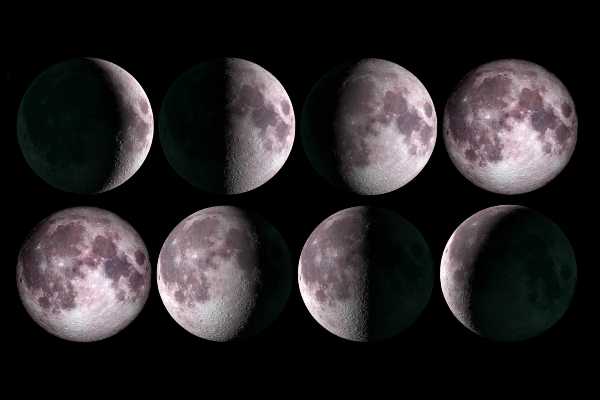
The phases of the moon
Major moon phases
1. New Moon occurs when the moon is between Earth and the Sun, and its illuminated side is facing away from us, making it invisible.
2. First Quarter happens when half of the moon is illuminated, and it appears as a half circle.
3. Full Moon is the most recognizable moon phase. This is when the entire face of the moon is illuminated, making it appear as a full circle.
4. Last Quarter occurs when half of the moon is illuminated, but the opposite half compared to the first quarter.
Minor moon phases
When the full moon gets smaller, this is waning, so it takes 14 days for our lunar partner to disappear; they call this point the new moon. Some people consider the full moon part of the waning cycle, but some see it as the waxing stage resolution.
Waxing means to increase, and there are approximately 14 days in the waxing cycle. When it is partially visible, waxing, or waning, it is called gibbous or less than a full circle.
The adjective gibbous is from the Latin noun gibbous, which means hump or humpbacked. In the 14th Century, the English described something less than a full circle. No one is sure how it got from meaning hump or bulging to less than half a circle is a mystery.
In the Southern Hemisphere, a waxing moon goes from left to right. It is the opposite in the Northern Hemisphere; it increases from right to left.
1. Waxing Crescent happens when the moon is increasing in illumination, visible as a thin crescent.
2. Waxing Gibbous occurs when more than half of the moon is illuminated, but it’s not yet full.
3. Waning Gibbous takes place after the full moon when the illumination decreases, but more than half is still visible.
4. Waning Crescent here, the moon continues to decrease in illumination, visible as a thin crescent before becoming a new moon again.
Different ways to measure the phases of the moon
There are several ways to measure the different phases of our lunar partner. These methods for calculating these cycles can involve intricate math, geometry, and astronomy.
The Draconic method has 27.212220815 days in a complete cycle. The Draconic, or nodical, is the time it takes for the moon to pass through the same node or intersection in its orbit. It takes 18.6 years for the plane of the moon’s orbit to complete a full circle, so the nodes move backward over the ecliptic with the same period.
The Tropical month has 27.321582252 days. The Tropical method measures the moon’s procession in the sky to the Vernal Equinox.
The Sidereal formula measures moon phases in 27.32 days. This is counted from a fixed point. Many cultures track this cycle by aligning lunar phases with a landmark.
The Anomalistic method contains 27.554549886 in this monthly cycle. Most satellites have an ellipse orbit and are not a perfect circle; it’s the same for our lunar partner.
The Synodic month measures 29.530588861 days in a phase. The phases of the moon depend on its relation to the Sun.
How major and minor moon phases affect life
Understanding lunar phases and their meanings has practical benefits.
Time, navigation, and calendars
Sailors and explorers used the moon and stars for navigation, while ancient civilizations used these phases to track time and build calendars.
The full moon served as a time marker in many cultures.
Some civilizations developed 13-month lunar calendars instead of 12-month systems. The Ethiopian calendar is one example, with 12 months of 30 days and a short 13th month.
Earth systems and natural effects
Farmers have long used moon phases to guide planting and harvesting.
The moon’s gravity drives tides and may influence soil moisture. New and full moons bring peak moisture levels, which can improve soil fertility. Moonlight can also affect photosynthesis, and some studies show increased crop growth during these phases.
Seed germination may also vary with lunar phases, and many traditional practices align planting with these cycles.
The moon creates stronger spring tides during new and full moons and weaker tides during quarter phases. These patterns help predict conditions for fishing, boating, and coastal activity.
Moonlight can influence animal behavior. Nocturnal animals like deer may reduce movement during bright full moons, though overall effects are limited. Fish are often more active during new and full moons.
Cultural and belief systems
Many cultures and religions use lunar calendars and base events on moon phases.
In astrology, phases are linked to behavior and meaning. The new moon represents beginnings, while the full moon represents completion and heightened emotion. These cycles are often used for reflection and decision-making.
Scientific understanding
The major and minor phases reflect the geometric relationship between the Sun, Moon, and Earth. As the Moon orbits Earth, the visible sunlit portion changes, creating the phases we see.
The moon drives tides, creating spring tides at new and full moons and neap tides at quarter phases. Moonlight can also affect nocturnal animals and plant activity.
Astronomers use lunar phases to plan observations and study the moon’s orbit and its effects on Earth.
Human experience
Moon phases have long been linked to human behavior and psychology. The term “lunacy” reflects this belief.
Some studies suggest full moons may affect sleep.
Survival applications
Moon phases can help with direction and time in survival situations.
A crescent moon can indicate direction by extending a line between its points to the horizon.
The moon rises in the east and sets in the west. A full moon rises at sunset, sets at sunrise, and is highest at midnight. First- and last-quarter moons peak at sunset and sunrise.
In conclusion
Knowing the major and minor phases of the moon gives you a greater sense of its value.
References
- Cosmos, Carl Sagan.
- The Moon Book: Fascinating Facts About the Magnificent, Mysterious Moon, Gail Gibbons.
- Introduction to Astronomy and Cosmology, Ian Morison.
- Astronomy: A Self-Teaching Guide, Dinah L. Moché.
- Moon Phases and Lunar Cycles, National Aeronautics and Space Administration.
- Tides and the Moon’s Gravitational Effects, National Oceanic and Atmospheric Administration.
- Lunar Cycles and Biological Rhythms, National Institutes of Health.
- Moonlight and Animal Behavior, National Library of Medicine.
- Lunar Calendar, Stanford Encyclopedia of Philosophy.
- Moon, Wikipedia.
- Lunar Phase, Wikipedia.