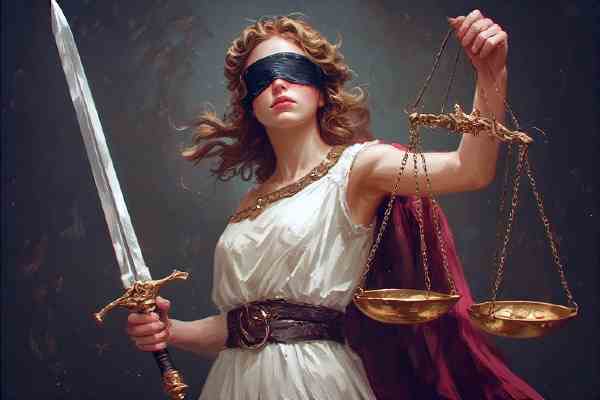
The Goddess Themis is usually only associated with justice, yet her symbols point to the modern role that expands the meaning beyond judgment. Once the imagery moves beyond right and wrong, the symbols of Themis take on greater meaning.
The blindfold, scales, and sword of Themis can be read as parts of a regulation system rather than instruments of law. Seen this way, her imagery becomes a map of how the mind stabilizes under stress and sorts competing pressures. Each symbol marks a different function, and together they show how inner order is built and maintained without leaning on myth or superstition.
This framing turns Themis into a way of understanding the capacities and mechanisms that keep thought steady, especially when the world becomes loud or uncertain.
Regulation Gate Notice:
This practice is for stabilizing the nervous system. It is not intended to change beliefs or resolve psychological patterns.
Beyond right and wrong
The goddess Themis comes from a time before moral codes were fixed, when order was understood as a natural force rather than a judgment. Her symbols were shaped in that older world, which means they were never meant to divide people into good and evil. They were meant to show how balance is held.
The blindfold, scales, and sword make sense when read this way. The blindfold is not about ignoring truth but about limiting what enters awareness. The scales are not for deciding guilt but for weighing competing pressures. The sword is not a punishment but a boundary, the line that protects what must remain intact.
Seen through this lens, the symbols stop functioning as legal tools and start functioning as cognitive ones. They describe how the mind filters, measures, and defends itself long before any moral judgment appears. This is the shift that allows Themis to move beyond right and wrong and into the deeper architecture of mental regulation.
The modern role of the goddess Themis
1. Themis as the inner calibration system
The mind depends on a set of internal instruments to make sense of the world. These instruments measure things you cannot see directly—how safe something feels, how fair a situation seems, how much trust to give, and how important an event should be. They guide your reactions long before you think about them.
But these instruments drift. Stress, habit, fear, and past experiences can pull them out of tune. When that happens, your readings become distorted. A small risk feels huge. A neutral comment feels unfair. A minor decision feels urgent.
The goddess Themis represents the part of the mind that checks these instruments and brings them back into alignment.
She is the system that asks: *Is this reaction accurate? Is this reading clear? Has something shifted inside me that needs to be reset?*
The goal of the modern role is not to judge but to recalibrate, keeping your inner measurements steady so your responses stay grounded.
2. Themis as the pressure‑balancing system
Every mind carries competing pressures—needs, fears, expectations, obligations, impulses, and the weight of other people’s reactions. These forces do not arrive one at a time. They stack, collide, and pull in different directions, often without your awareness. When the load becomes uneven, your thinking tilts with it.
- Themis represents the system that notices when one pressure is overpowering the rest.
- She helps the mind distribute weight so no single demand becomes the whole story.
- This balancing prevents overreaction, collapse, or the sense that everything is urgent at once.
- It also keeps quieter needs from being drowned out by louder, more immediate forces.
Pressure-blanching is an important element in the modern role. It explains how the mind can hold multiple pressures without losing its center. It becomes possible to respond from stability rather than from whichever force happens to be shouting the loudest.
3. Themis as the boundary‑setting system
Every mind needs boundaries to stay stable. Not the harsh, defensive kind, but the quiet lines that protect attention, energy, and emotional space. Without these lines, everything gets in. Every demand feels equal. Every voice feels urgent. The mind loses its edges and becomes overwhelmed.
Some things belong inside your attention.
Some things do not.
Themis represents the system that restores those edges. She marks the difference between what is yours to carry and what belongs to someone else. When this role is active, the mind can say no without guilt, step back without collapsing, and hold its shape even when the world presses in. Boundaries become a form of internal structure rather than a reaction to stress.
4. Themis as the clarity‑restoring system
Clarity slips long before we notice it. Stress distorts perception, speeds up some thoughts, slows others, and scatters the rest. The mind starts reacting to fragments instead of the full picture, and decisions that should be simple become tangled.
This isn’t confusion—it’s distortion.
The goddess Themis represents the system that cuts through that distortion.
She helps the mind separate what is actually happening from what pressure makes it feel like. When this role is active, the important details rise back into view, the false urgency drops away, and the next step becomes obvious without being forced. Clarity returns as a form of internal steadiness, not as a moment of insight but as the restoration of accurate perception.
5. Themis as the decision‑stabilizing system
Every choice carries a moment of instability. The mind weighs options, anticipates outcomes, and feels the pull of competing motives. Even small decisions can trigger hesitation when the internal signals are mixed. This wobble is normal, but if it lasts too long, it drains energy and erodes confidence.
Themis represents the system that settles this moment. She brings the mind to a steady point where action becomes possible, not by forcing certainty but by reducing the noise around the choice.
When this role is active, decisions feel grounded rather than rushed, and movement comes from alignment instead of pressure. The mind steps forward because the internal signals have converged, not because doubt has disappeared.
What these modern roles represent
The role of the goddess Themis expands to explain how a healthy mind takes care of itself. They form a picture of the inner systems that keep your thoughts steady, clear, and balanced. Instead of seeing Themis as a judge, we can move beyond right and wrong. These roles show her as the symbol of mental regulation. She stands for the inner tools that help you stay grounded when life feels confusing or stressful.
These roles explain how your mind protects itself, organizes itself, and guides itself. They show the different ways your inner world stays stable:
- Keeping your reactions accurate,
- Guarding what enters your thinking,
- Creating order inside you,
- Balancing the weight of your thoughts and feelings,
- Sowing you down so you can choose instead of react.
Together, these roles represent the mind’s full regulation system. This system helps you stay clear‑headed even when emotions run high or outside pressure tries to shape your thinking. Themis becomes the image of inner stability. She stands for the part of you that can stay steady, protect your clarity, and guide your choices with calm strength.
This system is not about moral judgment. It is about balance, order, and mental strength. Themis represents the inner structure that helps you think clearly and act with confidence.
Conclusion
The goddess Themis is more than a symbol of justice. In this modern view, she moves beyond right and wrong. She becomes the image of a clear and steady mind.
Her symbols point to the inner systems that keep your thinking balanced: calibration, boundaries, order, load balance, and slow thinking. Each one supports a different part of mental stability, and together they form the structure that keeps you grounded.
When these systems work together, you stay steady even when life becomes stressful. Your reactions stay accurate, your attention stays protected, and your choices stay connected to what matters. Clarity stops feeling like luck and starts feeling like something you can maintain.
Themis represents this inner stability. She stands for the part of you that can hold its shape, protect its clarity, and guide your choices with calm strength. These roles are not about judgment. They are about balance, order, and the quiet mental strength that lets you think clearly and act with confidence.
References
- Theogony, Hesiod.
- The Iliad, Homer.
- The Archetypes and the Collective Unconscious, Carl G. Jung.
- Man and His Symbols, Carl G. Jung.
- Thinking, Fast and Slow, Daniel Kahneman.
- Emotion Regulation and Cognitive Control, National Institutes of Health.
- Decision Making and Cognitive Bias, National Institute of Mental Health.
- Attention, Perception, and Cognitive Filtering, National Library of Medicine.
- Justice, Stanford Encyclopedia of Philosophy.
- Themis, Wikipedia.