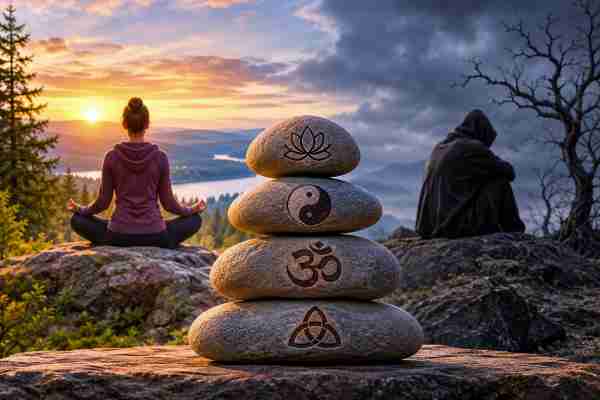
People define spirituality in very different ways. You can define spirituality in four ways that exist on a continuum from healthy to harmful. This gives us a simple test to gauge the health of any belief system, and a way to apply it to your own life.
Ask ten people what spirituality means, and you may get ten different answers. One person talks about finding meaning. Another talks about inner peace. A third talks about faithfully following the teachings of their church. A fourth describes a moment of awe on a mountaintop.
Each answer points to something real. But they are not all the same, and they don’t all lead to the same place. Some definitions help you grow and make you kinder, wiser, and freer. Others are used to control you, and leave you more fearful and rigid. Often the difference isn’t the belief itself. It is how the belief works in a person’s life.
That is why it helps to separate two questions. First, how do people define spirituality? Second, which of those definitions are healthy, and which are harmful? Mixing the two is how harmful practices end up being called healthy.
Inner Work Gate:
This article asks you to test a spiritual belief you hold strongly, about God, the afterlife, right and wrong, or your purpose. Imagining doubt, tracing where a belief came from, and asking whether changing it would cost you family or community can stir fear, guilt, or grief before things become clearer. It describes spiritual abuse, which may bring back painful memories for anyone who has lived through it. Establish emotional stability first, work with one belief at a time, and pause if the process becomes overwhelming.
Four ways people define spirituality
Most ideas about spirituality fit into one of four broad types. Each one focuses on a different part of life: meaning, mental balance, belonging, or experience. Each one also has real strengths, and each one can go wrong. Each one can be healthy or harmful.
Spirituality as personal meaning
The first way to define spirituality focuses on the inner life and the values a person chooses for themselves. Spirituality means knowing what truly matters to you, living by those values on purpose, and having a sense of direction.
Research supports the value of this. Psychologist Michael Steger and his colleagues developed a widely used measure of meaning in life.
People who feel their lives have meaning tend to report greater well-being and less depression. Psychologists Richard Ryan and Edward Deci found something related. People thrive when they act from their own choices, feel capable, and feel connected to others. They called these needs autonomy, competence, and relatedness.
This view often runs into tension with family, culture, or inherited religion. A person’s own sense of meaning may not match what they were taught. That clash can create cognitive dissonance, the discomfort of holding two views that don’t fit together.
Where it can go wrong: “Chosen” doesn’t automatically mean “good.” A person can freely choose values that are selfish or harmful. Personal meaning is healthy only when the values themselves hold up. They must not cause harm, and they must survive honest questions.
➡ For more, see: The Cultural Values Test — Are Your Beliefs Really Your Own?
Spirituality as psychological integration
A second way to define spirituality comes from psychology and the mental health field. A person is spiritually well when their thoughts, feelings, and actions work together instead of fighting each other.
Several qualities support this. They include purpose, connection, kindness, inner balance, and compassion for yourself and others.
The research here is strong. Psychiatrist Harold Koenig reviewed thousands of studies on religion, spirituality, and health. On average, people with an active spiritual or religious life had lower rates of depression and substance abuse. They also coped better with stress. Much of that benefit seems to come from meaning, community, and hope.
Where it can go wrong: Feeling balanced is not the same as being right. A belief can make someone feel calm and still be untrue or unkind. This view also risks turning spirituality into just another self-help tool, used only to feel better.
➡ For more, see: Spiritual Counseling: Where Tradition Meets Psychology
Spirituality as obedience to a group
A third way to define spirituality is by how well a person follows a group’s teachings and rules. Being spiritual means staying loyal and taking part in services. It means giving the group time and money, and taking its beliefs as your own.
Belonging has real value. Shared rituals, a caring community, and clear guidance can give people strength, especially in hard times. Many of the health benefits Koenig found likely come from exactly this kind of support.
The problem starts when obedience replaces conscience. In 1967, psychologists Gordon Allport and J. Michael Ross compared two kinds of religious people. Some lived their faith from the inside. Allport called this intrinsic religion. Others used religion mainly for status, comfort, or belonging, which he called extrinsic religion. The extrinsic group showed more prejudice. When faith becomes mainly about the group, it can turn against outsiders.
Where it can go wrong: When questions are treated as betrayal, the group’s needs come before the person’s growth. People learn to stop thinking for themselves. In this model, other definitions of spirituality are often discouraged or forbidden.
Group conditioning keeps members loyal by discouraging contact with conflicting ideas.
➡ For more, see: Layers of Social Programming and Influence
Spirituality as transcendent experience
The fourth way to define spirituality centers on powerful moments that feel larger than everyday life. It might be deep calm in meditation, wonder under a night sky, or a sense of connection during music, ritual, or time in nature.
These moments can change people for the better. In 2015, psychologist Paul Piff and his colleagues studied awe. In one experiment, some people spent a minute looking up at a grove of towering trees. Afterward, they were more helpful to a stranger than people who had looked at a building. Awe seems to shrink our sense of self and turn our attention outward.
Where it can go wrong: Psychologist John Welwood coined the term “spiritual bypassing” for one danger. It means using spiritual experiences and ideas to avoid real emotional problems. Someone might meditate to escape grief instead of facing it. Some people also chase peak experiences like a high, always looking for the next one. And because these moments are so powerful, a group can use them to make its own beliefs feel proven.
➡ For more, see: Meditation Methods for Training Attention
Most people mix all four
Few people fit neatly into one type. Most people define spirituality as a mixture of all four. A person might find meaning in their own values and meditate for balance. The same person might attend a faith community and treasure moments of awe in nature. Each type covers a different need.
That is why it isn’t useful to ask which type is “right.” A better question is where your beliefs, values, and actions are on the spectrum from healthy to harmful.
What makes spirituality healthy or harmful
Healthy spirituality isn’t defined by which type you follow. It is defined by what your spirituality does to you and to the people around you. Four questions make a simple test:
- Does it cause harm? Look at the real effects on you and others, not just what the belief promises.
- Does it allow honest questions? Healthy beliefs can be examined without fear or punishment.
- Are you free to change your mind, or to leave? If changing a belief would cost you your family, community, or sense of worth, the belief is being protected more than the truth.
- Does it help you grow? Healthy spirituality makes you more honest, more compassionate, and more capable over time.
Research shows why the difference matters. Psychologist Kenneth Pargament studied how people use faith to cope with hard times. Some take comfort in feeling supported by God or their community. That kind of coping is linked with better outcomes. Others feel punished or abandoned by God. In 2001, Pargament and Koenig studied older hospital patients. Those who felt this kind of struggle had a higher risk of dying over the next two years. The same faith can steady one person and crush another, depending on how it works in their life.
Here is how each way to define spirituality can be healthy or harmful:
| Type | Healthy when | Harmful when |
|---|---|---|
| Personal meaning | Chosen values are kind and hold up to questions. | “My truth” becomes an excuse for selfish or harmful choices. |
| Psychological integration | Balance supports honesty and growth. | Feeling calm becomes more important than facing the truth. |
| Group obedience | Community offers support, and questions are welcome. | Loyalty replaces conscience, and doubt is punished. |
| Transcendent experience | Awe opens you to others and to growth. | Experiences are used to escape problems or to “prove” a group’s claims. |
➡ For more, see: How The Self-Correction Mechanism Prevents Extremism
How controlling groups twist spiritual needs
Everyone needs meaning, belonging, and purpose. Some groups take those needs and turn them into tools of control. This happens in some religious groups, but not only there. The same pattern shows up in cults, political movements, wellness communities, and even workplaces. The method is always similar. An unhealthy behavior is given a holy-sounding name.
Researchers Lisa Oakley and Kathryn Kinmond have studied what they call spiritual abuse. They describe a pattern of control. It uses sacred language, scripture, or a leader’s spiritual authority to pressure, shame, or silence people. Here are some of the most common twists.
Suppression becomes “faith”
Curiosity is treated as disloyalty, and doubt is called weakness. The real goal is to stop people from thinking for themselves.
When questions become sin, obedience becomes the only virtue.
➡ For more, see: The Inverse Relationship of Faith and Critical Thinking
Manipulation becomes “guidance”
Fear and guilt are presented as care. Leaders claim that pressure is necessary for growth, even when it shrinks a person’s confidence. “Correction” becomes control. “Discipline” becomes shame. “Help” becomes a push back into obedience.
Prejudice becomes “purity”
Excluding outsiders is reframed as holiness. Separation is treated as a moral duty rather than what it often is: a fear response.
Purity language often hides a simple truth: it is fear wearing white robes.
➡ For more, see: Errors of Rigid Black-and-White Thinking and Moral Absolutism
Hierarchy becomes “divine order”
The group claims its chain of command is sacred. Its rules are “the only right way,” and its leaders’ authority is “God’s design.” Inequality starts to feel righteous and unchangeable.
Us versus them becomes “good versus evil”
The world is split into two camps, and the group claims the “good” side: believers and nonbelievers, the saved and the lost, the pure and the corrupt. This makes harm feel justified, because anything done for the “right” side feels morally safe.
➡ For more, see: Religious Extremism Across the Abrahamic Traditions
Gatherings become conditioning
Shared ritual can be beautiful. But some gatherings use emotional intensity to lower critical thinking. Repetition, group movement, music, and synchronized speech create a shared emotional state. That state makes people more open to influence. When leaders use it to push fear or guilt, they shape beliefs without real consent.
➡ For more, see: Disguises and Tactics of Counterfeit Spirituality and Manipulation
Self-check: healthy to unhealthy beliefs
The test works best when you apply it to one belief at a time. Choose a spiritual belief you hold strongly. It might be about God, the afterlife, right and wrong, or your purpose. Then ask the same four questions, ideally in writing:
- Does it cause harm? Think about what the belief actually does. Does it make you kinder, calmer, and braver? Or more fearful, judgmental, or ashamed? How does it affect the people around you?
- Does it allow honest questions? Imagine doubting it, and notice what happens in your body. Curiosity is a good sign. Dread may point to fear holding the belief in place.
- Are you free to change your mind, or to leave? Ask where the belief came from. Did you choose it, or was it handed to you before you could question it? If changing it would cost you your family, your community, or your sense of worth, that pressure deserves a closer look.
- Does it help you grow? Look back over the past few years. Has this belief made you more honest, more compassionate, and more capable? Does it still make sense after you look at the evidence and listen to people who disagree?
A belief doesn’t have to pass perfectly to be worth keeping. The goal isn’t to throw out everything you were taught. It is to keep what is honest and life-giving, and to loosen what is rooted in fear or borrowed certainty. You do this when you define spirituality one belief and value at a time.
Healthy spirituality strengthens what is honest and life-giving, and loosens what is rooted in fear.
Conclusion
Four ways to define spirituality are filters that help you see beliefs and behaviors that range from healthy to unhealthy.
Spirituality takes many forms, from healthy to unhealthy. Both forms can contain elements of personal meaning, psychological balance, belonging to a community, and moments of awe. Each can fulfill a personal or social need, and each exists on a spectrum from healthy to harmful.
What makes spirituality healthy isn’t the label or the tradition. It is how it works in your life. Healthy spirituality causes no harm, welcomes questions, leaves you free, and helps you grow. No institution can hand that to you, and none can take it away. It forms through honest experience and reflection. It stays steady because it rests on clarity rather than control.
References
- Personal Religious Orientation and Prejudice. Gordon W. Allport and J. Michael Ross, Journal of Personality and Social Psychology, 1967.
- A Theory of Cognitive Dissonance. Leon Festinger, 1957.
- Principles of Inner Work: Psychological and Spiritual. John Welwood, Journal of Transpersonal Psychology, 1984.
- Patterns of Positive and Negative Religious Coping With Major Life Stressors: Kenneth I. Pargament and colleagues, Journal for the Scientific Study of Religion, 1998.
- Self-Determination Theory and the Facilitation of Intrinsic Motivation, Social Development, and Well-Being. Richard M. Ryan and Edward L. Deci, American Psychologist, 2000.
- Religious Struggle as a Predictor of Mortality Among Medically Ill Elderly Patients. Kenneth I. Pargament, Harold G. Koenig, and colleagues, Archives of Internal Medicine, 2001.
- The Meaning in Life Questionnaire: Assessing the Presence of and Search for Meaning in Life. Michael F. Steger and colleagues, Journal of Counseling Psychology, 2006.
- Religion, Spirituality, and Health: The Research and Clinical Implications. Harold G. Koenig, ISRN Psychiatry, 2012.
- Breaking the Silence on Spiritual Abuse. Lisa Oakley and Kathryn Kinmond, 2013.
- Awe, the Small Self, and Prosocial Behavior. Paul K. Piff and colleagues, Journal of Personality and Social Psychology, 2015.
About this project
Seeker Project 4 Spiritual Exploration (SP4SE) offers resources for exploring consciousness. It also helps with awareness and self-observation. It is a project of Americans In Alliance.
- Support SP4SE to help maintain and develop its educational resources.
- Visit Americans In Alliance to learn more about the parent organization.