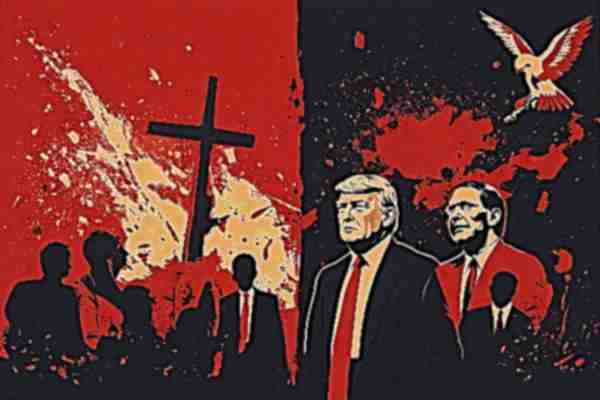
The self-correction mechanism is the way a belief system notices its own mistakes and fixes them. It prevents extremism from taking control of the system. Systems that have it can grow and change. Systems that lose it tend to harden, and over time they can drift toward extremism.
No belief system gets everything right. Teachings drift, leaders make mistakes, and new discoveries challenge old ideas. What matters is not whether a system makes mistakes. It is whether the system can catch and fix them. This article explains how that works, what gets in the way, and how you can use the same safeguard on your own beliefs.
This article is part of a series about how ideas take hold in the mind and shape culture. The last article looked at how shared beliefs shape norms, laws, and daily life. This one asks what keeps those beliefs from going wrong.
Each article in this series can be read on its own. But they make the most sense in order, from the inside of the mind out to the whole culture:
- Layers of Social Programming and Influence
- How Mental Conditioning and Brainwashing Shape Beliefs
- The Psychological Foundation of Belief Structures
- How the Narrative Mechanism Organizes Belief
- How Institutions Spread Beliefs and Defend Doctrine
- How Belief Systems Shape Society
- How the Self-Correction Mechanism Prevents Extremism (This article)
- How Memetic Transmission Shapes Culture
Emotional Readiness Gate:
This article examines how belief systems respond to mistakes, disagreement, and new evidence. Some examples may challenge beliefs tied to your faith, family, culture, or political views. If you feel upset or defensive, pause and return when you feel steady enough to consider the ideas and evidence.
Why beliefs need a self-correction mechanism
Every belief system, from an ancient religion to a modern political party, sits somewhere on a line. At one end are flexible systems. They welcome questions and allow people to disagree. At the other end are rigid systems. They treat every question as an attack and every doubt as betrayal.
Belief systems shape how people treat one another. They shape how leaders rule and what a community calls fair. Because they reach into so many parts of life, their mistakes can spread far. A wrong idea that no one is allowed to question can find its way into laws, schools, and families.
A self-correction mechanism works like the brakes on a car. It does not stop the system from moving forward. It gives people a way to slow down, look around, and change direction before they crash. When the brakes fail, small errors can grow into strict rules. Those rules ignore evidence and silence anyone who disagrees. That slide is often how extremism begins.
➡ For more, see: Religious Law As State Law: Islamic And Christian Sharia
When a belief system has no brakes
What happens when this mechanism is missing? One of the most famous studies in psychology shows us.
Just before midnight on December 20, 1954, a small group of believers gathered in a living room near Chicago. They had given up their jobs, their homes, and their savings. Their leader had told them that a great flood would destroy the world before dawn. At midnight, she said a spaceship would arrive to carry the faithful to safety.
Midnight came. No spaceship arrived. The hours dragged on, and the group sat in stunned silence. Then, at about a quarter to five in the morning, the leader announced a new message. Their faith, she said, had saved the world.
What happened next surprised everyone, except the scientists who were quietly watching. A psychologist named Leon Festinger and two colleagues had joined the group to study it. Before the failed prophecy, the members had avoided reporters. After it, they began calling newspapers and trying to win new followers. The prediction had failed, but the belief grew stronger.
Festinger wrote about the group in a book called When Prophecy Fails. The group had every reason to change its mind. The evidence could not have been clearer. Yet there was one question the group could not bring itself to ask: “What if we were wrong?” That question is the heart of the self-correction mechanism. Without it, even a failed prophecy can become proof that the belief was right all along.
The rest of this article looks at why some belief systems can ask that question and others cannot.
Where mistakes come from
No belief system is free of errors. People pass ideas down through many hands, and each pair of hands can change them a little. Most mistakes creep in quietly, through a few common doors.
Contradictions in documents used for authority can be that door, especially when the document contains extremist ideas. The belief system can fragment, with some choosing the more extreme ideas. Or leaders can adopt the extreme points of view and ignore the contradictions.
Teachings that drift over time
Beliefs travel through stories, sermons, and traditions. Each time a teaching is retold, its meaning can shift a little. Over many generations, a lesson meant as a symbol can turn into a strict rule. A teaching meant to comfort can be used to scare. If no one is allowed to ask what the teaching first meant, the new version can quietly replace the old one.
➡ For more, see: How the Narrative Mechanism Organizes Belief
Leaders who fear questions
Institutions help belief systems last. They train leaders, keep records, and hold traditions together. But leaders sometimes worry that questions will weaken their power. To protect it, they may punish doubt or ban other views. When that happens, the people best placed to spot a mistake are the ones told to keep quiet.
➡ For more, see: How Institutions Spread Beliefs and Defend Doctrine
Loyalty that silences doubt
Shared beliefs help people feel that they belong. That is a good thing until loyalty starts to matter more than truth. When a belief becomes part of who a group is, questioning it can feel like turning on your own family. People who notice a problem may say nothing, because speaking up could cost them their friends.
➡ For more, see: The Psychological Foundation of Belief Structures
How the self-correction mechanism works
The good news is that belief systems can be built to catch their own mistakes. Healthy systems tend to rely on three habits.
Open inquiry
Open inquiry simply means that people are allowed to ask questions. When questions are welcome, mistakes are easier to spot. Problems can be talked through while they are still small.
Some traditions build this habit right into their sacred texts. The Talmud is a central book of Jewish law. It records long arguments between rival groups of teachers. It keeps the losing side’s views alongside the winning side’s. An older part of the text explains why. Minority opinions are kept so that later teachers can look at them again. A tradition that saves its own disagreements leaves the door open to correction.
Debate and dialogue
Debate lets people test ideas against each other. When people listen to views that differ from their own, they often spot weak points in their own thinking. Debate does not have to be angry. At its best, it is a shared search for the best answer.
Science is the clearest example of a system built around this habit. In 1912, a German scientist named Alfred Wegener made a bold claim. He said the continents slowly drift across the Earth. Most experts rejected the idea for decades. Then, in the 1950s and 1960s, new maps of the ocean floor showed that he had been largely right. The scientific community changed its mind. The correction was slow, but it happened, because the system was designed to follow the evidence.
Learning from new knowledge
New discoveries often challenge old beliefs. Healthy belief systems do not reject new facts just because they are new. They ask whether their teachings need to change, and they keep the core values that matter most.
Some of the most powerful changes came from religious groups. They looked honestly at their own past. In 1633, the Catholic Church put the astronomer Galileo on trial. His crime was teaching that the Earth moves around the Sun. In 1992, Pope John Paul II formally admitted that the church had been wrong. In 1965, the same church declared that Jewish people as a whole could not be blamed for the death of Jesus. That teaching had fueled hatred for centuries. In 1995, the Southern Baptist Convention said it was sorry for once defending slavery and racism.
These corrections came late, sometimes centuries late. But each one shows that even very old systems can admit mistakes and change course.
➡ For more, see: Errors of Rigid Black-and-White Thinking and Moral Absolutism
What blocks self-correction
If correction is so useful, why do so many belief systems resist it? Three barriers show up again and again.
Fear of change
Change can feel like danger. Beliefs are tied to tradition, identity, and a sense of safety. Some people fear that changing one idea will make the whole system fall apart. So they may reject even small and helpful fixes. The group in Festinger’s study is an extreme case. If the prophecy had truly failed, then they had given up everything for nothing. That was too painful to admit. Doubling down felt safer than facing that truth.
Psychologists call this kind of painful clash between belief and evidence cognitive dissonance. People can ease the pain by changing the belief. Very often, they ease it by explaining away the evidence instead.
➡ For more, see: Strategies for Dealing with Cognitive Dissonance
Control of information
People can only correct mistakes they can see. When a group controls what its members read, watch, and hear, mistakes stay hidden. Some groups warn members not to read outside books or talk to former members. Some governments block outside news. In each case, the members never get the information they would need to notice that something is wrong.
Pressure to go along
Social pressure is powerful, even among strangers. In the 1950s, a psychologist named Solomon Asch asked people to compare the lengths of lines on a card. The answer was easy. But the other people in the room were actors who gave the wrong answer on purpose. About three out of four real volunteers went along with the wrong answer at least once.
People will deny what their own eyes tell them just to fit in with strangers. Imagine how much stronger the pull of a lifelong community must be. In groups where questions are punished, silence becomes the safest choice. The group may look united on the surface while doubts pile up underneath.
➡ For more, see: Symptoms of An Unhealthy Culture and Reasons For Cultural Breakdown
How self-correction prevents extremism
When all three barriers are in place, a belief system loses its brakes. Fear keeps people from wanting change. Control of information keeps them from seeing the need for it. Pressure keeps them from saying anything. Each small error that goes uncorrected makes the next one easier. Over time, the system can drift toward its most rigid and extreme form.
This pattern is not limited to any one religion, culture, or political side. It appears in faith groups, political movements, conspiracy communities, and cults. The beliefs differ, but the slide looks much the same.
A working self-correction mechanism breaks that chain. When people feel safe asking questions, errors come to light early. When debate is allowed, weak ideas lose ground to stronger ones. When new knowledge is welcome, the system can grow without losing its core. These habits do not make a belief system perfect. They make it able to learn, and a system that can learn is far less likely to turn extreme.
➡ For more, see: Religious Extremism Across the Abrahamic Traditions
Testing your own beliefs
The self-correction mechanism does not only belong to groups. Each of us needs one too. The members of the group in Festinger’s study were not foolish people. They were ordinary people who had tied their whole lives to a belief that could not bend.
A simple test can help you check your own beliefs. Pick one belief that matters to you, and ask yourself a few questions:
- What if I am wrong about this?
- What evidence would change my mind?
- Am I allowed to question it, and what happens if I do?
- Have I listened carefully to people who disagree?
- Do I look for facts that support it, or also for facts that challenge it?
- If I learned I was wrong, could I admit it?
If you cannot imagine any evidence that would change your mind, that belief may have lost its brakes. That does not mean the belief is false. It means you have stopped being able to check.
➡ For more, see: A Healthy Skeptical Mindset: Cultivating Healthy Skepticism
➡ For more, see: The Cultural Values Test
What comes next
The self-correction mechanism decides whether a belief system grows or hardens. But correction alone does not decide which ideas survive. Beliefs also have to spread, compete with other ideas, and win new followers. The final article in this series looks at how that happens.
➡ For more, see: How Memetic Transmission Shapes Culture
References
- When Prophecy Fails. Leon Festinger, Henry W. Riecken, and Stanley Schachter, 1956.
- A Theory of Cognitive Dissonance. Leon Festinger, 1957.
- Effects of Group Pressure upon the Modification and Distortion of Judgments. Solomon E. Asch, 1951.
- The Origin of Continents and Oceans. Alfred Wegener, 1915.
- The Logic of Scientific Discovery. Karl Popper, 1959.
- Mishnah, Tractate Eduyot, Chapter 1.
- Address to the Pontifical Academy of Sciences on the Galileo Case. Pope John Paul II, 1992.
- Nostra Aetate: Declaration on the Relation of the Church to Non-Christian Religions. Second Vatican Council, 1965.
- Resolution on Racial Reconciliation on the 150th Anniversary of the Southern Baptist Convention. Southern Baptist Convention, 1995.
- Motivated Reasoning and Belief Polarization. Current Opinion in Behavioral Sciences.
About this project
The Seeker Project 4 Spiritual Exploration (SP4SE) is a project of Americans In Alliance. The mission of SP4SE is spiritual education. The mission of Americans In Alliance is environmental conservancy. Click the links below to learn more and support our efforts.