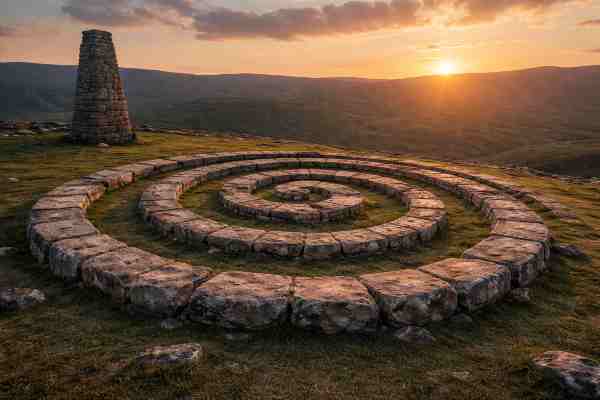
What if the sacred spiral symbol doesn’t mean what we’ve been told? Look closely, and the shape that supposedly stands for harmony and growth turns out to be far stranger. Rethinking the spiral follows it through nature, the human brain, and history.
We treat the sacred spiral symbol as something familiar. It shows up on jewelry, tattoos, yoga studio walls, and book covers about spiritual growth. Most people could tell you what it is supposed to mean: evolution, harmony, the journey of the soul.
But the shape has a way of unsettling that confidence. A curve here, a shift there, and the pattern starts to feel different from what was expected. That is where a new perspective begins. Not in certainty, but in the moment something doesn’t quite line up.
Rethinking the sacred spiral symbol
We talk about the spiral as if it were a single idea. But the form refuses to stay in one meaning. It shows up in storms, shells, galaxies, rock carvings, and mathematics, and it never behaves the same way twice.
A spiral can widen, tighten, rise, flatten, or collapse, depending on the forces shaping it. Some spirals grow. Others pull things in and crush them. The form doesn’t tell one story. It responds to whatever created it.
Why is the spiral referred to as sacred? Something becomes sacred when we set it apart from the ordinary. Some see sacredness as divine. When we treat something as sacred, we often render it with special significance and meaning.
So here is the shift this article asks you to make. Stop treating the spiral as a message, and start treating it as a behavior. Once you do, the shape becomes far more interesting than the tidy explanations we keep repeating.
Meaning is like memory. It changes over time because of outside influences.
1. Nature makes two kinds of spirals
The usual story says the sacred spiral stands for harmony and growth. Nature does make spirals like that. A fern unrolls in a tight curl that slowly opens. Sunflower seeds pack into crossing spirals, usually in Fibonacci numbers such as 34 and 55. Snail shells and spiral galaxies grow outward in steady curves.
But nature also makes spirals of a very different kind. A hurricane pulls air and water toward its center with enough force to flatten towns. A whirlpool drags floating objects down. Gas and dust circle a black hole in a spiraling disk before they disappear for good. These spirals don’t guide gently. They concentrate energy, speed up, and consume.
Both kinds are equally real. The popular reading simply remembers one and forgets the other. A more honest view holds both. Some spirals carry us forward. Others pull us under.
The golden spiral myth
The most famous sacred spiral claim is that the nautilus shell follows the golden ratio, the number 1.618 that is said to appear throughout nature and art. You will find this claim in countless books and websites.
It isn’t true. Mathematician Mario Livio, in his book The Golden Ratio, explains that the nautilus does grow in a logarithmic spiral, but not a golden one. When researchers have measured real shells, the growth ratio comes out closer to 1.3. The beautiful, widely repeated story was never checked against the actual shells.
That is a small lesson with a big reach. A symbol can feel ancient and certain, and still rest on a claim nobody tested.
2. A sacred spiral built into how we see
The sacred spiral symbol is often described as a universal archetype, something stored deep in the human psyche. There is a more grounded explanation, and it may be more surprising. The spiral may be a pattern the human visual system produces on its own.
In the 1920s, psychologist Heinrich Klüver studied the visions people saw after taking mescaline. He noticed that the same few shapes kept appearing, no matter who was seeing them: spirals, tunnels, lattices, and cobwebs. He called them form constants. The same shapes show up in migraine auras, when people stare at flickering lights, and sometimes just before sleep.
In 2001, a team of mathematicians and neuroscientists led by Paul Bressloff and Jack Cowan worked out why. The way the eye’s image is mapped onto the brain’s visual cortex is warped. Simple straight stripes of activity in the brain show up in what we “see” as spirals and tunnels. In other words, when the visual brain gets excited on its own, spirals are one of the shapes it naturally makes.
Some researchers believe this explains part of ancient art. In 1988, archaeologists David Lewis-Williams and Thomas Dowson argued that spirals, zigzags, and dots in rock art around the world may record visions seen in altered states. The idea is still debated, but it would explain why the same shapes appear in cultures that never met.
➡ For more, see: Aboriginal Dreamtime, Songlines and Altered States
Why the spiral feels meaningful
This changes how we understand the symbol. Instead of a cosmic message, the spiral symbol may be a pattern the brain is tuned to. It feels meaningful because perception responds to it strongly. It feels ancient because the nervous system is ancient. It feels spiritual because it skips past language and goes straight to the eyes.
And when a pattern grabs attention but offers no explanation, the mind starts filling one in. The longer a pattern resists closure, the more interpretation we pour into it. That is where belief often begins: not as a discovered truth, but as an answer to an unresolved feeling.
➡ For more, see: How We Reach A Conclusion And What Can Go Wrong
3. The spiral vs. the labyrinth
The sacred spiral is often grouped with the labyrinth, but the two shapes move in very different ways.
A labyrinth leads you inward and then back out again on the same path. It has a center, a turning point, and a built-in return. A single spiral does not. It pulls you inward, tighter and tighter, with no turn to bring you back. It is motion without completion.
Some ancient carvers seem to have known this. Many old spirals are double spirals, which curl inward and then unwind back out, like the carvings at Newgrange in Ireland. The double spiral has a return. The single spiral does not.
➡ For more, see: The Labyrinth: A Pattern with Meaning
Why the spiral breaks the idea of progress
Many people use the spiral as a symbol of spiritual progress. But progress needs a path that eventually turns and leads somewhere new. The single spiral offers no such turn.
That makes it a better picture of something else: the mental loops people fall into when they believe they are growing but are really circling. They return to the same insight, the same wound, or the same story about themselves, again and again.
The labyrinth resolves. The spiral deepens.
The hypnotic pull of the spiral
The spiral really does affect the eye. Stare at a spinning spiral for half a minute and then look at a wall. The wall will seem to swell or shrink. Scientists call this the motion aftereffect, and the spinning disk used to show it has been studied since the 1800s.
That disorienting pull is why films and stage shows made the spiral the symbol of hypnosis. Most real hypnotists don’t use spinning spirals, but the image stuck because it captures how hypnosis feels: attention narrowing, direction slipping, a sense of falling inward. Alfred Hitchcock’s 1958 film Vertigo opened with spinning spiral designs by Saul Bass to unsettle the audience before the story began.
➡ For more, see: The mechanics of the hypnotic trance state
How loops become beliefs
Repetition does more than hold attention. It steadies it. What repeats begins to feel familiar, and what feels familiar begins to feel true. Loops become beliefs not because they are accurate, but because nothing interrupts them.
As attention narrows and outside reference points fade, the mind starts responding more to its own activity than to the world. That is the doorway to altered states, where the line between observing and imagining begins to blur. Symbols like the spiral can become anchors for those loops.
4. The sacred spiral was never universal
The idea of the sacred spiral as one universal spiritual symbol is fairly recent. Much of it grew out of the “sacred geometry” movement of the 1970s and 1980s, which gathered shapes from many cultures and gave them shared mystical meanings. Books like Robert Lawlor’s Sacred Geometry (1982) helped spread the idea.
Ancient cultures didn’t agree on what the spiral meant. Many used it for practical purposes that had nothing to do with enlightenment.
| Place | What the spiral did there |
|---|---|
| Newgrange, Ireland | Spirals were carved at the entrance of a passage tomb built about 3200 BCE. Each winter solstice, the rising sun shines down its passage into the inner chamber. |
| Chaco Canyon, New Mexico | On Fajada Butte, a spiral carved by Ancestral Puebloan people works as a calendar. In 1977, artist Anna Sofaer documented how blades of sunlight cross it at the solstices and equinoxes. |
| Hopi tradition | The spiral is often described as a record of clan migrations, the long journeys that came before settling down. |
| Māori culture, New Zealand | The koru is based on an unfolding fern frond. It stands for new life, growth, and renewal. |
The same shape marked a tomb, kept a calendar, recorded a journey, and celebrated new life. It carried different meanings because it served different needs.
Being found in many cultures doesn’t mean those cultures agreed. The shape traveled, but its meaning didn’t travel with it. What we now call a universal symbol may be a collage of unrelated meanings, stitched together long after the fact.
➡ For more, see: How Myth And Symbolic Stories Shape Culture
➡ For more, see: The Meaning We Project Onto Rebirth Symbols
5. What the spiral symbol really shows
Symbols don’t store meaning the way words do. They compress it. A spiral can hold growth, danger, motion, repetition, and time all at once, because it doesn’t define any of them precisely. Each mind that meets it fills it in differently. That is why symbols travel so easily between cultures, and why their meanings never quite match.
The real question isn’t what the sacred spiral symbol means. It is why we are so quick to decide that it must mean one thing. Critical thinking begins at the moment a pattern feels significant, but the explanation feels borrowed.
| What the spiral is | What the spiral is not |
|---|---|
| A pattern of both growth and collapse | A universal message |
| A shape the visual brain makes on its own | Proof of a hidden cosmic order |
| A picture of how the mind loops | A guaranteed path of growth |
| A symbol each culture filled differently | A symbol with one ancient meaning |
None of this makes the spiral less useful. It becomes a mirror for human experience. We grow in spirals, and we also get stuck in them. We move through cycles, and we also circle the same lessons until we finally see them clearly.
➡ For more, see: Confusing Religious and Spiritual Language
The spiral returns
The sacred spiral symbol endures because it refuses to hold still. It can be precise or irregular, gentle or destructive, a fern in spring or a storm at sea.
The spiral returns because we return. We come back to the same patterns, the same meanings, and the same beliefs, until something interrupts the loop.
That may be the spiral’s real lesson. It is not a symbol of certainty. It shows us where we are expanding and where we are only circling. It shows the difference between a path that resolves and a pattern that deepens. Followed honestly, it leads not to one fixed truth but to the place where meaning is made, lost, and made again.
References
- The Golden Ratio: The Story of Phi, the World’s Most Astonishing Number. Mario Livio, Broadway Books, 2002.
- On Growth and Form. D’Arcy Wentworth Thompson, Cambridge University Press, 1917.
- Mescal and Mechanisms of Hallucinations. Heinrich Klüver, University of Chicago Press, 1966.
- Geometric Visual Hallucinations, Euclidean Symmetry and the Functional Architecture of Striate Cortex. Paul C. Bressloff, Jack D. Cowan, et al., Philosophical Transactions of the Royal Society B, 2001.
- The Signs of All Times: Entoptic Phenomena in Upper Paleolithic Art. J. David Lewis-Williams and Thomas A. Dowson, Current Anthropology, 1988.
- A Unique Solar Marking Construct. Anna Sofaer, Volker Zinser, and Rolf M. Sinclair, Science, 1979.
- Newgrange: Archaeology, Art and Legend. Michael J. O’Kelly, Thames and Hudson, 1982.
- Sacred Geometry: Philosophy and Practice. Robert Lawlor, Thames and Hudson, 1982.
- The Power of Myth. Joseph Campbell with Bill Moyers, Doubleday, 1988.
- Man and His Symbols. Carl G. Jung, Doubleday, 1964.
About this project
Seeker Project 4 Spiritual Exploration (SP4SE) offers resources for exploring consciousness. It also helps with awareness and self-observation. It is a project of Americans In Alliance.
- Support SP4SE to help maintain and develop its educational resources.
- Visit Americans In Alliance to learn more about the parent organization.