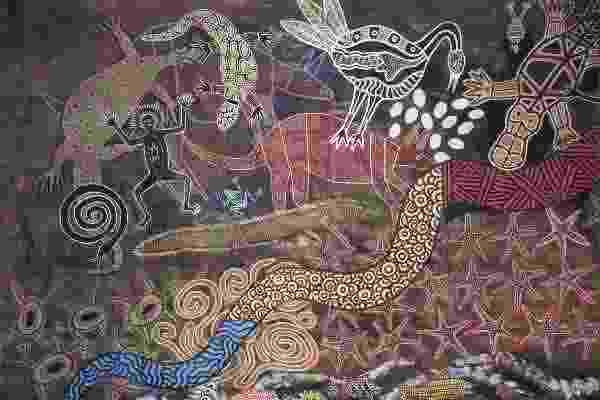
The Aboriginal Dreamtime, often called the Dreaming, is far more than a creation story. It is a living law that ties people to land, kin, and ancestors. Here is what it means, how its altered states work, and why it cannot simply be borrowed.
Aboriginal people have lived in Australia for at least 50,000 years. That makes their cultures among the oldest continuous cultures on Earth. Over that time, they built ways of understanding the world that are woven into the land itself. Every hill, waterhole, and rock formation can carry a story, a law, and a set of responsibilities.
Outsiders often meet these ideas through one English word: Dreamtime. The word is useful, but it can also mislead. It suggests a dreamy, distant past. To many Aboriginal dreamtime is neither a dream nor the past. It is the foundation of life, still active today.
Aboriginal dreamtime is also more than a belief system. It includes ceremony, song, initiation, and visionary experience. Some of these practices lead into altered states of awareness. Western writers have compared them to shamanic journeys, astral projection, and even time travel. Those comparisons are worth exploring, as long as we remember whose tradition it is.
What the Aboriginal Dreamtime is
The term “Aboriginal Dreamtime” comes from two anthropologists, Baldwin Spencer and Francis Gillen. In the 1890s, they used it to translate a word from the Arrernte people of central Australia. Some call it the Dreaming. The Anangu people of Uluru, for example, call it Tjukurpa.
It also helps to remember that there is no single Aboriginal culture. When Europeans arrived in 1788, more than 250 Aboriginal languages were spoken across the continent. Each nation had its own country, stories, and law. Torres Strait Islanders are distinct peoples with their own traditions. So any general description of Aboriginal dreamtime is a simplification.
With that in mind, many traditions share some core ideas. In Aboriginal dreamtime, ancestral beings traveled across the land. As they moved, they shaped rivers, hills, animals, and people. They also set down the law: how people should live, who they may marry, and how they must care for country. The land still holds the marks of that creation.
Anthropologist W. E. H. Stanner, who studied Aboriginal religion for decades, coined a word to capture this. He called Aboriginal dreamtime “everywhen.” It happened in the beginning, but it is also happening now. The ancestral beings are not gone. Their presence lives in the land, in ceremony, and in people.
Many groups also teach that a person’s spirit waits at a particular place before birth. A child is often linked to the spot where the mother first felt the pregnancy, or where a sign appeared. That place, and Aboriginal dreamtime tied to it, connects the person to the land for life. Your identity is not just who your parents are. It is also where your spirit comes from.
How Dreamtime differs from Western cosmology
The Abrahamic traditions are Judaism, Christianity, and Islam. Comparing them with Aboriginal Dreamtime helps outsiders see what makes it distinct. The point is not that one view is right. It is that they are built differently.
| Theme | Aboriginal dreamtime | Abrahamic traditions |
|---|---|---|
| Time | Creation is ongoing. Past and present exist together. | History moves in a line, from creation toward a final end. |
| Place | The stories are mapped onto real landscapes. The land is the record. | There are holy places, but the creation story isn’t tied to local hills and rivers. |
| Relationship | People, animals, plants, and places are kin. | Humans are usually set apart from, and given care over, the rest of creation. |
| Access | The sacred can be entered now, through ceremony, song, and dreams. | Revelation is mostly tied to sacred texts from the past, though mystics sought direct experience. |
| Practice | Faith is lived through duty to land, kin, and law. | Emphasis varies. Some branches stress belief, while others stress law and practice. |
Each of these differences shapes how Aboriginal dreamtime works.
Time that circles instead of marching
In the Abrahamic story, time has a direction. The world is created, people fall, history unfolds, and it all moves toward a final judgment. Each step happens once. In Aboriginal dreamtime, creation never fully ended. The ancestral events are still happening, and ceremony brings them into the present again. Time is less like a road and more like a set of layers that can be reached.
A sacred text written in the land
Most Western sacred stories don’t happen in your neighborhood. No one can point to the exact spot where Eden stood. In Aboriginal dreamtime, the opposite is true. A rock might be an ancestor’s body. A creek might be the track a great serpent carved. A hill might mark where two beings fought. The landscape is the scripture, and walking it is a way of reading.
A web of kin
In many Western traditions, humans stand apart from nature, with a duty to rule or care for it. In Aboriginal dreamtime people are related to animals, plants, and places. Many people belong to a totem, such as a kangaroo, a honey ant, or the rain. Kinship rules extend to that totem and the land it comes from. Harming it can be like harming family.
Doing, not just believing
Many Western traditions put weight on what you believe. Aboriginal dreamtime puts weight on what you do. Knowing the law means living it: performing ceremony, caring for country, and meeting your duties to kin. Knowledge isn’t proven by agreeing with it. It is proven by carrying it out.
➡ For more, see: The Core Principles of Shamanism: The Vision Quest
How knowledge is known in Aboriginal dreamtime
Aboriginal dreamtime is not just a set of stories. It is also a way of knowing. Knowledge in this system tends to be:
- Experienced: it is confirmed through direct experience in ceremony, dreams, and life on country, not just accepted.
- Relational: it comes from relationships with land, ancestors, and kin, not from standing back and observing.
- Embodied: movement, posture, song, and place are part of how it is learned and remembered.
- Tied to place: rocks, rivers, and tracks are both physical features and stores of information.
Western science asks for measurement and repeatable tests. Religious authority often relies on sacred texts and leaders. Modern psychology looks at inner states and personal stories. Aboriginal dreamtime combines elements of all three. It is tested in experience, rich in symbol, and deeply psychological. But it stays rooted in land and community in a way none of the others do.
Songlines: maps carried in song
Songlines are among the most remarkable parts of Aboriginal dreamtime. A songline traces the path an ancestral being took across the land. The songs describe that journey, place by place. Singing the song in order is like reading a map aloud.
Songlines did practical work. They helped people find water, food, and trade routes across huge distances. Some songlines run for hundreds or even thousands of kilometers. They cross the lands of many language groups. Each group holds its own section of the song.
Researcher Lynne Kelly has studied how songlines work as memory systems. Linking knowledge to places along a route makes it far easier to remember. That knowledge includes plants, animals, seasons, and law. It is the same idea behind the “memory palace” technique. But it is far older, and it is tied to real land instead of an imagined building.
Other traditions have their own maps of sacred space. Tibetan mandalas map the spiritual world in a circle. The Norse world tree, Yggdrasil, links the realms of creation. The Kabbalistic Tree of Life charts how the divine flows into the world. Songlines do something similar, with one big difference. They aren’t drawn on paper. They are walked, sung, and lived.
➡ For more, see: The Memory Palace Method: Learning Enhancement System
Ceremony and altered states
Much of Aboriginal dreamtime lives in ceremony. During ceremony, participants don’t just tell the old stories. They take part in them. Song, dance, body painting, and rhythm bring the ancestral world into the present. For many participants, this shifts awareness into a different state. The boundary between now and the Dreaming grows thin.
Much of this knowledge is restricted, so outsiders know only part of how it works. But anthropologists and Aboriginal teachers have described several key elements.
Preparation and initiation
The deepest ceremonies are not open to everyone. Initiation can take years, and elders decide who is ready. Young people may be taken away from camp and kept apart for weeks. They may face food restrictions, long silences, physical tests, and instruction at night. These conditions are demanding on purpose. Isolation, fasting, and lost sleep all change how the mind works. They also mark a clear break from ordinary life.
Initiation is not just about learning a technique. It builds character, discipline, and responsibility. A person has to be able to carry what they learn and use it for the community rather than for themselves.
Song, rhythm, and repetition
Ceremonies often last for many hours, sometimes over several nights. Long song cycles are sung in a set order, verse after verse, with the steady beat of clapsticks. In northern Australia, the didgeridoo adds a deep, continuous drone. It comes from Arnhem Land, where the Yolŋu people call it the yidaki, and it is played with circular breathing.
Repetition like this is used by cultures around the world to shift awareness. A steady beat, a droning sound, and hours of focus can quiet everyday thinking and open the mind to vivid imagery. Researchers have studied this mostly in other traditions. A few small studies suggest steady drumming can change brain wave patterns, but the evidence is limited. What is clear is that these practices reliably change how people feel and perceive.
The didgeridoo has one well-studied effect of its own. A 2006 study in the BMJ found that learning to play it eased sleep apnea. The breathing technique strengthens the muscles of the throat.
➡ For more, see: Shamanic Journeying Sounds and Rhythms
Clever men and visionary training
Some communities have people with special spiritual training. They are often called clever men, or in some places, clever women. In the 1940s, anthropologist A. P. Elkin collected accounts of their initiation in his book Aboriginal Men of High Degree.
The accounts describe a kind of death and rebirth. In some, spirits or elders were said to open the candidate’s body and place magic quartz crystals inside. Afterward, the clever man was believed to have new powers. He could heal and see inside a sick person’s body. Some accounts describe a magic cord that a clever man could sing out of his own body and then climb or travel along.
Elkin recorded these as the beliefs and experiences of the people he met. He couldn’t test them, and neither can we. But the pattern is striking. Death-and-rebirth initiations and spirit flight appear in shamanic traditions around the world. Women also hold their own ceremonies and their own law. Anthropologist Diane Bell documented these in her book Daughters of the Dreaming.
Dreams as a doorway
Night dreams matter, too. Anthropologist Robert Tonkinson worked with the Mardu people of the Western Desert for decades. He described how a dreamer may travel in spirit form during sleep. In dreams, spirit beings linked to the ancestors reveal new rituals. The dreamer shares the revelation, and others add songs, dances, and body designs. Over time, the new ritual passes from group to group.
So Aboriginal dreamtime isn’t only reached through ceremony. It can also be reached in sleep. That makes dreams a source of real knowledge, not just private images.
➡ For more, see: Integrating Altered-State Experiences Into Daily Life
What science can and can’t say
Psychologist Dieter Vaitl and his colleagues reviewed decades of research on altered states. Many different methods can produce them. These include rhythm, fasting, isolation, sleep loss, and deep focus. These states show real, measurable differences from ordinary waking, dreaming, and sleep.
But science has almost no direct data on Aboriginal ceremony. The practices are restricted, and they aren’t meant to be studied from outside. Any scientific explanation is a general one, drawn from other traditions.
Time travel and astral projection
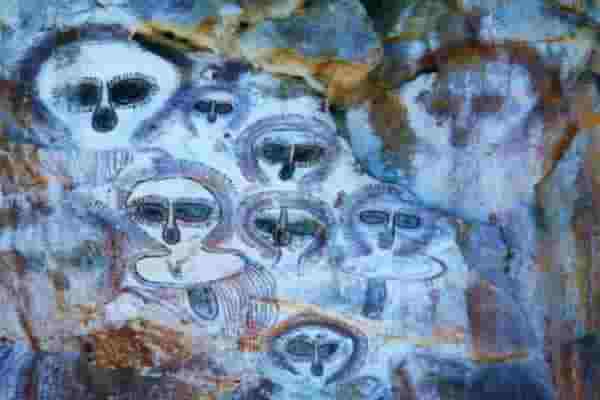
Western writers often compare Aboriginal dreamtime to time travel and astral projection. These comparisons aren’t random. They grow out of two real features of the Dreaming: its view of time, and its accounts of spirit travel. But the comparisons also leave out a lot.
Moving through time
In the Western picture, the past is gone. You can remember it, but you can’t go back. In Aboriginal dreamtime, the creation time is still present, so ceremony doesn’t remember it. It re-enters it. When dancers perform an ancestor’s journey, they don’t just act it out. In a sense, they become part of it.
Historian of religion Mircea Eliade described something similar in many cultures. He called it sacred time: a time of origins that ritual can open again and again. This is why Aboriginal dreamtime sounds like time travel to outsiders. It isn’t a machine that moves you to another date. It is a way of stepping into a time that never stopped.
Some writers go further and compare this to the “block universe” in physics. That is the idea that past, present, and future all exist at once. The comparison can be a helpful picture. But it is a metaphor, not evidence. Physics doesn’t prove Aboriginal dreamtime, and it doesn’t need physics to have meaning.
Spirit travel and astral projection
In Western esoteric traditions, astral projection means the mind leaving the body and traveling elsewhere. In the 1970s, writer Robert Monroe made the idea popular with his accounts of “journeys out of the body.”
Aboriginal dreamtime has its own accounts of spirit travel. Clever men were said to travel along a magic cord. Mardu dreamers were said to travel in spirit form during sleep. On the surface, these sound like astral projection.
The differences are just as important. Western astral projection is usually a private adventure. The traveler explores and reports back. Dreaming travel is tied to country, ancestors, and law. The spirit travels along known routes, meets known beings, and brings back knowledge for the community.
Science has studied the out-of-body feeling itself. Surveys suggest that roughly one person in ten has had at least one. In 2002, neuroscientist Olaf Blanke and his team were treating a woman with epilepsy. When they stimulated one small area on the right side of her brain, she felt herself floating above her own body. That shows the experience is real and has a basis in the brain. It doesn’t settle whether anything actually leaves the body.
Lucid dreaming and shamanic journeying
Two other comparisons come up often.
Lucid dreaming means becoming aware that you are dreaming, and sometimes shaping the dream. It is usually private and personal. Dreaming journeys, by contrast, are shared. Their meaning comes from a whole community’s stories and law.
Shamanic journeying, as Michael Harner taught it to Western students, uses steady drumming to reach an inner spirit world. The journey is mostly symbolic and personal, often used for healing. Aboriginal dreamtime includes visionary travel, but it is also a full system of law, kinship, and land. A journey is never just about the traveler.
➡ For more, see: Learning The Lucid Dreaming Process
Claims of seeing far away or into the future
Some popular books make bold claims. They say Aboriginal people could describe distant places or foresee the future with great accuracy. Older accounts of clever men do list powers like clairvoyance, the ability to know things beyond ordinary sight.
These are reports of what people believed and experienced. They are hard to check, and many of the boldest claims come from outside writers, not from Aboriginal sources. The honest position is to treat them as part of the tradition’s experience. That means neither claiming they are proven nor dismissing them as nonsense.
Other traditions describe similar abilities. The yoga tradition, for example, speaks of siddhis, powers said to arise from deep meditation. Wherever such claims appear, they deserve both open curiosity and careful testing.
➡ For more, see: The TM Yoga Siddhis Sutras of Patanjali
Why Aboriginal dreamtime cannot be borrowed
Aboriginal dreamtime survived something terrible. After 1788, colonization brought disease, violence, and the loss of land. Missions and government policies tried to stamp out Aboriginal languages and beliefs. For decades, many children were taken from their families. They are now called the Stolen Generations. Fewer than half of the original languages are still spoken today.
Aboriginal dreamtime endured because Aboriginal people kept it alive, often at great cost. That history is one reason outsiders need to tread carefully.
Much Dreaming knowledge is restricted. Some stories are public. Others belong to particular groups, families, or genders, and are passed on only through initiation. Elders decide who is ready and what they may know. This isn’t secrecy for its own sake. Knowledge carries responsibility, and the system works only when that responsibility stays attached.
That is why Aboriginal dreamtime can’t be “downloaded” as a technique. Imagine taking the song cycles, the seclusion, and the long nights of ceremony and turning them into a weekend workshop. Without the country, the kin, the law, and the elders, those practices lose what makes them work. Taking them also repeats an old pattern of taking from Aboriginal people without asking.
A clear example of respect came in 2019. The Anangu traditional owners of Uluru had long asked visitors not to climb the rock, which is sacred in Tjukurpa. In October 2019, the climb was closed for good. Visitors can still walk around Uluru, listen to its stories, and learn. They simply don’t climb.
What outsiders can learn
You don’t need to practice Aboriginal dreamtime to learn from it. Some of its deepest lessons can be lived anywhere, without borrowing what isn’t yours.
Learn whose land you are on
Every place has a deeper history than its street names suggest. In Australia, people often begin events with an acknowledgment of the Traditional Owners of the land. You can do something similar wherever you live.
Find out which Indigenous peoples lived there first, what they called the place, and what their stories say about it. Online maps like Native Land Digital are a good starting point. Knowing a place’s history changes how you walk through it.
Practice deep listening
Miriam-Rose Ungunmerr-Baumann is an Aboriginal elder and educator from the Daly River region of the Northern Territory. In 1988, she wrote about dadirri, which she described as inner, deep listening and quiet, still awareness. Her foundation now shares it as a gift, offered in the spirit of reconciliation. It means sitting quietly, often outdoors, and listening without rushing to speak or fix anything. It means waiting for understanding to come in its own time.
You can begin simply. Sit by a tree, a river, or even a window. Stay still for ten minutes. Let sounds come and go. Notice what you usually hurry past.
See yourself as part of a web
Aboriginal Dreamtime teaches that your identity includes your people, your place, and the living things around you. Try seeing your own life this way. Who and what keeps you alive? Which places shaped you? What do you owe them in return? These questions move the focus from “me” to “us.”
Treat knowledge as a duty
In Aboriginal dreamtime, knowing something means being responsible for it. You could apply that to anything you learn. Before sharing a story, a practice, or a teaching, ask: Is it mine to share? Do I understand it well enough? Will sharing it help or harm?
Loosen the grip of straight-line time
Western life often treats the past as finished and the future as a race. Aboriginal dreamtime suggests another view. Your ancestors’ choices still shape you, and your choices will shape those who come after. Pay attention to the seasons where you live. Learn the stories of the people who came before you. Think about the people who will live in your place a hundred years from now.
➡ For more, see: The Spiritual Technologies: Pillars, Capacities and Mechanisms
Why Aboriginal dreamtime matters now
The world faces an ecological crisis, and many people feel cut off from place and meaning. Aboriginal dreamtime offers a model of something different. It roots identity in land, ancestry, and responsibility. It asks for care and reciprocity, not just use. And it reminds us that humans have always had ways to explore consciousness far beyond ordinary waking life.
Conclusion
The Aboriginal Dreamtime is not a myth about the distant past. It is a living law that connects people to land, kin, and ancestors, in a way that has lasted tens of thousands of years. Its songlines turn the land into a map and a library. Its ceremonies, initiations, and dreams open a time that never stopped.
That is why outsiders reach for words like time travel and astral projection. The comparisons point at something real, but Aboriginal dreamtime is bigger than any of them. For outsiders, the right stance is respect. We can learn about Aboriginal dreamtime and let it challenge how we see time and belonging. We can practice the lessons its custodians have chosen to share. Its deepest practices belong to the people who carried them through every hardship.
References
- The Native Tribes of Central Australia. Baldwin Spencer and F. J. Gillen, 1899.
- The Dreaming. W. E. H. Stanner, 1953.
- The World of the First Australians. Ronald M. Berndt and Catherine H. Berndt, 1964.
- The Sacred and the Profane: The Nature of Religion. Mircea Eliade, 1957.
- Australian Religions: An Introduction. Mircea Eliade, 1973.
- Aboriginal Men of High Degree: Initiation and Sorcery in the World’s Oldest Tradition. A. P. Elkin, 1977.
- Daughters of the Dreaming. Diane Bell, 1983.
- Dadirri: Inner Deep Listening and Quiet Still Awareness. Miriam-Rose Ungunmerr-Baumann, 1988.
- The Mardu Aborigines: Living the Dream in Australia’s Desert. Robert Tonkinson, 1991.
- Ancestral Connections: Art and an Aboriginal System of Knowledge. Howard Morphy, 1991.
- Nourishing Terrains: Australian Aboriginal Views of Landscape and Wilderness. Deborah Bird Rose, 1996.
- Dream-Spirits and Innovation in Aboriginal Australia’s Western Desert. Robert Tonkinson, in Dream Travelers, edited by Roger Ivar Lohmann, 2003.
- The Memory Code. Lynne Kelly, 2016.
- Psychobiology of Altered States of Consciousness. Dieter Vaitl and colleagues, Psychological Bulletin, 2005.
- Didgeridoo Playing as Alternative Treatment for Obstructive Sleep Apnoea Syndrome: Randomized Controlled Trial. Milo A. Puhan and colleagues, BMJ, 2006.
- The Way of the Shaman. Michael Harner, 1980.
- Journeys Out of the Body. Robert A. Monroe, 1971.
- Stimulating Illusory Own-Body Perceptions. Olaf Blanke and colleagues, Nature, 2002.
- AIATSIS Code of Ethics for Aboriginal and Torres Strait Islander Research. Australian Institute of Aboriginal and Torres Strait Islander Studies, 2020.
About this project
Seeker Project 4 Spiritual Exploration (SP4SE) offers resources for exploring consciousness. It also helps with awareness and self-observation. It is a project of Americans In Alliance.
- Support SP4SE to help maintain and develop its educational resources.
- Visit Americans In Alliance to learn more about the parent organization.