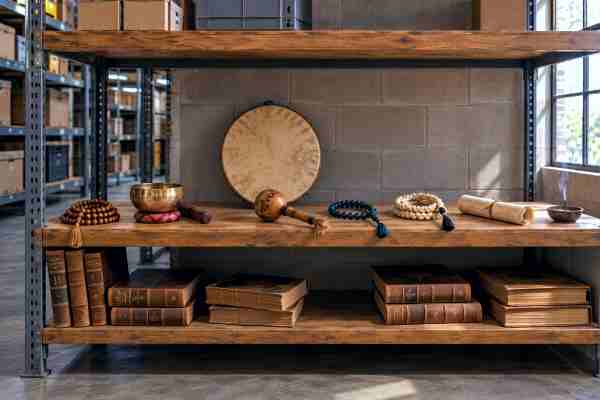
The ancient traditions of the world act as a storehouse for spiritual tools. The various religions and spiritual approaches may disagree about God, yet they each have built nearly the same methods. Attention training, repetition, breath, and inner maps appear in faiths that never met. That shows the spiritual tools work on the mind itself.
Every tool used for spiritual exploration today has a history. People discovered that repeating a sound quiets the mind. They learned that watching the breath steadies attention. Others found that a map of the inner world helps people find their way through it. Those discoveries were too valuable to lose, so religions and cultures kept them.
That is the best way to think about the world’s ancient traditions. Each one acted as a storehouse for spiritual tools. Monks, mystics, shamans, and teachers protected these methods for centuries. They kept more than the methods themselves. They also kept the reasons behind them, the preparation they required, and the warnings that came with them.
This article looks at eight ancient traditions that act as a storehouse for spiritual tools. It includes a range of Eastern and Western thought from shamanic cultures to Gnosticism. The goal is not to choose a tradition. It is to see which tools each one developed and the context in which each tool was taught. This knowledge can help you choose the right spiritual tools.
What ancient traditions kept
A spiritual tool is not like a hammer. A hammer works the same in anyone’s hand. A spiritual tool was taught in a certain order, with certain preparation, and with a clear sense of what it should lead to. In a way, you can leave a tradition’s beliefs behind. What you can’t leave behind is the context the tool was taught in, because that context is part of how it works.
The siddhis are an example of how a storehouse for spiritual tools can preserve both traditional context and method. Many who teach the sutras of Patanjali require a history of grounding meditation first, often six months at a minimum. Students learn to settle into a steady, quiet state through japa or Transcendental Meditation. Only then do they learn the mechanics of using a sutra from inside that state. Without the grounding, the sutras are just words.
North American shamanic traditions follow the same rule. A student does not begin with psychotropic plant medicine. They first learn to journey with a drum or rattle. Only when they can show they know how to enter, travel, and return safely are they even considered for anything stronger.
That order is not a ritual detail. It is how a tradition keeps a tool safe and makes it work. Skip the steps, and the tool often does nothing, or it does something you are not ready to handle.
Shamanic cultures: the first storehouse for spiritual tools
Long before written scripture, shamanic cultures were experimenting with consciousness. The term shaman originates from the Evenki people in Siberia. Similar practices can also be found in the Americas, Africa, Asia, and Australia.
Historian of religion Mircea Eliade called these methods “archaic techniques of ecstasy.” They include steady drumming and rattling to shift awareness. Fasting and solitude are essential during the vision quest. The journey involves a guided inner trip to meet symbolic helpers and seek answers. Similar themes, like rhythm and isolation, appear in many ancient traditions. They also share a structured inner landscape.
➡ For more, see: Step-By-Step Shamanic Journey Guide
Hindu traditions: sound, sutra, and the subtle body
India’s traditions may be the largest storehouse of spiritual tools. For over three thousand years, they have made tools for sound, posture, breath, focus, and devotion.
Mantra and japa
A mantra is a sound, word, or phrase used to focus the mind. Japa is the practice of using a mantra in an effortless way and allowing the mind to follow it as it diminishes. This method was rebranded for Western use by Maharishi Mahesh Yogi as Transcendental Meditation (TM). Repeating the mantra gives the restless mind one simple job, and the noise around it begins to settle.
TM keeps the traditional way of teaching the mantra, including the puja, a short ceremony that introduces it. This helps the student bring the right attention to the practice. Regular checking by a teacher keeps the practice on track and gives it the best results.
➡ For more, see: The Catalog of Mantras: Traditional Forms and Uses
The Yoga Sutras and the siddhis
About two thousand years ago, a teacher named Patanjali gathered the methods of yoga into 196 short verses called the Yoga Sutras. They describe eight limbs, or steps, from ethics and posture to deep concentration. The third book describes siddhis, unusual abilities said to come from advanced practice. Patanjali himself warned that these powers can become obstacles, a guardrail that is often left out when the siddhis are taught today.
➡ For more, see: The TM Yoga Siddhis Sutras of Patanjali
Chakras and the third eye
Later tantric texts described a subtle body. It has energy centers called chakras that run along the spine. The sixth chakra, ajna, is located between the eyebrows. It’s often called the third eye. This chakra is the center of insight and inner vision. The tidy seven-chakra system we know today was greatly influenced by Western books in the twentieth century. This shows how spiritual tools evolve as they spread.
➡ For more, see: The Third-Eye Activation Process
Buddhism: the science of attention
About 2,500 years ago, the Buddha taught that suffering could be understood by watching the mind closely. His followers turned that idea into one of the most detailed toolkits for attention ever built.
The core tool is mindfulness. An early text called the Satipatthana Sutta lays out four areas to observe: the body, feelings, the mind, and the patterns of thought. Two kinds of meditation grew from it. Calm meditation trains the mind to rest on one object. Insight meditation trains it to watch thoughts arise and fade without grabbing them.
As Buddhism spread, each region added its own spiritual tools. Zen added the koan, a puzzle with no logical answer that pushes the mind past its habits. Tibetan teachers developed detailed visualization and mandalas. Many schools practice walking meditation and loving-kindness. Today’s mindfulness programs in hospitals and schools came from this storehouse, though most left behind the ethical path that once surrounded the practice.
➡ For more, see: Meditation Methods for Training Attention
Taoism: breath, energy, and effortless action
Taoism grew in ancient China around two short books, the Tao Te Ching and the Zhuangzi. Their central idea is wu wei, often translated as effortless action. It means working with the natural flow of things instead of forcing them.
Taoist practitioners treated the body as a laboratory. They developed breathing methods to gather and move qi, or life energy. A practice called internal alchemy used breath, posture, and visualization to refine that energy. This mirrors the European concept of alchemy, which attempted to refine metal into gold. The Zhuangzi describes “sitting and forgetting.” This is a meditation that helps you let go of all you know. The methods of qigong and tai chi keep the energy-based spiritual tools alive.
➡ For more, see: Breathwork Practices and Techniques
Sufism: remembrance and the turning heart
Sufism is the mystical side of Islam. Its central practice is dhikr, which means remembrance. Sufis repeat the names of God, often linked to the breath, sometimes for hours. It is a close cousin of japa, developed independently in a different faith.
Sufis also used music and movement. In a practice called sama, or listening, poetry and music open the heart. Rumi’s followers are famous for their turning. This slow spinning meditation is still done today. Another Sufi tool, muraqaba, means watchfulness. The practitioner sits quietly and observes the heart, much like Buddhist mindfulness.
➡ For more, see: Moving Meditation: Training Attention with Motion
Christian mysticism: prayer, silence, and self-review
In the third and fourth centuries, Christian monks and nuns moved into the deserts of Egypt to live in silence. These Desert Fathers and Mothers became some of Christianity’s earliest guides on the inner life.
Evagrius Ponticus named eight “thoughts” that steal peace. They include anger, pride, and boredom. His list later became the seven deadly sins. It is also one of the roots of the modern Enneagram, which maps nine personality patterns. Teacher George Gurdjieff introduced the Enneagram symbol to the West in the early 1900s. He said it came from an ancient brotherhood in Central Asia. Historians have never confirmed that claim, but the line from Evagrius to the Enneagram’s list of patterns is well documented.
Christian mystics added other spiritual tools, too. The Jesus Prayer, repeated with the breath, is Christianity’s own version of japa and dhikr. Lectio divina is slow, reflective reading. The fourteenth-century book The Cloud of Unknowing taught that focusing on one short word can calm the mind. This idea inspired modern centering prayer. In the 1500s, Ignatius of Loyola created the examen. This practice involves a daily review of your thoughts and actions. It serves as an early form of journaling for self-observation, helping individuals reflect on their daily lives.
➡ For more, see: The Mechanisms Behind The Enneagram
Kabbalah: maps of the inner world
Kabbalah is the mystical tradition of Judaism. Its best-known book, the Zohar, appeared in Spain in the late 1200s. Kabbalah’s most famous tool is the Tree of Life, a diagram of ten connected spheres called sefirot. Each sphere stands for a quality, such as wisdom, mercy, or strength. Together they form a map of how the divine and the human mind are structured.
Maps like this are tools in their own right. They help a seeker locate where they are and what comes next. Kabbalists meditated on Hebrew letters and sacred names. They combined these with breath in long, focused sessions. Centuries later, Western Hermetic groups used the Tree of Life. They changed it for their magical and psychological practices.
➡ For more, see: Practical Ways to Use Ancient Hermetic Teachings Esoteric Knowledge
Gnosticism: knowing for yourself
The Gnostics were early groups, mostly from the second century, who blended Christian, Jewish, and Greek ideas. Their name comes from gnosis, the Greek word for knowledge. They did not mean book learning. They meant direct, inner knowing.
The Gnostics taught that each person carries a spark of the divine, and that self-knowledge is the path to finding it. Church authorities called them heretics, and most of their writings were lost. Then, in 1945, farmers in Egypt dug up a jar holding thirteen ancient books, now called the Nag Hammadi library. One of them, the Gospel of Thomas, teaches that the kingdom is found by knowing yourself.
Gnosticism’s tool is less a technique than a stance. It puts your own experience above the authority of an institution. That stance is the root of every questioning seeker, and the reason institutions have often tried to stamp it out.
➡ For more, see: The Ancient Mystery Religions and The Abrahamic Traditions
Same spiritual tools, different names
Put these ancient traditions side by side, and a pattern appears. Cultures that never interacted created similar tools. This happened because they all shared the same human mind. Each tradition shaped its version for a specific purpose. This purpose affects how the tool works.
| Tool | Where it appears | What it does |
|---|---|---|
| Repetition | Hindu japa, Sufi dhikr, the Christian Jesus Prayer, shamanic chant | Gives the mind one job and quiets mental noise |
| Watching the mind | Buddhist mindfulness, Sufi muraqaba, the Christian examen | Builds the inner observer |
| Breath | Yoga, Taoist qi practice, Kabbalist letter meditation, dhikr | Steadies the body and anchors attention |
| Rhythm and movement | Shamanic drumming, Sufi turning, tai chi, walking meditation | Shifts awareness through the body |
| Inner maps | Chakras, the Tree of Life, the Enneagram, the shamanic three worlds | Shows where you are and what comes next |
| Direct knowing | Gnostic gnosis, Zen koans, Taoist “sitting and forgetting” | Moves past belief to firsthand experience |
Using a tool in its context
Scholars have argued for decades about what these shared tools mean. In 1945, Aldous Huxley’s book The Perennial Philosophy claimed that all mystics reach the same truth by different roads. In 1978, philosopher Steven Katz and others pushed back. They said each tradition shapes its mystics’ experiences. So, a Christian mystic meets Christ, while a Buddhist meets emptiness.
Both sides have a point. The tools overlap because they work on the same human mind. What a person experiences with them depends on how the person was prepared and what they expected. It also depends on what their teachers trained them to notice. The spiritual tool is shared. The training around it is not.
Ancient traditions also stored guardrails along with the tools. Teachers checked whether a student was ready before moving them forward. Communities helped people make sense of strong experiences and return to ordinary life. When you practice on your own, you have to supply those guardrails yourself. Learn what a tool was for, what came before it, and what was supposed to come after. Then plan how you will bring what you experience back into daily life.
➡ For more, see: Integrating Altered-State Experiences Into Daily Life
The storehouse for spiritual tools
The world’s mystical traditions disagree about God, the soul, and the afterlife, but they agree far more about method. Repetition, attention, breath, rhythm, inner maps, and direct knowing show up again and again.
Seeing ancient traditions as a storehouse for spiritual tools changes how you use them. You don’t have to become Hindu to practice japa, Buddhist to practice mindfulness, or Christian to keep a daily examen. You can leave the beliefs behind. The context is what you keep, because each tool still depends on it. The history is not a museum label. It is part of the instructions.
➡ For more, see: Exploring Mysticism and Becoming A Modern Mystic
References
- Shamanism: Archaic Techniques of Ecstasy. Mircea Eliade, 1951.
- The Yoga Sutras of Patanjali. Edwin F. Bryant, 2009.
- The Heart of Buddhist Meditation. Nyanaponika Thera, 1954.
- McMindfulness: How Mindfulness Became the New Capitalist Spirituality. Ronald E. Purser, 2019.
- Tao Te Ching. Laozi, c. 4th century BCE.
- Mystical Dimensions of Islam. Annemarie Schimmel, 1975.
- The Cloud of Unknowing. Anonymous, late 14th century.
- The Spiritual Exercises. Ignatius of Loyola, 1548.
- Major Trends in Jewish Mysticism. Gershom Scholem, 1941.
- The Gnostic Gospels. Elaine Pagels, 1979.
- The Perennial Philosophy. Aldous Huxley, 1945.
- Mysticism and Philosophical Analysis. Steven T. Katz, editor, 1978.
About this project
Seeker Project 4 Spiritual Exploration (SP4SE) offers resources for exploring consciousness. It also helps with awareness and self-observation. It is a project of Americans In Alliance.
- Support SP4SE to help maintain and develop its educational resources.
- Visit Americans In Alliance to learn more about the parent organization.