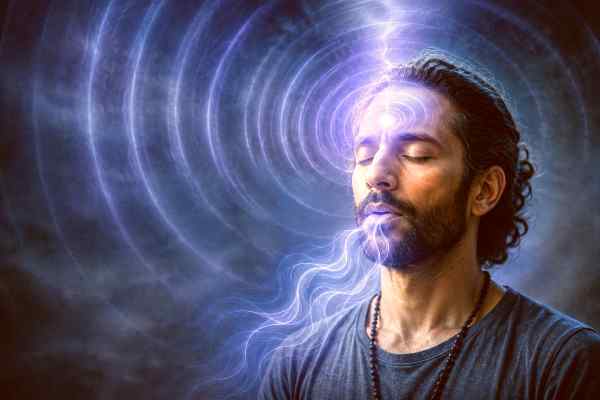
The third-eye activation process is an advanced practice that uses breath, sound, attention, and vibration to change inner perception.
This article has one purpose: to explain the third-eye activation process. It does not cover the full history of the third eye, all possible benefits and risks, or the larger chakra system. Those subjects are covered in other articles listed below.
This is not a beginner practice. Understand what the exercise may involve and complete the needed preparation before moving forward.
The third-eye activation process trains focus and induces an altered state using symbolic encoding and observer awareness. It creates lasting changes in perception.
Inner Work Gate Notice:
This is an advanced practice that may bring unfamiliar sensations, emotions, dreams, or changes in perception. Emotional stability and a solid grounding practice should come first. If you are under medical care for a mental health condition or take medication that affects mood or perception, discuss this type of practice with your healthcare professional before proceeding.
Before attempting activation
Do not begin with the third-eye activation exercise just because you are curious about the third eye. The goal is not to prove that you can make something happen. The goal is to enter an unfamiliar experience with enough stability to observe what happens without being overwhelmed by it.
The first question is whether you should open the third eye at all. The decision to use the third-eye activation process includes the possible benefits, drawbacks, changes in perception, and the level of preparation involved.
➡ For More See: Making a Decision to Open the Third Eye
You should also have an established meditation practice. You should practice Japa Meditation or Transcendental Meditation (TM) for at least six months before attempting the third-eye activation process.
The goal is attention training. You should be able to settle your attention and remain with an inner experience of the transcendent for 20 minutes. This inner silence should be free of any internal dialogue. You should be refreshed when you return to ordinary awareness.
➡ For More See: Meditation Methods for Training Attention
Experience with transcendental consciousness gives you experience with an altered state. You should already know what it feels like when ordinary mental activity becomes quiet while awareness remains present. This gives you a familiar inner state to return to when new sensations appear.
➡ For More See: Transcendental Consciousness — The Fourth State
The Shamanic Journey provides another useful form of preparation. You should be able to begin a journey, remain aware during it, follow the experience without losing yourself in it, recognize the return signal, and return fully to ordinary awareness.
➡ For More See: Step-By-Step Shamanic Journey Guide
Grounding is equally important. A strong inner experience is easier to manage when you can bring your awareness back to the body, breath, surroundings, and present moment. If you cannot settle yourself after meditation, intense dreams, or emotional experiences, strengthen this skill before continuing.
➡ For More See: The Path to Presence Through Mindfulness and Grounding
Finally, check your emotional readiness. The third-eye activation process should not be used to escape grief, fear, anger, trauma, or another unresolved problem. An altered state can bring existing material closer to awareness rather than make it disappear. If your emotions already feel hard to manage, deal with that first.
➡ For More See: The Emotional Check-In Process
Preparation is not a barrier placed in front of the practice. It is part of the practice.
Part one: initial activation
The first part of the third-eye activation process uses tonal resonance. You make a sustained sound while directing attention toward the area between and slightly above the eyebrows.
The important part is not simply saying a word. You are looking for a combination of sound, vibration, breath, and attention that produces a noticeable sense of resonance.
Use the sound “Thoh,” pronounced like “TOE.”
Your natural resonant pitch may not be the same as another person’s. You may need to adjust the volume and tone several times before finding the vibration that feels strongest for you.
Prepare the body and attention
Choose a quiet place where you will not be interrupted. Sit comfortably with your back straight but not rigid. Let your shoulders relax. Your head should feel balanced over your shoulders rather than pushed forward or held stiffly.
Close your eyes.
Take a slow breath in through your nose. Allow the breath to fill naturally. Hold it only as long as it remains comfortable. The goal is not to test how long you can hold your breath.
Allow yourself to settle. Notice your body and breathing. Then bring your attention toward the area of the forehead associated with the third eye.
Do not strain your eyes or squeeze the muscles in your face. Attention is enough.
Form the Thoh sound
When you are ready to exhale, open your mouth slightly. Keep a small space between your upper and lower teeth.
Place the tip of your tongue lightly between the teeth. Do not bite down or press hard. The tongue should make gentle contact.
Begin the sound with the same “th” used in the word “the.”
As you slowly breathe out, extend the sound:
T-H-H-O-H-H
Make the sound through one long, comfortable exhale.
Start with a natural volume. Listen to the tone and notice how the vibration feels in your tongue, mouth, jaw, face, and forehead. Keep the sound smooth rather than forced.
Find your resonant tone
Start at a comfortable middle pitch. Then move slightly higher or lower and notice how the vibration changes.
One pitch may stay mainly in the mouth or throat. Another may create a stronger vibration through the jaw or face. Look for the tone that produces the clearest sensation around the forehead while your attention remains focused there.
Do not become so concerned about getting the sound “right” that you stop observing what is happening. Finding your resonant tone is part of the exercise.
When done correctly, there should be a clear resonance around the forehead as the main feedback cue. Some people may notice pressure, warmth, tingling, pulsing, or vibration. Others may notice something much less dramatic.
These sensations are experienced during the exercise. Do not treat a forehead sensation by itself as proof that a physical gland has changed or that something supernatural has occurred.
If you feel nothing, do not force the exercise. Take a break and try again later.
Wait about 30 minutes before another attempt and limit yourself to five attempts in one day. If repeated attempts produce nothing, return to preparation instead of increasing the force, volume, breath holding, or length of the exercise.
Complete the first activation sequence
Once you find a comfortable tone that produces a clear sense of resonance, continue the Thoh sound for at least five breaths.
Use one long vocalization during each exhale.
The basic cycle is:
- Inhale slowly.
- Bring your attention to the forehead.
- Place the tongue lightly between the teeth.
- Exhale while sustaining the Thoh sound.
- Notice the vibration without chasing it.
- Pause briefly before the next breath.
Complete at least five cycles.
The exercise should take only a few minutes. Longer does not mean better.
The third-eye activation process calls for completing Part One on three consecutive days, with about 24 hours between sessions.
Do not perform several sessions on the same day to speed things up. The spacing is part of the method.
After the third session, stop the activation sequence and begin the observation period.
Immediate feedback and when to stop
People can notice a range of sensations during or shortly after Part One. These may include pressure, tingling, throbbing, warmth, vibration, or a feeling of activity around the forehead.
Not everyone will experience the same thing. The intensity of an experience also does not tell you how advanced you are. A strong sensation is not a spiritual score, and a mild experience is not a failure.
Pay attention to what actually happens rather than what you expected to happen.
Some people may experience discomfort or headaches after concentrated breath, sound, or attention practices. If discomfort becomes strong, stop. Do not respond by chanting louder, holding the breath longer, repeating the exercise many more times, or forcing your attention into the forehead.
Return to ordinary awareness.
Open your eyes. Notice the room. Feel your feet and body. Drink some water. Walk around if that helps you feel fully present again.
If an unusual physical or psychological symptom is severe, continues, or concerns you, treat it as a health issue rather than automatically labeling it a sign of spiritual progress.
The purpose of this process is expanded exploration with awareness. It is not a contest to see how much discomfort you can endure.
The 90-day integration period
Part Two does not begin when Part One ends.
The third-eye activation process calls for a 90-day waiting period after completing the first activation sequence.
Do not use Part Two the following week because you feel excited about the first experience. Do not shorten the waiting period because you felt nothing dramatic. Part Two is meant to follow a period of observation and integration.
During these 90 days, continue normal meditation and grounding practices. Do not spend the entire period searching for signs that something happened. Live your life and observe naturally.
Notice whether there are changes in:
- Meditation
- Dreams and dream recall
- Visualization
- Attention
- Emotional sensitivity
- Intuition
- Inner imagery
- Your response to people and surroundings
Changes may be obvious, subtle, temporary, or absent.
Keep notes about what you experience so you can compare changes over time. The recording process is explained below.
If the first stage left you feeling unstable, confused, fearful, or unable to remain grounded, do not move into Part Two just because 90 days have passed. A calendar does not determine readiness.
Return to the preparation work instead.
Part two: extending the activation process
Part Two adds another sound and a different direction of attention. It should be attempted only after the 90-day integration period.
This stage begins by returning briefly to the first activation method. You then use another sustained sound while shifting attention from the forehead toward the middle and upper part of the head.
The sound used in this stage is “MAY,” pronounced like the English word “may.”
As with Part One, the exact pitch is individual. The goal is to find a tone that produces a comfortable sense of resonance rather than forcing your voice into a fixed note.
Prepare and repeat part one
Sit comfortably with your back straight and your muscles relaxed.
Let your head balance naturally above your shoulders.
Close your eyes. Take a deep but comfortable breath. Hold it for a count of five if that feels easy. Release it slowly.
Repeat this three times.
These breaths are used to settle the body and bring attention inward. They are not meant to create strain or dizziness.
After the third breath, bring your attention toward the forehead. Notice whatever is present.
You may feel pressure, warmth, tingling, vibration, or nothing unusual at all.
Next, repeat the activation sequence from Part One using the Thoh sound. When that sequence is complete, sit quietly for about 30 seconds and allow your breathing to return to normal.
Use the MAY tone
Take another comfortable breath.
Hold it only as long as there is no strain.
As you release the breath, slowly vocalize:
M-a-a-a-a-a-a-a-ay
Stretch the sound across one smooth exhale.
As you make the sound, begin with your attention at the third-eye area. Then imagine or sense that attention moving inward toward the middle of the head.
Do not try to physically push anything through your head. This is directed attention.
Notice how the vibration changes as you adjust the pitch. Try a slightly higher or lower tone until you find one that seems to resonate more fully through the head.
Once you find a comfortable pitch, inhale again and repeat.
Complete five repetitions.
As you become comfortable with the sequence, allow your attention to move from the forehead, through the middle of the head, and toward the crown or top of the head.
This movement of attention is part of the second-stage process.
Continue the MAY sound for about three minutes. There is no need to make the exercise longer.
Stop if you feel significant discomfort, dizziness, distress, or a sense that you are losing control of the experience.
When finished, remain seated for a few minutes with your eyes closed.
Let your breathing return to normal. Do not immediately begin analyzing what happened. Simply observe the sensations that remain. Then open your eyes slowly and return your attention to the room around you.
Recording and integrating the experience
Your journal or book of shadows is an important part of both stages of the third-eye activation process.
Do not record only dramatic experiences. Small details become more useful when you compare them over time.
After a session, write down:
- The date and time
- How you felt before beginning
- The pitch or tone that seemed to work best
- Where you noticed vibration
- Any pressure, warmth, tingling, or other sensations
- Your emotional state during the practice
- Images, memories, or thoughts that appeared
- How you felt immediately afterward
- Changes in meditation during the following days
- Changes in dreams or dream recall
- Anything unusual that repeated more than once
Do not rush to give every experience a spiritual meaning.
A strange dream is still one dream. A sudden thought is still one thought. A sensation is still a sensation.
Patterns become more useful when they repeat and can be compared with other experiences. Journaling gives you the distance needed to observe without immediately turning every event into a conclusion.
This is where Observer Awareness becomes important. You are not simply having experiences. You are learning to notice them while they happen and examine them afterward.
➡ For More See: Meta-Awareness And Inner Observation
The same rule applies to intuitive impressions. An idea can feel powerful and still be wrong. Expanded awareness should increase observation, not remove critical thinking.
Continue testing what you experience against reality, evidence, your values, and the results that follow.
What may change after the process
The third-eye activation is linked with changes in dreams, meditation, intuition, visualization, and inner perception. Some people describe vivid dreams, stronger dream recall, flashes of insight, clearer inner images, or greater sensitivity to their surroundings.
Those experiences can be meaningful, but they are not guaranteed.
The larger question is not whether something dramatic happens. It is whether the process helps you become more aware without becoming less grounded.
A useful change of the third-eye should leave you better able to observe your inner experience and function in ordinary life. It should not require you to reject common sense, ignore evidence, or treat every unusual sensation as a message.
This is why the decision to attempt activation should come before the technique itself.
➡ For More See: Making a Decision to Open the Third Eye
If dream activity becomes stronger, record it rather than immediately accepting the dream at face value. Dreams often communicate through personal images and symbols. Their meaning becomes clearer when you examine patterns over time.
If meditation changes, continue using the basic practices that helped you develop stability in the first place. Advanced practices do not make foundational practices obsolete.
If you feel scattered, return to grounding.
If you become emotionally overwhelmed, return to emotional regulation.
If you become fascinated with every thought, image, sensation, or coincidence, return to observation.
Expansion without stability can become confusion. Stability gives you a place from which to explore.
Final thoughts
The third-eye activation process depends on skills that should already be present before you begin.
Part One uses breath, attention, and the Thoh tone over three consecutive days. Then comes a 90-day period of observation and integration. Part Two returns to the first sequence and adds the MAY tone while attention moves inward and toward the crown.
The steps are simple to describe. The preparation behind opening the third-eye is not. But it is the preparation that makes it safe and effective.
Do not rush into the third-eye activation process because you want an unusual experience.
Expanded perception has little value if it makes you less able to think clearly, care for yourself, relate to others, or examine what you experience.
The goal is not simply to open another doorway.
The goal is to remain aware enough to know what you are doing when you walk through it.
References
- The Serpent Power: Being the Ṣaṭ-Cakra-Nirūpaṇa and Pādukā-Pañcaka. Arthur Avalon (Sir John Woodroffe), trans. Ganesh & Co.
- Roots of Yoga. James Mallinson and Mark Singleton, trans. and eds. Penguin Classics.
- Attention Regulation and Monitoring in Meditation. Antoine Lutz, Heleen A. Slagter, John D. Dunne, and Richard J. Davidson. Trends in Cognitive Sciences.
- Psychobiology of Altered States of Consciousness. Dieter Vaitl, Niels Birbaumer, John Gruzelier, et al. Psychological Bulletin.
- Self-Awareness, Self-Regulation, and Self-Transcendence (S-ART): A Framework for Understanding the Neurobiological Mechanisms of Mindfulness. David R. Vago and David A. Silbersweig. Frontiers in Human Neuroscience.
- The Neuroscience of Mindfulness Meditation. Yi-Yuan Tang, Britta K. Hölzel, and Michael I. Posner. Nature Reviews Neuroscience.
- Effect of Rosary Prayer and Yoga Mantras on Autonomic Cardiovascular Rhythms: Comparative Study. Luciano Bernardi, Peter Sleight, Gabriele Bandinelli, et al. BMJ.
- The Neurophysiological Correlates of Religious Chanting. Junling Gao, Hang Kin Leung, Bonnie Wai Yan Wu, Stavros Skouras, and Hin Hung Sik. Scientific Reports.
- The Varieties of Contemplative Experience: A Mixed-Methods Study of Meditation-Related Challenges in Western Buddhists. Jared R. Lindahl, Nathan E. Fisher, David J. Cooper, Rochelle K. Rosen, and Willoughby B. Britton. PLOS ONE.
- Adverse Events in Meditation Practices and Meditation-Based Therapies: A Systematic Review. Miguel Farias, Everton Maraldi, Katja C. Wallenkampf, and Giancarlo Lucchetti. Acta Psychiatrica Scandinavica.
- Defining and Measuring Meditation-Related Adverse Effects in Mindfulness-Based Programs. Willoughby B. Britton, Jared R. Lindahl, David J. Cooper, Nathan E. Canby, and Rachel Palitsky. Clinical Psychological Science.
- Mind the Hype: A Critical Evaluation and Prescriptive Agenda for Research on Mindfulness and Meditation. Nicholas T. Van Dam, Marieke K. van Vugt, David R. Vago, et al. Perspectives on Psychological Science.
About this project
The Seeker Project 4 Spiritual Exploration (SP4SE) is a project of Americans In Alliance. The mission of SP4SE is spiritual education. The mission of Americans In Alliance is environmental conservancy. Click the links below to learn more and support our efforts.