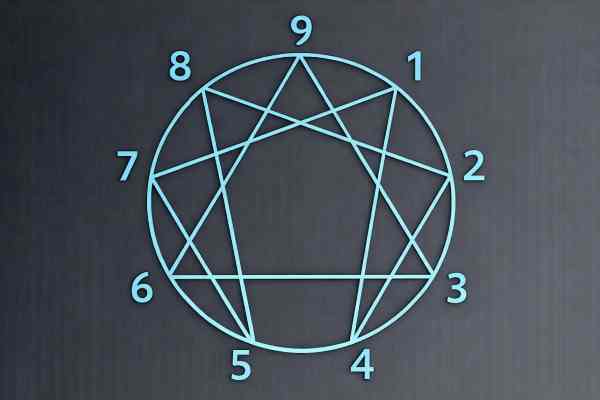
Most discussions about the Enneagram focus on labels and behavior. However, the mechanisms behind the Enneagram explain why each pattern keeps repeating. Once you can see the machinery, the pattern no longer looks like a fixed label; instead, it becomes something you can work with.
The Enneagram describes nine core personality types. Each one is a steady way of dealing with life, shaped by early habits, lasting motivations, and the ways we learn to manage our inner world. The type names, like the Reformer or the Peacemaker, are useful shorthand for the overall pattern.
The traditional approach stops there. It describes what each type looks like from the outside but rarely explains what drives it. This article looks underneath, at the moving parts that keep each pattern running day after day.
Inner Work Gate Notice:
This article asks you to examine habits, emotions, and ideas about who you are. Noticing these patterns may feel uncomfortable, especially when they have helped you feel safe or valued. Go at your own pace, and pause if the process becomes overwhelming.
The mechanisms behind the Enneagram
A personality type is not just a description. It works more like a system that is always running in the background. Something catches your attention, you feel a small inner reaction, you protect a certain picture of yourself, and you act. When the action brings relief or reward, the whole cycle gets a little stronger. Then it runs again.
➡ For more, see: Leveraging Your Habitual Nature to Build Good Habits
This is the same way any habit forms. A cue starts the pattern, a need drives it, a response follows, and repetition makes it automatic. Personality is that process working on a much larger scale. Over years, the cycle repeats so many times that it settles into what we call a personality pattern.
What we see as personality is the visible surface of a system that is always running.
The nine Enneagram types exist because the same basic machinery can be set up in nine different ways.
How the loop runs
Every type runs on the same five mechanisms. They work together like links in a chain, and each one hands off to the next.
The first link is attention, or what your awareness naturally locks onto. Two people can walk into the same room and notice completely different things. One sees the mess, another sees who looks upset, and a third sees the exit. Attention decides what shows up as important before you have even thought about it.
What you notice often stirs up a small discomfort or tension. That brings in the second link, emotional regulation, which is how you calm that inner feeling. Some people calm it by taking control, some by moving closer to others, and some by stepping back.
The third link is identity. Over time, the way you calm yourself shapes how you see yourself. If fixing things brings relief, you may come to see yourself as a responsible person. Your identity then works like a filter. It welcomes behaviors that fit the picture and pushes away the ones that do not.
Identity leads to behavior, the fourth link. This is what you actually do, the action that grows out of what you noticed, how you felt, and who you believe you are.
The last link is feedback, and it explains why the pattern repeats. When the behavior works, by bringing relief, praise, safety, or calm, the brain records it as a success. The next time a similar moment comes along, your attention goes to the same place, and the loop starts again.
- Attention: what you notice
- Regulation: how you handle it inside
- Identity: what you allow yourself to be and do
- Behavior: what you actually do
- Feedback: what makes it repeat
➡ For more, see: Why You Act Like a Trout: Reflex Loops Steering Behavior
Much of this happens faster than thought, which is why a type can feel like simply “who you are.” No mechanism is better than another, and no type is better than another. The mind runs these patterns because they are efficient. They save energy by giving you a ready-made way to handle life.
Understanding the mechanisms behind the Enneagram is more important than knowing your personality type. If you can learn to spot where you are in the loop, you can learn to adjust it rather than being carried by it.
The nine types in motion
The clearest way to understand the mechanisms behind the Enneagram is to watch them work. Each short story below follows one person through a single ordinary moment, so you can see all five links connect.
Type 1 — the Reformer
Ruth walks into the break room at work and spots it right away. Someone left a coffee ring on the counter, and the stack of napkins is crooked. Nobody else seems to notice. For Ruth, the mistakes almost jump out on their own, as if her eyes were trained to find what needs fixing.
A small tightness builds in her chest. Things are not the way they should be. She wipes the counter and straightens the napkins, and the tension eases. That relief fits the way Ruth sees herself, as responsible, correct, and principled. Being careless would not feel like her. Because fixing the problem worked, her attention will scan even harder for the next thing that is out of place.
If Ruth can notice when attention becomes fixated, then she can change the direction. The physical symptoms are a cue that the mechanisms behind her habit are driving behavior.
Spots what is wrong → feels tension → protects being correct → fixes it → relief strengthens the scanning.
Type 2 — the Helper
At a family dinner, Maria notices her cousin has gone quiet. Before anyone else catches it, she reads the slumped shoulders and the forced smile. Her attention naturally goes to people, to how they feel and what they might need.
Sensing that distance makes Maria uneasy, so she moves closer. She sits beside her cousin, refills his plate, and asks how he has been. Helping feels natural because Maria sees herself as warm, caring, and important to others. Being unneeded, or worse, rejected, feels threatening. When her cousin opens up and thanks her, the closeness rewards the habit, and Maria becomes even quicker to notice what others need.
The need to please is a response to the mechanism of identity telling her that others will value and validate her by what she does for them. Sensing the need before it is acted on gives her the choice.
Reads others’ needs → uneasy with distance → protects being caring → helps → closeness strengthens the habit.
Type 3 — the Achiever
Jordan opens his laptop on Monday and goes straight to the numbers: sales targets, deadlines, and what his boss will count as a win. His attention locks onto goals and on what earns recognition.
When a flicker of doubt shows up, he does not sit with it. He pushes through it by doing more, working faster, and staying busy. Jordan sees himself as capable and successful, and anything that looks like failure feels like a threat to who he is. He sets a plan, streamlines his day, and hits his target by Friday. The praise that follows tells his system that performing works, so next Monday his focus snaps to results even faster.
Here the mechanism of identity drives Jordan toward overwork. If Jordan pauses to ask some questions: Why is this so important? Am I simply repeating behaviors that I believe will satisfy my self-worth? Is my effort in line with healthy work/life balance? No matter the answer, Jordan can act with more control.
Locks onto goals → pushes past doubt → protects being successful → achieves → praise strengthens the drive.
Type 4 — the Individualist
Nadia walks through an art museum, but what catches her is not the famous painting everyone is crowding around. It is a small, faded portrait in the corner that feels lonely and full of meaning. Her attention goes to what is emotionally rich, personal, or missing.
When a wave of sadness rises, Nadia does not push it away. She moves toward it, feels it fully, and tries to understand its depth. That fits how she sees herself, as unique, authentic, and emotionally honest. Anything shallow or ordinary feels wrong. That evening she writes a poem about the portrait. Expressing the feeling deepens her sense of who she is, which keeps her attention tuned to meaning and depth.
If Nadia’s experience does not interfere with normal activity, she is following a passion in the same way as someone who rides roller coasters for enjoyment. If this becomes a pattern of emotional dwelling, then it can become unhealthy and lead to other unhealthy activities. Here the mechanism of regulation is at work, because moving toward the feeling is how she manages it. Noticing the behavior and need to indulge in emotions gives Nadia the option to seek balance by building relationships or physical activities.
Notices emotional depth → moves toward the feeling → protects being authentic → expresses it → deeper identity strengthens the focus.
Type 5 — the Investigator
In a team meeting, Sam notices what no one has explained. The new plan has a gap in its logic, and he wants to understand it. His attention moves toward information, patterns, and anything unclear.
But the meeting is loud, and people keep asking for his opinion before he is ready. Feeling overwhelmed, Sam pulls back. He says little, protects his energy, and decides to think it through alone. He sees himself as knowledgeable and self-reliant, so situations that feel draining or intrusive are ones he avoids. That night, he researches the problem and finds the answer. Stepping back restored his energy, and the insight brought clarity. So the pattern of withdrawing to understand grows stronger.
Isolation is a method of emotional regulation. This isn’t a harmful strategy when done in moderation. In Sam’s case, if he wasn’t ready to express his opinion, then stepping back was the correct thing to do. Sam can let his team manager know about his need to incubate ideas first before sharing. He can also find other like-minded people with whom he can meet and research together.
Notices gaps in understanding → withdraws when overwhelmed → protects self-reliance → studies alone → clarity strengthens the withdrawal.
Type 6 — the Loyalist
Before a family road trip, Dev checks the weather, the tire pressure, and the route twice. His attention scans for what might go wrong, such as risks, mixed signals, or anything uncertain.
As the departure date gets closer, a hum of worry grows. Dev calms it by preparing, asking questions, and texting his brother to confirm the plan. He sees himself as loyal, careful, and responsible, and acting without support or clear information feels unsafe. He packs a backup charger and an emergency kit. When the trip goes smoothly, the calm that follows tells his system that preparing works, and his attention keeps scanning for risk on the next trip.
Dev’s vigilance and planning help identify and solve problems, but it can lead to hypervigilance and distrust, which undermine the enjoyment of the trip. Dev’s internal and external feedback reinforce the behavior. What helps is noticing the emotional cost of living in a state of hypervigilance and always expecting the worst to happen. It can be a hard habit to break without support and emotional regulation.
Scans for danger → calms worry by preparing → protects being careful → checks and tests → safety strengthens the scanning.
Type 7 — the Enthusiast
Kai is halfway through a dull project when an idea pops into her head for a weekend trip. Then another for a new business. Her attention jumps to possibilities, to what could happen next.
When the boring task starts to feel like a trap, Kai shifts away from that discomfort. She reframes it, makes new plans, and moves toward something more exciting. She sees herself as upbeat, open, and free, and feeling stuck is what she avoids most. By lunch, she has three new plans in motion. The lift in her mood rewards the escape, so the next time a limit appears, her attention leaps to new options even faster.
Kai lives on the adrenaline that comes from experiencing the next new thing. Trying new things is not a bad thing. But thrill-seeking behavior can escalate because what was exciting last week is now boring. This is a pattern that is also likely in her career and relationships. She is attracted to new energy and new experiences, but it becomes a never-ending cycle that is not fulfilling or rewarding. The mechanism of feedback keeps this cycle going, because each new thrill rewards the escape. Noticing the pattern is the first step to finding the right outlets for her passion.
Spots possibilities → escapes discomfort → protects being free → plans and explores → relief strengthens the shifting.
Type 8 — the Challenger
At a neighborhood meeting, Victor quickly sizes up the room: who has influence, who is being talked over, and where strength is needed. His attention goes to power and control.
When one neighbor starts pushing the others around, Victor senses a threat, and he steadies himself by stepping in boldly. He takes charge of the conversation and confronts the issue head-on. Victor sees himself as strong and hard to push around, and anything that feels like weakness is something he rejects. When the meeting ends with his plan in place, being in control has lowered his sense of vulnerability. That success makes him even quicker to take charge next time.
Victor feels a responsibility to confront and take charge, and this comes from a strong protective instinct. Taking charge is his mechanism of regulation, the way he steadies himself when he senses a threat. Balance comes from learning to discern when to push boundaries and when not to. Things like social injustice and inequity are likely things Victor feels he must address in some way. Doing so with emotional stability makes the difference.
Sizes up power → steadies by taking charge → protects being strong → asserts control → reduced vulnerability strengthens the habit.
Type 9 — the Peacemaker
When her friends start arguing over where to eat, Grace’s attention goes to keeping things calm. She tends to overlook the conflict itself and focus on what will smooth things over.
As the tension rises, Grace softens her own response. She goes along with whatever the group wants and quietly sets aside her own preference. She sees herself as easygoing and low-demand, and causing a disruption does not feel like her. The friends pick a place, and the mood relaxes. That peace rewards her accommodating, so the next time tension appears, she steps back even more easily.
Avoidance may be the right strategy sometimes, but not always. When tension rises, Grace must learn to pause and choose which course to take. She doesn’t have to give up confidence or self-worth, whichever she chooses. She may still end up going along even if she is able to give her full input. When she does fully express her opinion, this is feedback that strengthens her ability to deal with confrontation more effectively.
Focuses on harmony → softens to ease tension → protects being easygoing → goes along → calm strengthens the avoidance.
Wings and centers
Few people fit one type perfectly. The Enneagram explains this with two more ideas.
Your wing is one of the two types sitting next to yours on the Enneagram circle. A Type 1 might lean toward Type 9 or Type 2, borrowing a bit of calm or a bit of warmth. The wing adds flavor to your main pattern without replacing it. In mechanism terms, it shifts the loop slightly. A One with a strong Two wing may still scan for what is wrong, but may calm the tension by helping others fix it.
The nine types also group into three centers, based on where the loop most often starts. The gut center, Types 8, 9, and 1, reacts first through instinct and a sense of control. The heart center, Types 2, 3, and 4, reacts first through feelings about self-image and connection. The head center, Types 5, 6, and 7, reacts first through thinking about safety and certainty. Knowing your center tells you which part of your system tends to fire first.
Where the loop can be interrupted
A pattern that runs automatically does not have to run forever. Because personality is a loop, every link in the chain is also a place where the cycle can be noticed and changed.
➡ For more, see: Meta-Awareness And Inner Observation
The easiest place to start is attention. As the stories above show, simply noticing where attention goes creates a moment of choice.
➡ For more, see: The Emotional Check-In Process: Manage Emotional Readiness
Regulation is the next opening. Noticing the inner tension before reacting makes room to ask what you actually want. Identity takes longer to change, but it loosens when people see that their type is a pattern they run, not the whole of who they are. Behavior and feedback change through practice. Each time someone tries a new response, and it works, the new response gets its own small reward, and a different loop begins to form.
➡ For more, see: The Enneagram Type Connection to the Virtues of the Spirit
This is what integration means. Your type remains your home base, the default setting you return to under stress. As awareness grows, though, you can draw on the strengths of the other eight types. Each pattern also has a natural doorway to growth, a virtue that helps balance its usual habits.
Conclusion
The Enneagram personality types give us a useful starting point, but the labels only describe the surface. Underneath, each type runs on the same five mechanisms. Attention picks what matters, regulation calms the reaction, identity protects the self-image, behavior acts it out, and feedback makes it repeat.
Seeing those mechanisms changes how you relate to your own pattern. It is not a box you are stuck in. It is a system you can watch, understand, and gently retrain. Knowing your type, wing, and center points you in the right direction. Understanding the mechanisms behind the Enneagram gives you the key to moving past the limits of your pattern.
References
- The Wisdom of the Enneagram. Don Richard Riso and Russ Hudson, 1999.
- Personality Types: Using the Enneagram for Self-Discovery. Don Richard Riso and Russ Hudson, 1996.
- The Complete Enneagram: 27 Paths to Greater Self-Knowledge. Beatrice Chestnut, 2013.
- Psychology of Habit. Wendy Wood and Dennis Rünger, 2016.
- The Emerging Field of Emotion Regulation: An Integrative Review. James J. Gross, 1998.
- The Enneagram: A Systematic Review of the Literature and Directions for Future Research. Journal of Clinical Psychology.
- A Cognitive-Affective System Theory of Personality: Reconceptualizing Situations, Dispositions, Dynamics, and Invariance in Personality Structure. Psychological Review.
- The Process and Mechanisms of Personality Change. Nature Reviews Psychology.
- Personality Stability and Change: A Meta-Analysis of Longitudinal Studies. Psychological Bulletin.
- Psychology of Habit. Annual Review of Psychology.
- Habit-Like Attention. Current Opinion in Psychology.
- Attentional Capture and Control. Annual Review of Psychology.
- The Emerging Field of Emotion Regulation: An Integrative Review. Review of General Psychology.
- Antecedent- and Response-Focused Emotion Regulation: Divergent Consequences for Experience, Expression, and Physiology. Journal of Personality and Social Psychology.
- Self-Concept Clarity: Measurement, Personality Correlates, and Cultural Boundaries. Journal of Personality and Social Psychology.
- Automaticity of Social Behavior: Direct Effects of Trait Construct and Stereotype Activation on Action. Journal of Personality and Social Psychology.
- Implementation Intentions: Strong Effects of Simple Plans. American Psychologist.
About this project
Seeker Project 4 Spiritual Exploration (SP4SE) offers resources for exploring consciousness. It also helps with awareness and self-observation. It is a project of Americans In Alliance.
- Support SP4SE to help maintain and develop its educational resources.
- Visit Americans In Alliance to learn more about the parent organization.