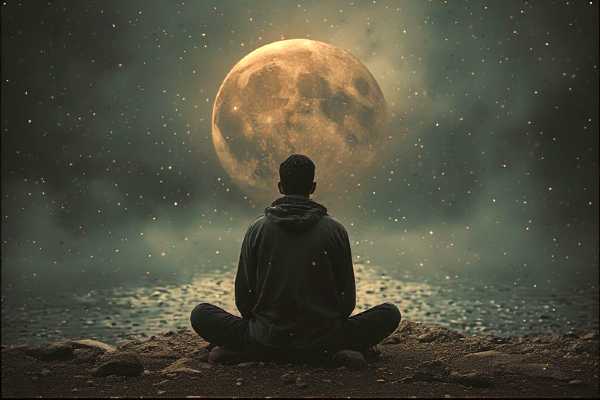
This is an invitation to learn the timeless lessons from the moon. The moon has watched over human life for as long as we have looked toward the night sky. Its light, silence, movement, and mystery teach us simple lessons for daily life
We do not need to believe the moon is sending us hidden messages to learn from it. People have always observed nature. They noticed its patterns and used them to reflect on their own lives.
The moon gives us plenty to work with because even its familiar features can make us stop and think. By taking a closer look, we can see five timeless lessons from the moon. This way, we won’t turn astronomy into a belief system.
➡ For More See: The Sigil Symbolism Mechanisms of Symbolic Encoding.
Five timeless lessons from the moon
Each of the timeless lessons begins with something we can see or know about the moon. From there, we can use that feature as a simple reminder about the way we live.
The point is not to make the moon into a teacher with answers for us. Instead, its familiar features give us useful images that can help us think about our own choices.
1. Keep part of yourself private
When we look at the moon, we keep seeing nearly the same side. This can make it seem as if the moon never turns, but it does. The moon rotates at about the same rate that it travels around Earth, so nearly the same side keeps facing us.
People also have a side that faces the world and another that remains private. We often hear that being authentic means showing people who we really are, but that does not mean showing them everything. We can be honest while still deciding what belongs in public and what should remain personal.
The far side of the moon gives us a good picture of that difference. People sometimes call it the dark side, but the name is misleading because the far side receives sunlight too. We simply do not see it from Earth most of the time.
Our private lives can work in much the same way. Choosing not to share something does not make it shameful or dishonest. Sometimes it simply means that the subject is personal.
That difference matters even more now because a private thought can become public within seconds. When we are angry, hurt, or disappointed, posting something right away can feel good for a moment. The feeling may be gone tomorrow, while the words could remain online for years.
Before sharing something personal, it helps to ask who really needs to know. A problem may belong in a talk with a trusted friend rather than on social media, while another issue may need time before we even know what we think about it.
This is one of the timeless lessons from the moon to use in daily life. We can remain open with other people without giving everyone access to every part of us.
2. Quiet influence can be powerful
The moon glides through the night sky, asking nothing from us. Still, its gravity shapes the tides in Earth’s oceans. That quiet effect gives us one of the timeless lessons from the moon: influence does not have to be loud.
We often notice the loudest person first. A person who talks over others or seeks attention might seem powerful. This happens because they are hard to ignore. Yet some of the strongest influence happens in a much quieter way.
Think about someone who helped you through a difficult time. They may not have given you a long speech or told you exactly what to do. They listened, asked a helpful question, or stayed calm when everything felt chaotic.
That kind of influence grows from presence rather than volume.
The same thing can happen during an ordinary disagreement. When someone listens rather than jumping to argue, the other person can feel less defensive. A calm reply can stop a small problem from growing bigger. Also, a few thoughtful words can mean more than ten minutes of talking.
Quiet also gives us time to notice things that constant activity can hide. When every spare moment is filled with messages, entertainment, conversation, or noise, our own thoughts can become hard to hear. A little quiet gives ideas and feelings time to settle so we can see them more clearly.
Of course, silence is not always the right response. There are times to object, defend someone, ask for help, or say plainly what needs to be said. It’s not that we should stay quiet. It is that becoming louder does not always make us more effective.
Meditation and solitude help us feel at ease with quiet focus. However, each practice has its own methods and goals.
➡ For More See: Meditation Methods for Training Attention.
➡ For More See: Why Making Time for Solitude and Self-Reflection Matters.
3. Reflect the light you receive
Moonlight can brighten a dark landscape even though the moon does not produce that light. Sunlight hits the Moon and reflects back to Earth. This shows how knowledge and wisdom travel between people.
Very little of what we know began entirely with us. We learned to speak by listening to other people, and someone taught us to read. Teachers, friends, family, books, and experiences have all taught us things we once didn’t know.
Even our mistakes can teach us. A bad choice can teach us what to avoid. A tough time might also show strengths or weaknesses we didn’t see before.
In one way or another, we keep receiving light. The important question is what we do with it. When something helps us see more clearly, we can keep that knowledge to ourselves or pass some of it along. An idea that once helped us might help a friend, while a skill someone patiently taught us can later be taught to someone else.
There is also some humility in remembering where our knowledge came from. We do not need to act as though every useful idea began with us.
The moon does not become less beautiful because its light came from somewhere else. In the same way, wisdom does not become less useful because someone else helped us find it.
A little light can still help
The changing appearance of the moon adds another part to this lesson. On some nights we see a full moon, while on others only a thin crescent is visible. Even that small amount of light can still stand out against a dark sky.
Life often gives us only part of the picture too. We may know that something is wrong without knowing exactly how to fix it. We might have one useful clue while many questions remain. A friend who is struggling may not need us to solve everything because one helpful thought could be enough to point toward the next step.
This does not mean missing information should be ignored. Important decisions may require more time, more facts, or better advice. Still, incomplete knowledge is not always useless.
Sometimes we know enough to take one reasonable step while we continue learning. The lunar phases have their own scientific explanation and symbolism, so there is no need to repeat that larger subject here.
➡ For More See: Lunar Phases: The Major and Minor Phases of the Moon.
4. Inspire without needing the spotlight
For thousands of years, people have gazed at the moon. They found something special there. The moon shows up in stories, songs, poems, paintings, myths, calendars, and spiritual traditions from many cultures. Yet, it never asks anyone to notice it.
That gives us a different kind of lesson. Inspiration does not always come from people who set out to become examples for others. When we think about inspiring people, famous leaders may come to mind first. Yet the people who shape our lives most deeply are often much closer to us.
A teacher may have treated us with respect when we were struggling. A friend could have supported us during a tough year. Or, a coworker might have taught us to stay calm under pressure. They showed us not to let stress affect others. These moments may not seem important when they happen. Years later, we may still remember them.
Other people can experience us in the same way. Children see how adults react when plans fail. Friends learn about trust by watching our actions when it’s hard to trust. At work, people remember who stayed fair under pressure and who offered help when it mattered.
Because we rarely know how another person will remember us, trying to look inspirational is not very useful. What matters more is whether our actions give people something worth remembering. That shifts attention away from the image we want to create and toward the way we actually live.
The moon has inspired people for ages without setting out to become a symbol. We can learn from that example. Instead of stressing about looking wise, kind, brave, or spiritual, we should focus on showing these qualities in our actions.
The larger work of turning values into behavior belongs in its own article.
➡ For More See: Turn Positive Values Into Action.
5. Let mystery keep you curious
The moon feels familiar. Many of us have seen it since childhood. But a closer look raises questions. What about its surface, history, formation, and connection to Earth? People have been asking those questions for thousands of years.
Modern science has answered many of them. Spacecraft have captured detailed photos of the Moon. Astronauts returned with samples. Now, researchers understand the lunar surface much better.
Still, exploration continues because one answer often leads to another question. That gives us the first part of the final lesson: not knowing does not require us to invent an answer.
Uncertainty can feel uncomfortable, so we naturally want to fill the empty space. The first reasonable explanation can be easy to accept. This is true even when we lack enough evidence to tell if it’s correct.
Curiosity gives us another choice. We can compare ideas, look for evidence, see what’s missing, and change our minds when we find better information. There is nothing wrong with saying, “I don’t know yet.” Those words can begin an investigation rather than end one.
The second part of the lesson is just as important: remaining open does not mean believing everything. This matters in spiritual exploration because unusual experiences often attract strong explanations. Strange things catch our attention, but mystery doesn’t show us the right answer.
We can explore unusual possibilities without treating every possibility as fact. In that way, curiosity and careful thinking can work together instead of pulling us in opposite directions. Learning more does not have to destroy wonder either. Understanding why the moon looks different doesn’t lessen the beauty of the night sky. Similarly, learning about lunar craters doesn’t take away the wonder of how worlds form and change.
Often, one answer simply gives us better questions. The unusual observations and disputed claims surrounding the moon deserve a closer look of their own.
➡ For More See: Strange Lunar Curiosities: Interesting Observations About the Moon.
Using the lessons from the moon
None of these lessons requires a special ritual because the reminder is already in the sky. You might see the moon while walking, driving, or looking out a window before bed. That quick moment can bring these ideas back to mind.
Maybe you need a firmer boundary in your life. Also, listening before you respond could help improve a conversation. At another time, you may realize that something useful you learned could help another person.
Consider what example your actions set. Also, remember that not every question needs an immediate answer.
The point is not to ask the moon what to do. These timeless lessons from the moon work because they prompt us to reflect. We must use our judgment to assess the situation and decide what makes sense. Nature provides the image. We decide whether the lesson is useful.
Conclusion
People have found meaning in the moon long before written history, but we do not need to claim that it was meant to teach us anything.
Its value here is much simpler. Looking at something familiar in a different way can sometimes remind us of things we already know but easily forget.
That is what makes these lessons useful. They begin with ordinary observations and lead back to ordinary choices, where their meaning depends on what we do with them.
Sometimes looking up can help us look at ourselves a little differently.
References
- Earth’s Moon Overview. NASA Solar System Exploration.
- Moon Facts. NASA Science.
- Moon Phases. NASA Science.
- What Causes Tides? NOAA National Ocean Service.
- Does the Moon Rotate? U.S. Geological Survey.
- The Moon. Encyclopaedia Britannica.
- Moon Formation and Evolution. NASA Science.
- Lunar Reconnaissance Orbiter. NASA.
- Moon. National Geographic.
- Moon. Wikipedia.
About this project
The Seeker Project 4 Spiritual Exploration (SP4SE) is a project of Americans In Alliance. The mission of SP4SE is spiritual education. The mission of Americans In Alliance is environmental conservancy. Click the links below to learn more and support our efforts.