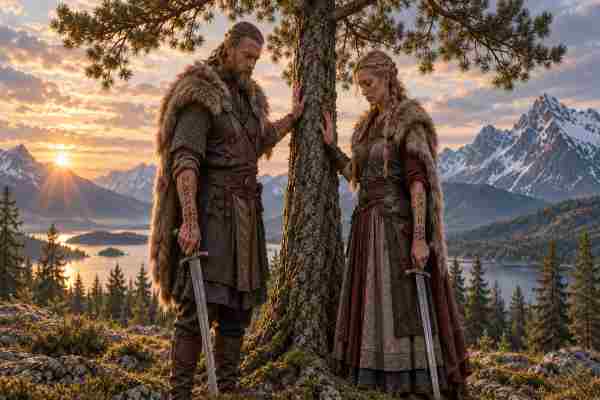
Nordic folklore preserves an older way of seeing our place in nature. Its stories grew from lives shaped by the land, sea, weather, seasons, animals, sun, and sky. They remind us that nature is not somewhere else; it’s where human life happens.
Modern life can hide that relationship. Water comes from a faucet, food waits on a shelf, and heat or light appears with the push of a button. These comforts are useful, but they can make it easy to forget how much of our lives still depends on nature.
Nordic folklore contains the keys to reestablishing this important relationship. Returning to the ancient ways does not mean trying to live as people did a thousand years ago. It means recovering something that their stories kept close. It is about attention to the natural world, respect for its power, gratitude for what it gives us, and the understanding that we belong within it.
Nordic folklore and our place in nature
Imagine living where winter changes almost every part of daily life. The days grow short, the cold deepens, and food becomes harder to find. Then the light slowly returns. Snow melts, plants rise again, animals become active, and people can move more freely.
The sea could feed a family and carry people to distant lands, yet a storm could turn the same water deadly. Forests offered wood, food, shelter, and animals, but they also held dangers. The sun, rain, wind, fire, moon, and changing seasons were not scenery around human life. People depended on them.
Nordic folklore comes from a world filled with gods, spirits, animals, giants, dragons, and sacred places. These elements helped people share stories about the forces in their daily lives. Nature was given faces, personalities, dangers, and mysteries that people could relate to.
Nature given a face and a story
A figure such as Odin could carry ideas about wisdom, sacrifice, risk, and the search for knowledge. A dragon could give great danger or power a shape. A tree could become a symbol of roots, life, growth, death, and connection. The sea could offer food and travel while also reminding people that human plans have limits.
A modern reader does not have to accept these stories as literal facts to understand what they preserve. The old symbols keep pointing back toward forces that still surround us.
The sun is still here. So are the forests, storms, rivers, animals, seasons, and sea. Our explanations have changed, but our dependence has not.
➡ For More See: How Myth And Symbolic Stories Shape Culture
How the Nordic worldview survived
Old traditions often remain even when the religion or society around them changes. A temple can crumble, and a public ritual can cease. People may embrace new beliefs, but old stories still flow quietly through families and communities.
That happened across much of Europe as Christianity spread. Some older beliefs were rejected. Some practices were ignored. Others got new names or meanings. Nordic folklore reveals how parts of an older worldview survived over time. The full history is more extensive than this article.
A story could still be told. A seasonal custom could still return each year. A symbol linked to an animal, tree, moon, sun, winter, harvest, or nature stays familiar, even if people stop explaining it the same way.
In that way, the legacy did not last since every ancient belief stayed the same. It survived because stories and symbols carried parts of the old way of seeing from one generation to the next. In that sense, Nordic folklore became a form of cultural memory, preserving parts of an older relationship with nature even as beliefs and institutions changed.
➡ For More See: The Rebranding of Magic by Religious Authority
➡ For More See: The Pagan Origins of Christian Holidays and Festivals
What survives when belief changes
Think of an old story about a sacred tree. Someone centuries ago may have understood that story as a literal part of religion. A person today may see the same tree as a symbol.
The belief has changed, but the tree can still draw attention toward roots, growth, age, shelter, death, and renewal. A sun figure can still remind us that life depends on light and warmth. A story about the sea can still carry respect for a force that can feed people one day and overwhelm them the next.
This gives us a useful way to approach the old gods as well. We do not have to choose between worshiping them as literal beings and treating them as meaningless fantasy.
The forces behind the stories are still with us.
They are in the Earth beneath us, the sky above us, the wind, sunlight, water, animals, forests, storms, and seasons. Nordic folklore gives those relationships a language that modern life can use. It’s a language for remembering our place in nature.
What modern culture lost
Modern life provides substitutes for nature. It has simply hidden many of the steps between nature and us. Water comes from a faucet, so we may rarely think about the river, lake, rain, or underground source behind it. Food sits on a store shelf, far from the soil, sunlight, water, plants, animals, and weather that made it possible.
Our symbols also point in a different direction. Show someone an apple with a bite taken from it and many people will think of a computer company. Show them a swoosh, and they may think of shoes. These are powerful modern symbols, but they point toward companies and products.
But Nordic folklore is filled with symbols tied to land, animals, weather, trees, sky, sea, life, and death. People were reminded again and again of the world around them because that world was woven into their stories.
From source to scenery
Today, nature can become something we visit on vacation or drive past on the way somewhere else. A tree becomes landscaping. A forest becomes timber. A river becomes a water supply. The source slowly becomes scenery.
Yet nothing important about our place in the world actually changed. The city still stands on the Earth. Its people still breathe air, drink water, eat food, and live under the same weather and sky. What changed was our attention and the loss of our place in nature.
Returning to the ancient ways
The ancient ways are all about remembering our connection to nature. Remembering our place in nature begins with paying attention to the world around us. You do not need ancient clothing, old weapons, or a cabin far from modern life. You do not need to reject science or pretend ancient people had answers they did not have.
Start with something much simpler.
When was the last time you stopped and looked at the sky without doing anything else?
When did you last watch the moon rise or notice the colors of a sunset? Have you listened to wind moving through trees instead of covering it with music? Can you remember the last time you smelled wildflowers, wet soil, or rain?
These are ordinary experiences, but they change when we stop treating them as background.
Nordic folklore focused on the relationship with nature. It was a strong relationship because people had to pay attention. They watched weather, seasons, animals, water, light, and land because their lives were tied directly to them.
We can choose to pay attention again even though modern life no longer forces us to do it in the same way.
That is where the return begins.
➡ For more, see: The Practical Methods for Honoring Ancestral Roots
Reconnecting through the senses
We can follow the pattern of Nordic folklore and remember our place in nature.
Find a place where you can spend a little time with the natural world. A forest or shoreline is wonderful if one is nearby, but you do not need wilderness. A park, yard, field, garden, creek, or quiet place beneath a few trees can work.
When you arrive, put your phone away. Do not hurry into an exercise. Stand there for a moment and let whatever you were doing before begin to settle.
Sight
Stand and look around.
Let your eyes travel across the place instead of searching for something special. Notice where the ground rises or falls. Look at the shapes of trees and the spaces between their branches. Follow the light across the ground. Look upward and notice the sky as part of the place rather than an empty space behind it.
If a tree is near you, spend a little time with it. Follow the trunk upward until branches divide and spread. Notice the bark, knots, scars, leaves, or needles. A tree that first looked like part of the scenery starts becoming a particular living thing.
Sound
As you keep looking, let your hearing open as well.
The first sounds may come from cars, people, or machines. Listen beyond them. You might see birds in the distance, insects on the ground, wind rustling leaves, water nearby, or branches moving together.
Do not try to turn the sounds into a message. Simply hear them.
This is one of the easiest ways to notice how much of the world continues whether you are paying attention or not.
Smell
Then notice the air.
You may smell wet soil, leaves, flowers, pine, dry grass, salt, or rain. Some smells may bring back memories before you have even decided what they remind you of.
Touch
Feel the air too. Is it warm, cold, still, or moving? Can you feel sunlight on your face or wind against your skin?
If it is safe and comfortable, touch something. Place a hand against a tree. Feel the rough or smooth bark instead of only seeing it. Touch a stone, grass, soil, or the ground beneath you. If you are beside water, notice its temperature.
Now return to the tree. Follow the trunk down toward the Earth and imagine where the roots continue below the surface. They spread through soil you cannot see, drawing in what the tree needs to live.
You are standing on the same ground. The image is simple, but it makes the relationship hard to miss. The tree needs soil, water, air, and sunlight. So do the plants around it. Animals depend on those plants and on one another. Human life rests inside the same larger system.
Breath and presence
Close your eyes for a moment if you are comfortable doing so. Listen again. Feel the wind or sun. Take one slow breath.
Nothing supernatural has to happen. You do not need to reach a special state or convince yourself that you feel something profound. The purpose is only to notice what modern life makes easy to overlook.
A simple return-to-nature practice
Through sight, sound, smell, touch, and breath, nature stops being an idea. It becomes the place where you are standing.
This is close to what people today sometimes seek through practices such as forest bathing. The name may be modern, but the act of slowing down and meeting the natural world through the senses is much older.
For the Nordic worldview, this kind of attention brings the old symbols back to their source. The sacred tree leads back to an actual tree. Stories of sun and storm lead back to light, heat, wind, rain, and sky. The old gods return to nature. And so do we.
Let the place become real again
One visit can wake up your senses, but returning to the same place builds something deeper. Choose somewhere close enough that you can visit again. Over time, you begin to see changes that were invisible during the first visit.
A tree opens new leaves. Birds arrive and later disappear. Rain changes the smell of the ground. Light falls differently as the seasons move forward. Cold changes the sound of a place, while spring fills it with movement again.
The place begins to hold memories.
That tree is no longer just a tree. You know when its leaves changed. You remember standing beneath it in rain or wind. A stream is no longer only water because you have watched it rise and fall. This is how relationship begin.
Nature’s bond in Nordic folklore wasn’t built on rare visits to stunning landscapes. It came from living with places long enough to know them.
We can recover some of that relationship wherever we live.
Give honor and thanks
As you begin to know a place, gratitude can become less abstract. You see how much happens without your help. Rain falls. Seeds open. Plants grow. Birds build nests. The sun rises. Seasons continue their long cycle.
You can answer that awareness in a simple way. Give thanks. You may thank the land for holding you, a tree for shade, rain for water, or the place itself for giving you a few quiet minutes away from the noise of daily life.
Someone following a Pagan or nature-centered path may choose to speak to an old god, an ancestor, or the spirit of the place. Another person may simply stand quietly.
The form matters less than the act of recognition. You are no longer moving through the world as if everything around you exists without deserving notice.
An echo of Nordic ancestry
Nordic folklore also carries a strong awareness of those who came before. A person stands within a line of other lives rather than appearing alone in the world.
The film The 13th Warrior uses that idea in a prayer about family, ancestry, courage, death, and joining those who came before. It is a modern film prayer, not proof of an ancient Viking prayer, but it captures themes that fit this part of the Nordic legacy.
Here’s a prayer from the movie The 13th Warrior. It’s a mirror of the legacy of Nordic folklore. You may find something like this helpful in your practice.
Lo there do I see my father;
Lo there do I see my mother, my sisters and my brothers;
Lo there do I see the line of my people back to the beginning.
Lo, they do call me;
They bid me take my place among them, in the halls of Valhalla, where the brave may live forever. ― Viking Prayer
The value of that image is not that we should pretend to be Vikings. It reminds us that our lives did not begin with us. Remembering our place in nature also connects us to our ancestral roots.
People before us shared the same sky. They relied on land and water. They saw seasons change and understood that every life is part of something bigger.
➡ For More See: Mechanisms of Structured Pretending and Prayer Patterns in Rituals
Gratitude becomes responsibility
Returning to the ancient ways should not end with feeling peaceful beneath a tree. Once nature becomes real again, what happens to it begins to matter in a more personal way.
A river you know is harder to think of as only a water supply. A woodland you have walked through becomes more than timber. When you realize that your food, water, air, and health depend on living systems, caring for them becomes essential, not just a favor. This is where the relationship preserved in Nordic folklore can become stewardship.
We can waste less and care for our surroundings. Let’s support conservation, protect water and wildlife, and think carefully about the impact of our choices.
Climate change makes this relationship harder to ignore. We depend on natural systems, and damage to those systems eventually reaches human lives too.
Nordic folklore does not give us a modern environmental plan. What it can give us is an older reminder of why stewardship matters. We protect the natural world because we belong to it.
➡ For More See: A Gratitude Mindset: Engineering a Positive Outlook
Conclusion: carrying the ancient view forward
Nordic folklore carries stories from people who lived much closer to the forces of nature than many of us do today. We do not need to rebuild their world to learn from the relationship those stories preserve.
Returning to the ancient ways can begin by going outdoors and observing. Look at the sky, listen to the wind, learn one nearby place, give thanks, and remember where our food, water, air, and life come from.
The old stories point backward, but the lesson can move forward. We are part of nature. Remembering that is the return.
References
- The Poetic Edda. Oxford World’s Classics.
- The Prose Edda. Penguin Classics.
- Norse Mythology: A Guide to the Gods, Heroes, Rituals, and Beliefs. Oxford University Press.
- The Pre-Christian Religions of the North: History and Structures. Brepols.
- Landscape, Religion, and the Supernatural: Nordic Perspectives on Landscape Theory. Oxford University Press.
- Old Norse Religion in Long-Term Perspectives: Origins, Changes and Interactions. Nordic Academic Press.
- Gods and Myths of Northern Europe. Penguin Books.
- The Viking Way: Magic and Mind in Late Iron Age Scandinavia. Oxbow Books.
- Nature and Health. Annual Review of Public Health.
- The Relationship Between Nature Connectedness and Happiness: A Meta-Analysis. Frontiers in Psychology.
- Meta-Analysis of Human Connection to Nature and Proenvironmental Behavior. Conservation Biology.
- The Effects of Forest Bathing on Psychological Well-Being: A Systematic Review and Meta-Analysis. International Journal of Mental Health Nursing.
About this project
The Seeker Project 4 Spiritual Exploration (SP4SE) is a project of Americans In Alliance. The mission of SP4SE is spiritual education. The mission of Americans In Alliance is environmental conservancy. Click the links below to learn more and support our efforts.