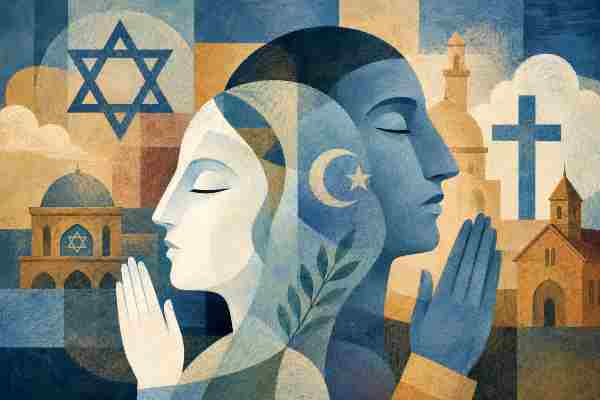
Religious extremism appears in many cultures and belief systems. The Abrahamic traditions of Christianity, Islam, and Judaism are built on extremist philosophies. They inspire movements that use religious authority to divide people, control public life, or excuse harm. Comparing them reveals patterns that reach beyond any one religion.
The Abrahamic traditions share many stories, moral teachings, and religious figures. They also contain many branches, cultures, and ways of reading their sacred texts.
Most Christians, Muslims, and Jews do not support violence or oppression. This article focuses only on extremist groups and leaders. It does not blame the Abrahamic traditions for what some people do in their name.
Emotional Readiness Notice:
This article discusses the effects of extremism in connection with religion, violence, discrimination, and coercive control. These subjects may bring up strong emotional reactions. Emotional balance and stability can help you critically assess the beliefs and claims being discussed without allowing emotional triggers to overwhelm careful judgment.
What religious extremism means
Religious extremism is more than strong faith. A person can be deeply religious and still respect the rights of others. The danger begins when one group claims that everyone must live by its beliefs.
An extremist group may try to control laws, schools, healthcare, family life, or public speech. It may also punish people who question the faith or leave it. At that point, religion is no longer only a personal belief. It has become a tool of power.
Religious extremism often includes several warning signs:
- One group claims to hold the only complete truth.
- Religious authority is placed above facts and human rights.
- Outsiders are treated as dangerous, sinful, or less worthy.
- Questions and disagreement are treated as disobedience.
- Political power is used to enforce religious rules.
- Violence is called holy, needed, or justified.
Not every extremist movement uses open violence. Some groups work through elections, courts, schools, or public policy. Others rely on shame, family pressure, or fear of rejection. The method may change, but the goal is often the same: one approved way of life for everyone.
This article does not explain how single beliefs grow into full systems of thought.
➡ For more, see: The Narrative Structure: How Beliefs Become Ideologies.
It also does not explain every way beliefs are passed through families, schools, media, and religious groups.
➡ For more, see: How Mental Conditioning and Brainwashing Shape Beliefs
➡ For more, see: Mental Conditioning and Social Programming: Layers of Influence.
The purpose here is narrower. It compares the patterns of religious extremism found within the Abrahamic traditions of Christianity, Islam, and Judaism.
Patterns shared across the Abrahamic traditions
The Abrahamic traditions promote variations of different scriptures, customs, laws, and histories. Yet extremist movements within them often use similar methods. Looking at those shared methods helps us judge the movement by what it does, not only by the name it uses.
Dividing people into insiders and outsiders
Extremist groups often divide the world into two sides. One side is seen as faithful, pure, chosen, or saved. The other side is called sinful, corrupt, unclean, or dangerous.
This split makes unfair treatment easier to defend. Once people are seen only as enemies, their rights seem less important. Exclusion may be called faithfulness, while violence may be called defense.
The language sounds moral, but the result is still harm. People are no longer judged by their actions. They are judged by the group they belong to.
➡ For more, see: Religious Law As State Law: Islamic And Christian Sharia
Claims of religious superiority
Faith can give people comfort, purpose, and a sense of belonging. It becomes dangerous when those beliefs are used to claim the right to rule. An extremist group may insist that its moral laws should apply to everyone.
Religious identity may also become tied to race, nation, or family background. The group then claims that both the religion and the country belong to it. People outside the group are treated as guests, threats, or second-class citizens.
This creates an “us versus them” view of public life. Political disagreement becomes a fight between good and evil, and compromise begins to look like betrayal.
Male control over family and public life
The Abrahamic traditions developed in societies led mostly by men. Men often held greater power in religion, law, and family life. Many believers today reject this unfair system, but extremist groups often try to protect or restore it.
These groups may teach that men must lead the home, the faith, and the government. Women may face strict limits on education, work, clothing, marriage, or healthcare. Obedience may be described as part of God’s order.
Because the rule is called sacred, it becomes harder to question. A woman who asks for equal rights may be called selfish or sinful. A man who supports her may be called weak or disloyal.
Using doctrine against women and LGBTQ+ people
Extremist groups often defend one narrow view of gender, sexuality, and family. People who do not fit that model may be shamed, rejected, or denied equal rights.
Women may lose control over pregnancy or reproductive care. LGBTQ+ people may lose family support, housing, or access to healthcare. Some are pushed toward harmful practices that claim to change who they are.
Supporters may describe these actions as moral care. Yet the results often include fear, shame, loneliness, and loss of safety. The harm grows when private beliefs shape public laws.
Turning sacred duty into violence
Religious extremism becomes most dangerous when violence is described as holy. Leaders of the Abrahamic traditions may claim that harming enemies serves God or protects the faith. They may promise honor, reward, or salvation to those who obey.
Normal moral limits can then weaken. Victims are called unbelievers, traitors, sinners, or enemies instead of being seen as people. The label becomes the excuse for the harm.
This pattern can appear in any faith. It begins when loyalty to the group becomes more important than the life and dignity of another person.
Christian extremism
Christianity boasts the largest worldwide sect of the Abrahamic traditions. Some Christians are strict, some are moderate, and others are progressive. Christian extremism appears when one form of Christianity tries to control others through fear, punishment, or political power.
Religious authority used as public power
Christian history includes times when church leaders held great power over law and public life. They could shape education, marriage, politics, and which beliefs were allowed. People who rejected church teaching could face serious punishment.
The Spanish Inquisition shows the danger of joining religious certainty with courts and state power. People accused of rejecting approved beliefs could be arrested, tortured, or killed. Punishment was presented as a way to defend truth and protect society.
The Salem witch trials show a related danger. Fear, superstition, and unsupported claims shaped public judgment. Once the community accepted the charges, the accused had little chance to defend themselves.
These events do not prove that all Christians support abuse. They show what can happen when religious claims are placed beyond fair review.
Violence against abortion providers
Some Christian extremists have attacked clinics and medical workers involved in abortion care. Their actions have included threats, shootings, and bombings. Some attackers claimed that they were protecting life.
That claim does not remove the harm they caused. Their actions placed other people in danger and took away their safety. A person may oppose abortion without becoming an extremist, but violence crosses a clear line.
Strong moral belief does not give anyone the right to terrorize or kill. Once violence becomes acceptable, the cause has begun to erase the value it claims to defend.
Targeting LGBTQ+ people
Some Christian extremist groups oppose equal rights for LGBTQ+ people. They may support limits on marriage, family rights, healthcare, or school life. They may also defend harmful practices that try to change a person’s sexual identity.
These beliefs can cause young people to lose family support, housing, or personal safety. Adults may face unfair treatment at work or in public life. Some may also be denied equal legal protection.
The groups may say they are defending morality. Yet their actions make peaceful people less safe and less free. A private belief becomes oppressive when it is used to deny others equal rights.
Christian nationalism and far-right politics
Christian nationalism joins Christian identity with national power. It may teach that a nation belongs mainly to Christians or that government should defend one approved form of Christianity.
National and religious symbols are then used together to decide who truly belongs. Some far-right groups also add ideas about race, immigration, strict gender roles, and strong leaders.
Words such as family, tradition, patriotism, and religious freedom are not extremist by themselves. The danger comes when those words hide unfair treatment. One group receives greater power while everyone else is expected to follow its rules.
That is not equal religious freedom. It is religious privilege backed by political power.
Islamic extremism
Islam includes many cultures, branches, and schools of thought. Most Muslims do not support terrorism or harsh religious rule. Extremist groups make up only a small part of the Muslim world, but some have caused great harm.
Many of their victims have also been Muslim. This matters because Islamic extremism is often described only as a threat to non-Muslims. In fact, it is also a struggle within Muslim societies over power, law, and freedom.
Rule through harsh religious law
Islamic extremist groups may claim that one form of religious law must control the whole society. Leaders may set rules for clothing, school, worship, speech, marriage, work, and family life.
Disagreement may be treated as a crime against the faith. Fear and public punishment may be used to force obedience. People may have no safe way to question how the rules are read or enforced.
Under Taliban rule in Afghanistan, women and girls have faced harsh limits on school, work, travel, and public life. These rules are presented as God’s law, yet human leaders decide what the law means.
The problem is not only that the rules are strict. The deeper problem is that ordinary people have little power to challenge them.
Terrorism as a religious mission
Al-Qaeda and ISIS have used religion to defend terror attacks and mass killing. ISIS also destroyed cultural sites, enslaved people, and attacked religious minorities.
These groups taught that violence proved faith and loyalty. Victims were called unbelievers, traitors, or enemies. Such labels made cruelty easier because the victims were no longer seen as full human beings.
The mission was placed above the life of the person being harmed. Once that happens, nearly any act can be called necessary.
The harm done to Muslim communities
Muslims are often among the main victims of Islamic extremism. Extremist groups may attack Muslims from another branch of Islam or punish those who support peaceful government.
Muslims who defend women’s rights may face threats. So may those who read religious teachings in a different way. Families may be forced to flee, while schools, markets, homes, and places of worship become targets.
Islamic extremism is therefore not only a conflict between Muslims and non-Muslims. It is also a fight within Muslim societies over who has the right to define the faith.
Jewish extremism
Judaism includes religious, cultural, and ethnic identities. Jewish communities also hold many political and religious views. Many Jewish people oppose extremism and support equal rights.
Jewish extremism appears when religious or national claims are used to excuse harm, block peace, or deny equal rights. The examples below focus on extremist acts and groups, not on Jewish people as a whole.
Violence used to stop compromise
Israeli Prime Minister Yitzhak Rabin was killed in 1995 by Yigal Amir. Amir opposed peace agreements with Palestinians and saw compromise as betrayal.
The murder showed how extremism can turn against its own group. Rabin was a Jewish leader killed by another Jewish man. The killer placed his own religious and national beliefs above the law and above another person’s life.
Extremist movements often create strict tests of loyalty. Anyone who fails the test may become an enemy, even if that person shares the same faith or national identity.
Violence during the struggle for Israel
The Irgun bombed the King David Hotel in 1946 during the struggle against British rule. Many people were killed in the attack.
Supporters described the group as freedom fighters, while critics called the bombing terrorism. These labels show how groups defend violence by focusing on the cause instead of the victims.
The cause does not erase the harm. An attack should be judged by what it did to people, not only by the goal claimed by those who carried it out.
Religious nationalism and the Israeli-Palestinian conflict
The Israeli-Palestinian conflict has many causes. It involves land, history, war, safety, forced movement, and national identity. Religion is only one part of the conflict.
Even so, religious extremism can make peace harder. Some Jewish extremist groups claim a sacred right to land without giving equal weight to Palestinian lives and rights.
Religious claims may be used to support settlements, forced removal, or long-term control. Checkpoints and blockades may keep people from work, school, family, or healthcare. Military actions may also damage homes and needed services.
Israel has real safety concerns, and violence against Israeli civilians is wrong. The danger comes when a whole people are treated as one threat. Each person should be judged by their own actions.
Groups that oppose coexistence
Some Jewish extremist groups oppose close ties between Jews and non-Jews. Lehava is one example. It has opposed marriage and close relationships across religious lines.
The group has used public pressure, harsh speech, and fear to discourage such ties. This follows a common purity pattern found in many extremist movements.
Contact with outsiders is treated as a threat to the group. People are not trusted to choose their own friends or partners. The movement tries to control those choices and keep the groups apart.
What the comparison reveals
The extremist movements of the Abrahamic traditions often use modified translations of scriptures, symbols, and historical stories. Yet they often create similar results. But their methods often look alike.
They divide people into insiders and outsiders. They place leaders above questions and turn old customs into sacred rules. They may control women, minorities, and people who disagree.
They may also call control, protection, and violence duty. The religious name is not the main issue. The deeper problem is power that cannot be questioned or corrected.
Religion can give that power special force because leaders may claim that God supports them. Questioning the leader may then feel like questioning God. This can silence both believers and outsiders.
When a movement becomes free from review, harmful actions can continue for years. The group protects its beliefs instead of facing the harm those beliefs cause.
Why self-correction matters
A healthy belief system must be able to examine its own actions. People need the freedom to question leaders, report harm, and compare teachings with real results.
Extremists within the Abrahamic traditions resist this kind of review. They protect the belief before they examine the damage. When facts challenge the group, leaders may blame outsiders, enemies, weak believers, or moral decline.
Each failure then becomes a reason to demand more loyalty. The system grows harder to correct because doubt itself is treated as a threat.
A healthy community responds in another way. It admits mistakes, protects critics, and listens to people who were harmed. It changes actions that do not match the values it claims to hold.
➡ For more, see: The Self-Correction Mechanism: Belief Safeguard to Avoid Extremism.
The Abrahamic traditions have changed many times. Believers have challenged slavery, racism, unfair laws, male control, religious violence, and the punishment of doubt.
These reformers show that harmful teachings do not have to remain fixed. A tradition can grow when it allows honest review and change.
Religious belief is not extremist rule
People should be free to follow a religion, leave it, change religions, or follow no religion. These rights must apply to everyone.
A Christian does not lose freedom when a Muslim has equal rights. A Muslim does not lose freedom when a Jewish person worships openly. A Jewish person does not lose freedom when a nonbeliever questions public policy.
Equal freedom does not require agreement. It requires the same basic rights for people who hold different beliefs.
Religious extremism rejects this equal standard. The favored group receives greater power and protection, while other people must live under rules they did not choose.
This is not equal religious freedom. It is religious rule backed by power.
The wider effects of extremist rule are explained in another article.
➡ For more, see: Are Freedom and Autonomy Possible When Extremists Rule?
Final thoughts
Religious extremism does not belong to one religion or one nation. Its warning signs can appear in all branches of the Abrahamic traditions.
The words and symbols may change, but the basic pattern often stays the same. Extremist leaders claim special truth, protect authority from questions, and place one group above others.
They may control private life, punish disagreement, or use fear to demand obedience. Some may also use violence and call it sacred duty.
These movements do not speak for every believer. Many Christians, Muslims, and Jews oppose extremism, defend human rights, and work for peace.
Blaming the Abrahamic traditions as a whole would repeat the same “us versus them” thinking that extremism depends upon. The goal is not to decide which religion is worst.
The goal is to notice the warning signs and judge each movement by what it does. A religious movement becomes oppressive when it forces its rules on people who did not choose them.
It becomes dangerous when people cannot question it safely. The name of the movement does not excuse the harm. Its actions show what it has become.
References
- The Terror in the Mind of God: The Global Rise of Religious Violence, Mark Juergensmeyer.
- The Ambivalence of the Sacred: Religion, Violence, and Reconciliation, R. Scott Appleby.
- Strong Religion: The Rise of Fundamentalisms Around the World, Gabriel A. Almond, R. Scott Appleby & Emmanuel Sivan.
- Terror in the Name of God: Why Religious Militants Kill, Jessica Stern.
- Inside Terrorism, Bruce Hoffman.
- Taking America Back for God: Christian Nationalism in the United States, Andrew L. Whitehead & Samuel L. Perry.
- Jihad: The Trail of Political Islam, Gilles Kepel.
- The Rise of Islamic State: ISIS and the New Sunni Revolution, Patrick Cockburn.
- For the Land and the Lord: Jewish Fundamentalism in Israel, Ian S. Lustick.
- Brother Against Brother: Violence and Extremism in Israeli Politics from Altalena to the Rabin Assassination, Ehud Sprinzak.
- Fundamentalisms Observed, Martin E. Marty & R. Scott Appleby (eds.).
- Fundamentalisms and the State: Remaking Polities, Economies, and Militance, Martin E. Marty & R. Scott Appleby (eds.).
- Fundamentalisms and Society: Reclaiming the Sciences, the Family, and Education, Martin E. Marty & R. Scott Appleby (eds.).
- Freedom of Religion or Belief, Office of the United Nations High Commissioner for Human Rights.
- International Religious Freedom Reports, U.S. Department of State.
About this project
The Seeker Project 4 Spiritual Exploration (SP4SE) is a project of Americans In Alliance. The mission of SP4SE is spiritual education. The mission of Americans In Alliance is environmental conservancy. Click the links below to learn more and support our efforts.