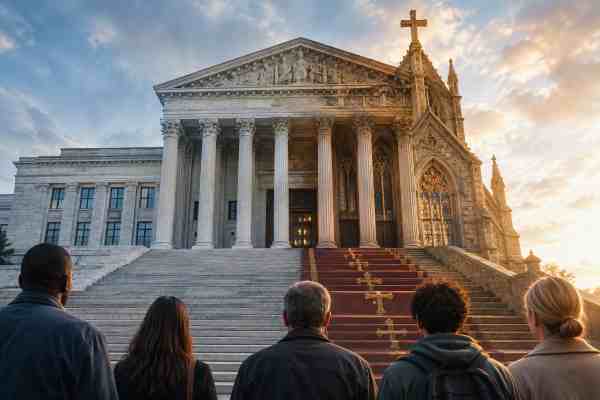
When religious law becomes State law, the government enforces biased and prejudiced beliefs. A person no longer chooses whether to follow a faith. The state makes that choice for them. The follower mindset becomes a legal duty for every citizen, believer or not.
This is not only a problem of the past, and it is not limited to one religion. Sharia, or Islamic law, governs some nations today. Christian law once governed much of the West, and a movement called Christian Nationalism now seeks to bring it back.
Critics call that goal “Christian Sharia” because the structure would be the same. Only the religion at the top would change. This article follows that structure from start to finish. It explains how religious law takes over a government and where it rules today. It shows how the Islamic and Christian forms compare. It ends with what keeps religious law out of government, and why that protection matters to everyone.
Emotional Readiness Notice:
This article discusses religion, government, religious identity, and the use of law to enforce beliefs. These subjects may bring up strong feelings, especially when they involve your own faith or family beliefs. Emotional balance can help you examine the history, claims, and evidence clearly. If the material becomes upsetting, pause and return when you feel steady enough to continue.
➡ For More See: The Emotional Check-In Process: Manage Emotional Readiness
What religious law as state law means
Before we look at how religious law takes power, a few terms need clear meanings. Each one comes up again and again in the sections that follow.
Religious law and state law
Religious law is a set of rules for living that comes from holy books and religious leaders. It tells believers how to live. It dictates how to pray, what to eat, whom to marry, and how to treat others. Within a faith community, people follow it because they believe in it.
State law works differently. It is the set of rules a government establishes, and the government enforces them with courts, police, and prisons. You must follow state law whether you agree with it or not.
Religious law as state law joins these two together. The government takes the rules of one religion and enforces them on everyone. A person’s own beliefs no longer matter. The State law applies to all.
Sharia
Sharia is Islamic law. It comes from the Quran and from the teachings and practices of the Prophet Muhammad, and religious scholars explain what it means.
For many Muslims, Sharia is a personal guide to living a good life. It shapes their prayer, their diet, and the way they treat others. In that form, it is a matter of private faith. Sharia becomes state law only when a government enforces it on the whole nation.
Theocracy and the secular state
A theocracy is a government ruled by religious leaders or in the name of God. In a theocracy, religious authority and political authority are the same thing.
A secular state is the opposite. It does not take its power from any religion. Instead, it protects freedom of conscience for everyone. Freedom of conscience means the right to believe, to question, or to not believe at all without being punished.
➡ For more, see: The Self-Correction Mechanism: Belief Safeguard to Avoid Extremism
Christian Sharia
Christian Sharia is a term used by critics. It describes a Christian form of religious law as state law. Supporters of Christian Nationalism reject the label, and that disagreement is worth noting. This article uses the term to compare the structures of two systems, not to judge any person’s faith.
➡ For more, see: Are Freedom and Autonomy Possible When Extremists Rule?
How religion takes over government
Religion can take over a government more easily than most people realize. The reason is simple. Religion and government are built the same way, so religion does not need to build a new system. It only needs to take the top of the one that already exists.
One hierarchy, two uniforms
Both religion and government use what can be called a military hierarchy. In this kind of system, power sits at the top, and orders flow down through the ranks. Each rank receives only the information it needs to do its job. This is called need-to-know, and it keeps the people at the bottom dependent on the people at the top.
Because government and religion share this design, they fit together easily. When religious leaders sit at the top of a government, their reading of holy books becomes the law of the land. The ranks below simply carry out orders, as they always have.
➡ For more, see: Agency Orientations: Follower Mindset And Seeker Mindset
How the merger works
The merger usually happens in three steps. First, a holy book becomes the highest law in the nation. It ranks above the constitution and above the voters.
Next, religious scholars take on the job of deciding what the holy book means. The courts then enforce their decisions. In practice, a small group of religious leaders now writes the law for everyone.
Last, every path of appeal is closed. No vote, court, or law can overrule the holy book. Disagreeing with the law now means disagreeing with God. Disagreement becomes disobedience, and disobedience becomes a crime.
Sharia as state law today
This merger is not just a theory. In several nations today, Islamic law is state law, and the government enforces belief. Looking at these nations closely shows both how far religious law can reach and how much its use varies.
A range of practice
Not every Muslim country runs the same way. Many Muslim-majority countries use Sharia only for family matters, such as marriage, divorce, and inheritance. A smaller number apply it to crime, speech, and public life.
Some Muslim-majority nations do not use Sharia as state law at all. Turkey and Senegal, for example, have secular constitutions. Their governments do not take their power from religion.
This range matters because it shows where the real problem lies. The problem is not Islam itself or the people who follow it. The problem is what happens when any government enforces religious law on everyone.
Where it governs fully
Three nations show what full religious rule looks like. In Iran, a council that includes six senior clerics reviews every new law. Only the clerics decide whether a law matches Islam, and laws that fail their test cannot take effect. The elected parliament can write laws, but religious leaders have the final word.
Saudi Arabia goes further in its founding law. Instead of a written constitution made by the people, it names the Quran and the teachings of the Prophet as its constitution.
Afghanistan shows how quickly religious rule can reshape a nation. The Taliban returned to power in 2021, and their religious rule now controls education, dress, travel, and public life. Girls have been barred from school after the sixth grade. Afghanistan is the only country in the world that bans girls from high school and college.
Blasphemy and apostasy laws
Religious law reaches into speech and belief through two kinds of laws. Blasphemy laws punish people for speaking against religion. Apostasy laws punish people for leaving their religion. In countries ruled by strict religious law, both can be serious crimes.
Pakistan shows how dangerous these laws can be. There, insulting the Prophet Muhammad carries a mandatory death sentence. The state has never executed anyone under this law, and most convictions are overturned on appeal. Even so, an accusation alone can be deadly. Mobs have killed dozens of people accused of blasphemy before or after their trials.
In a few countries, leaving Islam can also be punished by death under the law or its interpretation. In these places, simply asking questions about faith carries real risk.
When Christianity ruled the West
It would be easy to see religious law as a problem of other cultures. History says otherwise. For centuries, Christian religious law governed Western nations, and it used the same structure.
Church law and church courts
During the Middle Ages, church law ruled much of Europe. It governed marriage, morality, and belief. Church courts put people on trial for heresy, which means holding beliefs the church has not approved.
The church did not act alone. Through the Inquisition, it used the power of the state to enforce belief. People found guilty could lose their property, their freedom, or their lives.
Christian law in new governments
Religious law did not end with the Middle Ages. In the 1500s, John Calvin’s Geneva used city government to enforce church rules. In 1553, the city burned Michael Servetus at the stake for heresy.
The same pattern crossed the ocean to America. In 1641, the Massachusetts Bay Colony wrote a list of crimes worthy of death. Many of those laws cited Bible verses as their source. The list included worshiping other gods, witchcraft, and blasphemy.
These laws lasted far longer than most people realize. In 1838, a man named Abner Kneeland spent 60 days in a Massachusetts jail for blasphemy. He was the last person in the United States jailed for that crime. Across the Atlantic, England and Wales did not end their old blasphemy law until 2008.
How the West moved away
Over time, the West turned away from religious rule, and it learned that lesson at great cost. Wars between Christian groups killed millions of people. In the aftermath, thinkers of the Enlightenment argued that reason, not religion, should guide government. They called for freedom of conscience.
America wrote this idea into its founding law. The First Amendment says the government may not set up an official religion. It also protects every person’s right to practice their faith, or no faith at all. With that, religion lost its place at the top of the American hierarchy.
The push to restore Christian rule
Some people want to give religion that place again. In the United States, the movement working toward this goal is called Christian Nationalism.
Christian Nationalism
Christian Nationalism blends being Christian with being American. It often teaches that the nation belongs mainly to Christians. It also teaches that the government should protect one approved kind of Christianity. Not every supporter wants the same thing. Some want more prayer and Christian symbols in public life. Others want much more.
➡ For more, see: Religious Extremism Across the Abrahamic Traditions
Biblical law as civil law
The most extreme supporters want the laws of the Bible to become the laws of the land. This idea is called Christian Reconstructionism. Its main thinker was a minister named R.J. Rushdoony.
In 1973, Rushdoony wrote a book called The Institutes of Biblical Law. In it, he argued that the laws of the Old Testament should still govern society today. His followers have called for the death penalty for idolatry, blasphemy, and adultery. These are the same kinds of crimes the Massachusetts Bay Colony punished with death in 1641.
A second idea spreads the goal more widely. It is called the Seven Mountains Mandate, and it goes back to 1975. It teaches that Christians should take dominion, or rule, over seven parts of society: family, religion, education, media, arts and entertainment, business, and government. Its supporters say they only want to spread Christian values. Critics warn that the real goal is control of public life.
Most Christian Nationalists do not hold these extreme views. But these movements show the clearest version of the goal, which is biblical law enforced by the state.
Not all Christians agree
Many Christians oppose these ideas, and some of the strongest opposition comes from inside the faith. Most Calvinists, the tradition Rushdoony came from, reject Christian Reconstructionism. In 2019, the Baptist Joint Committee for Religious Liberty launched a campaign called Christians Against Christian Nationalism. Its supporters argue that joining church and state harms both faith and freedom.
This opposition shows that the issue is not Christianity itself. The issue is the structure. Any religion placed at the top of government takes away the agency of every citizen, including its own believers.
Comparing Islamic and Christian Sharia
With both histories in view, the comparison becomes clear. The Islamic and Christian forms of religious law share the same structure. Only the religion at the top is different.
Where the structures match
The first match is the source of law. In both forms, a holy book ranks above the constitution, and neither voters nor courts can overrule it. The second match is who decides. In both forms, religious leaders explain what the holy book means, and their reading becomes the law.
The two forms also treat speech and belief the same way. Strict Sharia punishes blasphemy and apostasy. Christian Reconstructionism would punish blasphemy and idolatry, in some cases by death. Both make questioning the faith a crime.
Women and families face similar rules under both systems. Each places limits on marriage, family roles, and women’s lives. Each puts men at the head of the home and gives the state a say in family choices.
Finally, both forms give outsiders a lower place. Under strict Sharia, non-Muslims can face legal limits. Christian Nationalism often teaches that the nation belongs mainly to Christians. In both cases, a citizen’s standing depends on their faith.
Where the comparison has limits
A fair comparison must also state its limits. Christian Nationalism does not control any nation the way Sharia controls Iran or Saudi Arabia. Most Christian Nationalists do not call for the full program of biblical law.
The comparison is about goals and structure, not current practice. It shows where the road leads if religion takes the top of government. It does not claim that every country has already arrived there.
What religious law takes from citizens
Whatever the religion at the top, the cost to citizens is the same. Religious law as state law takes agency from every citizen, not just believers.
It takes freedom of conscience, because belief is enforced and doubt is punished. It takes equal citizenship, because a person’s rights depend on their faith. It takes personal choice, because the law decides matters of marriage, children, clothing, and worship.
In this system, the follower mindset is no longer a role a person chooses. It is the law, and every citizen must obey it.
➡ For more, see: The Social Cost and Systemic Harm of Organized Religion
➡ For more, see: Are Freedom and Autonomy Possible When Extremists Rule?
Keeping religious law out of government
If religion can take the top of government so easily, the next question is how to stop it. The answer is to keep religion and government separate. That separation protects believers and nonbelievers alike.
What protects freedom of conscience
Three safeguards keep religious law out of government. The first is a secular constitution that does not take its power from religion. The second is equal protection under the law, so every citizen has the same rights no matter what they believe. The third is a court system that answers to the constitution, not to religious leaders.
These safeguards also protect religious people. A believer whose faith is not the one in power has the most to lose under religious law. Separation protects every faith by favoring none.
Warning signs
Religious law rarely arrives all at once. It moves into government step by step, and each step can seem small. Watch for these signs:
- Laws justified by holy books instead of reasons all citizens can share.
- Religious tests for public office or citizenship.
- Public schools teaching one faith as the truth.
- Calls to make the nation officially belong to one religion.
➡ For more, see: The Continuum of Freedom, Personal Autonomy, and Human Rights
Conclusion — no religion at the top
Religious law as state law turns the follower mindset into a legal duty. Every citizen must follow, whether they believe or not. History shows this happening under Islam and under Christianity, and it shows the same results each time.
The two forms share one structure. A holy book sits above the people, religious leaders sit above the law, and questions become crimes. The religion at the top may change, but what citizens lose stays the same.
A secular state keeps the top of the hierarchy free of any religion. That does not make it an enemy of faith. It protects every person’s right to believe, to question, or to not believe. Most of all, it keeps the power to decide what is true where it belongs: with each citizen.
References
- Sharia: Theory, Practice, Transformations. Cambridge University Press.
- Basic Law of Governance, Kingdom of Saudi Arabia (Royal Decree No. A/90, 1992). WIPO Lex.
- Constitution of the Islamic Republic of Iran, Articles 91–96 (Guardian Council). Constitute Project.
- Constitution of the Republic of Senegal, Article 1. Constitute Project.
- Taliban Have Deliberately Deprived 1.4 Million Afghan Girls of Schooling Through Bans, Says UNESCO. Associated Press.
- Pakistan Penal Code, Section 295-C. Government of Pakistan.
- Pakistan’s Blasphemy Law Goes Bollywood. Human Rights Watch.
- Blasphemy: Verbal Offense Against the Sacred, from Moses to Salman Rushdie. Alfred A. Knopf.
- Hunted Heretic: The Life and Death of Michael Servetus. Beacon Press.
- The Body of Liberties of the Massachusetts Colony in New England (1641). Teaching American History.
- Commonwealth v. Kneeland (Mass. 1838). The First Amendment Encyclopedia, Middle Tennessee State University.
- Criminal Justice and Immigration Act 2008, Section 79: Abolition of Common Law Offences of Blasphemy and Blasphemous Libel. legislation.gov.uk.
- The Institutes of Biblical Law. The Craig Press.
- What Is the “Seven Mountains Mandate” and How Is It Linked to Political Extremism in the US? The Conversation.
- Taking America Back for God: Christian Nationalism in the United States. Oxford University Press.
- Christians Against Christian Nationalism. BJC (Baptist Joint Committee for Religious Liberty).
About this project
The Seeker Project 4 Spiritual Exploration (SP4SE) is a project of Americans In Alliance. The mission of SP4SE is spiritual education. The mission of Americans In Alliance is environmental conservancy. Click the links below to learn more and support our efforts.