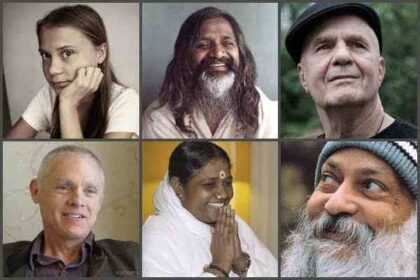
The idea of spiritual knowledge has evolved over time. Ancient traditions often described it as enlightenment, or as an awakening or liberation from ignorance. Modern teachers offer a wide range of enlightened perspectives on consciousness, meditation, ethics, and the search for meaning.
Today’s gurus and teachers approach the search for meaning from many directions. Some emphasize meditation and mindfulness, others explore consciousness through philosophy, while still others apply spiritual values to social change or environmental responsibility.
By examining these perspectives side by side, we gain a clearer picture of how contemporary thinkers interpret spirituality.
Influential spiritual teachers and thinkers
The individuals selected come from different traditions, cultures, and historical periods. Rather than ranking them, the goal is to highlight voices that have contributed meaningful perspectives to modern discussions about spirituality, consciousness, and human development.
Meditation and mindfulness
Many of the most influential spiritual thinkers discuss meditation and mindfulness, but their enlightened perspectives on awareness and practice often take very different forms.
Thích Nhất Hạnh taught that mindfulness is not merely a meditation exercise performed in silence but a continuous practice integrated into daily life. Ordinary activities such as walking, breathing, or eating can become moments of awareness when performed with attention and gratitude. His teachings encourage people to bring calm attention to every experience. As he explained, “The present moment is the only moment available to us, and it is the door to all moments.”
Eckhart Tolle approaches mindfulness from the perspective of presence. Rather than focusing on formal meditation rituals, he teaches that awakening begins when we become aware of the constant internal dialogue of the mind. When a person recognizes that they are not their thoughts, a deeper awareness begins to emerge. Tolle summarizes this idea clearly: “Realize deeply that the present moment is all you ever have.”
While both teachers emphasize awareness, Pema Chödrön frames mindfulness as a way of working directly with suffering and uncertainty. Instead of avoiding discomfort, she encourages practitioners to observe difficult emotions without resistance. Through this process, compassion and resilience naturally develop. As she writes,
You are the sky. Everything else is just the weather.
A similar theme appears in the teachings of Jack Kornfield, who helped introduce Vipassana meditation to Western audiences. Kornfield blends traditional Buddhist teachings with modern psychology, encouraging a gentle approach to mindfulness rooted in compassion. In his words, “In the end, just three things matter: how well we have lived, how well we have loved, and how well we have learned to let go.”
Consciousness, philosophy, and the inner world
The enlightened perspectives from influential spiritual teachers often converge on similar ideas, even though their methods and practices can differ greatly.
Some influential spiritual thinkers explore enlightenment not primarily through meditation, but through philosophical inquiry into the nature of consciousness and human identity.
Alan Watts became one of the most important interpreters of Eastern philosophy for Western audiences. His lectures and writings explained Zen Buddhism and Taoism in an accessible language, helping readers understand the relationship between self and universe. Watts often reminded audiences that the boundary between the individual and the cosmos is largely an illusion. As he famously said,
You are an aperture through which the universe is looking at and exploring itself.
Carl Jung approached spirituality through psychology. His work on archetypes and the collective unconscious suggested that spiritual symbols emerge from deep structures within the human mind. Jung believed that understanding these inner patterns could lead individuals toward greater self-awareness. His insight is captured in the line, “Who looks outside dreams; who looks inside awakens.”
Joseph Campbell explored spirituality through mythology. By studying stories from cultures around the world, he discovered recurring patterns that reflect humanity’s search for meaning. Campbell’s concept of the “hero’s journey” describes a universal path of transformation that appears in both ancient myths and modern narratives. He summarized the importance of this journey by saying, “The privilege of a lifetime is being who you are.”
Friedrich Nietzsche challenged traditional religious ideas while still grappling deeply with the nature of human transformation. His writings emphasized personal responsibility and the need for individuals to create meaning rather than relying on inherited belief systems. In one of his most quoted observations, he wrote, “He who has a why to live can bear almost any how.”
Yoga, meditation traditions, and spiritual practices
Several influential teachers introduced Eastern spiritual practices to Western audiences, helping transform meditation and yoga into global movements.
Paramahansa Yogananda was among the first of the Eastern influential spiritual teachers to establish a lasting presence in the United States. Through his organization, the Self-Realization Fellowship, he taught meditation techniques such as Kriya Yoga and emphasized the unity of world religions. His teachings focused on direct spiritual experience rather than religious dogma. Yogananda summarized his view simply: “The soul loves to meditate, for in contact with the Spirit lies its greatest joy.”
Maharishi Mahesh Yogi played a central role in popularizing meditation during the twentieth century. His method of Transcendental Meditation offered a simple technique designed to calm the mind and promote deeper awareness. Maharishi believed that widespread meditation could even influence society as a whole by reducing stress and conflict.
Sadhguru Jaggi Vasudev continues this tradition in the modern era. Through the Isha Foundation, he teaches yogic practices aimed at inner transformation and personal responsibility. Sadhguru often emphasizes that spiritual development is a practical process of refining awareness. As he puts it, “Meditation is a means for transforming the mind.”
Another voice within this tradition is Mooji, whose teachings draw from Advaita Vedanta. Mooji encourages seekers to question their identification with thoughts and emotions in order to discover a deeper sense of self that lies beyond the mind.
Spirituality and social responsibility
For some spiritual figures, enlightenment is not only an inner experience but also a guide for ethical action in the world.
Mahatma Gandhi demonstrated how spiritual principles can shape political movements. His philosophy of nonviolent resistance was rooted in the belief that truth and compassion ultimately possess greater power than violence. Gandhi encouraged individuals to embody the values they wish to see reflected in society. His famous advice captures this idea: “Be the change that you wish to see in the world.”
Jane Goodall represents another form of spiritual activism through her lifelong commitment to environmental conservation. Her work studying chimpanzees transformed our understanding of animal intelligence and inspired a global movement for wildlife protection. Goodall often reminds people that individual actions matter, saying, “What you do makes a difference, and you have to decide what kind of difference you want to make.”
A younger generation of activists is represented by Greta Thunberg, whose advocacy has brought worldwide attention to climate change. While not a traditional spiritual teacher, her message reflects the moral urgency of caring for the planet and future generations.
Spirituality in modern culture
Spiritual ideas increasingly appear in literature, entertainment, and popular culture, where public figures sometimes explore philosophical questions about identity and meaning. Perspectives from influential entertainers show that spirituality is not confined to religious figures.
Russell Brand has spoken openly about addiction recovery and personal transformation. Drawing from meditation practices and philosophical traditions, he often discusses spirituality as a way of overcoming destructive habits and reconnecting with deeper purpose.
Jim Carrey has also shared reflections on the nature of identity and ego. In interviews and public talks, he frequently discusses the illusion of the separate self and the freedom that comes from recognizing that identity is more fluid than we assume.
Keanu Reeves is admired not only for his acting career but also for his humility and generosity. Many observers see his quiet philosophical outlook as an example of how spiritual awareness can appear in everyday life.
In literature, Paulo Coelho explores spiritual themes through storytelling. His novel The Alchemist presents the idea that each person has a unique destiny and that following one’s path requires courage and trust. As he writes, “When you want something, all the universe conspires in helping you to achieve it.”
Controversial perspectives from influential thinkers
Some spiritual teachers have had a powerful influence while also generating debate and criticism. In fact, enlightened perspectives are often outside of mainstream thinking.
Osho, also known as Bhagwan Shree Rajneesh, encouraged meditation, personal freedom, and the rejection of rigid religious traditions. His movement attracted many followers but also controversy due to its unconventional lifestyle and leadership structure.
Sogyal Rinpoche was an influential Tibetan Buddhist teacher and author whose work helped introduce Tibetan spirituality to Western readers. However, allegations of misconduct later complicated his legacy.
Carlos Castaneda became widely known through books describing his apprenticeship with a Yaqui shaman. Although scholars debate the accuracy of his accounts, his writings brought shamanic ideas into mainstream spiritual discussion.
Conclusion: Enlightened perspectives
Modern spiritual thinkers approach enlightenment from many different directions. Some emphasize meditation and mindfulness, others philosophy or activism, and still others explore spiritual ideas through literature and culture.
Together, these perspectives from influential spiritual teachers demonstrate that the search for meaning is not limited to one tradition or discipline. Whether through contemplation, scholarship, social action, or creative expression, the pursuit of awareness continues to evolve in the modern world.