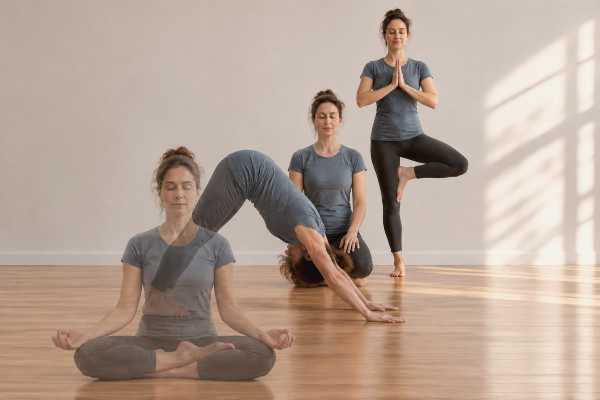
There are many types of yoga that go far beyond stretching. This guide places them on the traditional paths and Patanjali’s eight limbs. This is your guide for choosing a yoga practice that fits your life and matches your goals and your body.
Most people in the West first meet yoga as an exercise class. They learn a series of postures, follow their breath, and leave feeling looser and calmer. That is a real yoga practice, but it is only one part of a much larger system.
Traditional yoga was built to train the whole person. It included ethics, breath, attention, devotion, service, and meditation, with postures as just one piece. Today’s many styles grew out of that larger system. Each one kept some parts and set others aside.
Knowing where a style comes from tells you what it was built to do. Instead of trying classes at random, you can choose a yoga practice that fits your goal, your health, your life, and the teacher who will guide you.
Two maps of yoga
Yoga has been described in many ways over the centuries. Two maps are especially useful for understanding today’s styles. The first sorts yoga into paths, based on the kind of person and the kind of effort involved. The second, from Patanjali, lays out the steps of practice in order.
The traditional paths of yoga
The best-known classical grouping divides yoga into four paths. The Bhagavad Gita describes them, and the teacher Swami Vivekananda made them famous in the West in the 1890s. Each path suits a different temperament: the thinker, the devoted heart, the person of action, and the meditator.
Many modern teachers describe seven paths instead. They tell the story of Shiva as Adiyogi, the first yogi, who passed different parts of yoga to seven sages. In this version, mantra, tantra, and hatha join the original four. The story is legend rather than history, but the seven-path map is a helpful way to see the range of practices that grew from yoga.
| Path | What it develops |
|---|---|
| Jnana yoga | The path of knowledge. It uses inquiry and reflection to see the true nature of the self. |
| Bhakti yoga | The path of devotion. It turns emotion into love for the divine or a chosen ideal. |
| Karma yoga | The path of action. It practices selfless service without attachment to results. |
| Raja yoga | The royal path of meditation. It trains the mind through discipline and concentration. |
| Mantra yoga | The path of sound. It uses a mantra to settle and refine awareness. |
| Tantra yoga | The path of balancing polarities. It works with energy, ritual, and visualization to unite opposites. |
| Hatha yoga | The path of the body. It uses postures and breath to prepare body and mind for deeper practice. |
The paths are not walls. A single yoga practice often draws from more than one.
Patanjali’s eight limbs of yoga
About two thousand years ago, Patanjali gathered the methods of yoga into the Yoga Sutras. He did not invent yoga. He organized it into eight limbs, or steps, that build on each other. The first two shape how you live. The middle steps train the body, breath, and senses. The last three train the mind.
| Limb | What it means |
|---|---|
| 1. Yamas | Ethical restraints in how you treat others, such as nonviolence and honesty. |
| 2. Niyamas | Personal observances, such as cleanliness, contentment, and self-study. |
| 3. Asana | Postures that make the body steady and comfortable for sitting. |
| 4. Pranayama | Breath regulation to influence energy and attention. |
| 5. Pratyahara | Drawing the senses inward, away from outside distraction. |
| 6. Dharana | Concentration, holding attention on one object. |
| 7. Dhyana | Meditation, an unbroken flow of attention. |
| 8. Samadhi | Absorption, where the sense of a separate observer falls away. |
Patanjali called the last three limbs together samyama. In the third book of the Yoga Sutras, he describes the siddhis, unusual abilities said to come from practicing samyama. That is why siddhi practice is traditionally taught only after a solid foundation in meditation.
➡ For more, see: The TM Yoga Siddhis Sutras of Patanjali
How the two maps fit together
The paths describe what kind of practice you are drawn to. The eight limbs describe how a yoga practice unfolds over time. A Hatha class works mostly on limbs three and four. A Raja or japa practice works mostly on limbs five through eight. Bhakti and karma yoga live out the first two limbs in devotion and daily action.
This also shows what most modern classes leave out. Many keep the postures and the breath but drop the ethics and the meditation. The postures still help, but they were originally the doorway, not the destination.
Choosing a yoga practice step by step
The right yoga practice matches your goal, your body, and your life as it is right now. Trends come and go, but those three things stay the same. Work through them in order.
Start with your real goal
Be honest about what you want. Some people want physical health: strength, flexibility, or balance. Others want stress relief, better sleep, and a calmer nervous system. Some want to understand their thoughts and emotions. Some are drawn to devotion, chanting, or ritual. And some are curious about energy and deeper states of awareness.
Match your goal to a style
Once you know your goal, this table points to the styles that serve it best. Each style is described in more detail later in the article.
| If you want | Styles to try |
|---|---|
| Strength and stamina | Vinyasa, Ashtanga |
| Flexibility and mobility | Hatha, Yin, Iyengar |
| Stress relief and better sleep | Restorative, yoga nidra, Yin, slow Hatha |
| Recovery from injury or pain | Iyengar, chair yoga, restorative, with your doctor’s approval |
| Gentle practice with limited mobility | Chair yoga, gentle Hatha, Iyengar |
| Practice during pregnancy | Prenatal yoga |
| A calm, focused mind | Japa meditation, dhyana meditation, Raja yoga |
| Self-understanding | Jnana yoga, Raja yoga, Kripalu |
| Devotion and community | Bhakti yoga, kirtan, Sivananda |
| Living your values through service | Karma yoga |
| Energy and deeper states | Kundalini or siddhi practice, but only after a steady foundation in meditation |
Check your health first
A yoga practice is safe for most people, but some styles carry real risks for certain conditions. Talk with your doctor before you start if you are pregnant, have high blood pressure or a heart condition, have glaucoma, have osteoporosis, have had recent surgery, or live with back or joint problems.
Some practices deserve extra care. Heated classes strain the heart and can be dangerous during pregnancy. Upside-down poses raise pressure in the head and eyes, which matters for glaucoma and high blood pressure. Deep forward bends and twists can harm bones weakened by osteoporosis. Fast, forceful breathing, used in some Kundalini classes, may not suit people with heart conditions or epilepsy. If you are under care for a mental health condition, talk with your provider before beginning intense breathwork or long meditation retreats.
For a health condition, look for a certified yoga therapist. These teachers have advanced training in adapting a yoga practice for medical needs.
Fit your yoga practice to your life
Choose a yoga practice you will actually keep doing. Think about how much time you have. A twenty-minute home routine you do four times a week will help more than a ninety-minute class you skip.
Consider cost and format, too. Group classes cost less and offer community. Private lessons cost more but help with injuries or specific goals. Online classes are convenient, but no one is there to correct your form. If you are new, a few in-person classes first will help you learn safe alignment before you practice on your own.
How to start a yoga practice
Begin your yoga practice with a beginner or gentle Hatha class two or three times a week. Add a few minutes of quiet sitting at the end, even if the class does not include it. This builds the foundation that every other style depends on.
Give a style six to eight weeks before you judge it. The first few classes are mostly about learning the basics, so it takes time to feel what a practice really does. After each session, notice how you feel later that day and the next morning. Calmer, steadier, and more energized are good signs. Lingering pain, exhaustion, or emotional upset mean it is time to adjust or try something else.
Finding a good teacher
A good teacher shapes your yoga practice more than the style does. Look for a place where you feel safe and respected, where the pace matches your level, and where the teacher explains why each practice is done.
What teacher credentials mean
In the United States, yoga teaching is not licensed by the government. Yoga Alliance is a private registry, not a licensing board. A teacher listed as RYT-200 has completed a 200-hour training program, and RYT-500 means 500 hours. E-RYT means the teacher also has years of teaching experience. A certified yoga therapist (C-IAYT) has much more training, often over 800 hours, and is the best choice for health conditions.
Credentials tell you about training, not about character or skill. Before you join a studio, ask a few simple questions. How long has the teacher practiced and taught? Do they offer beginner classes? Do they ask before giving hands-on adjustments? Can you try a class before you commit?
Red flags in yoga communities
Most yoga teachers are caring and ethical. A few are not, and the warning signs are usually clear:
- Pressure to buy expensive programs, retreats, or teacher trainings.
- Demands for loyalty to a single guru or lineage.
- Being discouraged from learning from other teachers.
- Hands-on adjustments given without asking first.
- A teacher who cannot be questioned or who claims special powers.
- Pushing through pain or ignoring an injury “for your growth.”
If you keep leaving class in pain, overwhelmed, or emotionally shaken, that style or teacher is not right for you now, no matter how traditional it is.
➡ For more, see: Selecting the Right Spiritual Teacher or Guru and Avoiding Scams
Types of yoga at a glance
These tables group common styles by what they emphasize. Use them as a map for choosing a yoga practice, not as a ranking. Each style also shows the traditional path it grows from.
Physical and posture-based styles
| Style | Path | Best for | Cautions |
|---|---|---|---|
| Hatha | Hatha | General health, flexibility, and gentle strength. Most Western “yoga classes” are Hatha. | Choose classes at your level, and never force a deep pose. |
| Vinyasa | Hatha | People who enjoy flowing movement linked to the breath and a changing routine. | Can be too fast for beginners or people with joint problems. |
| Ashtanga | Hatha | Experienced students who want a set, demanding series and steady discipline. | Not a good fit for beginners or anyone with injuries. |
| Iyengar | Hatha | Precise alignment with props. Good for injury recovery and detail-minded students. | Long holds can feel slow or intense. |
| Hot yoga | Hatha | A strong physical challenge in a heated room. Bikram, with its set series of 26 postures, is the best-known form. | Not safe for heart conditions, heat sensitivity, or pregnancy. |
| Yin | Hatha | Long, quiet holds that build flexibility and comfort with stillness. | Easy to overstretch. Joint problems need careful changes. |
| Kripalu | Hatha | A gentle blend of postures, breath, and self-reflection. | Choose classes at your level. |
Gentle and restorative styles
| Style | Path | Best for | Cautions |
|---|---|---|---|
| Restorative | Hatha | Deep rest in fully supported poses, using bolsters and blankets. One of the best choices for stress. | Very slow. People who want a workout may feel restless at first. |
| Yoga nidra | Raja, Tantra | Guided deep relaxation done lying down. Widely used for sleep, stress, and recovery. | Strong memories or emotions can surface. Stop and return to your breath if it becomes too much. |
| Chair yoga | Hatha | Older adults, people with limited mobility, and short breaks at work. | Use a sturdy chair that will not slide. |
| Prenatal | Hatha | Pregnant students who want to stay strong, flexible, and calm. | Choose a teacher with prenatal training, and get your doctor’s approval. |
Meditative and inner-work styles
| Style | Path | Best for | Cautions |
|---|---|---|---|
| Japa meditation | Mantra, Raja | A simple seated practice. The mantra is used effortlessly, and the mind follows it as it fades into deeper rest. Transcendental Meditation (TM) is a modern form. | Learning from a qualified teacher, with regular checking, makes the practice effective. |
| Dhyana meditation | Raja | Building calm, clarity, and steady attention. | Start with short sessions and a simple point of focus. |
| Raja yoga | Raja | People committed to steady inner discipline and self-exploration. | Deep inner work needs guidance and emotional stability. |
| Jnana yoga | Jnana | Reflective people drawn to philosophy and the question “Who am I?” | Can become abstract without grounding in daily life. |
| Moving meditation | Hatha, Raja | People who struggle with stillness. Slow yoga sequences, walking, tai chi, and qigong done with full attention. | Needs enough balance and coordination to stay safe. |
| Kundalini | Tantra, Hatha | Experienced students with a steady foundation who are curious about subtle energy and the chakras. | Intense breathing and practices should be approached slowly and with qualified guidance. |
➡ For more, see: Meditation Methods for Training Attention
Devotional, service, and integrative styles
| Style | Path | Best for | Cautions |
|---|---|---|---|
| Bhakti yoga | Bhakti | People drawn to music, chanting, and heartfelt devotion. | Choose communities that respect your independence. |
| Mantra yoga and kirtan | Mantra, Bhakti | People who connect with sound, rhythm, and group chanting. | Learn what a mantra is for before you use it. |
| Karma yoga | Karma | People who want to live yoga through service and everyday ethics. | Service should never turn into self-neglect. |
| Tantra yoga | Tantra | Experienced students interested in uniting body, energy, and mind through ritual, breath, and visualization. | Needs ethical, mature guidance. Avoid teachers who exploit its sexual side. |
| Sivananda | Hatha, Bhakti, Raja | A classical blend of twelve basic postures, breathing, relaxation, chanting, and ethics. One of the few modern styles that keeps several limbs together. | The chanting and philosophy may not suit students who want only exercise. |
| Jivamukti | Hatha, Bhakti | A modern blend of flowing postures, chanting, philosophy, and ethical themes. | Look closely at the teacher and community culture. |
➡ For more, see: The Catalog of Mantras: Traditional Forms and Uses
Finding the right yoga practice
Each type of yoga grew from one of the traditional paths, and each one carries part of Patanjali’s eight limbs. Knowing that helps you see what a class can give you and what it leaves out. You can practice postures purely as exercise, and that is worthwhile. But when you see them as the first steps of a longer path, your yoga practice becomes a doorway instead of a destination.
Start with your real goal, check your health, and choose a yoga practice that fits your life. Build a foundation before you reach for advanced practices, and choose teachers who respect your limits and your independence. The right yoga practice is not a mold you force yourself into. It is a way to move, breathe, and focus that truly supports your life.
➡ For more, see: The Four Portals of Awareness: Mechanics and Symbolism
References
- The Yoga Sutras of Patanjali. Edwin F. Bryant, 2009.
- The Yoga Tradition: Its History, Literature, Philosophy and Practice. Georg Feuerstein, 1998.
- Yoga Body: The Origins of Modern Posture Practice. Mark Singleton, 2010.
- The Bhagavad Gita. Translated by Eknath Easwaran, 1985.
- Raja Yoga. Swami Vivekananda, 1896.
- Karma Yoga. Swami Vivekananda, 1896.
- Hatha Yoga Pradipika. Svatmarama, 15th century.
- Light on Yoga. B.K.S. Iyengar, 1966.
- The Complete Illustrated Book of Yoga. Swami Vishnudevananda, 1960.
- Yoga Nidra. Swami Satyananda Saraswati, 1976.
- Science of Being and Art of Living. Maharishi Mahesh Yogi, 1963.
- The Science of Yoga: The Risks and the Rewards. William J. Broad, 2012.
About this project
Seeker Project 4 Spiritual Exploration (SP4SE) offers resources for exploring consciousness. It also helps with awareness and self-observation. It is a project of Americans In Alliance.
- Support SP4SE to help maintain and develop its educational resources.
- Visit Americans In Alliance to learn more about the parent organization.