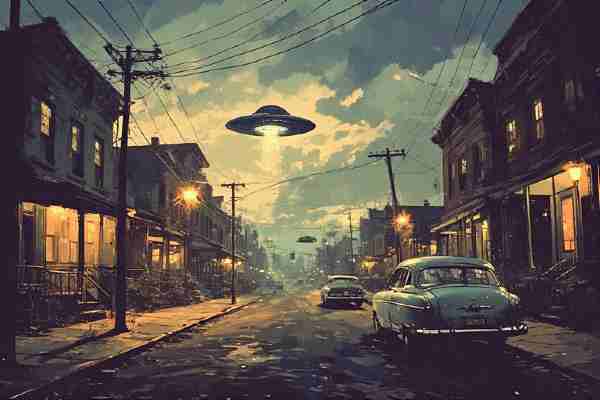
Are we alone in the universe? Only two answers are possible, and both are equally terrifying. Either one would change everything. It would make us rethink how we see ourselves and our place in the cosmos. We must be ready for the answer because humanity has been searching for it for some time.
This article follows how the question, “Are we alone in the universe?” has grown. It’s been something we have been wondering about for hundreds, if not thousands, of years. It has been posed by ancient thinkers as a famous saying about two possibilities.
This question prompts us to look at what each answer could mean. Here’s where the Drake equation and the Fermi Paradox can and cannot tell us, and where the search for life beyond Earth stands today.
Are we alone in the universe?
Every new telescope seems to make the universe bigger. We now know there are billions of galaxies, each holding billions of stars, and most of those stars have planets circling them. Some of those planets are rocky like Earth. Some may have oceans. With numbers that large, it feels almost impossible that Earth is the only world where thinking beings ever appeared.
Yet when we listen, the universe stays quiet. For more than sixty years, scientists have scanned the sky for radio signals, watched for strange flashes of light, and studied the air around distant planets. They have found worlds with the right temperatures for water and atmospheres that could support life. What they have not found is a single message, machine, or structure that tells us someone else is out there.
That tension leaves us facing a question with only two possible answers. Either intelligent life has appeared only once, here on Earth, or it has appeared somewhere else as well. There is no middle answer that makes the question less serious. A famous saying puts it this way:
Two possibilities exist: either we are alone in the Universe or we are not. Both are equally terrifying. — Commonly attributed to Arthur C. Clarke
The saying does not invite us to guess or daydream. It asks us to face what each answer would mean for our importance, our future, and our place in the story of the cosmos.
How the question of these two possibilities has evolved
People did not need telescopes to wonder whether we are alone. The question is far older than modern science, and the way people have asked it has changed as their picture of the universe has grown.
From ancient thinkers to the space age
More than two thousand years ago, the Greek philosopher Epicurus taught that the universe holds countless worlds, many of them perhaps like our own. The Roman poet Lucretius carried the idea forward, arguing that nature would not create only one of anything. For centuries afterward, most of Europe held a very different view, with Earth fixed at the center of creation.
When the Italian thinker Giordano Bruno claimed that the stars were other suns with their own inhabited worlds, the idea was among those that made him a target of the church, and he was burned at the stake in 1600.
As astronomy grew, so did public curiosity. In 1686, the French writer Bernard de Fontenelle published a popular book of conversations about life on other planets, written so that ordinary readers could enjoy it.
Around 1900, the American astronomer Percival Lowell convinced many people that long lines on Mars were canals built by a dying civilization. Better telescopes later showed that the canals were an illusion, but the excitement he sparked never fully faded.
The question became scientific in the twentieth century. Over lunch in 1950, the physicist Enrico Fermi asked his colleagues a simple question that still has no answer: if the galaxy is full of life, where is everybody?
Ten years later, the astronomer Frank Drake pointed a radio telescope at two nearby stars and listened for signals, beginning the modern search for extraterrestrial intelligence. The question had moved from philosophy into the laboratory.
The story behind the two possibilities saying
The saying at the top of this article is usually credited to the science fiction writer Arthur C. Clarke, but its history is more complicated. Researchers at Quote Investigator traced it back to a 1966 magazine profile of the film director Stanley Kubrick, who was working with Clarke on 2001: A Space Odyssey. Kubrick repeated a version of the line and said it came from an unnamed English science fiction writer.
Two years later, he credited it to an unnamed astronomer instead. A similar thought had even appeared years earlier in the comic strip Pogo, where a character decided that either answer made for a sobering thought.
The wording kept changing as the saying traveled. In 1966, the idea was “quite staggering.” By 1974, a version called it frightening. The “equally terrifying” form, with Clarke’s name attached, appeared in a 1996 news story. Clarke himself did write about the question. In a 1951 book on space exploration, he called it one of the greatest questions in philosophy, but he never put it in such dramatic terms.
This history matters because it shows how ideas grow as they are passed along. A thoughtful remark became sharper and scarier with each retelling until it attached itself to a famous name. The saying still captures something true, but knowing where it came from reminds us to check our sources, especially when a quote sounds perfect.
➡ For more, see: How We Reach A Conclusion And What Can Go Wrong
The first of two possibilities: we are alone
If humanity is the only intelligent life in the universe, then awareness is unbelievably rare. Across billions of galaxies and trillions of stars, only one planet produced beings who can look up at the night sky and wonder what it means. The silence we hear would not be a temporary gap in our search. It would be the way things truly are.
If we are alone, then all meaning, memory, and observation in the observable universe rest on a single fragile species.
The weight of being unique
Being alone would mean that every thought, discovery, and story ever told exists only because of us. No other mind anywhere would be asking questions or trying to understand reality. The universe would be full of stars, but empty of witnesses.
That kind of rarity comes with fragility. If intelligence exists in only one place, then a single disaster, whether a natural catastrophe or one we cause ourselves, could erase the only observers the universe has ever had. The stars would keep shining, but no one would be left to see them, study them, or give them meaning.
This possibility changes how we think about responsibility. Every scientific discovery, every work of art, and every attempt to understand the world would become part of the universe’s only record of itself. If we are alone, humanity is not just one species among many. We are the entire voice of the cosmos, and protecting that voice becomes the most important job we have.
The second possibility: we are not alone
If intelligent life exists somewhere else, the consequences are just as unsettling. Other civilizations could be far older than ours. They could be far more advanced. They could be curious about us, uninterested in us, or even hostile.
If we are not alone, then humanity is not unique.
Opening Pandora’s box
Discovering other intelligent beings would force us to rethink our place in the universe. Intelligence would no longer be a rare spark but a pattern that repeats wherever conditions allow. Then the hard questions would begin. How advanced are they? Do they see us as equals, or as something far less important?
A civilization that is millions of years older than ours could have technology we cannot imagine. It might travel between stars, reshape whole planets, or communicate in ways we cannot even detect. To such beings, humanity might look like a young species still learning how to survive its own inventions.
History shows what often happens when a less powerful culture meets a more advanced one. The fear is not simply contact. It is comparison.
We might discover that we are not the smartest beings in the universe.
We might not even be remarkable.
The galaxy could be home to civilizations that have already solved problems we still struggle with, such as energy, disease, war, or even aging. Or it could be scattered with the ruins of civilizations that failed, leaving warnings we have not yet found. Either way, the discovery would change how we see ourselves forever. Fear of the unknown is itself enticing.
➡ For more, see: Decoding The Fear and Fascination With the Unknown
Microbes are not minds
It is important to separate two very different discoveries. Finding simple life, such as bacteria living beneath the ice of Jupiter’s moon Europa or traces of ancient microbes on Mars, would be one of the biggest discoveries in history. It would prove that life is not a one-time miracle but something that can begin wherever conditions are right.
Even so, microbes would not answer the question this article is asking. The two possibilities are about intelligence, about whether anyone else is out there thinking, building, and wondering about us. A universe full of microbes could still be a universe with only one mind looking back at it. Simple life would make intelligent life seem more likely, but it would not prove we have company.
The Drake equation and the odds of alien civilizations
In 1961, Frank Drake gathered a small group of scientists at the Green Bank Observatory in West Virginia to discuss the search for alien signals. To organize the meeting, he wrote an equation that breaks the big question into smaller ones. The equation does not give a single answer. Instead, it shows exactly what we would need to know to estimate how many civilizations might be sending signals in our galaxy.
Reading the equation
Written out, the Drake equation looks like this: N = R* × fp × ne × fl × fi × fc × L. Each letter stands for one piece of the puzzle:
- N is the number of civilizations in our galaxy that we might be able to detect.
- R* is how many new stars form in our galaxy each year.
- fp is the share of those stars that have planets.
- ne is how many planets around each of those stars could support life.
- fl is the share of those planets where life actually begins.
- fi is the share of planets with life where intelligence develops.
- fc is the share of intelligent civilizations that build technology we could detect.
- L is how long those civilizations keep sending detectable signals.
What the numbers can and cannot tell us
At that first meeting, Drake and his colleagues estimated that our galaxy might hold anywhere from 1,000 to 100,000,000 civilizations. That huge range is often quoted as the answer to the equation, but it was really an educated guess based on what scientists believed in 1961.
Since then, part of the equation has become much clearer. Space telescopes have shown that planets are common and that many of them orbit in the zone where liquid water could exist. The first three pieces of the puzzle are now on solid ground. The rest of the equation is a different story. We still have no idea how often life begins, how often it becomes intelligent, or how long intelligent civilizations last. With only one example of life to study, our own, those numbers are pure guesswork.
Depending on what values scientists plug into those unknown pieces, estimates swing wildly, from millions of civilizations down to fewer than one. A 2018 study called “Dissolving the Fermi Paradox” took this uncertainty seriously and found a strong chance that we are the only civilization in our galaxy. The equation, in other words, does not settle the debate. It shows us exactly where our knowledge runs out.
Probability can make one of the two possibilities seem more likely than the other, but it can never create a third choice. No matter what the numbers say, either someone else is out there, or no one is. Science does not erase the dilemma. It sharpens it.
➡ For more, see: Exploring The Impact of Evidence-Driven Decisions for Humanity
The Fermi Paradox and the great silence
Fermi’s lunchtime question has grown into one of the biggest puzzles in science. If the galaxy is billions of years old and full of planets, even a few civilizations should have had plenty of time to spread out, send signals, or leave traces we could find.
The fact that we see nothing at all is called the Fermi Paradox. The gap between what the numbers suggest and what we actually observe is sometimes called the great silence.
Possible explanations for the silence
Scientists and writers have offered many explanations, and each one points back to one of the two possibilities.
The Rare Earth idea, made popular by scientists Peter Ward and Donald Brownlee, suggests that simple life may be common but complex life is extremely rare. Earth may have needed an unusual mix of luck, including a large moon, a stable sun, and protective neighboring planets, to produce animals and people. If that is true, the silence makes perfect sense, and we may be alone.
The Great Filter, an idea from economist Robin Hanson, suggests that somewhere between simple chemistry and star-traveling civilizations, there is a step that almost no one survives.
The filter might be behind us, such as the leap from single cells to complex life. Or it might be ahead of us, such as a tendency for advanced civilizations to destroy themselves. This explanation is unsettling because we do not know which side of the filter we are on.
Other explanations assume we are not alone. The galaxy is enormous, and civilizations might simply be too far apart in space or time to overlap with us. The zoo hypothesis suggests that advanced beings know we are here but choose not to interfere, the way people watch animals in a nature reserve.
The dark forest idea, made famous by the novelist Liu Cixin, imagines a galaxy where every civilization stays silent because revealing your location could invite attack.
None of these explanations has been proven. Each one is a different way of telling the same story, and each one ends at one of the two possibilities.
Where the search for life stands today
The search is not standing still. In the past few years, scientists have come closer than ever to finding signs of life beyond Earth, and those close calls teach an important lesson about how science handles big claims.
Signs on Mars
In July 2024, NASA’s Perseverance rover drilled a rock sample from an ancient riverbed in Jezero Crater on Mars. The sample, nicknamed Sapphire Canyon, contains small mineral patterns that scientists call “leopard spots.” On Earth, patterns like these are often linked to microbes. In 2025, after a year of study, scientists published their findings and described the sample as a potential biosignature, meaning something that might have been made by life but still needs more proof.
The scientists were careful to point out that the same minerals can also form through chemistry alone. The only way to know for sure is to bring the sample back to Earth, where laboratories can test it far more closely than a rover can. Plans to return Mars samples have been put on hold, so for now, the answer waits inside a sealed tube on the Martian surface.
Signals from distant worlds
A similar story played out much farther away. K2-18b is a planet about 124 light-years from Earth, more than twice Earth’s size, orbiting in its star’s habitable zone. In 2025, a team using the James Webb Space Telescope reported signs of a gas called dimethyl sulfide in the planet’s air. On Earth, that gas is made by living things, mostly tiny ocean organisms, so the announcement made headlines around the world.
Other scientists soon took a closer look. A NASA-led review of the same telescope data found no clear evidence that the gas was there at all, and later studies showed how nonliving chemistry could produce similar signals. Something similar happened in 2020, when scientists announced they had found phosphine, another possible sign of life, in the clouds of Venus. That claim was also questioned once other explanations came to light.
Why caution matters
These stories are not failures. They are science working the way it should. A bold claim is announced, other experts test it, and the claim either holds up or falls apart.
When the question is as important as whether we are alone, the standard of proof has to be extremely high. A single signal, no matter how exciting, is not enough. The real test is whether many independent teams, using different tools, all reach the same conclusion.
➡ For more, see: A Healthy Skeptical Mindset: Cultivating Healthy Skepticism
➡ For more, see: The Black Cat Analogy and the Search for Truth
How we fill the silence
People do not like unanswered questions, especially ones this big. When science cannot give an answer, belief often rushes in to fill the gap. Stories of flying saucers, alien abductions, and ancient astronauts building the pyramids all grow out of the same deep need to know whether we have company.
Some of these stories begin with real experiences. A strange light in the sky, a vivid dream, or a moment of confusion can feel like proof, especially when a person already expects to see something unusual. Once a story spreads, it can take on a life of its own, gathering details and believers as it travels, much like the two possibilities saying did.
The challenge is to keep the question open without filling it with a story we want to believe. Wonder is healthy. Certainty without evidence is not. The honest answer, for now, is that we do not know.
➡ For more, see: The Mechanisms Behind Cryptozoology Research and Conspiracy Theories
or more, see: Interpreting Non-ordinary Experience, Metaphysical and Unusual Events
➡ For more, see: Perceptual Tunnel Vision and Mass Hallucination
Standing between isolation and insignificance
The real question is not which answer we would prefer. It is whether we are ready for either one.
If we are alone, the burden of awareness rests entirely on humanity. Our survival becomes more than a matter of keeping our species alive. It becomes a responsibility to the whole universe, because we would be the only ones who know it exists.
If we are not alone, we are part of a universe far larger and possibly far more advanced than we ever imagined. Our greatest achievements might look small next to civilizations that have existed for millions of years, and our fears and conflicts might seem tiny on a cosmic scale. At the same time, we would know that the spark of awareness is not ours alone.
Until the answer arrives, we are left living with an open question. That can feel uncomfortable, but it is also an invitation to stay curious, to keep searching carefully, and to take care of the one world we know holds life. Whoever first spoke of the two possibilities understood something lasting. Either answer will change us, and both remain equally terrifying.
➡ For more, see: Seeking Truth Beyond Religion: Living Without Certainty
References
- Are We Alone in the Universe? NASA Astrobiology Program.
- The Drake Equation. SETI Institute.
- Dissolving the Fermi Paradox. Anders Sandberg, Eric Drexler, and Toby Ord, 2018.
- Quote Origin: Sometimes I Think We’re Alone, and Sometimes I Think We’re Not. Quote Investigator, 2020.
- The Exploration of Space. Arthur C. Clarke, 1951.
- A Potential Biosignature in the Bright Angel Formation, Jezero Crater, Mars. Hurowitz et al., Nature, 2025.
- New Constraints on DMS and DMDS in the Atmosphere of K2-18 b from JWST MIRI. Madhusudhan et al., The Astrophysical Journal Letters, 2025.
- The Great Filter: Are We Almost Past It? Robin Hanson, 1998.
- Rare Earth: Why Complex Life Is Uncommon in the Universe. Peter Ward and Donald Brownlee, 2000.
- Relative Likelihood for Life as a Function of Cosmic Time. Proceedings of the National Academy of Sciences.
- Exoplanet Exploration and the Search for Habitable Worlds. NASA.
- Fermi Paradox. Encyclopaedia Britannica.
- Extraterrestrial Life. Stanford Encyclopedia of Philosophy.
- The Great Silence: The Controversy Concerning Extraterrestrial Intelligent Life. arXiv.
About this project
The Seeker Project 4 Spiritual Exploration (SP4SE) is a project of Americans In Alliance. The mission of SP4SE is spiritual education. The mission of Americans In Alliance is environmental conservancy. Click the links below to learn more and support our efforts.