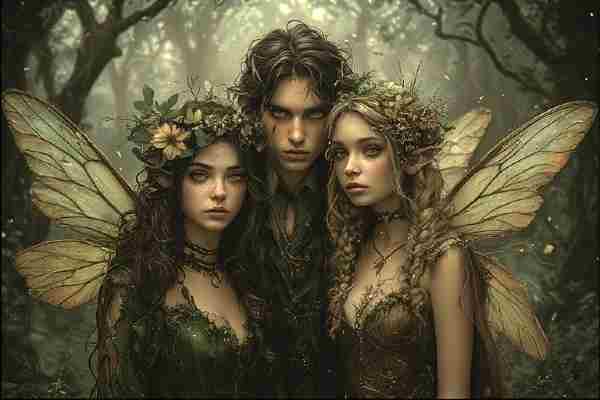
Ever wonder why fairy tales, folklore, and myths endure? Some stories survive for centuries while most disappear. Their endurance suggests they provide something more than entertainment. It’s a phenomenon worth investigating.
Cultures separated by language, geography, and history contain remarkably similar characters and symbolism. Wolves, witches, helpers, monsters, tricksters, fairies, and shapeshifters are repeating themes.
These recurring stories have common fears, lessons, warnings, and hopes. They are presented in a form that is easy to remember and difficult to forget. Instead of seeing them as ancient tales, we can explore how folklore acts as a time capsule for shared experiences.
The central question of this article is simple. Why do fairy tales, folklore, and myths continue to survive when so many other stories vanish?
Legends, fairy tales, folklore and myths
The words myths, legends, folklore, and fairy tales are often used as if they mean the same thing. They overlap, but they describe different kinds of cultural material.
Myths are traditional stories that deal with significant cultural norms and assumptions. These stories often focus on the world, nature, gods, origins, or human existence. Myths explain how things began and help people understand powerful forces.
Legends are narratives connected to a person, place, event, or time. It is a story presented as having some connection to history. A legend can include supernatural elements, but it usually starts with something the community sees as real or based in history.
Folklore is a larger category. It can hold different types of shared cultural knowledge. It includes stories, beliefs, customs, songs, and rituals. Folklore is passed down through generations. They belong to no single author, making them a collective cultural treasure.
Fairy tales are a special type of traditional narrative. These are stories that often include magical events and anthropomorphic creatures. These creatures are often the focus of the narrative. They teach important moral and cultural lessons. They take on impossible tasks. Their character roles are easy to recognize. The story may take place in an unspecified time and place rather than claiming to describe a real historical event.
Legends, fairy tales, and myths can overlap. A story can contain mythic ideas and become part of folklore. A legend can develop into folklore. Fairy tales can carry warnings and beliefs from the culture that tells it.
The important point is that folklore is not simply another word for old stories. It is a process through which communities preserve and change shared knowledge.
Fairy tales as emotional-compression technology
Fairy tales are unusually efficient ways to carry information. Instead of explaining an idea through a long list of rules, a story turns the idea into a person, place, object, or event.
A dangerous stranger becomes a wolf. Deception becomes a witch. A powerful threat becomes a giant. Unexpected assistance becomes a magical helper. This is a kind of emotional compression. A single image can carry a large amount of information.
Fairy tales are also built from elements that make stories easier to remember:
- Strong imagery gives the mind something concrete to hold.
- Simple narrative structures make the sequence easier to follow.
- Emotional events make important moments stand out.
- Repeated patterns reinforce what happens next.
- Recognizable characters allow the listener to understand a role quickly.
This explains why someone might forget most of a story but remember key parts. They might recall the wolf, the witch, the forbidden room, the enchanted object, or the mysterious helper. The story does not need to preserve every detail to preserve its basic message. The memorable parts can carry the structure forward.
Characters that remain long after the story ends
The wolf, witch, giant, trickster, and magical helper appear in many different forms. They are memorable because each can represent a recognizable situation.
The wolf can represent a predator or a dangerous stranger. The witch can represent someone whose intentions cannot be trusted. The giant can represent an overwhelming force. The trickster can expose the weakness in a rule or system. The magical helper can represent unexpected assistance.
These figures do not have to mean exactly the same thing in every culture. Their value comes from their ability to give a complicated problem a recognizable form. That makes them portable. A forest can become a dangerous road. A witch can become a deceptive authority figure. A magical helper can become a teacher, friend, mentor, or stranger who offers needed information.
The image changes, but the problem remains recognizable.
Why fairy tales and their characters remain in memory
A story is easier to remember when its important parts are repeated, emotionally meaningful, and easy to picture. Fairy tales use all three. A character may appear several times. A task may have to be attempted more than once. A warning may be repeated. A familiar pattern may appear with a new challenge.
These repetitions give the listener a framework for remembering what matters. Fairy tales, folklore, and myths make characters easy to identify. The listener does not need a long description of the wolf’s personality. The wolf already has a role in the story.
The same is true of helpers, villains, tricksters, monsters, and other recurring figures. Their roles create expectations. When a familiar figure shows up in a new place, the listener can still grasp what kind of problem might be forming.
This is one reason stories can survive even when their original setting disappears. The characters carry enough of the structure to allow the story to be rebuilt somewhere else.
The architecture of fairy tales
Fairy tales are not simply collections of strange events. Many use recurring structures that organize the experience of the main character.
A person may begin in an ordinary situation and then receive a call into danger. A warning may be ignored, a forbidden place may be entered, or an unexpected problem may force the character to leave what is familiar.
The character then encounters a test. The test may involve courage, judgment, patience, honesty, or the ability to recognize deception.
A helper may appear. The helper does not always solve the problem. Sometimes the helper provides a tool, warning, piece of knowledge, or opportunity that the character must learn to use.
A forbidden act may create another turning point. The character may break a rule, trust the wrong person, open something that should remain closed, or enter a place that was meant to be avoided.
A magical gift may then provide an advantage. The gift can be an object, ability, piece of knowledge, or unexpected assistance.
The story moves toward transformation. The character has changed through what happened. Finally, there may be a return to the ordinary world, but the character is no longer exactly the same person who left it.
Not all fairy tales contain every element. The value of the pattern is that it provides a recognizable framework for moving from uncertainty to some form of resolution.
This structure also helps explain why fairy tales can change their settings without losing their identity. The forest can become a city. The monster can become an institution. The magical gift can become knowledge. The helper can become a mentor.
The structure can survive even when the surface details change. A more general structure of this process is also echoed in the Hero’s Journey.
➡ For More See: The Hero’s Journey: Map for Inner Change
Fairy tales, folklore, and myths as survival technology
Many traditional stories can also be understood as compressed survival knowledge. Fairy tales, folklore, and myths are frequently used as discernment pointers.
A community does not need to give a child a long lecture about every danger that may exist beyond the village. A story can make the warning memorable.
A wolf can warn about predators. A dangerous stranger can warn against trusting unfamiliar people. A forbidden forest can represent an environment that is difficult to survive. A character who ignores a warning can demonstrate what may happen when danger is underestimated.
Some stories focus on scarcity, deception, and isolation. Others explore cooperation and the fallout from breaking community rules.
This does not mean every fairy tale was deliberately created as a survival manual. It means that stories can preserve useful observations even when no one writes them down as instructions.
Lessons that travel farther than instructions
People often remember stories more easily than lists of rules.
- A rule says, “Do not trust strangers.” A story can show what happens when a character trusts the wrong stranger.
- A rule says, “Do not enter dangerous places alone.” A story can show a character entering the forest and encountering something they cannot handle.
The story gives the rule a context. It creates an emotional consequence that can make the lesson easier to remember.
Folklore can therefore act as a storage system for community experience. A warning that might otherwise disappear can survive because it has become part of a story people continue to tell.
Folklore as cultural memory
Folklore also preserves more than warnings about physical danger. It can preserve values, customs, beliefs, concerns, and ideas about how a community understands the world.
Stories survive through oral transmission, community storytelling, repetition, and retelling. A storyteller may change a detail because the original no longer makes sense in a new place. Another storyteller may add something from local experience.
Memory also changes stories. A detail may be forgotten, simplified, or replaced. A new detail may be added because it makes the story more meaningful to the people hearing it.
This creates local variations. The same basic story can exist in many forms without any single version becoming the permanent original.
Folklore therefore has an unusual form of ownership. It can belong to a community rather than to one author. Every storyteller participates in preserving it and changing it.
➡ For More See: How Myth And Symbolic Stories Shape Culture
Folklore as everyday knowledge
Folklore is not limited to narrative.
Folklore often uses props to focus the story or lesson. It can include lucky objects. It may also have household rituals. Seasonal customs are common too. There are warnings and sayings. Supernatural precautions might be included. Community practices can also play a role. These beliefs can become part of everyday behavior even when people no longer remember where they came from.
In this sense, folklore can operate like a cultural operating system. It provides small rules and expectations for situations that may never be formally taught.
Some people may follow such practices because they believe they are literally effective. Others may follow them because they are family or community traditions. Still others may treat them as symbolic customs.
The important point is that folklore can shape behavior without appearing as formal instruction.
Why similar figures appear around the world
If cultures develop independently, why do similar figures keep appearing?
Heroes, monsters, witches, tricksters, helpers, shapeshifters, dragons, and forest spirits are common characters. They appear in various forms around the world. Each plays a unique role in stories and cultures. Their details are different, but their recurring roles raise an important question.
One explanation is that different cultures face many of the same basic problems. People everywhere face danger, uncertainty, and deception. They deal with illness, loss, and scarcity. Social conflict and natural forces also pose challenges. Lastly, the unknown adds to their struggles. They also face similar questions about trust, cooperation, courage, change, and survival.
Stories provide ways to represent those problems.
- A monster can give danger a face.
- A trickster can represent unpredictable behavior.
- A helper can represent assistance that arrives when it is least expected.
- A shapeshifter can represent uncertainty about what something really is.
The similarity does not prove that every culture inherited these figures from one original source. Similar human problems can produce similar storytelling solutions.
Recurring solutions to recurring problems
A culture does not need to copy another culture to create a story about a dangerous creature. Fairy tales are often selective in their use of anthropomorphic characters.
- If people live where large predators are a real threat, stories may develop around creatures that embody that danger.
- If social deception is a concern, stories may show characters who hide themselves. They might lie, manipulate others, or even change forms to get what they want.
- Communities obviously depend on cooperation. So, stories often emphasize helpers, alliances, and generosity. They also reveal the consequences of selfishness in these groups.
This gives folklore a practical reason to develop recurring figures. The same kinds of problems repeatedly require ways to talk about them.
➡ For More See: Belief Maps And Archetypes Of Rebirth, Renewal, And Resurrection
➡ For More See: Goddess Myth Stories And Divine Feminine Archetypes
The shadow side of fairy tales, folklore, and myths
Fairy tales, folklore, and myths are not always comforting or helpful. Many traditional stories contain fear, loss, danger, abandonment, uncertainty, violence, and death.
The darkness has a function within the story. A threat gives the character something to overcome. Without danger, there may be no test. Without a test, there may be no reason for the character to change.
A forest is frightening because the character does not know what is inside it. A monster is frightening because the character cannot control it. Abandonment is frightening because the character must survive without familiar protection.
The story gives these fears a form that can be remembered and discussed.
Why stories rarely remove the danger
Removing every threat from a story can remove the reason for the story. Fairy tales often allow the danger to remain real while giving the character a way to face it. The character may escape, defeat the threat, learn from it, receive help, or become capable of dealing with it.
This does not mean every traditional lesson is healthy. Folklore can hold onto prejudice, fear of outsiders, and harmful stereotypes. It may also keep beliefs that no longer match the world that created them. It gives another reason folklore should be studied rather than simply accepted. A story can preserve useful knowledge and harmful assumptions at the same time.
The fact that a belief is old does not make it true. The fact that a story survives does not make every lesson within it beneficial.
Why every generation reinvents these stories
Folklore survives partly because it changes.
Every generation lives with different technologies, institutions, dangers, values, and social conditions. Old stories are therefore given new settings and new meanings.
- Forests might become a city.
- Monsters can become powerful institutions.
- Witches transform into deceptive authority figures.
- Magical helpers become a teacher, mentor, friend, or unexpected ally.
- The unknown can become a journey through a new social or technological world.
The changes are not necessarily a loss of the original story. They are part of how folklore remains useful.
New settings for old lessons
A story that once warned about a dangerous road may now warn about a dangerous online interaction. A story about deception may now appear in a setting involving technology. A story about an outsider may be rewritten to explore modern questions about identity and belonging.
The surface changes because the circumstances change. The underlying problem may remain familiar.
This process allows folklore to function as a living tradition rather than a museum collection. Each generation tests old patterns against new circumstances and decides which parts still make sense.
Modern folklore and contemporary myths
Folklore did not disappear when printed books, radio, television, and the internet appeared. The methods of transmission changed.
Modern societies continue to create and share stories whose forms resemble traditional folklore.
Urban legends circulate stories about supposedly true events in modern settings.
Internet folklore develops through forums, social media, videos, memes, and online communities.
Paranormal narratives describe mysterious encounters. They include ghosts, strange creatures, unexplained events, or other unusual experiences.
Viral stories can spread rapidly through communities, often changing as they move from person to person.
Creepypastas show how people create, copy, change, and share horror stories online.
UFO stories and conspiracy narratives have become part of contemporary folklore. Social media often shares and adjusts them to explain strange or uncertain events. That does not establish that the claims in those stories are true. It shows how stories can circulate as shared cultural material.
Folklore is still being created
The internet has made the fairy tale, folklore, and myth process easier to see. A story can begin with one person’s experience or invention. Other people repeat it. Someone changes a detail. Another person adds a photograph, video, explanation, warning, or personal experience.
Soon, the story may have many versions. This is not fundamentally different from oral folklore. The technology changes, but the steps of sharing, modifying, repeating, and involving the community stay the same.
Folklore is not simply something ancient cultures created. It is something people continue to create.
Why these stories still matter
Fairy tales, folklore, and myths continue to matter because the problems underneath them have not disappeared.
- They help people remember lessons
- Preserve cultural knowledge.
- Communicate dangers.
- Transmit values.
- Provide ways to discuss uncertainty.
- Help people adapt to changing circumstances.
- Give recognizable forms to problems that can otherwise be difficult to explain.
Their continued presence does not mean that every traditional story contains a hidden truth or timeless wisdom. Some stories preserve useful observations. Others preserve outdated beliefs. Some entertain. Some frighten. Some reinforce social expectations. Some challenge them. Their value comes partly from what they reveal about the people who tell them.
When a community often shares stories about dangerous strangers, those tales show its worries. Stories about generous helpers, tricksters, monsters, or transformations show deeper issues. Folklore can be seen as a mix of stories and a record of what people value.
The human issues in these stories are familiar. They include danger, trust, cooperation, deception, loss, transformation, survival, and the unknown.
Conclusion: Why fairy tales, folklore and myths endure
Why do some stories survive for centuries while most disappear?
They survive because they can do several things at once. They can entertain while preserving a warning. They can create memorable characters while carrying cultural knowledge. They can express fear while showing a path through it. They can preserve old concerns while adapting to new circumstances.
Their survival depends on transmission. People tell them, remember them, change them, and tell them again. Each generation brings its own changes. Yet, it keeps enough familiar structure. This makes the story feel recognizable.
That is why folklore is more than a collection of ancient stories.
It is a living process.
Fairy tales, folklore and myths survive because they provide cultural and psychological functions. They help us understand values, emotions, and the world around us. They help people remember the things that matter most: danger, trust, transformation, survival, and the unknown.
References
- The Cultural Transmission and Evolution of Folk Narratives. Oxford Handbook of Cultural Evolution, Oxford University Press.
- Memory in Oral Traditions: The Cognitive Psychology of Epic, Ballads, and Counting-Out Rhymes. Oxford University Press.
- Oral Traditions as Collective Memories: Implications for a General Theory of Individual and Collective Memory. Memory in Mind and Culture, Cambridge University Press.
- Morphology of the Folktale. University of Texas Press.
- The Forms of Folklore: Prose Narratives. Journal of American Folklore.
- Toward a Definition of Folklore in Context. Journal of American Folklore.
- Oral Tradition as History. University of Wisconsin Press.
- The Irresistible Fairy Tale: The Cultural and Social History of a Genre. Princeton University Press.
- Fairy Tales and the Art of Subversion. Routledge.
- On the Origin of Stories: Evolution, Cognition, and Fiction. Harvard University Press.
- Myth: A Very Short Introduction. Oxford University Press.
- The Interpretation of Cultures: Selected Essays. Basic Books.
About this project
The Seeker Project 4 Spiritual Exploration (SP4SE) is a project of Americans In Alliance. The mission of SP4SE is spiritual education. The mission of Americans In Alliance is environmental conservancy. Click the links below to learn more and support our efforts.