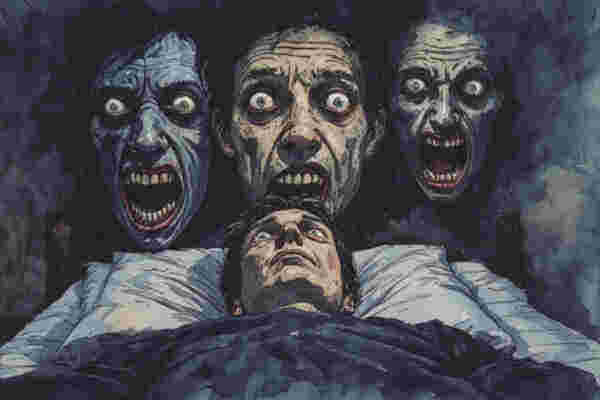
Many people want to understand what’s behind their nightmares and night terrors. Do they reveal hidden messages or unresolved issues? These experiences have an intensity we don’t choose, can’t control, and often don’t understand.
Most people treat these episodes like static: unpleasant, meaningless, and something to shake off in the morning. But the emotions they leave behind can be difficult to ignore.
This article looks at emotions without trying to interpret dreams or assign fixed meanings to images. It looks at how nightmares and night terrors are different. It also explores what might stay with you after they end and highlights emotional patterns useful to notice.
We want to distinguish three distinct aspects surrounding these experiences. The first is what is actually experienced. The second is what details can we actually remember. And the third is what we can infer from the patterns of the experience.
Inner Work Gate:
This article asks you to examine emotions, recurring patterns, and situations that may be difficult to face. Reflection can bring up uncomfortable feelings or memories. Make sure you feel steady before engaging deeply. If the process becomes overwhelming, pause and seek appropriate support.
How nightmares and night terrors differ
Nightmares are emotionally intense dreams that occur during REM sleep. They typically leave a strong impression and are often remembered after waking.
Night terrors are sudden episodes of intense fear or alarm. They often involve partial sleep behavior and usually occur during NREM sleep, often earlier in the night. Typically, these episodes are not fully remembered.
The two can look similar from the outside because both can involve intense fear, movement, or vocalization. The key difference lies in how consciousness, memory, and dream narratives form.
Emotional pressure is often the fuel behind nightmares
Nightmares and night terrors are impactful because the mind treats them as real. Your brain is using the same machinery it uses when you are awake, which means the experience has weight even if the setting is unreal.
The mind does not distinguish between “real” and “imagined” in the moment.
The mind responds to meaning, not accuracy. If something feels dangerous, the body prepares for danger. If something feels painful, the emotional system responds as if the pain is happening now. Dreams use the same circuits that shape perception, memory, and emotion during the day, so the experience lands with the same force.
The radio metaphor
Nightmares can be compared to music coming through a radio. Taking the radio apart does not reveal where the music was created. The radio is the point through which the signal becomes available to you.
Sleep is similar in one important respect. The experience you remember is not necessarily the source of every emotion or image within it. Memory, imagination, and emotions all shape our dreams. Current situations and arousal patterns also play a role in what we see while we sleep.
Memory, imagination, and emotions are like the ingredients of the music you hear on the radio. You don’t see the musicians on your radio, but you know they are there behind the sound.
Dreams often has many different musicians and instruments that contribute to the composition. These include fear, regret, desire, conflict, recent events, old memories, and other feelings. The resulting experience can be difficult to make sense of because these elements do not always combine into a logical story.
Sometimes the radio picks up more than one station at a time. The songs and news broadcasts overlap. That’s what some nightmares feel like.
The metaphor is useful only up to a point. It does not prove that every nightmare has a hidden message or that every night terror contains a decipherable meaning.
Emotional pressure can build from several sources at once. For example:
- A bad day at work
- A traffic jam
- An unexpected bill
- A troubling memory surfaces
- A misunderstanding with your partner
These experiences can add to emotional pressure. Memory, imagination, and the body’s state during sleep can all play a role in what happens next. But these factors do not explain every nightmare or night terror episode.
What makes them easy or hard to remember
Nightmares often leave a scene, fragments of a storyline, or a strong emotional impression soon after waking. You may not remember every detail, but there is usually enough narrative structure to describe what happened.
That makes a nightmare easier to reflect on. You remember it or parts of it. You can consider the emotion, the situation in the dream, and whether a similar emotional pressure exists in waking life.
During a night terror, a person may sit up, shout, move, or appear partly awake while remaining in a state of incomplete consciousness. Afterward, detailed recall may be poor or absent.
What remains may be a vague sense of fear, confusion, or distress rather than a coherent story. The lack of memory does not mean the fear was unreal. It means the episode may not have been experienced and encoded in the same way as a remembered dream.
Emotional narrative versus physiological alarm
A key difference is that nightmares often have a story or narrative structure. In contrast, night terrors can trigger a quick alarm response without a clear story. The difference makes understanding night terrors more challenging.
With night terrors, you awaken with a sense of fear or dread but don’t know why. Professional counseling to direct inner work is more likely to help you identify and resolve the cause.
A nightmare may involve escape, exposure, helplessness, loss of control, or arriving too late. The mind gives the emotional experience a setting and sequence.
A night terror may involve intense physiological activation before any story or explanation for the event forms. Sweating, shouting, movement, and sudden panic can occur even when the person later cannot explain what they were afraid of.
This difference matters because a remembered nightmare provides more material for later analysis. A night terror event often provides no information at all about causation. So, you know you had the experience, but have no memory of it and therefore no way to analyze the experience.
What this changes about reflection
The goal is not to dismantle the dream until a single hidden answer appears.
For nightmares, the remembered emotional narrative may provide useful material for reflection. For night terrors, there may be much less narrative information, so the surrounding conditions of sleep may be more useful to examine.
In both cases, the intensity of the experience is worth noticing without assuming that the intensity itself proves what caused it.
Nightmares are more than the images you remember
Emotion matters more than a fixed symbol
Nightmares can feel like messages because they bypass some of the filters used during waking life. But the most useful part of the experience is not necessarily the image itself.
A chase might involve a monster, a stranger, or an unknown threat. Falling might happen from stairs, a building, or somewhere that could not exist in waking life. Feeling trapped might appear as a locked room or an impossible exit.
The images can change while the emotional pressure remains recognizable. Fear, shame, helplessness, regret, guilt, vulnerability, and loss of control can all appear in different forms.
This does not mean that every image has a hidden meaning. It means that emotional experience may provide more useful information than treating dream imagery as a fixed code.
Recurring emotional patterns
When people describe recurring nightmares, what repeats is not always the literal scene. Sometimes the recurring element is an emotional theme.
Common patterns include:
- Being chased
- Falling
- Being trapped
- Losing control
- Being exposed
- Failing to protect someone
- Arriving too late
These experiences can involve fear. But they often involve other factors like regret, shame, or unresolved conflict. They might also involve longing, guilt, or rejection.
Why different images can carry similar pressure
Dream imagery is not always consistent. Memory, imagination, emotion, and recent experience can combine in ways that do not produce a simple or logical story.
The same emotional pressure can therefore appear through different images. Vulnerability may appear as exposure in one dream and helplessness in another. Loss of control may appear through falling, being trapped, or being unable to protect someone.
The image changes. The emotional pattern may not.
Recurring nightmares
Recurring nightmares may indicate that something remains emotionally active that needs a resolution. A recurring nightmare may repeat the same scene, or it may repeat an emotional theme while the details change.
Recurrence does not prove that one specific unresolved issue is causing the dream. It does suggest that the same emotional pattern may still be active enough to appear repeatedly during sleep.
Sometimes waking life changes and the nightmare fades. Sometimes the dream changes first, becoming less intense or taking on a different form. These changes can be worth noticing without assuming that they reveal a single hidden cause.
How coping can shape recurring nightmares
People develop ways of coping with difficult experiences. Some coping strategies let a person manage daily life. They may not fully address tough emotions.
When emotional topics are hard to face, sleep can be a time when those feelings surface. The resulting dream does not necessarily reproduce the original event. It may instead express some of the emotional pressure associated with it.
This is particularly important when a recurring nightmare seems connected to trauma.
A caution about trying to recover hidden memories
A recurring nightmare should not be treated as proof that a specific event happened, nor should a person try to force a memory from dream material.
Memory is not a perfect recording. It can be influenced by emotion, expectation, imagination, and later information. A vivid dream can feel like proof of something. But it doesn’t show what really happened.
A dream can raise questions without answering them. When trauma is a concern, a trained professional can help. They address your distress while keeping clear boundaries. They separate what you remember, what you feel, and what you are trying to understand.
What can happen when a recurring nightmare changes or stops
A recurring nightmare may change when the emotional conditions surrounding it change. Waking life may become more stable. A difficult decision may be made. A boundary may be established. Support may become available. A person may develop a different way of responding to the pressure.
The nightmare may then become less intense, change its storyline, occur less often, or stop.
The important point is not that the dream has been successfully decoded. The important point is that the emotional pattern may no longer require the same response.
The aftermath of a nightmare can continue after waking
Emotional residue: what you feel
A nightmare does not necessarily end the moment you open your eyes. The images may disappear quickly while the emotional reaction remains.
For a while, ordinary situations may feel more threatening. Thoughts may become more urgent or guarded. A person may continue to feel unsettled even though the immediate threat existed only in the dream.
Hypervigilance: what your body does
When the nervous system reacts strongly to a threat in a nightmare, it might take a while to calm down after waking up.
Small sounds can seem unusually noticeable. Ambiguous situations can feel more charged. Attention may remain focused on possible danger even though the person knows they are awake.
Altered perception: how you interpret the day
The day after a disturbing nightmare, fear might feel stronger than the situation actually calls for. Uncertainty can feel like risk, making us focus on what feels unfinished or threatening.
This does not mean the nightmare predicted anything. The emotional state during sleep can shape how we experience situations when we wake up.
Avoidance can become part of the cycle
Avoidance can provide short-term relief after a frightening experience. If this pattern goes on, avoiding certain situations, talks, places, or choices could keep the emotional pressure alive.
The useful question is not whether every avoidance behavior is wrong. It is whether fear from the nightmare is beginning to shape waking choices in ways that are no longer helpful.
Common interpretations that can block useful reflection
Mistake #1: treating every image literally
A collapsing building, a predator, a locked door, or public humiliation can feel like a literal message. But treating every image literally can turn an emotional experience into false certainty.
The image may be part of the dream’s story without having a universal meaning. The meaning of symbols is a topic that touches on how myth and symbolism shape thinking and culture.
➡ For more, see: How Myth And Symbolic Stories Shape Culture
Mistake #2: using dream dictionaries as universal truth
Dream dictionaries assume that symbols carry the same meaning for everyone. That ignores personal experience.
Two people can dream about the same object while experiencing completely different emotions. The context, personal history, current circumstances, and emotional response all matter. Dream interpretation is a different subject.
➡ For more, see: Interpreting Dreams With A Personal Symbol Map
Mistake #3: assuming nightmares predict future events
Nightmares can feel real because the threat is experienced as present during the dream. That feeling does not make the dream a prediction.
A nightmare may reflect fear, stress, emotional conflict, or other types of psychological pressure. However, it does not provide reliable information about what will happen next.
➡ For more, see: The Superstition Mechanism: How Myth Becomes Doctrine
Mistake #4: focusing on the plot instead of the emotional experience
It is easy to become absorbed in questions about who appeared, what a house represented, or why a particular sequence occurred.
Those details may be interesting, but they are not necessarily the most useful place to begin. The emotional experience may be more consistent than the plot.
A practical framework for reflecting on nightmares
Reflection instead of interpretation
The purpose of reflection is not to solve the dream like a puzzle. It is to notice what remains emotionally meaningful after the intensity has settled. Start with the experience rather than the symbolism.
Ask these questions after the intensity settles
- What emotion was strongest?
- Where do I recognize that emotion in waking life?
- What situation currently carries similar pressure?
- What am I avoiding?
- Has this pattern appeared in other nightmares?
- What has changed in my waking life since the pattern began?
When dealing with symbols and metaphors
Apply the same method used with any intense dream experience. Instead of asking, “What does this symbol or metaphor mean?” Ask:
- What emotion does it evoke in me?
- What situation in waking life carries a similar emotional pressure or meaning?
This approach does not require believing that the dream contains a hidden message. It simply treats the emotional response as information worth examining.
If you remember the emotion but not the story
Sometimes you wake with fear, shame, helplessness, anger, or urgency but cannot remember what happened.
You can still begin with what remains. Notice the emotion and how it feels in the body without assuming that the sensation proves a particular cause.
The absence of a story does not make the experience meaningless. It simply limits what can reasonably be concluded from it.
What resolution means here
Resolution does not mean finding a perfect interpretation. It means that the emotional pressure becomes easier to understand, tolerate, respond to, or integrate.
As circumstances change, the emotional intensity may decrease. A recurring nightmare may soften, change, become less frequent, or stop.
Night terrors require a different kind of reflection
They can look like waking without being fully awake
Night terrors can be frightening for the person experiencing them and for anyone witnessing them. An episode may include movement, shouting, sitting up, or intense fear.
They are more common in children between ages 3 and 7. Most grow out of them. Although less common in adults, they are more prone to injury with these episodes.
The person may appear awake but remain in a state of incomplete consciousness. This helps explain why the episode can be intense while leaving little clear memory afterward.
Why memory may be missing
A night terror may not develop into the kind of coherent narrative that can later be recalled as a dream.
Someone may wake later with little or no memory of the event. They might hear about an event from someone else. Or they may just feel uneasy without understanding why.
The lack of recall does not mean the episode was insignificant. It means there may be less narrative material available for interpretation or reflection.
Why physical activation can be so intense
Night terrors can involve a strong physiological alarm response. Sudden movement, sweating, shouting, and apparent panic can occur without a clear story that explains them.
This is one reason it is misleading to treat night terrors exactly like nightmares. There may be no remembered plot to decode.
What to look for when night terrors repeat
When dealing with night terrors, it’s better to focus on what happens around sleep instead of what dreams might mean.
Patterns worth noticing can include:
- When the episodes occur
- Changes in sleep schedule
- Sleep deprivation
- Periods of increased stress
- Illness or other disruptions to sleep
- Whether the episodes involve injury or other safety concerns
If night terrors happen often, are dangerous, or cause major disruptions, seek clinical guidance.
There is no specific treatment for night terrors, but following basic sleep hygiene tips is often the starting point. This involves a consistent bedtime, a cool, dark room, a comfortable bed and pillow, reading, a warm shower, and even yoga. It discourages late-night eating, caffeine, intense exercise, screen time, or the use of alcohol.
The basic strategy is to stabilize the emotions, mind, and body before sleep.
The final takeaway
Nightmares and night terrors do not need to be treated as coded messages to be worth understanding.
A nightmare can leave strong feelings that may point to patterns worth exploring. A night terror may not be remembered at all. However, the patterns around the episodes can provide clues to underlying conditions and ways to manage them.
A useful approach is to notice your emotions. Separate what you remember from your interpretations. Try not to turn uncertainty into certainty.
References
- International Classification of Sleep Disorders – Third Edition, Text Revision (ICSD-3-TR). American Academy of Sleep Medicine.
- Position Paper for the Treatment of Nightmare Disorder in Adults: An American Academy of Sleep Medicine Position Paper. Journal of Clinical Sleep Medicine.
- Nightmare Disorder. Sleep Medicine Clinics.
- Aetiology and Treatment of Nightmare Disorder: State of the Art and Future Perspectives. Journal of Sleep Research.
- Disturbed Dreaming, Posttraumatic Stress Disorder, and Affect Distress: A Review and Neurocognitive Model. Psychological Bulletin.
- Nightmares: A New Neurocognitive Model. Sleep Medicine Reviews.
- Nightmares and Psychiatric Symptoms: A Systematic Review of Longitudinal, Experimental, and Clinical Trial Studies. Clinical Psychology Review.
- Sleep Terrors. Sleep Medicine Clinics.
- Diagnosis and Management of NREM Sleep Parasomnias in Children and Adults. Diagnostics.
- Non-Rapid Eye Movement Sleep and Overlap Parasomnias. Continuum.
- Imagery Rehearsal Therapy for Chronic Nightmares in Sexual Assault Survivors With Posttraumatic Stress Disorder: A Randomized Controlled Trial. JAMA.
- Dreams Reflect Nocturnal Cognitive Processes: Early-Night Dreams Are More Continuous With Waking Life, and Late-Night Dreams Are More Emotional and Hyperassociative. NeuroImage.
About this project
The Seeker Project 4 Spiritual Exploration (SP4SE) is a project of Americans In Alliance. The mission of SP4SE is spiritual education. The mission of Americans In Alliance is environmental conservancy. Click the links below to learn more and support our efforts.