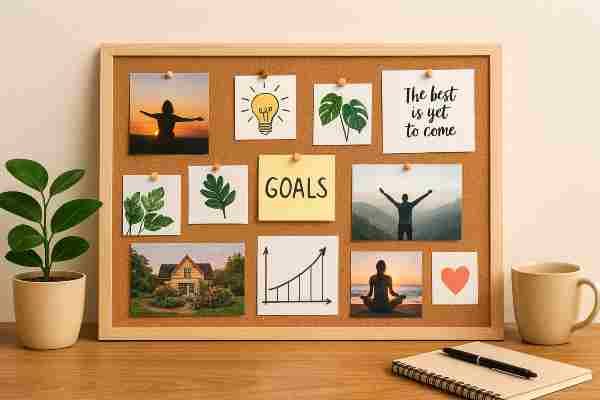
A vision board can help you reach your goals by keeping them active in your thoughts. When daily life gets busy, important plans can fade into the background. A vision board brings them back into view and helps you stay connected to what you are working toward.
We all have hopes, plans, and goals. Yet even important goals can fade into the background when daily life gets busy. Work, family, stress, and routine compete for our attention.
A vision board gives those goals a physical or digital form. It uses pictures, words, or symbols to represent what you are working toward. Used well, it becomes a practical reminder of direction rather than a promise that simply thinking about something will make it happen.
Inner Work Gate:
This process asks you to examine whether your goals are truly your own and may bring up doubt, fear, disappointment, or painful feelings about goals you have not reached. Emotional stability and basic grounding should be in place before using the vision board for deeper self-examination. If the process becomes overwhelming, return to stabilization before continuing.
Using a vision board to reach your goals
The basic idea behind a vision board is simple. The things we see often are reminders. That is what safety signs are all about. They remind us to be safe around hazards. A vision board reminds about an important goal that we have so that we can align thinking and action to reach it.
A goal written in a notebook may disappear into a drawer. A plan saved on a computer may not be opened again for weeks. A vision board stays where you are more likely to notice it.
That does not mean you must stare at it for long periods. Regular contact is enough. Seeing the board can bring a larger goal back into mind when you are making everyday choices.
You may be deciding how to spend your time. You may be tempted to give up a useful habit. You may face several choices and need to decide which one supports what you want most.
A visible reminder can help reconnect those small choices with the larger goal.
Images can also act as symbols. A picture of a quiet room may represent a calmer home life. A trail through the mountains may represent becoming more active. A graduation photo may represent finishing an education.
The image is not the goal itself. It carries the meaning you have given it.
➡ For More See: The Sigil Symbolism Mechanisms of Symbolic Encoding.
A vision board is a reminder, not a promise
Vision boards are sometimes presented as if seeing something often enough will cause it to appear. That is not what makes them useful.
A picture of a healthier body will not improve your health by itself. A picture of a new career will not create the skills needed for that career. A peaceful home will not appear because its picture is on a wall. A vision board works when it helps connect intention with action.
That distinction matters. The board can support a practical plan, or it can become a form of wishful thinking. A useful question is:
What can I do that moves me toward what this image represents?
The answer may be a large step, but it is more often something small and practical.
Visualizing your goals more clearly
Visualization can make a vague idea more specific. Instead of thinking, “I want my life to be better,” you begin asking what “better” would actually look like.
Maybe you want a calmer home. Does that mean fewer arguments, less clutter, stronger boundaries, or more time together?
Maybe you want a different career. Does that mean learning a skill, finishing training, working in a different setting, or changing your schedule?
A vision board encourages you to turn broad wishes into clearer pictures. That clarity matters because it is hard to move toward a goal when you cannot describe what the goal means.
Visualization has uses that go far beyond vision boards. Mental rehearsal, imagination, and focused imagery are separate practices with their own methods.
➡ For More See: Practical Mindset Exercises — Developing Positive Intent.
➡ For More See: Shamanic Visualization: Creating the Inner Landscape.
Why the images you choose matter
Not every attractive picture belongs on a vision board.
The image needs to mean something to you.
A photograph that looks impressive to someone else may have little value if it does not connect with your actual goal. You are not making a decoration for other people. You are making a personal tool. Specific images are usually more useful than vague ones.
Suppose your goal is simply called “success.” That word can mean almost anything. One person may think of money. Another may think of family time. Someone else may think of education, health, creative work, travel, service, or peace of mind.
If your idea of success includes having more time with your family, an image of people sharing a meal may mean more to you than a photograph of money.
If you want greater peace, choose an image that represents what peace would look like in your actual life.
The meaning behind the image is what gives it value. Value can create motivation.
Emotion can strengthen the connection
The strongest images usually create some kind of personal response. They may bring hope, relief, excitement, calm, courage, or determination. That response helps make the image meaningful instead of decorative. But every image does not have to make you feel intensely positive.
Important goals can bring mixed emotions. Going back to school may create excitement and fear. Leaving an unhealthy situation may bring relief and uncertainty. Starting something new may also mean grieving what you are leaving behind.
The goal is not to force yourself to feel good. Choose images that honestly represent something important to you.
If an image feels false or chosen only because you think you are supposed to want it, leave it off the board.
A vision board should reflect your goals, not someone else’s idea of what your life should become.
How to create a vision board that supports real action
The materials can be simple. A physical board might use poster board, a corkboard, printed photographs, magazine pictures, drawings, written words, or a notebook. A digital board can use photographs and images stored on a computer or phone. It may become a desktop image, phone background, digital notebook page, or another display you will see regularly.
The format matters less than how well it fits your life. The following steps help turn a collection of images into a useful vision board.
Step one: decide what you are working toward
Begin with the goal, not the pictures. Ask what you actually want to change, build, complete, or protect.
Try to move beyond broad statements. “I want to be happier” gives you little direction.
Ask what would make daily life better.
Maybe you want less financial stress. Maybe you want more time outdoors. Maybe you want to finish a project, improve a relationship, learn a skill, change careers, or create more stability at home.
You do not need every step planned before starting the board. You only need enough clarity to know what it is supposed to represent.
If you have several major goals, you can divide the board into sections or create separate boards. Too many unrelated goals can make the message harder to see.
Goal-setting itself is a larger process.
➡ For More See: Design A Self-Guided Coaching Plan: How to Become Your Own Coach.
Step two: choose images that match the goal
Once the direction is clear, look for images that show it. If you want more time in nature, a photograph of a place you might actually visit may be more useful than a general landscape.
If you want a home office, choose an image of the kind of workspace you would like to create.
If your goal involves education, choose something connected to the school, subject, training, or work you are pursuing.
The image should make the goal easier to recognize.
Step three: choose images that matter to you
After finding possible images, notice your reaction to them.
Ask why each one belongs on the board.
Can you explain what it represents?
Does it connect with something you truly want?
This step can also reveal goals that are not really yours. People sometimes pursue things because family, friends, culture, advertising, or social media tell them those things represent success.
If an image represents status but not anything you genuinely value, remove it. The board should help you clarify your direction, not pressure you to follow someone else’s.
Step four: choose a format you will actually use
There is no single correct type of vision board. Some people enjoy cutting out pictures and arranging them on a physical board. Others prefer a digital version because they already spend much of the day using a computer or phone.
A notebook may work better if you like journaling. A small board near a desk may work better if you want a private reminder.
Choose the format that fits your normal routine. The most useful board is one you will see often.
Step five: put it where you will naturally notice it
Placement is part of the method. You should not have to remember to search for the board every day.
Put it somewhere you are already likely to notice it. That might be near your desk, inside a planner, on a bedroom wall, beside a workspace, a door, or on your phone.
The goal is not constant attention. You simply want enough contact to keep the board connected with everyday life.
Step six: review what the board means
Take a little time to look at the board with intention. A minute or two may be enough. Remember why you chose the images. Ask yourself:
- What does this image represent?
- Does this goal still matter?
- Am I doing anything that supports it?
- Has something changed?
This keeps the board from becoming part of the background.
You may discover that some images no longer fit. Goals and circumstances change. What mattered deeply a year ago may no longer belong in your life. It is fine to update the board when your direction changes.
Step seven: connect the board with something you can do
This is the most important step. Choose actions that support what the images represent. If the board includes education, perhaps the next action is researching one course.
If it includes better health, the action might be taking a walk, making an appointment, preparing a healthier meal, or improving a sleep routine.
If it represents a calmer home, you might clear one area, set one boundary, or have one needed conversation.
If it represents a different career, you might update a résumé, learn a skill, or speak with someone who works in that field.
The action does not need to be dramatic. Small actions can be repeated, and repeated actions can create larger changes over time.
➡ For More See: Design A Self-Guided Coaching Plan: How to Become Your Own Coach.
Common problems that make vision boards less useful
A vision board can lose its purpose when the board itself becomes more important than what it represents. One common problem is trying to include everything you might ever want.
The result may become a crowded collection of houses, vacations, money, careers, relationships, health goals, spiritual ideas, hobbies, and inspirational sayings.
Instead of creating direction, the board creates noise.
Another problem is choosing images only because they look good. Every image should represent something you can explain.
The board can also become a source of pressure. You may begin looking at it as a list of everything you have failed to achieve. If that happens, review the goals themselves.
Some may need to be broken into smaller steps. Others may no longer matter. Some may depend too heavily on things outside your control.
A vision board should help you think more clearly about direction. It should not become a daily measure of failure.
Vision boards and the law of attraction
Vision boards have become closely tied to the law of attraction and the idea of manifestation. Books, websites, courses, and products sometimes suggest that imagining an outcome will help draw that outcome into your life.
A vision board does not need that explanation to be useful. You can use one without believing that thoughts control outside events. Its practical role is more limited.
It can help you remember what you want to work toward. It can make vague goals more concrete. It can bring those goals back into mind when choices arise.
None of this guarantees the outcome.
Money, health, other people, social conditions, timing, opportunity, and unexpected events can all affect what happens. Some things remain outside our control.
This is also an important distinction when using affirmations, intention, and other methods that are sometimes presented as ways to create results through thought alone.
➡ For More See: The Real Power of Affirmations to Create Lasting Change.
What changes should you expect?
A useful vision board is unlikely to create a sudden breakthrough. Its effects are usually quieter.
The vision board prompts you to remember a goal when deciding how to spend an hour.
You may notice an opportunity that fits what you are trying to do. Many people recognize that an old habit conflicts with your new goals.
It helps you to remember why a difficult task matters.
You may even discover that a goal needs to change.
These small moments matter because goals are often reached through many ordinary decisions rather than one dramatic act. Confidence may grow as you begin to see evidence of progress. A setback may feel less final when you can still see the larger direction you are working toward.
One difficult day, mistake, or delay does not have to end the effort. You can adjust and continue.
Let the vision board change with you
A vision board should not become a contract with your past self. People change. Priorities change. Circumstances change.
Sometimes reaching one goal shows you that you want something different. Sometimes new information changes what is possible. Sometimes you discover that an old goal no longer fits who you are.
Reviewing the board gives you a chance to notice those changes.
You can remove completed goals. You can replace images that no longer fit. You can simplify a crowded board or add a new direction when your life changes. Changing the board is not failure.
It means the tool is still connected to your life as it is now.
Final thoughts
A vision board gives form to something that might otherwise remain a vague idea. It can help you define what you want, choose images that represent it, and keep those goals connected with daily choices.
But the pictures do not create the change. They provide a point of focus. Reflection helps you decide whether the goal still matters. Practical action moves you toward it.
Used this way, learning how to create a vision board is not about wishing hard enough for something to happen. It is about making your direction easier to see while doing the work needed to move toward it.
References
- Building a Practically Useful Theory of Goal Setting and Task Motivation: A 35-Year Odyssey — Edwin A. Locke and Gary P. Latham, American Psychologist.
- Implementation Intentions and Goal Achievement: A Meta-Analysis of Effects and Processes — Peter M. Gollwitzer and Paschal Sheeran, Advances in Experimental Social Psychology.
- Harnessing the Imagination: Mental Simulation, Self-Regulation, and Coping — Shelley E. Taylor, Lien B. Pham, Inna D. Rivkin, and David A. Armor, American Psychologist.
- From Thought to Action: Effects of Process-Versus Outcome-Based Mental Simulations on Performance — Lien B. Pham and Shelley E. Taylor, Personality and Social Psychology Bulletin.
- Self-Regulation of Goal Setting: Turning Free Fantasies About the Future Into Binding Goals — Gabriele Oettingen, Hyeon-ju Pak, and Karoline Schnetter, Journal of Personality and Social Psychology.
- The Motivating Function of Thinking About the Future: Expectations Versus Fantasies — Gabriele Oettingen and Doris Mayer, Journal of Personality and Social Psychology.
- Positive Fantasies About Idealized Futures Sap Energy — Heather Barry Kappes and Gabriele Oettingen, Journal of Experimental Social Psychology.
- Goal Striving, Need Satisfaction, and Longitudinal Well-Being: The Self-Concordance Model — Kennon M. Sheldon and Andrew J. Elliot, Journal of Personality and Social Psychology.
- Social Cognitive Theory of Self-Regulation — Albert Bandura, Organizational Behavior and Human Decision Processes.
- Self-Determination Theory and the Facilitation of Intrinsic Motivation, Social Development, and Well-Being — Richard M. Ryan and Edward L. Deci, American Psychologist.
- Health Goal Priming as a Situated Intervention Tool: How to Benefit From Nonconscious Motivational Routes to Health Behaviour — Esther K. Papies, Health Psychology Review.
- Preserving Prospective Memory in Daily Life: A Systematic Review and Meta-Analysis of Mnemonic Strategy, Cognitive Training, External Memory Aid, and Combination Interventions — Winston E. Jones, Jared F. Benge, and Michael K. Scullin, Neuropsychology.
About this project
The Seeker Project 4 Spiritual Exploration (SP4SE) is a project of Americans In Alliance. The mission of SP4SE is spiritual education. The mission of Americans In Alliance is environmental conservancy. Click the links below to learn more and support our efforts.