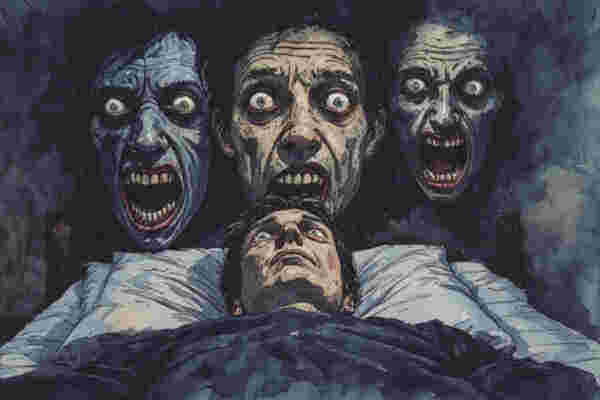
Decoding intense nightmares and night terrors is important. They reveal hidden messages and unresolved issues. These dreams have an intensity we don’t choose, can’t control, and often ignore.
Most people treat these episodes like static: unpleasant, meaningless, something to shake off in the morning. But the charge they carry—the way they hit, linger, or echo—suggests that there is more happening than random fear.
This article stays with that charge. Not to interpret your dreams or solve them, but to look at what shifts when you stop dismissing the intensity and start noticing what is shaping them.
Nightmares as Real Experiences of the Mind
Nightmares and night terrors hit with force because the mind treats them as real while they are happening. The fear, the images, the sense of threat—none of it is pretend to the nervous system. Your brain is using the same machinery it uses when you are awake, which means the experience has weight even if the setting is unreal.
The mind does not distinguish between “real” and “imagined” in the moment.
The mind responds to meaning, not accuracy. If something feels dangerous, the body prepares for danger. If something feels painful, the emotional system responds as if the pain is happening now. Dreams use the same circuits that shape perception, memory, and emotion during the day, so the experience lands with the same force.
Dreams also influence waking life more than we notice. A dream can shift your mood, change how you interpret a situation, or bring a buried feeling closer to the surface. Even when the images fade, the emotional tone can linger. The mind carries that residue into the day, shaping thoughts, reactions, and the way you read the world around you.
When you see nightmares this way, they stop looking like glitches or random noise. They become part of how the mind shows you what it is struggling with, what it is tracking, and what it has not resolved yet.
Decoding intense nightmares takes time. This section sets that foundation for the rest of the article. To build on that foundation, the next step is to clarify the basic terms the mind moves through at night.
Sleep, Dreaming, Nightmares, and Night Terrors
Sleeping is the natural state your body and brain enter to rest and restore energy. Even though your body is still, your brain stays active, moving through different stages of activity across the night.
Dreaming is the experience of images, stories, emotions, and sensations created by the mind while the body rests. These experiences can seem vivid and real at the time, but they come from within, not from the outside world.
Nightmares are distressing dreams filled with fear, danger, or threat. They feel real because the mind treats them as real while they are happening. The emotional system is fully engaged.
Night terrors are different. They are sudden episodes of intense fear during sleep in which a person may sit up, shout, move, or appear awake but is not fully conscious. Nightmares are remembered dreams; night terror events often leave no memory at all.
This section clarifies the basic terms so the rest of the article can build on them without confusion. With the terms clear, we can look at how the dreaming mind actually works.
The Dreaming Mind and the Partition of Fear
Dreaming is not one unified state. It encompasses a whole range of mental activity, most of it loose and harmless. The mind drifts, rearranges memories, and plays with images that do not need to make sense. Most dreams stay in that softer partition of consciousness—symbolic, fluid, and low‑stakes.
Nightmares and night terrors come from a different slice of that same system. They are built from fear, urgency, and emotional pressure. The mind stops drifting and locks onto one feeling, one threat, one unresolved tension. That is why intense nightmares feel vivid and convincing: the brain is using the same machinery it uses to signal danger when you are awake. The fear is real, even if the scene is not.
The difference is not the content—it is the emotional system running the show.
Why Nightmares Arise: Fear, Memory, Trauma
Nightmares and night terrors often surface when fear or stress has nowhere else to go. The mind carries tension long after the day ends, and sleep becomes the one place where that pressure can move. What feels random at night is often the emotional backlog we have been holding together during the day.
Memory adds another layer. Unresolved fragments—moments we ignored, feelings we avoided—can come back twisted. A nightmare does not replay the event itself; it replays the emotional charge attached to it.
Night terrors come from deeper in the nervous system. The body responds before the mind understands. That is why thrashing, sweating, or waking up in a panic feels so intense and sudden.
- Fear and stress that never found resolution.
- Memory fragments resurfacing under pressure.
- Physiological alarm responses with no narrative attached.
Once you understand why nightmares arise, the next question is how different cultures have made sense of them.
Decoding Intense Nightmares
Nightmares feel like messages because they bypass the filters we use during the day. They bring forward the feelings we avoid, the tensions we mute, and the truths we do not want to name. The psyche uses intensity when subtlety has stopped working.
They look and feel like literal experiences, but they are not. They speak with pressure, tone, and emotional accuracy. A nightmare may distort the story, but it rarely distorts the feeling. What rises in the dream is often the thing you have been trying not to feel while awake.
The message of a nightmare is rarely in the imagery—it is in the emotion that refuses to stay buried.
When decoding intense nightmares and night terrors, focus on the emotions they trigger, not the symbolism of the imagery.
Cross‑Cultural Approaches to Nightmares
Many cultures treat nightmares as encounters rather than accidents. In shamanic traditions, a nightmare is a meeting with something you fear or avoid. The task is not to escape it but to face it and understand what it represents.
This approach overlaps with psychoanalysis, where the nightmare is seen as a direct meeting with the unconscious. The images may be strange, but the fear behind them is familiar. Both traditions treat the nightmare as a doorway into something real inside you.
Across cultures, the nightmare is not a mistake—it is an encounter.
Working With Nightmares: Awareness, Recall, Lucidity
Working with nightmares starts with remembering them. Writing them down helps in decoding intense nightmares by clarifying the emotions involved. It helps you notice details that disappear once you are fully awake. Even a few lines can open the door to deeper memory.
Lucid dreaming adds another layer. When you know you are dreaming, you can stay with the fear instead of running from it. This shift turns the nightmare from something that happens to you into something you can explore with curiosity.
Recurring nightmares often soften when you approach them instead of avoiding them. The goal is not control—it is awareness.
What changes when you stop running from the dream and start paying attention to it?
Intense Nightmares as Invitations to Integration
Nightmares and night terrors point toward the parts of ourselves we have not faced. They bring forward emotions we avoid, fears we push down, and truths we are not ready to name. Instead of punishing us, they show us where something inside is asking for attention.
They act like thresholds. When a nightmare repeats or hits with unusual force, it often marks a place where healing or honesty is needed. The dream is not the problem. It is the doorway.
Nightmares are not warnings of danger. They are signals of pressure.
Nightmares are not punishments. They are invitations.
Nightmares are not obstacles. They are openings.
References
- Nightmare Disorder. StatPearls Publishing, National Center for Biotechnology Information.
- Nightmares: From Anxiety Symptom to Sleep Disorder. Sleep Medicine Reviews.
- Dreaming and the Brain: Toward a Cognitive Neuroscience of Dreaming. Behavioral and Brain Sciences.
- Parasomnias and Night Terrors. Current Neurology and Neuroscience Reports.
- REM Sleep and Emotional Memory Processing. Frontiers in Behavioral Neuroscience.
- Nightmares. Sleep Foundation.
- Dreams and Dreaming. Stanford Encyclopedia of Philosophy.
- Lucid Dreaming. Sleep Foundation.