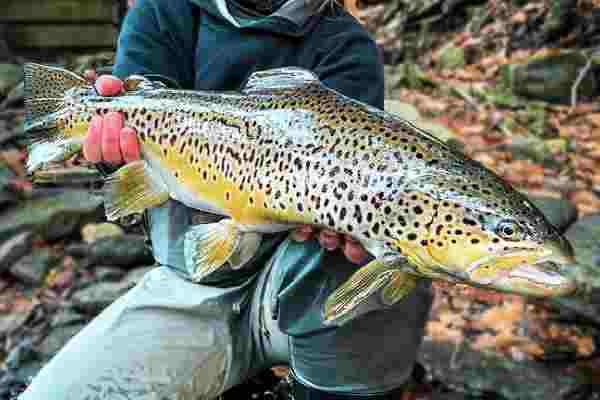
Observe people in modern life, and you find they act like a trout. They follow “shiny” objects, we call celebrities and conspiracy theories. In reality, these are just like trout reflex loops, steering behavior. Learn to spot the lures, and you can stop being manipulated.
Most people believe they make choices because they think things through. It feels good to imagine we are careful, aware, and in control. But when you watch how people react in real time, a different picture appears. We behave a lot like trout in a stream. We snap at anything that flashes, drift with whatever current is strongest, and follow the school because it feels safe. These reactions happen so fast that we rarely notice them.
If you have ever watched trout in a stream, you know it does not pause to reflect. It darts, turns, and lunges at movement without hesitation. People can act like a trout in the stream of information, emotions, and social pressure. We respond to signals without asking who created them or why they appeared. We feel pulled, pushed, or swept along, and we assume it is all natural because it feels automatic.
This article explains the mechanisms behind this behavior. If you understand these patterns, you can see when you are reacting automatically and when you are choosing your own direction.
Inner Work Gate Notice:
It may increase discomfort before resolution. The exercises are designed to examine and restructure belief patterns, identity structures, or emotional resistance. Emotional stability should be established before engaging this material. This article is not designed for immediate calming. It is designed for transformation.
Why you act like a trout
Trout reflex loops steering behavior
To understand why the trout metaphor works, you have to look at how the human mind handles the world. We live in a constant flood of information. Every sound, image, message, and emotion competes for space in our attention. If we tried to think deeply about every signal, we would freeze. So the brain uses shortcuts. These shortcuts are fast, simple, and automatic. They help us survive, but they also make us predictable.
Think about walking into a busy store. Before you think, your eyes jump to the brightest color, the loudest voice, or the fastest movement. You notice where people are gathering. You sense the mood of the room. You feel a pull toward what seems familiar. All of this happens before you form a single conscious thought. You are not choosing these reactions. They are choosing you.
These trout reflex loops follow a pattern:
- You see something that stands out.
- You react before thinking.
- You look at what others are doing.
- You avoid anything that feels uncomfortable.
- You settle into the familiar flow.
Each loop is simple. But together, they shape how you move through the world. Anyone who understands these loops can guide your behavior. They can make you act like a trout without ever revealing their intentions. This is why the trout metaphor matters. It shows how easy it is to move people when you use trout reflex loops steering behavior.
The four reflex patterns
These patterns are not random. They are the core reflexes that shape human attention and behavior. Each one can be triggered on purpose. And each one has a story behind it that explains why it works so well.
1. The flash reflex
A trout snaps at anything that flashes because its brain is wired to treat sudden movement as food or danger. Humans do the same thing with information. When something jumps out at us, we react before we think. This reflex is so fast that it feels like instinct, not choice.
Picture yourself scrolling through your phone. You are relaxed, not looking for anything in particular. Then a headline jumps out at you. It is loud, dramatic, and emotional. Before you know it, you have clicked it. You did not pause. You did not question it. You reacted to the flash. The moment grabbed you, and your mind followed.
Trout reflex loops are powerful because it feels natural. It feels like curiosity, but it is really a pull created by something designed to stand out. The flash reflex works because it bypasses slow thinking and goes straight to action.
Examples of flash reactions include:
- Sharing a post because it shocked you.
- Clicking something because it looked exciting or scary.
- Getting pulled into drama because it felt urgent.
The flash reflex enables steering behavior without anyone noticing. It is the first tug on the line.
2. The schooling reflex
Trout swim in schools because the group feels safe. When one fish turns, the others follow without hesitation. Humans do the same thing. We look to the group for cues, even when we do not realize it. This reflex is built into us because belonging once meant survival.
Think about the last time you hesitated to speak up because everyone else seemed to agree. Or the last time you joined a trend simply because it was everywhere. You may have felt a small tug inside, a quiet voice saying, “Everyone else is doing it. Maybe I should, too.” That tug is the schooling reflex.
This reflex is not about logic. It is about safety. When the group moves, we feel pressure to move with it. When the group believes something, we feel pressure to believe it too. Even silence can feel dangerous when the group is loud.
Examples of schooling behavior include:
- Joining trends because they look popular.
- Repeating opinions that match the group.
- Staying silent when the group seems certain.
The schooling reflex keeps us aligned with the crowd. It feels safe, but it also keeps us from asking questions. It turns the group into the current, and we follow without noticing.
3. The current drift
A trout lets the current carry it because fighting the water takes energy. Humans drift through information streams the same way. We follow whatever path is easiest, even if we did not choose it. Those in charge of the information are steering behavior. This reflex is subtle because it feels like we are going with the flow, not being guided.
Imagine opening a video app “just for a minute.” The next thing you know, an hour has passed. You did not choose each video. The current chose for you. You drifted because it was easier than swimming against the flow. The same thing happens with news feeds, conversations, habits, and routines.
This reflex works because it removes friction. When something is already moving, it feels natural to follow it. When an idea is already spreading, it feels normal to repeat it. When a habit is already formed, it feels easier to continue it.
Examples of current drift include:
- Letting algorithms decide what you see.
- Sliding into habits without noticing.
- Repeating ideas because they are already in motion.
The current drift makes influence feel natural. You do not feel pushed. You feel carried. That is what makes it powerful.
4. The deep-water reflex
Trout use deep water when they feel threatened. Humans avoid deep thinking when they feel threatened. When something feels uncertain or uncomfortable, we retreat to simple answers. This reflex protects us from fear, but it also limits us.
Think about a time when a topic felt too big or too confusing. Instead of exploring it, you grabbed onto the first explanation that felt safe. Or you trusted someone who sounded confident. You avoided the deep water because it felt risky. This reflex is not about truth. It is about comfort.
This reflex works because deep thinking takes effort. It forces us to face things we would rather avoid. It challenges our identity, our beliefs, and our sense of control. So we stay in the shallow water, where everything feels familiar.
Examples of deep-water fear include:
- Choosing beliefs that feel safe instead of true.
- Avoiding information that challenges identity.
- Trusting anyone who promises protection.
The deep-water reflex keeps us from exploring ideas that require effort or courage. It makes us easy to reassure and easy to guide.
How these reflexes get used against us
These reflex loops are easy to trigger. Anyone who wants to guide behavior only needs to activate one or two of them. When all four fire together, the influence becomes invisible. You are choosing, but you act like a trout, reacting and not thinking about the decision or consequences.
Imagine a message designed to pull you in. It starts with something flashy to grab your attention. Then it shows you that many people already agree with it. Next, it pulls you into a stream of similar messages. Finally, it warns you about something scary or uncertain. By the time you reach the end, you feel like the message is obvious, natural, and true.
Here’s how the loops combine:
- The flash reflex grabs your attention.
- The schooling reflex keeps you aligned with the group.
- The current drift moves you without resistance.
- The deep-water reflex stops you from questioning the path.
When these loops work together, you do not feel manipulated. You feel like you are following your instincts. That is what makes the mechanism so effective.
How to stop acting like the trout
You cannot remove these reflexes. They are part of being human. But you can interrupt them. The goal is not to fight your instincts. The goal is to notice when they are steering you.
The first step is slowing down. When something feels urgent or dramatic, pause. When you feel pressure to match the group, step back. When you feel yourself drifting, ask who set the current. When something feels too simple or too comforting, check what you are avoiding.
Here are the key defenses:
- Slow down when something feels urgent or dramatic.
- Ask whether you agree or if you are following the group.
- Check who benefits from the “current” you are drifting in.
- Face uncomfortable ideas instead of avoiding them.
- Choose your direction instead of reacting to signals.
Awareness breaks the loop. Once you see the reflex, it loses its power. You stop reacting like a trout and start responding like a person who understands the stream.
In Conclusion
Acting like the trout is easy. It feels natural. It feels safe. But it also makes you predictable. When you understand your reflex loops, you stop reacting to flashes, crowds, currents, and fears. You start choosing your own path.
The goal is not to escape the stream. The goal is to stop swimming blind.
References
- Thinking, Fast and Slow, Daniel Kahneman.
- Predictably Irrational: The Hidden Forces That Shape Our Decisions, Dan Ariely.
- Nudge: Improving Decisions About Health, Wealth, and Happiness, Richard H. Thaler & Cass R. Sunstein.
- The Attention Economy: Understanding the New Currency of Business, Thomas H. Davenport & John C. Beck.
- Hooked: How to Build Habit-Forming Products, Nir Eyal.
- Influence: The Psychology of Persuasion, Robert B. Cialdini.
- Attention and Cognitive Control, National Institute of Mental Health.
- Decision-Making and Cognitive Bias, National Institutes of Health.
- Social Influence and Group Behavior, National Library of Medicine.
- Heuristics and Biases, Stanford Encyclopedia of Philosophy.
- Attention, Wikipedia.
- Herd Behavior, Wikipedia.