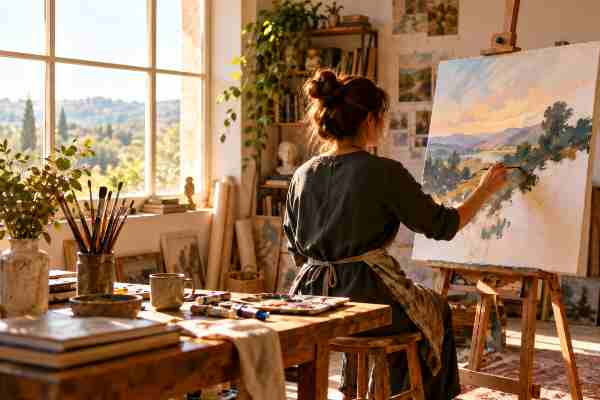
Lawyers practice law. Doctors practice medicine. Musicians rehearse. Scientists test and revise their ideas. They keep practicing because mastery is never finished. The art of living life as an artistic process works the same way: we learn, adjust, and refine as we go.
Living well is not something we learn once and then finish. Life keeps changing, and so do we. New experiences bring new problems, choices, and lessons. We learn by taking part in life and paying attention to what happens.
When we stop treating life as something that simply happens to us, our role begins to change. We become more involved in shaping what comes next. We cannot control everything that enters our lives, but we can learn to work with what we are given. That is where the art of living life as an artistic process begins.
Inner Work Gate Notice:
This process asks you to reflect on choices, values, habits, reactions, and long-standing beliefs that may be shaping the way you live. Recognizing patterns that no longer fit and making deliberate changes may bring discomfort, uncertainty, or difficult emotions into awareness. Establish emotional stability and grounding first, work at a manageable pace, and seek appropriate support when deeper patterns become difficult to work through safely.
Living life as an artistic process
An artist begins with raw material and slowly gives it form. A painter works with color and shape. A musician works with sound. A writer works with words. In life, our materials are experiences, relationships, abilities, problems, choices, and changing circumstances.
We do not get to choose all of those materials. Some events arrive without warning, while decisions shape other parts of life made long ago. What matters is what we do with what is in front of us now.
This does not mean that we can create any life we want by thinking positively or trying harder. Real limits exist, and some events remain outside our control. The artistic part is learning how to work within those limits while still shaping the parts of life that are ours to shape.
Maharishi Mahesh Yogi used the idea of an art of living in The Science of Being and Art of Living. His larger spiritual system had its own beliefs, but the basic idea reaches beyond one tradition. The art of living life as an artistic process can be approached as something we learn to do with greater awareness and skill.
Seen this way, life is not a finished object. It is a work that keeps developing.
1. Life is something we practice
Most skills improve because we practice them. A musician does not expect to master an instrument after one lesson, and a doctor does not stop learning after medical school. Experience continues to teach them what books and training could not.
Our lives develop in much the same way. We make a choice, see what happens, and carry what we learn into the next situation. Sometimes the result is what we hoped for. At other times, we discover that our judgment was incomplete or that our approach needs to change.
When life is treated as a practice, mistakes take on a different meaning. A mistake can still cause harm and may need to be corrected, but it does not have to become proof that we are failures. It can also show us where our understanding or skill was weak.
This makes humility an important part of the art of living. We never reach a point where every choice will be right. What we can do is become better at noticing when something is not working and more willing to change course.
Over time, the process becomes familiar. We try, observe, learn, and try again. Life keeps providing another chance to practice.
2. Experience provides the raw material
Artists often begin with materials they did not create themselves. A sculptor may find an unusual piece of stone or wood and discover that its shape affects what can be made from it. Life gives us material in much the same way.
We are born into a certain family, culture, time, and place. As life continues, relationships begin and end, opportunities appear, plans fail, health changes, and unexpected events force us to respond. Some experiences are welcome, while others are painful or unfair.
Treating life as an artistic process does not mean pretending that every experience is good. It means recognizing that what happens becomes part of the material we now have to work with.
A disappointment may reveal that we were following the wrong goal. A difficult relationship may show us where a boundary is needed. Success may reveal a skill we did not know we had. Even an ordinary day can show us something about the habits and choices shaping our lives.
We do not have to turn every event into a lesson while it is happening. Sometimes we simply need to live through the experience first. Later, when there is enough distance, we may be able to see what it taught us or how it changed our direction.
➡ For More See: Spiritual Growth Pathways: Finding Wisdom and Insight
➡ For More See: The Timeless Lessons From The Moon
3. Awareness lets us see what we are creating
Practice only helps when we notice what is happening. A musician has to hear when a note is wrong before it can be corrected. In the same way, we need enough awareness to notice how our thoughts, feelings, and actions are affecting the life around us. This is the critical thinking aspect of the art of living life.
This can be difficult because much of daily behavior becomes automatic. We react to familiar situations before we have given them much thought. A certain comment may trigger anger, or an old fear may push us toward the same choice we have made many times before.
Awareness creates a little space inside that pattern. Instead of moving straight from reaction to action, we begin to notice what is happening while it is happening.
Sometimes this means practicing a simple pause. We stop long enough to recognize the feeling, thought, or urge before following it. That brief pause does not solve the problem, but it gives us a chance to see what we are about to add to the situation.
With practice, we begin to notice larger patterns as well. We may see that certain choices keep producing the same conflict, or that we feel better when we respond in a different way. Awareness gives us the information needed for the next part of the artistic process.
➡ For More See: Leveraging Your Habitual Nature to Build Good Habits.
4. Reflection shows what needs refinement
After an artist works for a while, there comes a point when stepping back is useful. Up close, one small part of the work may seem important. From farther away, the artist can see how that part fits into the whole.
Reflection serves the same purpose in life.
Looking back at an experience gives us time to ask what actually happened instead of relying only on our first reaction. We can consider what worked, what created trouble, and what we might do differently if a similar situation happens again.
The purpose is not to judge every choice harshly. Constant self-criticism does not produce clear reflection. A better approach is curiosity. We are trying to understand what the experience shows us so that the next choice can be better informed.
Sometimes reflection reveals a simple problem. We were tired, rushed, or missing important information. At other times, it may uncover something deeper, such as an old belief or fear that keeps shaping the same kind of decision.
Those deeper patterns need more than a quick adjustment. When a harmful belief continues to shape thought and behavior, it may need to be examined through a more focused inner work process.
➡ For More See: The Core Process for Repairing Harmful Thinking, Beliefs and Values.
5. Values give the work direction
An artistic life is not only about becoming better at making decisions. Art also expresses something. What we care about affects what we choose to create.
Values serve this role in life. They help give direction to the choices we make after reflection has shown us that something needs to change.
If honesty matters to us, that value should slowly become visible in the way we speak and act. If compassion matters, it should affect the way we treat people when life becomes difficult. Courage matters most when fear is present, just as fairness matters most when being fair costs us something.
We do not need to express every value perfectly. In fact, the difference between what we value and how we actually behave often shows us where more practice is needed.
This is one reason values fit so naturally into the art of living. They give us something to move toward without pretending that the work is already finished.
Spiritual traditions may describe these qualities as virtues. Other systems may simply call them personal or ethical values. The name matters less than whether they begin to shape the way we live.
➡ For More See: Living the Virtues of the Spirit.
➡ For More See: Turn Positive Values Into Action.
6. Make the next adjustment
Reflection becomes useful when it leads to the next attempt. An artist may change a line, remove a color, slow a passage of music, or try a different tool. The whole work does not need to be destroyed because one part needs improvement.
Life often changes in the same way.
If a conversation went badly, the next adjustment may be listening longer before answering. If a goal has become unrealistic, the adjustment may be making it smaller. If the same habit keeps causing trouble, a different routine may need to take its place.
These changes do not need to be dramatic. Small corrections can have a large effect when they are repeated over time. A slight change in direction may lead somewhere very different after months or years.
The result of the adjustment gives us new information. We see whether it worked, whether another change is needed, or whether our first understanding of the problem was incomplete.
That is why the art of living as an artistic process is a cycle rather than a straight path. Experience leads to awareness. Awareness makes reflection possible. Reflection guides the next action, and that action creates a new experience from which we can learn.
➡ For More See: The Threefold Path from Awareness to Action.
7. Your way of living develops over time
Artists often develop a style after years of practice. They may learn from teachers and copy methods while they are beginning, but eventually their own way of working starts to appear.
Something similar happens as we learn how to live.
At first, many of our ideas about life come from family, culture, religion, teachers, and the people around us. Those influences give us a starting point, but they do not have to become the final design.
Experience slowly shows us what fits and what does not. Some inherited values remain important because we have tested them and found that they still make sense. Other ideas may fall away as our understanding grows.
Over time, our choices begin to show a more personal pattern. We learn how we handle conflict, what kind of relationships help us grow, where our strengths are useful, and what matters enough to deserve our time.
This is where authenticity begins to appear without needing to become another goal we chase. We are no longer trying to perform a role or copy someone else’s life. Our way of living begins to reflect what we have learned about ourselves and what we have chosen to value.
Teachers, traditions, and methods can still help us. An artist can learn from other artists without becoming a copy of them. In the same way, guidance can shape our development without taking away the need to create our own path.
8. The work is never finished
A work in progress changes as the artist changes. Life does too.
What worked when we were twenty may not fit when we are forty. A value may remain important while the way we express it changes. A goal that once gave life direction may be completed, replaced, or left behind when circumstances change.
This does not mean we have failed to find the right way to live. It means living requires ongoing adjustment because the conditions never remain exactly the same.
There will also be times when old habits return. We may make a poor choice that we thought we had outgrown or react badly during a difficult period. The useful response is not to declare that all earlier progress has been lost. We look at what happened, make the needed repair, and return to the practice.
This is why perfection is a poor goal for the art of living. Perfection suggests that the work can reach a final form where nothing else needs to change.
A living person never reaches that point. We continue meeting new people, gaining new knowledge, losing things, changing our minds, and entering stages of life we have never faced before.
The skill is learning how to meet those changes without expecting ourselves to already know everything.
Conclusion: the art of living life as an artistic practice
Lawyers keep practicing law because new situations keep appearing. Doctors keep learning because medicine changes and every patient is different. Musicians continue rehearsing because skill can always become deeper and more natural.
Living deserves the same patience.
The art of living life as an artistic process means paying attention to what experience is showing us, reflecting on what we are creating, and making changes when they are needed. Our values give the work direction, while practice slowly turns those values into the way we actually live.
Some stages of life will feel balanced and clear. Others will be messy and uncertain. Both can become part of the same larger work.
A well-lived life is therefore not a finished masterpiece that we someday complete. It is a work that grows with us. We keep learning from the material life gives us, shaping what we can, and refining the way we take part in what comes next.
References
- The Art of Living: Socratic Reflections from Plato to Foucault. University of California Press.
- Philosophy as a Way of Life: Spiritual Exercises from Socrates to Foucault. Blackwell.
- The Science of Being and Art of Living. Maharishi International University Press.
- Art as Experience. Penguin Publishing Group.
- Experiential Learning: Experience as the Source of Learning and Development. Pearson FT Press.
- The Reflective Practitioner: How Professionals Think in Action. Basic Books.
- Nicomachean Ethics. Oxford World’s Classics.
- Self-Determination Theory and the Facilitation of Intrinsic Motivation, Social Development, and Well-Being. American Psychologist.
- Goal Striving, Need Satisfaction, and Longitudinal Well-Being: The Self-Concordance Model. Journal of Personality and Social Psychology.
- The Benefits of Being Present: Mindfulness and Its Role in Psychological Well-Being. Journal of Personality and Social Psychology.
- Psychological Flexibility as a Fundamental Aspect of Health. Clinical Psychology Review.
- Theoretical Propositions of Life-Span Developmental Psychology: On the Dynamics Between Growth and Decline. Developmental Psychology.
About this project
The Seeker Project 4 Spiritual Exploration (SP4SE) is a project of Americans In Alliance. The mission of SP4SE is spiritual education. The mission of Americans In Alliance is environmental conservancy. Click the links below to learn more and support our efforts.