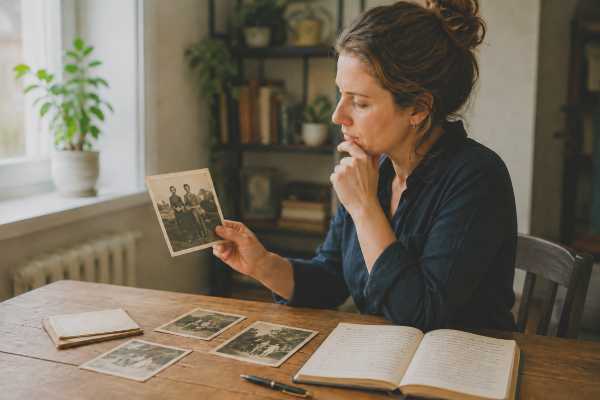
The memory rewind technique is a structured way to revisit personal memories. It enables you to observe them with some emotional distance. In this way, you can notice memory patterns that may still shape how you think, feel, and respond in daily life.
Our memories are more than stored information. They are a blueprint of our experiences that shape our thinking and identity. We are the total of our memories. Without memories, we have no experience. And without experiences, we have nothing to identify with.
Inner Work Gate Notice:
This practice involves recalling and exploring personal memories, including memories connected with fear, shame, grief, anger, rejection, or loss. Emotional stability and grounding should be established before beginning. Stop if you become overwhelmed, lose awareness of the present, or can no longer think clearly. Painful or traumatic memories may require support from a qualified mental health professional.
➡ For More See: The Emotional Check-In Process: Manage Emotional Readiness.
Memory and Perspective
Some memories bring comfort, while others carry fear, shame, grief, anger, or confusion. Even when we are not thinking about them, they can influence how we react to people and situations in the present.
Memory is fluid, not fixed… each time we recall an event, we subtly modify it.
Learning how our memories affect our worldview is important. The memory rewind technique provides a deeper level of insight and understanding.
Without perspective, memories pull us back into the past. With perspective, they become something we can observe, learn from, and eventually reshape. The difference is not the memory itself, but how we relate to it.
A memory is not the past. It is the past seen through the present.
Using the memory rewind technique
Using the memory rewind for inner work provides a structured way to explore memories with care. The purpose is not to prove exactly what happened in the past. It is to examine what we remember, what we connect with those memories, and what those connections may reveal.
The goal is not to become numb or emotionally distant from your life. You are creating enough space to notice the memory while remaining aware that you are here in the present.
➡ For More See: Meta-Awareness And Inner Observation.
➡ For More See: Methods for Cultivating Inner Observer Self-Awareness.
Memory is not a perfect recording of the past. Details can fade, change, or become mixed with later experiences. A detail that appears using memory rewind is something you remember or associate with an event. It is not proof that the event happened exactly that way.
This distinction is important. Inner work with the memory rewind techniqe is about examining the experience you carry now. Experiences can include people, places, feelings, physical sensations, images, sounds, and other associations. These elements may still shape how you view yourself and your life
A memory may appear as a complete event or only as a brief snapshot. Both can be useful. You do not need to force a complete story from an incomplete memory.
Exercise one: begin with positive memories

Start by working with positive memories. This lets you learn the memory rewind technique first. Then, you can use it with more emotionally charged experiences.
The exercise has four stages:
- Prepare
- Select positive memories
- Explore and expand each memory
- Review memories and memory patterns
Learning the process is more important than collecting a large number of memories. Move slowly enough to notice what is happening.
1. Prepare
Check your emotional readiness before beginning. Don’t begin if you are feeling overwhelmed, tired, angry, scared, or dealing with any other emotional issues.
You do not need to reach a special altered state. You only need enough stability and attention to remain aware of the present while remembering the past.
Sit somewhere comfortable. Close your eyes if that helps you focus. A few slow breaths may help settle your attention before you begin.
If emotional intensity becomes too strong at any point, stop the exercise and return to the emotional check-in process.
➡ For More See: The Emotional Check-In Process: Manage Emotional Readiness.
2. Select positive memories
Allow one positive memory to come to mind. Childhood memories can be useful because they give you a historical perspective. But don’t force the selection. The positive memories can come from any time.
Do not search for the perfect memory. If this is your first session, begin with the first clearly positive memory that appears.
You may remember the event from inside the scene, or you may picture yourself watching it from a short distance. Some people imagine the memory on a screen. Others picture themselves looking from a doorway, balcony, chair, or other safe position.
Use the viewpoint that makes it easiest to observe the memory without becoming lost in it. The memory rewind process is about accessing memories, not trying to recall things perfectly.
Focus on one memory at a time. During early sessions, three to five positive memories are enough. If your attention weakens or another memory does not appear naturally, stop rather than forcing one.
Write down a few details as each memory appears. These might include:
- A person
- A place
- An object
- A feeling
- A sound
- A smell
- A color
- A short phrase
At this stage, simply capture what appeared. Save interpretation for later.
3. Explore and expand each memory
Choose one memory and return your attention to it. Let the scene develop at its own pace. If other memories appear, document a short description, but return to the selected snapshot or movie memory. Immerse yourself in the scene.
Ask simple questions:
- Who was there?
- Where were you?
- What were you doing?
- What was happening?
- About when did it happen?
- What details stand out?
- What emotions appear?
- What physical sensations do you notice?
Pay attention to whatever senses naturally appear. You may remember a voice, music, temperature, clothing, light, food, smells, textures, movement, or the arrangement of a room.
If you do not remember something, leave the gap open. Do not add details because they seem likely or because you want the memory to become complete. Fragments are often the key pieces of the memory rewind technique. They become valuable later when you begin looking for patterns and similarities.
Working with longer memories
If the memory includes a sequence of events, examine its edges. Ask what you remember immediately before the part that first appeared. Then ask what you remember happening afterward.
Sometimes another part of the event will surface. Sometimes nothing will.
Either result is okay; using the memory rewind technique explores what is available without forcing the mind to produce more.
Working with fragments and snapshots
Some memories appear only as fragments. You may remember a doorway, a face, a toy, a room, a smell, or a few seconds of an event. Record the fragment along with any feelings, sensations, people, or places connected with it.
A later memory may add context, but do not automatically assume that separate fragments belong to the same event. Let connections develop through repeated observation instead of forcing them.
4. Review memories and memory patterns
Before you begin the review process, take a break. This helps your mind disengage from the exploration mode. It gives you a fresh mindset. Keeping recall and analysis separate makes it easier to notice what appeared before deciding what it means. This is an important checkpoint in the memory rewind technique.
Look over your notes and ask:
- Do several memories share the same theme?
- Do the same people appear repeatedly?
- Are similar emotions connected with several memories?
- Do certain places or situations appear more than once?
- What seems connected with safety, joy, freedom, belonging, or meaning?
- Do any memories connect with repeated thoughts or dreams?
Memory patterns become more useful when they appear across several experiences. One isolated detail may mean very little, while a repeated theme can point toward something worth examining further.
Positive memories may also reveal what has mattered to you for a long time. You may notice activities, people, places, or experiences. These can be connected to curiosity, independence, creativity, belonging, or happiness.
Not every memory needs a deeper meaning. Some positive memories are simply worth remembering.
Recording what appears
Writing down memories makes it easier to compare them later. Record enough information to capture what appeared. Focus on small fragments that might fade quickly.
For each memory, you may want to record:
- The basic event
- Who was present
- Where it happened
- What you saw or heard
- Physical sensations
- Emotions connected with it
- Other memories that appeared
- Questions you want to revisit
These notes are working material. They do not need to be polished or complete.
Journaling is useful throughout inner work because it preserves details from each session. This makes repeated patterns easier to see over time. The larger structure and purpose of journaling are covered separately.
➡ For More See: The Architecture of Journaling as The First Tool.
Pacing the memory rewind technique
Using the memory rewind technique can become tiring even when you are exploring positive memories. Longer sessions do not automatically produce better results. The key is being rested and ready to focus on the practice.
Work with a small number of memories and stop before you become mentally exhausted. Take breaks when attention weakens, and do not keep searching simply because you planned to complete a certain number.
Healthy pacing includes:
- Working with one memory at a time
- Limiting the number of memories in one session
- Taking breaks when attention weakens
- Checking emotional readiness as needed
- Stopping before becoming overwhelmed
- Returning to the work another day
End each session deliberately. Take a moment to review your notes. Look around you and notice your surroundings. Give yourself time to settle before jumping into another task.
You do not need to solve every question during one session. Memory rewind works better as a repeated process than as an attempt to uncover everything at once.
Exercise two: exploring difficult memories
Become familiar with the process by using it with positive memories first. This normally takes several sessions. Avoid difficult or emotional memories until you understand the process well.
The same basic method works with emotionally charged memories, but they need stronger limits. This is because emotions like fear, shame, grief, and anger can come up quickly.
A difficult memory may involve conflict, rejection, loss, humiliation, betrayal, failure, or fear. A traumatic memory can be riskier. It might need professional help instead of self-guided work.
Do not choose the most painful memory you can find because you believe greater discomfort will create faster change. The goal is observation, not intensity.
Check your readiness first
Complete an emotional check-in before selecting a difficult memory.
Ask whether you can remain aware of the present while remembering the past. If you are already emotionally activated or unsure whether you can stop when necessary, do not continue.
You can return to positive memories or leave the work for another day.
Use shorter sessions
Spend less time with difficult memories than with positive memories, especially when you first begin.
Work with only one difficult memory during an early session. Stop if the emotional reaction becomes stronger than your ability to remain present and think clearly.
Signs that it is time to stop may include:
- Feeling pulled fully back into the event
- Losing awareness of your present surroundings
- Strong panic or fear
- Rapidly increasing anger
- Becoming unable to think clearly
- Feeling driven to continue even though you want to stop
Stopping is part of safe memory work. It is not a failure.
Recall first and analyze later
Use the same order as you did with positive memories. First observe and record what appears. Analyze it afterward.
Notice the people, place, and sequence tied to the memory. Pay attention to sensations, emotions, and fragments. Don’t rush to decide what caused them or what they mean.
Strong emotion can make an interpretation feel certain. Giving the memory some distance before analyzing it makes it easier to separate what you remembered from what you concluded about it.
Return to the present
When you finish, bring your attention back to your present surroundings and check your emotional state again.
You may find it useful to review one or two positive memories from earlier sessions. This does not erase or cancel the difficult experience. It simply helps you finish from a more stable point of view.
If the memory remains highly active after the session, stop further memory work and seek appropriate support.
What the memory rewind technique cannot establish
Using the memory rewind technique shows what you remember and what your mind currently connects with that memory. It cannot prove that every remembered detail happened exactly as it appears now.
A new image or fragment should therefore be treated as a recollection or association, not as confirmed evidence.
The memory rewind technique is also different from hypnosis. It depends on conscious observation. You remain aware of what you are doing and can stop whenever you choose.
Most importantly, it does not attempt to modify beliefs, emotions, or behaviors that may be connected with a memory. Its job is to help you observe the memory and recognize what may still be active.
For example, a difficult memory may reveal a repeated belief such as:
- I cannot trust anyone.
- I always fail.
- I have to please people to be accepted.
- I am responsible for everything that went wrong.
- I am not safe unless I stay in control.
Recognizing that belief is useful, but testing and changing it is a separate inner work process.
➡ For More See: The Core Process for Repairing Harmful Thinking, Beliefs and Values.
Using memory patterns for inner work
After several sessions, compare your notes. Instead of placing too much importance on one memory, look for patterns.
You may find that similar experiences carry the same emotion. Certain people, situations, places, or themes may appear repeatedly. Positive memories can highlight activities or relationships that give you meaning. Difficult memories often trigger strong feelings. These include fear, shame, anger, or helplessness.
Ask what the pattern tells you about your present life.
You may find several common activities that involve positive memories. Look for the common denominators: the patterns and similarities. When the same kinds of activities appear again and again, they may point toward interests and values that still matter.
Some memories may show repeated experiences of rejection, control, criticism, abandonment, or conflict. Recognizing the pattern does not automatically explain it, but it can show where deeper inner work may be useful.
Do not turn every repeated image into a hidden message. A memory pattern matters when it helps you see your present thoughts, feelings, choices, values, or behavior more clearly.
Conclusion: memory rewind as an inner work tool
Our memories connect different periods of our lives. We must remember they are not perfect recordings. They hold events, emotions, interpretations, and gaps. These can shift over time.
The memory rewind technique gives us a structured way to examine that material. We start with positive memories and observe them from different viewpoints. Learn to document what appears. Explore fragments without pressure, and compare several memories to find meaningful memory patterns.
When we are ready, the same process can be used more carefully with difficult memories. The purpose is not to relive the past or prove every remembered detail. It is to understand what we still carry from the past and how it may affect the present.
Some memories may simply deserve to be remembered. Others may point toward beliefs, emotional patterns, or unresolved issues. They provide us with clues that we need to investigate with other inner work tools. Memory rewind helps us recognize what is there so we can decide what, if anything, should come next.
References
- The Construction of Autobiographical Memories in the Self-Memory System. Martin A. Conway and Christopher W. Pleydell-Pearce. Psychological Review.
- Stability and Malleability of Emotional Autobiographical Memories. Victoria Wardell and Daniela J. Palombo. Nature Reviews Psychology.
- Planting Misinformation in the Human Mind: A 30-Year Investigation of the Malleability of Memory. Elizabeth F. Loftus. Learning & Memory.
- Emotion and Autobiographical Memory. Alisha C. Holland and Elizabeth A. Kensinger. Physics of Life Reviews.
- Looking Back in Time: Self-Concept Change Affects Visual Perspective in Autobiographical Memory. Lisa K. Libby and Richard P. Eibach. Journal of Personality and Social Psychology.
- Making Meaning out of Negative Experiences by Self-Distancing. Ethan Kross and Özlem Ayduk. Current Directions in Psychological Science.
- Reminiscing About Positive Memories Buffers Acute Stress Responses. Megan E. Speer and Mauricio R. Delgado. Nature Human Behaviour.
- Developments in the Functions of Autobiographical Memory: An Advanced Review. Farrah Sow, Katinka Dijkstra, and Steve M. J. Janssen. WIREs Cognitive Science.
- Autobiographical Memory Specificity and Emotional Disorder. J. Mark G. Williams, Thorsten Barnhofer, Catherine Crane, Dirk Hermans, Filip Raes, Ed Watkins, and Tim Dalgleish. Psychological Bulletin.
- Autobiographical Memory for Trauma: Update on Four Controversies. Chris R. Brewin. Memory.
- Transdiagnostic Distortions in Autobiographical Memory Recollection. Tim Dalgleish and Caitlin Hitchcock. Nature Reviews Psychology.
- Clinical Practice Guideline for the Treatment of Posttraumatic Stress Disorder (PTSD) in Adults. American Psychological Association.
About this project
The Seeker Project 4 Spiritual Exploration (SP4SE) is a project of Americans In Alliance. The mission of SP4SE is spiritual education. The mission of Americans In Alliance is environmental conservancy. Click the links below to learn more and support our efforts.