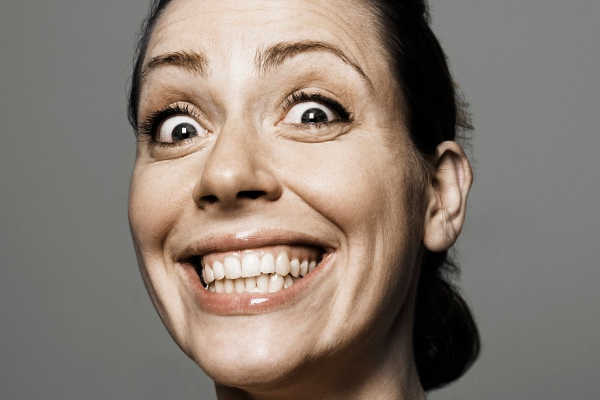
Faking happiness is something we learn. We are taught to smile, be friendly, and say everything is fine. Learning to notice when words and signals mismatch can help us understand forced happiness without pretending we can read another person’s mind.
Most of us have met someone whose smile did not seem quite right. They may have said all the right things and looked cheerful, yet something about the interaction did not fit. We often notice that difference before we can explain why.
A forced smile can have many causes. The useful skill is learning to notice the full message. When faking happiness becomes part of an interaction, the face, voice, posture, timing, and words may no longer point in the same direction.
How Faking happiness disrupts communication
A genuine smile usually fits the moment. Something makes us happy, amused, relieved, or excited, and the expression grows from that feeling. Our face, voice, body, and words often work together to send the same basic message.
Forced happiness works differently. A person may smile because the situation calls for it, not because they feel happy. They may be trying to avoid conflict, reassure someone, make a good impression, or get through an awkward moment without explaining what they feel.
The problem begins when the smile sends one message while other signals send another. Someone may say, “I’m happy to be here,” while speaking in a flat voice. Another person may smile while leaning away. Someone may say, “Everything is fine,” while their jaw and shoulders remain tight. That kind of words and signals mismatch can make an interaction hard to read.
Mixed signals can also hide useful information. Someone who appears cheerful may seem as though they do not need support. Friends or coworkers may assume everything is fine because that is what the smile appears to say.
The point is not to distrust every smile. It is to notice whether the rest of the message supports it.
➡ For More See: Regulation and Suppression: Guidance Or Control?
Not every false smile is dishonest
A forced smile does not automatically mean someone is trying to fool you. People smile when they are nervous, embarrassed, polite, uncomfortable, or trying to keep an interaction peaceful. They may also smile because they do not want to explain how they feel.
This matters because body language can easily become a guessing game. A nervous person may smile during a serious conversation, while someone who dislikes conflict may smile while disagreeing. The outward expression can look similar even when the reasons are very different.
If faking happiness is happening, context still matters. A polite smile and a misleading smile may look similar even though their purpose is very different.
The social smile
Smiling is part of ordinary social life. We smile when meeting someone, having our picture taken, thanking a stranger, or trying to make another person feel welcome. These smiles help everyday interactions go more smoothly.
A social smile can simply mean, “I want this interaction to go well.” It does not have to mean, “I feel happy right now.” Someone may look pleasant while feeling tired, worried, or distracted. Courtesy and private emotion can exist at the same time.
The mistake is treating every smile as a report about someone’s inner state.
The service smile
Customer service gives us one of the clearest examples. Many workers are expected to appear cheerful throughout the day. A cashier may have just dealt with an angry customer or hours of stress, yet the next customer still expects a friendly greeting.
The worker smiles because it is part of the job. This kind of managed expression is often called emotional labor. The smile can be useful and professional even when it does not reflect the worker’s private mood.
This makes faking happiness easy to understand in a real setting. A smile can express joy, courtesy, duty, nervousness, or an effort to avoid conflict. Context helps us tell these situations apart.
Look for mismatch rather than a single tell
Many people want one secret sign that reveals what another person is really thinking. They look for crossed arms, wandering eyes, a strange smile, or nervous movement. Human behavior does not work like a simple code.
Someone may cross their arms because they are cold, look away because they are thinking, or move their hands because that is simply how they speak. One movement is usually too weak to support a strong conclusion.
A better approach is to compare the different parts of the interaction. Words, facial expression, voice, posture, and timing all provide information. A words and signals mismatch becomes more useful when several of those parts seem to point in different directions.
When the words and face don’t match
Words are usually the first thing we notice because they give us a clear message. Someone tells us they are happy, comfortable, excited, or fine.
Sometimes the face adds a different message. Imagine someone saying, “I’m really excited about this,” but the smile appears only after the sentence is finished. Their forehead remains tense, and the expression quickly disappears.
Perhaps the person is tired, distracted, or unsure how to respond. Whatever the cause, the face and words do not fully line up. The useful observation is the difference, not a guess about what caused it.
When the smile and eyes don’t match
A natural smile often changes more of the face than the mouth. The cheeks may rise, and the area around the eyes may change. The expression tends to look like one connected movement.
A forced smile may stay mostly around the mouth while other parts of the face remain still or tense. This can be one part of a larger mismatch, but the eyes should never be treated as a truth test.
People differ in how much emotion they show. The eyes become useful only when considered with the voice, body, timing, and situation.
When the face and body don’t match
The body can add information that the face does not show. A person may smile while their shoulders become stiff or their body shifts away. They may hold their hands tightly, move toward the door, or become restless when a certain subject comes up.
One movement means little by itself. Imagine instead that someone smiles while leaning away, becoming quieter, and repeatedly looking toward the exit. Several changes now point in the same direction.
This is why faking happiness is easier to notice when we look at the full person. The body may not explain the discomfort, but it can show that the cheerful display is only one part of the interaction.
When the voice doesn’t match the words
The voice can change the meaning of a sentence even when the words stay the same. “That’s wonderful” can sound warm and excited, but it can also sound tired, doubtful, nervous, or sarcastic.
Listen for changes in tone, speed, volume, pauses, hesitation, laughter, or energy. A person may suddenly become quiet or pause before an answer that would normally come easily.
A words and signals mismatch can sometimes be easier to hear than to see. Cheerful words delivered with a strained voice suggest that the message may be more complex than the sentence alone.
Timing can reveal a mismatch
When an expression appears can be as useful as the expression itself. Natural reactions usually connect to what is happening. Someone tells a joke, and we smile. A friend arrives, and our face brightens. We receive good news, and our expression changes.
A forced smile may appear at a less expected moment. Someone may smile after criticism or laugh while answering an uncomfortable question. Timing can make faking happiness easier to notice because the expression does not seem to fit the moment.
Watch what happens before the smile
The moments just before a smile can provide useful context. A person might pause, become tense, look away, or show another expression first.
Suppose someone is asked a difficult question. For a moment, their face becomes serious. Then they smile and give a cheerful answer. The pause or first reaction shows that the response had more than one stage.
Watch how the smile begins
Some smiles develop naturally with the conversation. The expression grows as the emotional response develops, and the face changes as a whole.
Other smiles appear very quickly. The mouth may change first while the rest of the face moves very little. That difference matters more when it appears with other changes in voice, posture, or behavior.
Watch what happens while the smile is there
Once the smile appears, notice whether the rest of the interaction supports it. A relaxed voice and open posture may fit the expression. A tense body and strained voice may not.
This is where a words and signals mismatch becomes practical. We are asking whether the different parts of the message seem to belong together.
Watch what happens when the moment ends
Expressions normally change as situations change. A smile may fade as the conversation moves to another topic and the person’s attention shifts.
Sometimes the change is sharper. A person turns away, and the smile disappears. Someone leaves the room, and the face changes. A difficult subject ends, and the shoulders suddenly relax.
These transitions can show how closely the expression was tied to the social moment. They may also show that faking happiness stops when the reason for the display is gone.
Brief expressions may show a hidden mismatch
Sometimes an expression appears for such a short time that it is easy to miss. A flash of surprise, fear, sadness, irritation, or another emotion may appear before the person changes their expression. Very brief facial changes like these are often called micro-expressions.
Imagine asking someone whether they enjoyed an event. Their face changes for an instant before they smile and say, “It was great.” Perhaps they disliked part of the event, remembered something unpleasant, or were simply surprised by the question.
A micro-expression should be treated as part of a larger words and signals mismatch, not as proof of a hidden truth. It becomes more useful when we consider the setting, normal behavior, and whether a similar reaction happens again.
Know the person’s normal behavior
Body language makes more sense when we know what is normal for the person. Human beings do not share one standard way of smiling, speaking, moving, or making eye contact.
Some people smile often, while others rarely do. Some talk with their hands, while others sit very still. One person may look directly at you while speaking, while another looks away whenever they are thinking.
Because these differences are normal, a better comparison is often the person against their own usual behavior. Someone who normally talks freely may suddenly give short answers around one topic. A person who usually sits comfortably may become stiff whenever a certain name is mentioned.
A words and signals mismatch becomes more meaningful when it is also a change from the person’s normal pattern. We are noticing that this person changed when the situation changed.
Patterns matter more than isolated moments
Anyone can force a smile, hesitate, look away, cross their arms, or sound nervous. Daily life is filled with small movements that mean little by themselves.
Patterns become more useful because they repeat. Imagine someone who says everything is fine whenever you ask about work. Each time, the smile appears only after the question. Their voice becomes quieter, their shoulders tighten, and the expression disappears when the subject changes.
Work may be stressful. They may not want to discuss it. They may simply be tired of being asked. We still cannot say exactly what is happening.
What we can see is that the same words and signals mismatch keeps appearing around the same subject. That repeated pattern is more useful than any one smile, glance, pause, or movement.
Careful observation is not about catching someone. It is about recognizing when communication repeatedly becomes unclear while leaving room for uncertainty.
A words and signals mismatch are clues, not proof
We can watch behavior, listen to speech, and notice changes. We cannot directly see another person’s thoughts. Many different emotions can produce similar outward behavior.
A strained smile may come from fear, embarrassment, discomfort, social pressure, or simple politeness. Someone may want privacy or may not yet know how they feel. Deliberate concealment is only one possibility.
This is why simple rules such as “crossed arms mean rejection” or “looking away means someone is lying” are unreliable. Human behavior depends on the person, the setting, and what is happening at the time.
Faking happiness should be treated the same way. A smile that does not fit the rest of the interaction deserves attention, but it does not give us permission to invent the missing explanation.
A better rule is simple: observe what changed, notice whether other signals changed with it, and look for repetition. You may learn the reason later, or you may never know.
Notice faking happiness in yourself
The easiest person to observe may be yourself because you have access to both sides of the mismatch. You know what you are saying, and you can also notice what is happening inside your body.
Think about the times you have said, “I’m fine,” without considering whether you really were. Perhaps you smiled when you wanted to say no. Maybe you laughed because everyone else laughed or acted excited because someone expected you to be excited.
These reactions are common and can make social life easier. The useful part is noticing when they happen automatically. You may feel your jaw tighten while you smile or hear yourself agreeing even as your body becomes tense.
In these moments, the words and signals mismatch is happening inside your own experience. That recognition gives you useful information: your outward response and inner experience are not fully aligned.
Once you notice the difference, other tools can help you work with the feelings behind it.
➡ For More See: The Emotional Check-In Process: Manage Emotional Readiness
Learning to observe thoughts and feelings without immediately identifying with them is another skill with its own process.
➡ For More See: Meta-Awareness And Inner Observation
Social pressure can encourage forced happiness
We learn many rules about emotional behavior before we are old enough to question them. Be polite. Smile for the picture. Don’t make a scene. Act happy for the other person. Keep the customer happy. Don’t ruin the mood.
These rules are not always harmful. Courtesy often requires some control over how we behave. Social life would be difficult if everyone expressed every passing feeling without considering the people around them.
But social rules can also create pressure to show emotions we do not actually feel. A person may smile because honesty seems rude, laugh because everyone else is laughing, or appear cheerful because a job requires it.
Over time, these responses can become automatic. We follow the expected script without noticing whether the expression matches how we feel.
That helps explain why faking happiness is not always a private issue. Sometimes the immediate pressure comes from the social environment. Social expectations can create a words and signals mismatch by rewarding one outward display even when the person’s feelings are different.
➡ For More See: The Cultural Values Test — Are Your Beliefs Really Your Own?
What faking happiness can tell us
Learning to notice forced happiness is an exercise in careful observation. Communication happens through more than words, and each part of an interaction adds information.
The useful question is whether the different parts of the message fit together. A words and signals mismatch matters most when the context and the larger pattern support it. A smile at a checkout counter may serve a different purpose from a smile during a difficult family conversation. Changes from normal behavior and repeated reactions around the same subject can add more information.
Used this way, observation does not become a trick for reading minds. It becomes a way to listen more carefully and avoid assuming everything is fine simply because someone smiles.
The same skill can improve self-awareness. We can recognize when our own words and outward behavior do not match what we are experiencing.
Faking happiness is not just about whether a smile is genuine. It is about whether the full message fits together.
Conclusion: notice first, interpret carefully
A smile can show happiness, warmth, politeness, embarrassment, nervousness, or a desire to make someone else comfortable. Sometimes it reflects exactly what a person feels. Sometimes it does not.
There is no single facial movement, body position, tone of voice, or brief expression that gives us a perfect answer. What matters is how the signals work together, how they fit the situation, and whether the same pattern appears again.
When words and signals mismatch, it deserves closer attention. That does not mean we know what another person is thinking. It means the message may be more complex than the smile suggests.
The goal is not to become suspicious of people. It is to become more observant. That is the best way to approach faking happiness: notice first, stay curious, and interpret carefully.
References
- Emotion Work, Feeling Rules, and Social Structure — Arlie Russell Hochschild, American Journal of Sociology.
- The Managed Heart: Commercialization of Human Feeling — Arlie Russell Hochschild, University of California Press.
- Emotion Regulation in the Workplace: A New Way to Conceptualize Emotional Labor — Alicia A. Grandey, Journal of Occupational Health Psychology.
- Is “Service with a Smile” Enough? Authenticity of Positive Displays During Service Encounters — Alicia A. Grandey, Glenda M. Fisk, Anna S. Mattila, Karen J. Jansen, and Lori A. Sideman, Organizational Behavior and Human Decision Processes.
- The Emerging Field of Emotion Regulation: An Integrative Review — James J. Gross, Review of General Psychology.
- The Social Consequences of Expressive Suppression — Emily A. Butler, Boris Egloff, Frank H. Wilhelm, Nancy C. Smith, Elizabeth A. Erickson, and James J. Gross, Emotion.
- Nonverbal Leakage and Clues to Deception — Paul Ekman and Wallace V. Friesen, Psychiatry.
- Smiles When Lying — Paul Ekman, Wallace V. Friesen, and Maureen O’Sullivan, Journal of Personality and Social Psychology.
- Cues to Deception — Bella M. DePaulo, James J. Lindsay, Brian E. Malone, Laura Muhlenbruck, Kelly Charlton, and Harris Cooper, Psychological Bulletin.
- Reading Lies: Nonverbal Communication and Deception — Aldert Vrij, Maria Hartwig, and Pär Anders Granhag, Annual Review of Psychology.
- Microexpressions Are Not the Best Way to Catch a Liar — Judee K. Burgoon, Frontiers in Psychology.
- Reconsidering the Duchenne Smile: Formalizing and Testing Hypotheses About Eye Constriction and Positive Emotion — Jeffrey M. Girard, Jeffrey F. Cohn, Lijun Yin, and Louis-Philippe Morency, Affective Science.
About this project
The Seeker Project 4 Spiritual Exploration (SP4SE) is a project of Americans In Alliance. The mission of SP4SE is spiritual education. The mission of Americans In Alliance is environmental conservancy. Click the links below to learn more and support our efforts.