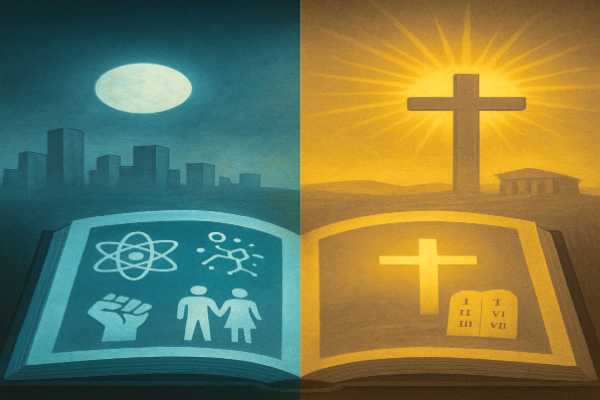
Many people care about living a life with the highest moral values and beliefs. The challenge is that people do not agree on the source of this moral guidance. Secular Humanism and Western Religion are the two major perspectives in modern culture. Choosing the right one is important for everyone.
Some people believe moral truths come from God and are revealed through sacred texts. This is the perspective of Western Religion. This worldview comprises Christianity, Judaism, and Islam. Together, they represent almost one-half of the population of developed countries.
Others believe moral principles should come from reason, evidence, compassion, and human experience. This is the perspective of Secular Humanism.
Many people have strong opinions about both. Unfortunately, these opinions are often based on stereotypes rather than understanding. Some people believe secular humanists reject morality altogether. Others believe religious people cannot think for themselves. Neither view is accurate.
To have a meaningful discussion, we first need to understand what these terms actually mean.
This article explores the ethics, values, morals, and beliefs found in both traditions. We will examine where they agree, where they differ, and how each attempts to answer one of humanity’s oldest questions:
How should we live?
Ethics, values, morals, and beliefs
Before comparing these two worldviews, it helps to understand four important ideas.
Ethics
Ethics are guidelines that help us decide what actions are right and wrong. Ethics helps people make decisions when faced with difficult choices. For example, ethics can help us answer questions such as:
- Should people tell the truth even when it is difficult?
- How should we treat people who disagree with us?
- What responsibilities do we have toward future generations?
Values
Values are the qualities or principles a person finds important. They guide decisions, priorities, and how someone chooses to live. Examples include:
- Honesty — Believing it matters to be truthful.
- Family — Prioritizing time and support for loved ones.
- Education — Valuing learning and personal growth.
- Independence — Wanting to make one’s own choices.
- Creativity — Appreciating imagination and original ideas.
Our values influence the choices we make every day.
Morals
Morals are beliefs about right and wrong behavior. Morals guide how people act toward themselves and others.
Examples include:
- Treating others with kindness — A person believes it is right to be kind and wrong to be cruel.
- Telling the truth — Someone feels lying is wrong, even when it’s difficult to be honest.
- Helping those in need — A person believes it is right to offer help when someone is struggling.
- Respecting others’ property — Someone believes it is wrong to take or damage things that don’t belong to them.
- Keeping promises — A person believes it is right to follow through on commitments they make.
Beliefs
Beliefs are ideas that we accept as true. Some beliefs are based on faith. Others are based on evidence, experience, or observation. Beliefs shape how people understand the world and their place within it.
- Belief in gravity — Accepts gravity because they’ve seen it happen repeatedly.
- Belief in kindness — Someone believes people should treat each other with respect because of their values and experiences.
- Belief in a higher power — A person believes in God or a spiritual force based on faith.
- Belief in hard work — Someone believes effort leads to success because they’ve seen it pay off in their own life.
- Belief that the Earth is round — A person accepts this as true because of scientific evidence and observation.
Comparing two approaches to morality
Although secular humanism and Western religion often reach similar conclusions about how people should behave, they begin from different starting points.
Western religion begins with the belief in God.
Secular humanism begins with human beings.
Here’s a chart to see how these four concepts relate to secular humanism and traditional religious beliefs.
| Topic | Choosing Secular Humanism | Choosing Western Religion |
|---|---|---|
| Ethics | Use reason and kindness to decide what’s right and wrong. | Follow the rules from the Bible to know what God says is right and wrong. |
| Values | Care about honesty, helping others, freedom, and learning. | Value faith, love, forgiveness, and respect for God and others. |
| Morals | Be honest, fair, and kind based on thinking and caring—not religion. | Do what is right based on the Bible, like loving others and obeying God. |
| Beliefs | Believe people can live good lives using science, reason, and compassion. | Believe in God and Jesus, and trust the Bible to guide how to live. |
Neither tradition is a single belief system.
There are many forms of Christianity, Judaism, and Islam. Likewise, there are many secular philosophies that share humanist values.
Still, the chart helps us understand the general differences between these two approaches. It is possible to have elements of each perspective.
What are the morals and beliefs of Western Religion
The morality of Western religion is based on the belief that God is the source of truth and morality. This is the lynchpin on which everything is built. It requires one to accept everything else that comes with this belief system.
Followers believe that God has revealed important teachings through sacred texts. These teachings guide how people should live, treat one another, and understand their purpose in life.
For many believers, morality is not something that humans create. Instead, morality comes from a higher authority. This authority comes from tradition, the sacred texts, and their leaders’ inspired interpretation.
Because of this, the morality of Western religion often emphasizes faith, obedience, and trust in divine wisdom.
While different religious traditions interpret scripture differently, many share several common moral principles.
Common Western religion moral teachings
- Belief in God.
- Tell the truth.
- Respect others.
- Help people in need.
- Honor your family.
- Forgive those who wrong you.
- Show kindness and compassion.
- Be humble rather than arrogant.
- Practice self-control.
- Act with integrity.
- Seek justice and mercy.
Many of these teachings have influenced laws, customs, and cultures throughout history.
Supporters believe these principles provide stability, purpose, and a clear moral foundation.
Common beliefs of Western religion
Many believers also share several core religious beliefs.
1. God is All-Powerful and All-Knowing. God knows everything and has power over all things.
2. God gave us rules to follow. These rules help us live good lives (like the Ten Commandments or teachings in the Quran and Torah).
3. God sends prophets. God chose prophets like Abraham, Moses, and others to teach people about Himself.
4. Life has a purpose. We are here to worship God and do good.
5. There will be a Day of Judgment. One day, God will judge everyone based on their actions.
6. Prayer and worship are important. Talking to God and showing respect through prayer are part of daily life.
7. Books from God teach us. The Torah (Judaism), the Bible (Christianity), and the Quran (Islam) are holy books that guide people.
8. Forgiveness and mercy matter. God is forgiving, and we should forgive others, too.
These beliefs help shape how religious communities understand morality, meaning, and human responsibility.
The rise of secular humanism
Secular humanism did not appear overnight. Its roots can be traced to the Enlightenment, a period in history when many thinkers began emphasizing reason, scientific inquiry, and individual rights.
As scientific knowledge expanded, some people began asking whether morality required religious authority. Others argued that ethical principles could be developed through observation, experience, and careful reasoning.
Over time, these ideas contributed to the development of modern secular humanism. Today, humanist principles influence discussions about education, government, human rights, science, and public policy throughout much of the world.
What are secular humanism ethics and values?
Secular humanism is a philosophy that focuses on human well-being, reason, compassion, and responsibility. Rather than asking, “What does God command?” secular humanists often ask, “What helps people live healthier, safer, and more meaningful lives?”
Humanists believe people can work together to solve problems using evidence, critical thinking, and cooperation. This does not mean humanists reject morality. In fact, secular humanism places great importance on ethical behavior.
The difference is that humanists believe moral principles should be evaluated by their effects on people, communities, and the world around us.
If a belief or practice causes unnecessary harm, humanists believe it should be questioned. If it improves human well-being and promotes fairness, it should be encouraged.
Because knowledge grows over time, the ethics of secular humanism can change as new information becomes available.
For example, modern societies face questions that ancient cultures never imagined.
These include:
- Artificial intelligence
- Genetic engineering
- Climate change
- Digital privacy
- Global communication
- Advanced medical technologies
- Nuclear power and weapons
Humanists believe ethical systems should continue evolving as our understanding of these issues improves.
Common secular humanism values
Although humanists come from many different backgrounds, several values are widely shared.
1. Respect for human rights and equality. All people are valuable and must have the same fundamental human rights. People need clean water, food, shelter, and medical care. These rights should be available to everyone regardless of their socioeconomic status.
2. Promotes the long-term care of the environment. All living creatures are valuable, with the right to coexist. It sees our role in the world as caretakers of the future. Everyone has a responsibility in the world as caretakers of the future.
3. Valuing compassion, empathy, and cooperation. The health of people, living things, and the environment takes precedence over profit.
4. Commitment to evidence-based reasoning. It champions the scientific approach, which is the most reliable way to solve complex problems and improve the world.
5. Advocating for a democracy built on laws that reflect equality and inclusion and promote equal access to the election process. It does not support using religion as a basis for public policy.
6. A belief that meaning and morality are human-made, not divinely dictated. It encourages a humanist approach. This means treating everyone fairly and ethically. It does not favor any group or class.
7. It promotes the protection of the environment. And it promotes science and rational thinking to help us solve global issues.
8. It even fights for your right to hold irrational beliefs as long as they don’t harm others. This approach is well-suited for addressing ethical issues in the modern world.
These values encourage people to think carefully about how their actions affect others.
Humanists generally believe that improving the lives of all people is one of our most important responsibilities.
Common secular humanism beliefs
While secular humanism is not a religion, many humanists share several common beliefs.
- People can use reason to understand the world.
- Science is one of the most reliable tools for discovering facts.
- Human beings are capable of growth and improvement.
- All people deserve dignity and respect.
- Ethical decisions should consider consequences and evidence.
- People should be free to hold different beliefs.
- Cooperation is often better than conflict.
- Societies should work toward fairness and opportunity for everyone.
Humanists do not all agree on every issue. However, these principles form a common foundation for many secular humanist perspectives.
Where Western religion and secular humanism agree
Many people assume these two worldviews have nothing in common.
In reality, there is often significant overlap.
Although they arrive at their conclusions differently, both traditions frequently support many of the same ethical behaviors.
For example, both encourage people to:
- Tell the truth.
- Help those in need.
- Treat others with kindness.
- Act with compassion.
- Practice forgiveness.
- Show generosity.
- Take responsibility for their actions.
- Build strong communities.
- Reduce unnecessary suffering.
- Promote justice and fairness.
Because of these shared values, people from both traditions can work together to address social problems.
They can come together to support disaster relief efforts, community service projects, educational programs, poverty reduction efforts, or healthcare initiatives.
These areas of agreement remind us that people with different beliefs can still cooperate toward common shared goals.
Why do these worldviews often reach similar conclusions?
One of the most interesting aspects of this comparison is that Western religion and secular humanism often support many of the same moral behaviors, even though they begin from very different assumptions.
A religious believer may help someone because they believe God commands compassion and mercy. A secular humanist may help someone because reducing suffering improves human well-being. The actions can look almost identical even though the reasoning behind them is different.
This raises an important question. If two people arrive at the same moral conclusion through different paths, does the source of the belief matter more than the outcome?
Some philosophers argue that morality requires a higher authority to provide an objective foundation. Others argue that empathy, reason, and cooperation naturally lead people toward many of the same ethical principles.
This debate has existed for centuries and remains one of the central questions in moral philosophy. While neither side has completely resolved the issue, both traditions continue to influence how people think about justice, responsibility, and the common good.
Where Western religion and secular humanism disagree
The largest differences usually involve the source of moral authority.
Western religion teaches that moral truth and the authority to defend it come from belief in God.
Secular humanism teaches that moral understanding develops through human experience, reason, evidence, and empathy.
Because of this difference, the two traditions sometimes reach different conclusions about important issues.
Authority
Religious traditions often look to sacred texts and religious teachings for guidance.
Humanists generally look to evidence, ethical reasoning, and the likely consequences of actions.
Both approaches seek wisdom, but they use different methods.
One reason this difference matters is that it affects how people settle disagreements. When two religious believers disagree, they may appeal to scripture, tradition, or religious authorities for guidance. When two secular humanists disagree, they often turn to evidence, ethical arguments, or the likely consequences of different actions.
Neither approach completely eliminates disagreement. Religious communities often interpret the same texts differently, while humanists may disagree about which outcomes create the greatest benefit. In both cases, people must decide how they evaluate competing claims and determine which sources they trust.
Change and adaptation
Humanist ethics are designed to adapt when new information becomes available.
Religious traditions may also evolve, but changes often occur through reinterpretation of existing teachings.
As a result, change sometimes happens more slowly within religious systems.
Public policy
Many humanists support keeping the government neutral regarding religion.
They believe laws should be based on evidence, equal rights, and public benefit rather than the teachings of any one faith.
Many religious believers agree with this principle, while others believe religious teachings should play a larger role in public life.
Science and belief
Humanists generally view scientific discovery as an important source of knowledge.
Most modern religious believers also accept science.
However, disagreements sometimes occur when scientific findings appear to conflict with traditional interpretations of scripture.
These discussions continue within many religious communities today.
Modern ethical challenges
The modern world presents ethical questions that affect everyone, regardless of their beliefs.
These issues are often complex and do not have simple answers.
Examples include:
- How should artificial intelligence be used?
- What responsibilities do we have toward the environment?
- How should healthcare resources be distributed?
- What rights should future generations have?
- How should society balance freedom and security?
- What responsibilities do wealthy nations have toward poorer nations?
People from both Western religion and secular humanism traditions bring different perspectives to these discussions.
Sometimes they disagree.
Sometimes they find common ground.
In either case, thoughtful dialogue helps people understand the strengths and limitations of their own assumptions.
Questions for reflection
Consider the following questions as you think about your own beliefs and values.
- Where do your moral beliefs come from?
- How do you decide what is right and wrong?
- What values matter most to you?
- How do you respond when new evidence challenges an existing belief?
- Do you think morality requires religion?
- Can people with different worldviews work together for the common good?
- How should societies balance tradition and progress?
- What kind of world do you hope future generations will inherit?
There are no easy answers to these questions.
What matters is the willingness to examine them honestly and thoughtfully.
Conclusion: Two paths to meaning
At their core, the morality of Western religion and secular humanism attempts to answer many of the same questions.
- How should we live?
- How should we treat others?
- What responsibilities do we have to our communities?
- What gives life meaning and purpose?
In Western religion, the moral and ethical authority comes from God, sacred texts, and religious traditions for guidance.
Secular humanism looks to reason, evidence, compassion, and human experience.
Each approach offers a different way of understanding morality and human responsibility.
Despite their differences, both traditions encourage people to think about how their actions affect others and how they can contribute to a better world.
Understanding these perspectives does not require agreement.
It requires curiosity, respect, and a willingness to learn.
When people take the time to understand one another, they create opportunities for dialogue instead of division.
In a world facing increasingly complex challenges, that willingness to learn from one another may be one of the most valuable ethical principles of all.
References
- Nicomachean Ethics, Aristotle.
- The Republic, Plato.
- Groundwork of the Metaphysics of Morals, Immanuel Kant.
- Utilitarianism, John Stuart Mill.
- A Theory of Justice, John Rawls.
- The Righteous Mind: Why Good People Are Divided by Politics and Religion, Jonathan Haidt.
- The Varieties of Religious Experience, William James.
- The Humanist Manifesto I, II, and III, American Humanist Association.
- The Catholic Encyclopedia (1907–1912 Edition), Robert Appleton Company.
- Moral Philosophy, Stanford Encyclopedia of Philosophy.