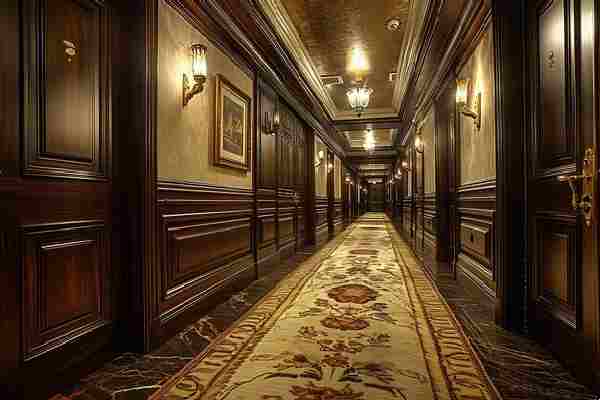
Most people spend their lives in default mode. It’s just like living in the hallway of a mansion. This hallway or entryway to the mansion is familiar and safe. But it is only the beginning of consciousness. Inside is a whole mansion. Learning how to open these doors is the key to greater possibilities.
An analogy like this one about a beautiful mansion helps us grasp the fundamental structures of consciousness. And it also helps us understand how the mind operates, just like any complex machine. This analogy helps you to remember the connection between them, so that you can recognize them, follow the shifts, and map out how your mind works.
What’s in the rooms of a mansion
Living in the hallway represents the default modes of consciousness: waking, sleeping, and dreaming. Beyond this is a whole mansion of other rooms that are filled with many wonders. Are you stuck here? Or do you want to see what’s inside the mansion of your mind?
The mansion of the human mind has seven major types of rooms or mechanisms that operate these special compartments. Some rooms or capacities of the mind are simple, with one function. Others are complex with several interlocking functions.
Some rooms have doors we must unlock with the right key. Other doors we can push open without any effort. In fact, we can move through a door without realizing it sometimes. We do this when we move from sleeping to dreaming in our default modes of awareness. We only realize it because we observe the mind shifting into a different mode of operation.
Over time, the structure of the rooms becomes clearer. The mind recognizes that these rooms are organized into seven distinct types, each one supporting a different kind of mental work.
These seven types of rooms are the architectural layout of the mind’s deeper abilities. They explain why the hallway is only the starting point. It was necessary as a tool to acclimate us to our bodies. It is the entryway of awareness that handles routine and daily tasks, but the rooms allow the mind to operate with greater range, depth, and clarity. Each type of room opens a different side of the mind’s potential, and together they form the full structure of the mansion.
At the end of each section that follows, the mansion metaphor returns to show how that capacity appears as a set of rooms inside the larger house.
Why people stay in the hallway
Even though the mansion holds many types of rooms, many people stay there. This happens because it becomes familiar. It is the part of the mind that handles daily tasks, repeated patterns, and the routines that keep life moving.
These routines create a sense of stability. They make this partition feel predictable, even when it is limited. The entryway becomes the default path because it asks the least from a person. It does not require new thinking, new choices, or new forms of awareness. It simply continues what is already known.
- Routine becomes easier than stepping into something unfamiliar.
- Old stories shape the entryway into the safest and most familiar place.
- Uncertainty makes the unopened doors seem unnecessary or risky.
These forces are not enemies. They are patterns that form over time. They keep attention moving in the same narrow track and make living in the hallway in a mansion feel like the whole house, even when it is not.
The keys that open the doors
The doors are not ALL locked. Some require keys like mantras, sutras, and inner work. But the many open when the mind becomes aware and interrupts old patterns.
You can open a door right now. It’s a shift that does not require dramatic effort. You can begin by noticing you are thinking or reading. It happens when you see something that you missed before. You might question an assumption or pause to notice a choice that has always been there.
Conscious movements open doors.
Conscious actions enable the mind to step out of the entryway and into a different kind of room. Over time, these small shifts build the strength needed to explore the mansion more fully.
- Questioning old assumptions creates the first openings.
- Focused attention reveals doors that were always present.
- Reflection breaks the automatic patterns that keep the entry or hallway in control.
These keys work slowly and steadily. They do not force the doors. They invite them to open in their own time. Each small use of a key makes the next use easier.
From living in the hallway to the rooms of a mansion
As you explore these seven rooms, it helps to understand how they connect to the broader spectrum of consciousness. Each room reflects a capacity that supports movement into the higher states described in the ten levels of consciousness.
1. Perception
Perception is the mind’s ability to recognize what is present.
Try it now, before you read on and see how easy some doors can open.
Being present is identifying details, comparing information, noticing patterns. It’s about separating facts from assumptions. Perception allows the mind to examine what is in front of it with accuracy. It supports the ability to revise conclusions when new information appears. It helps the mind detect errors, correct misunderstandings, and update beliefs.
Perception includes many skills working together. It involves recognizing structure and identifying relationships. This mindset is about noticing when something does not match the expected pattern. It includes tracking changes over time. This helps us understand how different pieces of information connect. Perception supports learning, problem-solving, and decision-making. Clear perception provides a clear picture of what is actually happening.
Perception relates to the room where the mind studies and contemplates what is real. These rooms expand our understanding of experience. We are no longer living in the hallway of a mansion, but looking in the rooms. Eventually, you can move into and inhabit them at will.
2. Attention
Attention is the mind’s ability to stay with something long enough to work through it. It includes focus, stability, and the ability to hold a task or idea without drifting. Attention supports the ability to follow a line of thought, complete a project, or stay engaged with a problem until it is solved.
Attention involves several processes. It includes selecting what to focus on, ignoring distractions, and maintaining mental effort over time. It supports planning, learning, and careful work. It helps the mind stay organized and prevents tasks from being abandoned before they are finished.
Attention also supports the ability to shift focus when needed. It allows the mind to move from one task to another without losing track of what matters. It helps manage time, track priorities, and stay aligned with goals.
A mansion needs a solid foundation; in these rooms, the mind finds stability. They expand awareness, giving the mind the ability to stay engaged instead of being pulled in every direction.
3. Inner analysis
Inner analysis is the mind’s ability to study itself. Analysis of our inner world focuses on examining patterns. It includes tracing motives, reviewing reactions, and understanding how experiences shape present choices. Inner analysis helps the mind identify habits that no longer serve it and replace them with better ones.
The study of patterns also looks at repeated behaviors. By identifying the reasons behind them and understanding how they developed we learn to change them. It includes the ability to question assumptions, test beliefs, and revise outdated ideas. It supports growth because it allows the mind to understand itself with accuracy.
Inner analysis also includes the ability to track progress over time. It helps the mind see how changes in thinking lead to changes in behavior. It supports long‑term development by helping the mind understand its own structure.
A mansion is built around a pattern. Inner analysis gives us the ability to examine and change patterns of thinking.
4. Relational understanding
Relational understanding is the ability to work with other people. It includes recognizing perspectives, understanding social patterns, and seeing how actions affect others. Relational understanding supports cooperation, communication, and shared problem‑solving.
Relational understanding involves identifying the needs, goals, and viewpoints of others. It considers group dynamics, recognizing unspoken rules, and predicting how situations may unfold. It supports teamwork, conflict resolution, and leadership.
Relational understanding also includes the ability to adjust behavior based on context. It helps the mind choose the right approach for different situations. It supports the ability to build trust, maintain relationships, and participate in community life.
Relational understanding is found in the rooms where the mind maps and seeks to understand social connections. In a mansion, it is the ballroom or party rooms where we invite others into our lives.
5. Interpretation
Interpretation is the mind’s ability to make sense of events. It includes connecting ideas, identifying themes, forming explanations, and understanding meaning. Interpretation helps the mind understand how different parts of life fit together.
Interpretation involves identifying causes and effects and understanding the significance of events. It includes the ability to form theories, test them, and revise them when needed. It supports planning, learning, and long‑term thinking.
Interpretation also includes the ability to understand purpose and direction. It helps the mind see how experiences relate to goals and values. It supports the ability to learn from the past and prepare for the future.
Maintaining a mansion requires organization. The metaphor of interpretation corresponds to the rooms where the mind organizes experience. These rooms expand the hallway by helping the mind understand life as a connected whole.
6. Agency
Agency is the mind’s ability to choose and act. It includes evaluating options, setting direction, making decisions, and carrying out plans. Agency helps us respond to challenges thoughtfully instead of just reacting.
Agency involves identifying goals, selecting strategies, and following through on commitments. It includes the ability to adjust plans when conditions change. It supports problem‑solving, leadership, and personal responsibility.
This capacity supports the ability to maintain direction under pressure. It helps the mind stay aligned with long‑term goals even when obstacles appear. It supports the ability to act with purpose and consistency.
A mansion requires coordinated action. Agency is the capacity that organizes the resources of willpower and intention.
7. Integration
Integration is the mind’s ability to bring everything together, supporting balance, coherence, and unity.
Integration involves recognizing how different mental processes interact. It includes the ability to combine information from many sources and form a complete picture. It supports long‑term growth because it helps the mind operate as a single, organized whole.
Integration also includes the ability to maintain stability while adapting to change. It helps the mind stay centered even when life becomes complex. It supports the ability to live with clarity and direction.
In the mansion metaphor, integration corresponds to ease and familiarity that allows the whole to function as one unit. Integration is like the library or kitchen of a mansion. It is in the rooms of integration that the mind gets sustenance.
Which door do we open first?
People often wonder which door they should open first. It is not a test or a reward. It usually happens in simple ways.
- Sometimes the first door is the closest one. A person pauses for a moment, and the nearest door becomes visible because the rush of the hallway slows down.
- Others find the first door opens through a quiet inner pull. There is a subtle sense that one area of life needs attention, and the matching door becomes clear.
- Often, the first door opens in response to an event. Something breaks the usual pattern, and the person finds themselves inside a new type of room without planning it.
There is no single correct door to begin with. The mansion does not judge the starting point. What matters is that movement begins. Once one type of room is entered, it becomes easier to notice doors to the others. The structure is built to support ongoing exploration.
Crossing the first threshold
There is a moment when a person stands at a door and does not turn away. The hallway is still there, but so is the opening. The choice is simple but not always easy: stay with what is known, or step into what is possible. When the step is taken, the mind enters a new kind of room. The structure of experience changes. New options appear. The mansion stops being an idea and becomes something lived.
This first crossing does not solve everything. It does something more important: it proves that movement is possible. It shows that the hallway is not the limit of the mind.
Exploring the mansion
As more types of rooms are entered, life begins to organize itself differently. Perception changes how choices are made. Attention changes how time is used. Inner analysis changes how the past shapes the present. Relational understanding changes how others are treated. Interpretation changes how events are understood. Agency changes how challenges are faced. Integration changes how all of this fits together.
The mansion is not explored in a straight line. People move back and forth between hallway and rooms, sometimes for years. That movement is part of the design. Each visit to a room leaves a trace. Over time, those traces build new paths inside the mind.
Conclusion
The hallway is not a mistake. It is where everyone begins. It is needed for daily life. But it is not the whole structure. The mansion is already built into the mind. Its doors are already present. When a person begins to explore, they discover that their inner world is wider, deeper, and more ordered than the entryway suggests.
The journey begins when the entrance to the mansion is no longer treated as the final home, but as the starting place for a much larger house.
References
- The Varieties of Religious Experience, William James.
- Maps of Meaning: The Architecture of Belief, Jordan B. Peterson.
- Flow: The Psychology of Optimal Experience, Mihaly Csikszentmihalyi.
- Thinking, Fast and Slow, Daniel Kahneman.
- The Power of Now: A Guide to Spiritual Enlightenment, Eckhart Tolle.
- Man and His Symbols, Carl G. Jung.
- The Archetypes and the Collective Unconscious, Carl G. Jung.
- The Rediscovery of the Mind, John R. Searle.
- Being and Time, Martin Heidegger.
- Attention and Cognitive Control, National Institute of Mental Health.
- Metacognition and Self-Awareness, National Library of Medicine.
- Neuroplasticity and Human Adaptation, National Institutes of Health.
- Consciousness, Stanford Encyclopedia of Philosophy.
- Self-Awareness, Wikipedia.
About this project
The Seeker Project 4 Spiritual Exploration (SP4SE) is a project of Americans In Alliance. The mission of SP4SE is spiritual education. The mission of Americans In Alliance is environmental conservancy. Click the links below to learn more and support our efforts.