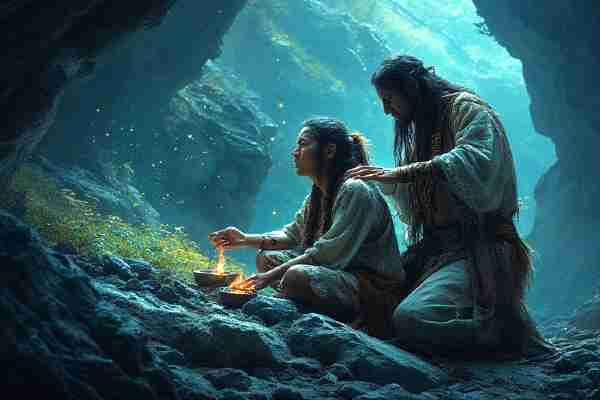
The inward journey is a primary element of shamanic practice. It opens the doorway to an inner world of symbolism and typologies of the psyche. Here, you can find healing, guidance, and spiritual insight. We have a step-by-step shamanic Journey guide to help you learn this process.
Before we explore the deeper meaning of journeying and entering the spirit realm, it helps to see how this practice fits into the larger framework of shamanism. Journeying has deep cultural roots and modern twists. It’s not just a ritual; it’s a living tradition that influences how shamans operate.
Journeying Is the Soul of Shamanic Practice
Shamanic journeying is an inward quest in which you talk with spirits, restore balance, and maintain harmony in your community. This practice has linked diverse worlds for thousands of years, from the Siberian tundras to the Amazon rainforests. Sandra Ingerman, who wrote *Shamanic Journeying: A Beginner’s Guide*, describes it as:
Shamanic journeying is the inner art of traveling to the ‘invisible worlds’ beyond ordinary reality to retrieve information for change in any area of your life—from spirituality and health to work and relationships. — Sandra Ingerman
This “inner art” is not limited to traditional shamans. Modern seekers journey to reconnect with nature, heal emotional wounds, and find purpose in a fragmented world.
What Is Shamanic Journeying?
At its core, shamanic journeying is a disciplined method for entering an altered state of consciousness to explore what anthropologist Michael Harner called the Shamanic State of Consciousness (SSC).
The shamanic journey is not daydreaming or fantasy—it’s a structured spiritual experience rooted in indigenous traditions worldwide. Anthropologists trace its origins to Paleolithic cultures, where shamans acted as mediators between the physical and spiritual realms, guiding their communities through healing, divination, and rites of passage.
Why It’s Different from Imagination
Sandra Ingerman emphasizes that journeying is experiential and interactive. You’re not “making things up”; you’re entering the spirit realm with symbolic landscapes and spirit allies that feel autonomous and meaningful. These experiences often bring insights that align with real-life challenges, which is why shamans across cultures have relied on them for thousands of years.
Authenticity and the Nature of Reality
Many people assume non-ordinary reality is “just imagination.” But imagination is not trivial — it is the operating system of the subconscious. Dreams, visions, intuitive flashes, symbolic memories, and inner voices all use the same neurological pathways.
If we dismiss imagination, we dismiss half of consciousness.
Every culture draws boundaries around reality. Some societies allow non-ordinary experiences; others punish them. Western religion demonized shamanism because it threatened the monopoly on spiritual authority. Its myths replaced indigenous knowledge, but they borrowed heavily from it. What was once a living spiritual technology became dogma — and the practitioners who used the original techniques were persecuted.
The irony is that modern neuroscience now validates what shamans already knew:
Entering the spirit realm of Non-ordinary reality is a genuine, measurable dimension of human consciousness.
Understanding SSC (Shamanic State of Consciousness)
The Shamanic State of Consciousness (SSC) is a distinct partition of awareness. Neuroscience confirms that rhythmic drumming at 4–7 beats per second shifts the brain into theta waves, the same state linked to deep meditation and creativity.
Why SSC Matters:
-
- Provides measurable benefits—EEG studies show increased gamma activity during the trance state of shamanic practice.
- Opens access to non-ordinary reality.
- Enhances intuition and emotional processing.
As Michael Harner wrote:
“Shamanism is a great mental and emotional adventure, one in which the patient as well as the shaman-healer are involved.”
Three Worlds of Shamanic Cosmology — Entering the Spirit Realm
Most shamanic practice traditions describe reality as layered into three interconnected realms. These aren’t physical places but symbolic maps for navigating spiritual dimensions:
-
- The Lower World: A realm of nature spirits and animal allies. Often accessed for grounding, healing, and retrieving lost vitality. Journeys here may involve caves, tunnels, or tree roots as portals.
-
- The Middle World: The spiritual counterpart of our physical reality. Useful for insight into current life situations, environmental healing, and connecting with the spirits of places.
-
- The Upper World: A space of higher wisdom, guides, and teachers. Associated with vision, inspiration, and spiritual growth. Journeys often begin by ascending through clouds, mountains, or celestial pathways.
Sandra Ingerman notes that these worlds are symbolic yet profoundly real in the context of spiritual experience. They serve as maps for navigating unseen dimensions and organizing the journey process.
Cultural Examples
-
- Siberian Shamans use drumming and chanting in shamanic practice to descend into the Lower World for healing.
-
- Amazonian Curanderos combine plant medicine with visionary journeys to communicate with forest spirits.
-
- Australian Aboriginal Elders enter Dreamtime—a timeless spiritual dimension—to access ancestral wisdom.
Despite cultural differences, the goal remains the same: connection, healing, and balance.
The Shaman is The Mystical Athlete of the Spirit World
Indigenous cultures describe the shaman as someone who moves between realities. They were the first “psychologists” and “scientists of the inner world,” long before those words existed. Their skill set included:
-
- Interpreting symbols and typologies.
- Guiding others safely into altered states.
- Healing emotional and physical trauma.
- Retrieving lost wisdom and insight.
- Helping communities maintain balance and harmony.
These abilities required training and an understanding of the individual’s typologies and symbolism. In ancient times, the culture shared many common elements. The modern world is very different. Individuals in the same society can have vastly different meanings for symbols and typologies of the mind.
For example, in an ancient tribal culture, nearly everyone shared the same symbolic framework: a snake might universally represent healing, rebirth, or the underworld. A shaman could rely on that shared meaning when interpreting visions or guiding someone through a journey.
In the modern world, two people living in the same city might experience the same symbol in entirely different ways. One person may see a snake as a sacred guide connected to transformation, while another—shaped by movies, religion, or childhood fears—may see it as a threat or a warning. What was once a shared cultural language of symbols is now highly individualized. Because of this, modern practitioners must understand each person’s unique psychological typology and symbolic associations, rather than assuming universal meaning.
Modern psychology later rediscovered much of this. Jung borrowed from shamanic techniques for a tool he called active imagination. Freud’s work on dreams reflected insights from shamanic practice. Both men studied myth, symbolism, and trance because these states revealed universal structures of the mind.
These differences mean that it is important for a spiritual explorer to conduct their own journey and interpret their own results. A modern-day shaman can assist and lead you on this journey, but you must be responsible for undertaking this inner quest.
Modern Perspective
Today, journeying is practiced without hallucinogens or extreme rituals. Rhythmic drumming, rattling, and guided audio tracks help safely induce the Shamanic State of Consciousness (SSC). Neuroscience confirms that repetitive rhythms can shift brainwaves into theta states, associated with deep meditation and vivid imagery—validating what shamans have known for millennia.
Indigenous spiritual practitioners did not require priests, holy books, or intermediaries. They entered the spirit world directly. The experience belonged to the individual, not a hierarchy. The step-by-step shamanic journey guide process is almost universal across all cultures.
This independence made organized religion nervous. Systems built on belief and obedience cannot compete with methods based on experience and evidence. So religious authorities used fear, shame, and punishment to suppress shamanism.
But the ancient methods survived — not because of institutions, but because they work.
Benefits for Spiritual Growth
Journeying offers profound benefits that ripple through every aspect of life:
-
- Direct Communication with Spirit Guides (Direct Revelation). Unlike dogma-based systems, shamanism emphasizes personal experience. You receive guidance directly from spirit allies rather than through intermediaries.
-
- Emotional Healing and Empowerment. Journeying can help release trauma, grief, and fear. By engaging with symbolic landscapes and compassionate spirits, practitioners often experience emotional renewal.
-
- Connection with Nature and Ancestral Wisdom. The practice reinforces the principle of interconnectedness—reminding us that we are part of a living web that includes ancestors, animals, and the Earth itself.
-
- Expanded Awareness Beyond the Physical World. Entering SSC shifts perception, opening access to archetypal symbols and spiritual truths that transcend ordinary consciousness.
The Step-By-Step Shamanic Journey Guide
Every successful journey rests on three foundational pillars—intention, rhythmic sound, and visualization—and follows a clear sequence of preparation, entering trance, journeying, returning, and integration. Together, these elements create the conditions for entering the Shamanic State of Consciousness (SSC) and navigating non-ordinary reality with clarity and safety.
Stage 1. Preparation
1. Create A Sacred Space
Before you begin, prepare your environment. This signals to your mind and spirit that you are entering a different mode of awareness.
-
- Cleanse the Area: Use sage, palo santo, or incense to clear stagnant energy.
-
- Dim Lights & Remove Distractions: Silence phones, close doors, and create a calm atmosphere.
-
- Add Sacred Objects: Crystals, feathers, or natural items can help anchor your intention.
Why It Matters: Sacred space acts as a container for your experience, reducing external interference and enhancing focus.
2. Select the Proper Shamanic Rhythms and Instruments
Sound is the engine of the step-by-step shamanic journey guide process. Select a rhythmic pulse—often 4 to 7 beats per second—that guides the mind into theta waves, associated with deep meditation, creativity, and vivid imagery.
How Drumming Works: Neuroscience confirms that repetitive rhythms synchronize brainwaves, shifting the mind into theta states—ideal for visionary experiences. Studies show increased gamma power and enhanced imagery during shamanic practice.
Stage 2 — Begin the Journey
3. Set Your Intention
Your intention is the compass of the journey. Whether you seek healing, guidance, or connection, clarity shapes the outcome. Sandra Ingerman emphasizes that intention should be specific and heartfelt, not vague.
Why it matters: Intention acts as a signal when entering the spirit realm and primes the brain for pattern recognition and meaning-making during altered states.
Practical tips:
-
- Write It Down: This anchors your focus and signals clarity.
-
- Keep It Specific: Instead of “I want clarity,” try “I seek guidance on balancing work and family.”
4. Begin Playing the Shamanic Rhythm
This rhythm entrains the mind toward theta and supports vivid imagery.
Practical Tip: Start with at least 5-7 minutes of steady drumming. If you’re new, use recorded tracks designed for journeying.
5. Visualization Portals — Entering the Spirit realm
Visualization is the doorway to the journey. Once you visualize the entrance, you are on the way. Choose a portal—such as a cave, tree roots, or river—serves as the symbolic threshold between ordinary and non-ordinary reality. Choose a portal that resonates with you and feels safe.
-
- Examples: hollow tree (Lower World), shimmering river (Middle World), ladder of light (Upper World).
Stage 3 — Journeying
6. Journey
Allow images, sensations, and messages to arise without judgment. Relax and let the rhythm carry you into the Shamanic State of Consciousness. Sandra Ingerman’s instruction:
Stay Open: Don’t force the experience. Trust what comes. Don’t analyze while inside the journey.
7. Engage Respectfully
As you meet spirits, greet them and ask for guidance related to your intention. You are engaging with entities that could be a symbolic representation of some issue or aspect of your psyche. But others argue that the unpredictability and autonomy they enjoy are indications that they are indeed separate spiritual beings.
Stage 4 — Return & Reintegration
8. Return
Follow the drum’s callback rhythm (a distinct pattern signaling it’s time to return). Retrace your steps through the portal and re-enter ordinary reality. Sandra Ingerman’s advice: “Always come back fully. Wiggle your fingers and toes, and thank the spirits for their help.”
9. Integrate
Integration is where the magic becomes practical.
-
- Journal Your Experience: Record symbols, messages, and feelings.
- Reflect on Meaning: How do these insights apply to your life?
- Take Action: Spiritual guidance often calls for real-world steps.
Why Integration Matters: Without integrating what you have learned, the journey remains an isolated event. Integration transforms insight into lasting change.
Summary of Process for the Shamanic Journey
These three stages contain ten elements that enable you to safely and effectively traverse the subconscious mind. Through the unique symbolism and typologies of your psyche, you can forge a spiritual path. This process can be used to overcome any obstacles to growth and development. Use this step-by-step shamanic journey guide to solidify the process. You can even print it for future reference.
Common Experiences During a Journey
Journeying often brings vivid, symbolic encounters. These experiences are deeply personal yet share universal patterns across cultures.
-
- Spirit Allies: Animal guides, ancestors, or non-physical beings offering wisdom. These allies often appear spontaneously and provide guidance aligned with your intention.
-
- Symbolic Landscapes: Rivers, mountains, forests, and caves frequently emerge as metaphors for transformation. Psychological research suggests that symbolic imagery activates emotional and cognitive processing, making these experiences powerful tools for healing. [psycnet.apa.org]
Safety and Ethics in Shamanic Practice
Shamanic journeying is transformative, but it requires responsibility and respect. Sandra Ingerman reminds practitioners:
We journey not to manipulate but to restore balance. — Sandra Interman
Modern Adaptations
Today, journeying blends ancient wisdom with contemporary tools:
-
- Guided Audio Tracks: Accessible for beginners seeking structure.
- Online Workshops & Community Circles: Offer safe spaces for learning and sharing.
Emerging Technologies: Virtual reality and binaural beats are being explored as aids for inducing trance states, making the practice more approachable for modern seekers.
These adaptations preserve the essence of shamanism while meeting the needs of a fast-paced, digital world.
Explore More
References
- Neural Correlates of the Shamanic State of Consciousness, Huels, E.R.; Frontiers in Human Neuroscience, 2021.
- Exploring Shamanic Journeying: Repetitive Drumming with and without Suggestion, Gingras, B.; International Journal of Transpersonal Studies, 2014.
- Scoping Review on Shamanistic Trance Practices, Marie, N.; PLOS / Open Access Review, 2024.
- Shamanism as the Original Neurotheology, Winkelman, M.; Zygon / American Journal of Theology & Science (article & PDF), 2004.
- The Impact of Music on the Bioelectrical Oscillations of the Brain, Kučikienė, D.; Frontiers / Review, 2018.
- Brain Oscillations, Hypnosis, and Hypnotizability, Jensen, M.P.; Adachi, T.; Neuroscience & Biobehavioral Reviews, 2015.
- Altered States During Shamanic Drumming, Kjellgren, A.; International Journal of Transpersonal Studies, 2010.
- The Creative Drummer: An EEG-Based Pilot Study on Emotional and Neural Correlates of Drumming, Ramírez-Meléndez, R.; Frontiers in Human Neuroscience, 2023.