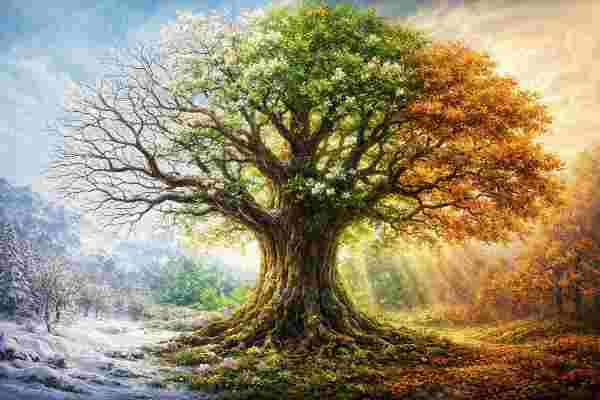
The spiritual symbolism of trees is a major focus for many cultures. Trees as sacred archetypes of nature become living icons that are metaphors for the deeper patterns of existence.
Trees have carried meaning for as long as humans have been telling stories. Their roots, branches, and cycles provide a natural way to describe growth and resilience. They also show the link between what we see and what we don’t. Every culture turns to trees when trying to express what cannot be spoken directly.
This article explores how trees became some of our oldest spiritual teachers. We’ll explore their role in myth, ritual, and psychology. We’ll also see how they shape our views on life, death, and change.
The spiritual symbolism of trees
Tree symbolism appears across cultures as a way to understand life. We automatically interpret trees as sacred archetypes of nature without the need for explanation. This understanding is not limited to a single tradition. It emerges wherever people look to nature to explain what cannot be seen directly.
Trees reflect patterns that repeat across both the natural world and human experience. Their roots, trunks, and branches offer a way to visualize how life is organized—what is hidden supports what is visible, and what is stable allows for growth.
This symbolism becomes especially powerful because it connects multiple layers of meaning at once. It links the physical and the symbolic, the individual and the universal, the visible and the unseen.
Trees become symbols because they reveal what is hidden while grounding what is seen.
Understanding the symbolism of trees provides a foundation for exploring how trees function as archetypes, psychological models, and cultural symbols across different traditions.
What do trees reveal about the parts of life we cannot see?
Trees as sacred archetypes of nature
Trees are uniquely suited to carry symbolic meaning. Trees embody both visible and invisible processes. Their roots disappear into the soil, drawing nourishment from places we cannot see.
Tree trunks rise through the middle world of human experience. Their branches reach into the open air, interacting with forces of wind, light, and weather. This vertical structure naturally becomes a metaphor for the layered nature of existence.
Archetypes are universal patterns of meaning. They are recurring forms found in various cultures. They show fundamental patterns of human awareness. Typologies are the structured variations of those patterns. Typologies are recognizable forms that help people categorize experiences.
Archetypes show the deep, recurring patterns of human experience.
Typologies show the recognizable forms those patterns take in the world.
Trees embody both archetypes of nature and the typologies of many patterns and structures. Their upward growth and hidden roots reflect the spiritual symbolism of existence itself. Their branching forms reflect the symbolism of trees as living structures of meaning.
The longevity of trees also contributes to their symbolic power. Some trees live for hundreds or thousands of years, witnessing the rise and fall of civilizations. Their endurance makes them natural symbols of continuity, memory, and the long arc of transformation. Even when damaged, many trees regenerate. They sprout new branches, heal old wounds, and continue growing in unexpected directions. This resilience becomes a lesson in adaptation and renewal.
Universal patterns naturally become spiritual symbols.
The psychological of spiritual symbolism and trees
People grasp their identity through patterns—how they grow, face challenges, adapt, and connect with others. Trees mirror these internal structures with striking clarity.
Tree roots resemble the unconscious foundations of identity. Their trunks echo the stable center of the self. Their branches resemble the expanding possibilities of thought, imagination, and relationship.
Trees as sacred archetypes of nature also function as psychological symbols. Their structure mirrors the organization of the inner world.
- Roots — the unconscious foundations of memory, ancestry, and instinct.
- Trunk — the stable center of identity and self‑definition.
- Branches — the expanding possibilities of thought, imagination, and relationship.
- Leaves — the shifting expressions of mood, experience, and perception.
- Fruit — the outward impact of one’s growth on others.
Roots represent memory, ancestry, and the unconscious. The trunk symbolizes identity and stability. Branches express thought, imagination, and possibility. Leaves reflect changing expressions of experience, and fruit represents the impact of growth on others.
When people look to trees for insight, they are recognizing the architecture of their own inner world.
Many meditation practices use tree imagery for this reason. People are encouraged to imagine themselves as trees—rooted, stable, and open. This helps cultivate groundedness and presence while integrating different aspects of the self.
If your inner life had roots, a trunk, and branches, where would you locate your growth?
The symbolism of tree life cycles and transformation
The movement from seed to sprout, from growth to decay, and from loss to renewal is one of the oldest metaphors for human development. Trees rise from darkness into light, endure seasons of abundance and scarcity, and regenerate after damage.
The cycle of life reveals a truth about inner life.
Transformation is not linear. It unfolds in phases, each with its own purpose.
Leaves emerge, flourish, fall, and return. This cycle mirrors the emotional and psychological seasons that shape human life. It shows how letting go is not an ending but a natural part of transformation.
Trees replicate the cycle of life. Their patience, resilience, and capacity for renewal become a living map of how change actually works. Continuity is not the absence of change—it is the integration of it.
Which season of your own inner cycle are you living through right now?
Tree symbolism in mythology and culture
| Culture | Tree Symbol | Meaning |
|---|---|---|
| Norse | Yggdrasil | Cosmic structure linking all realms |
| Mesoamerican | Ceiba Tree | Axis connecting underworld, earth, and sky |
| Hindu | Ashvattha Tree | The visible world grows from an unseen source |
| Celtic | Crann Bethadh | Cycle of life, continuity, and renewal |
| African | Baobab | Survival, generosity, and spiritual connection |
| Indigenous North American | World Tree | Relationship between people, animals, and sky beings |
The world tree
Many traditions describe a great tree that holds the whole universe together. This “world tree” or “axis mundi” connects the sky above, the earth we live on, and the world below. It acts as a map of reality, showing how everything is linked.
Tree of life
The Tree of Life appears in many traditions. It stands for divine wisdom, strength, and the bond between people and the sacred. Its presence in Genesis and later mystical writings shows how long this symbol has lasted.
In Celtic tradition, the Crann Bethadh, or Tree of Life, shows this cycle clearly. Its roots and branches often form a circle, reminding people that life continues even after hard times. Cutting down a tribe’s sacred tree was seen as a deep wound, because the tree stood for strength, memory, and renewal.
In African traditions, the baobab is often called the “Tree of Life.” It stores water, provides food, and shelters whole communities. Its huge trunk and long life make it a symbol of survival and generosity. Many stories describe it as a bridge between the human world and the spirit world.
Center of creation
In Norse stories, Yggdrasil stands at the center of creation. In Mesoamerican traditions, the ceiba tree connects the underworld, earth, and sky. In Hindu philosophy, the Ashvattha tree shows that the visible world grows from an unseen source.
The pathway between realms
In shamanic traditions, the world tree becomes a pathway between realms. In Indigenous North American traditions, it links people, animals, and sky beings, showing that life is held together through relationship.
Trees also appear as sites of revelation. The Bodhi tree marks enlightenment. The banyan tree represents expanding awareness. Deborah’s palm tree represents wisdom and judgment. The Sidrat al-Muntaha marks the boundary between the known and the unknown.
Natural gathering place
Across African and Indigenous traditions, trees become places of gathering, teaching, and vision.
The spiritual symbolism of trees remains consistent across cultures. They express connection, transformation, and continuity in ways that are immediately understood.
Why do you think every culture eventually turns to the tree when words fall short?
Tree symbolism for personal and spiritual growth
Inner work involves psychological work that benefits from the use of metaphor and analogy. Trees as sacred archetypes of nature also function as guides for inner development.
Trees demonstrate qualities that support growth. Their steadiness encourages patience. Their deep roots suggest grounding. Their branches show how exploration can occur without losing stability.
Growth needs inward grounding and outward expression. The tree shows that strength can be quiet, wisdom can grow slowly, and identity can be complex without breaking.
A tree’s ability to heal after damage becomes a powerful metaphor. The wound remains, but the tree continues to grow. The mark becomes part of its structure. This reflects a deeper truth: growth does not erase the past—it transforms it.
Observing a tree becomes a form of reflection. It reveals how development happens over time through adaptation, balance, and continuity.
When people look to trees for guidance, they engage with one of the most enduring symbols of human understanding.
Conclusion
Trees endure, adapt, and renew themselves through every season. Their roots ground them, their branches extend them, and their cycles sustain them.
The symbolism of trees as sacred archetypes of nature provides a structure to understand life, change, and the inner world. Across cultures, they appear in myth, ritual, and daily experience because they express patterns that are universally recognized.
When we look at trees for meaning, we see more than nature. We see a reflection of our own path—slow, patient, and always unfolding. The tree reminds us that becoming whole is not a single moment. It is a lifelong process of rooting, growing, shedding, and beginning again.
References
- The Archetypes and the Collective Unconscious, Carl G. Jung, 1959.
- The Golden Bough: A Study in Magic and Religion, James George Frazer.
- Tree Worship, Encyclopaedia Britannica.
- Yggdrasil, Encyclopaedia Britannica.
- Archetypes, Stanford Encyclopedia of Philosophy.
- The Symbolism of the Tree in Myth and Ritual, History of Religions.
- Axis Mundi, Encyclopaedia Britannica.
- Nature and Psychological Well-Being: Symbolism and Human Cognition, Frontiers in Psychology.